Safety Box For Syringe Market Size
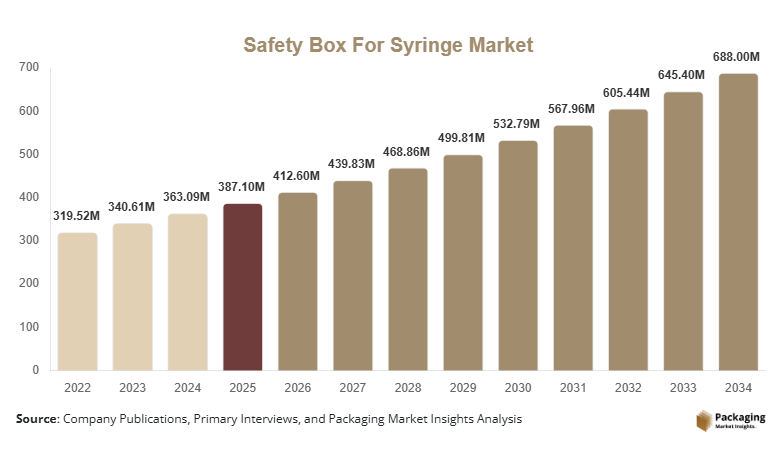
The safety box for syringes market size is projected at USD 412.6 million in 2026 and is expected to hit USD 689.8 million by 2034 with a CAGR of 6.6%. The report evaluates industry performance through comprehensive segmentation by type and application while assessing production capacity, consumption trends, pricing analysis, and competitive positioning across major regions. It further provides quantitative analysis of demand distribution, manufacturing output, regulatory developments, and the competitive landscape to support strategic business decisions.
The Safety Box for Syringes market comprises specialized containers designed for the safe collection, transportation, and disposal of used syringes and sharps generated in healthcare environments. Global production exceeded 420 million units in 2025, while healthcare facilities reported adoption levels above 79% across regulated medical waste streams. Hospitals contributed approximately 58% of total consumption, clinics represented 27%, and diagnostic laboratories accounted for nearly 15%. Continuous expansion of immunization programs, infection prevention initiatives, and biomedical waste regulations continues to strengthen the safety box for the syringe market.
Explore more data points, trends and opportunities Download Free Sample Report
Safety Box For Syringe Market Trends
Expansion of Sustainable Disposal Solutions
Healthcare providers are increasingly adopting recyclable and high-strength safety boxes manufactured using corrugated fiberboard and recyclable polymers. Annual production surpassed 435 million units during 2026, while environmentally compliant product adoption exceeded 46% among healthcare institutions. More than 68% of public healthcare facilities now integrate standardized sharps disposal systems, reinforcing Safety Box For Syringe market trends.
Digital Waste Management Integration
Manufacturers are integrating QR-enabled tracking, RFID labeling, and digital inventory management into medical waste collection systems. Smart waste monitoring solutions have witnessed adoption growth exceeding 31%, while automated inventory management reduced disposal errors by nearly 22%. Hospitals managing over 5 million sharps annually increasingly utilize digital monitoring systems, strengthening the long-term safety box for syringe market trends.
Safety Box For Syringe Market Drivers
Growing Biomedical Waste Generation and Immunization Programs
Global healthcare activities continue generating increasing volumes of sharps waste due to vaccination campaigns, chronic disease treatment, and expanding healthcare infrastructure. More than 18 billion injections are administered annually worldwide, while healthcare facilities reported over 6% annual growth in sharps waste generation. Government regulations covering biomedical waste management now extend to more than 80% of organized healthcare facilities, supporting sustained safety box for syringe market growth.
Safety Box For Syringe Market Restraints
Price Sensitivity Across Developing Healthcare Systems
Budget limitations within small healthcare providers continue restricting premium product adoption. Nearly 38% of rural healthcare facilities still rely on conventional waste containers, while procurement costs increased by approximately 9% due to raw material inflation. Transportation expenses for regulated medical waste also increased by nearly 12%, creating procurement challenges for the Safety Box for Syringes market.
Safety Box For Syringe Market Opportunities
Expansion of Healthcare Infrastructure and Vaccination Coverage
Investments in hospitals, primary healthcare centers, and diagnostic laboratories continue expanding demand for certified sharps disposal products. Healthcare infrastructure spending increased by over 8%, while vaccination coverage programs expanded by approximately 11% across emerging economies. Annual procurement volumes exceeded 440 million units, creating significant opportunities for the safety box for syringes market.
Challenges in Safety Boxes for Syringe Market
Compliance with Diverse Medical Waste Regulations
Manufacturers face varying certification requirements across international markets regarding puncture resistance, leak protection, labeling, and transportation standards. Compliance costs increased by nearly 14%, while testing procedures extended product launch timelines by approximately 5–7 months. Managing certification across multiple jurisdictions remains a key operational challenge for the Safety Box for Syringe Market.
Report Scope
| Report Metric | Details |
|---|---|
| Market Size in 2025 | USD 387.1 Million |
| Market Size in 2026 | USD 412.6 Million |
| Market Size in 2034 | USD 689.8 Million |
| CAGR | 6.6% (2026-2034) |
| Base Year for Estimation | 2025 |
| Historical Data | 2022-2024 |
| Forecast Period | 2026-2034 |
| Report Coverage | Revenue Forecast, Competitive Landscape, Supply Chain Disruption, Growth Factors, Environment & Regulatory Landscape and Trends |
| Geographies Covered | North America, Europe, APAC, Middle East and Africa, LATAM |
| Countries Covered | U.S., Canada, U.K., Germany, France, Spain, Italy, Russia, Nordic, Benelux, Rest of Europe, China, South Korea, Japan, India, Australia, Singapore, Taiwan, South East Asia, Rest of Asia-Pacific, UAE, Turkey, Saudi Arabia, South Africa, Egypt, Nigeria, Rest of MEA, Brazil, Mexico, Argentina, Chile, Colombia, Rest of LATAM |
Explore more data points, trends and opportunities Download Free Sample Report
Safety Box For Syringe Market Segmentation
The market is segmented according to product type and application. Plastic safety boxes account for approximately 44% of total revenue, while hospitals contribute nearly 58% of global consumption. Combined annual manufacturing exceeds 430 million units, reflecting expanding healthcare waste management requirements.
By Type
Cardboard safety boxes represent nearly 34% of global demand and are widely used for short-duration medical campaigns and vaccination drives. Production exceeded 145 million units during 2025. These products feature puncture-resistant liners, moisture-resistant coatings, and capacities ranging from 3 liters to 10 liters.
Plastic safety boxes dominate with approximately 44% market share due to superior durability, liquid resistance, and extended storage capability. Annual production exceeded 185 million units. Products commonly include tamper-proof locking systems, HDPE or PP construction, and capacities between 5 liters and 15 liters.
Corrugated safety boxes account for around 22% of market demand. Production surpassed 90 million units, driven by recyclable material usage and cost efficiency. These products offer reinforced walls, compression resistance, and lightweight transportation benefits for healthcare providers.
By Application
Hospitals represent nearly 58% of total consumption with annual utilization exceeding 245 million units. Large medical centers require continuous disposal of syringes from emergency departments, surgical units, vaccination centers, and inpatient facilities while maintaining regulatory compliance.
Clinics account for approximately 27% of demand, consuming more than 115 million units annually. Primary care facilities, dental clinics, outpatient treatment centers, and vaccination clinics increasingly adopt standardized safety boxes for infection control and biomedical waste segregation.
Diagnostic laboratories contribute roughly 15% of market demand with annual usage exceeding 65 million units. Blood collection centers, pathology laboratories, molecular diagnostic facilities, and research laboratories rely on certified sharps containers to safely dispose of needles and lancets.
Safety Box For Syringe Market Segmentations
Type
- Cardboard Safety Box
- Plastic Safety Box
- Corrugated Safety Box
Application
- Hospitals
- Clinics
- Diagnostic Laboratories
Safety Box For Syringe Market Regional Outlook
North America
North America accounts for approximately 34% of global demand with annual production exceeding 135 million units. The United States contributes nearly 82% of regional revenue, supported by stringent biomedical waste regulations, while Canada continues expanding healthcare investments and vaccination programs.
Europe
Europe represents around 29% of the global market. Germany, France, the United Kingdom, Italy, and Spain collectively contribute over 76% of regional demand. Production exceeds 118 million units, supported by mature healthcare systems and strict infection prevention standards.
Asia-Pacific
Asia-Pacific holds nearly 28% market share and records the fastest expansion. China, India, Japan, South Korea, and Australia account for over 84% of regional consumption. Production surpassed 125 million units, driven by hospital expansion, immunization programs, and improving biomedical waste management.
Latin America
Latin America contributes approximately 5% of global demand. Brazil and Mexico together represent nearly 67% of regional consumption, supported by expanding public healthcare infrastructure and improved medical waste regulations.
Middle East & Africa
The Middle East & Africa account for nearly 4% of the market. GCC countries, South Africa, and Egypt continue investing in healthcare modernization, resulting in annual consumption exceeding 18 million units.
Top Players In The Safety Box For Syringes Market
- Becton, Dickinson and Company
- Daniels Health
- Bemis Manufacturing Company
- Bondtech Corporation
- EnviroTain LLC
- Stericycle Inc.
- Cardinal Health
- Medline Industries
- Thermo Fisher Scientific
- GPC Medical Ltd.
- Narang Medical Limited
- Simport Scientific
- Sharps Compliance Inc.
- Henry Schein Inc.
- Fisher Scientific
Becton, Dickinson and Company
- Estimated market share: 14–16%
- Strong global presence across medical devices and sharps disposal products.
- Broad healthcare distribution network covering hospitals, laboratories, and vaccination programs.
- Continuous investment in safety-engineered disposal systems, regulatory compliance, and sustainable product development has strengthened its leadership across developed and emerging healthcare markets. The company benefits from extensive manufacturing capacity, diversified healthcare solutions, and long-term procurement agreements with healthcare organizations.
Daniels Health
- Estimated market share: 9–11%
- Specialized provider of healthcare waste management solutions.
- Strong expertise in reusable and sustainable sharps containment systems.
- The company focuses on integrated waste collection, transportation, treatment, and compliance services while supporting hospitals and healthcare providers with environmentally responsible disposal programs. Its expanding international operations and technology-enabled waste tracking strengthen its competitive position.