Medical Devices Secondary Packaging Market Size
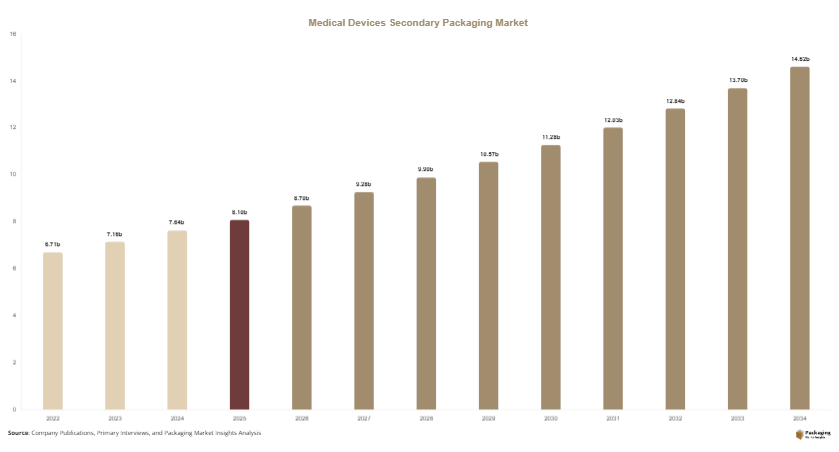
Medical Devices Secondary Packaging Market size is projected at USD 8.7 billion in 2026 and is expected to hit USD 14.6 billion by 2034 with a CAGR of 6.7%.”
The Medical Devices Secondary Packaging Market includes packaging solutions used for the external protection, transportation, labeling, storage, and handling of medical devices after primary packaging. These solutions include cartons, corrugated boxes, protective cases, trays, and specialty packaging systems designed to maintain product integrity and regulatory compliance. Global medical device production exceeded 40 billion units annually, with secondary packaging accounting for nearly 18–22% of total packaging requirements. Hospitals, pharmaceutical companies, and medical device manufacturers contribute approximately 35%, 30%, and 25% of market demand respectively. Increasing regulatory requirements, sterile handling practices, and healthcare logistics expansion are accelerating Medical Devices Secondary Packaging Market growth.
Explore more data points, trends and opportunities Download Free Sample Report
Medical Devices Secondary Packaging Market Trends
Growing Adoption of Sustainable and Smart Packaging Solutions
The Medical Devices Secondary Packaging Market is witnessing increased adoption of recyclable and intelligent packaging formats, with sustainable materials representing nearly 35% of new packaging developments in 2025. More than 60% of medical device manufacturers are shifting toward lightweight corrugated and paper-based secondary packaging to reduce waste and transportation costs. Advanced tracking technologies such as RFID and smart labels are integrated into approximately 25% of high-value medical device shipments, improving inventory management and supply chain visibility. These technology shifts are supporting long-term Medical Devices Secondary Packaging Market trends.
Expansion of Healthcare Logistics and Protective Packaging Demand
Healthcare supply chains are generating demand for high-performance secondary packaging, with global medical device shipments exceeding 50 billion units annually. Protective packaging solutions including shock-resistant boxes and temperature-controlled containers are experiencing adoption rates of over 45% among manufacturers handling sensitive devices. Growth in surgical instruments, diagnostic equipment, and disposable medical products has increased secondary packaging requirements by nearly 8% annually. These sector-specific developments are strengthening Medical Devices Secondary Packaging Market demand.
Medical Devices Secondary Packaging Market Drivers
Increasing Global Medical Device Production and Healthcare Infrastructure Expansion
Rising medical device manufacturing output is a major driver for the Medical Devices Secondary Packaging Market. Global healthcare product manufacturing increased by approximately 7% in 2025, with more than 40 billion medical device units requiring protective secondary packaging annually. Emerging markets contributed nearly 30% of additional packaging demand due to hospital expansion and healthcare investments. Increasing compliance requirements from regulatory authorities have encouraged more than 70% of manufacturers to upgrade packaging systems, supporting Medical Devices Secondary Packaging Market growth.
Medical Devices Secondary Packaging Market Restraints
High Material Costs and Complex Regulatory Compliance Requirements
The Medical Devices Secondary Packaging Market faces challenges due to fluctuating raw material prices and strict regulatory standards. Packaging material costs increased by nearly 12% between 2023 and 2025, impacting manufacturers using premium protective materials. Compliance testing, validation processes, and documentation requirements contribute approximately 10–15% additional operational costs. Small and medium-sized medical device companies experience difficulties adopting advanced packaging solutions due to investment limitations, restricting Medical Devices Secondary Packaging Market expansion.
Medical Devices Secondary Packaging Market Opportunities
Growth in Sustainable Packaging and Digital Supply Chain Integration
Sustainability initiatives create significant opportunities for the Medical Devices Secondary Packaging Market, with demand for recyclable materials expected to grow above 9% annually through 2034. More than 55% of healthcare companies are investing in environmentally responsible packaging systems. Digital supply chain technologies, including QR tracking and RFID-enabled packaging, are projected to reach adoption levels exceeding 40% by 2030. These developments provide new opportunities for Medical Devices Secondary Packaging Market innovation.
Challenges in Medical Devices Secondary Packaging Market
Maintaining Product Protection While Reducing Packaging Waste
A key challenge in the Medical Devices Secondary Packaging Market is balancing protection requirements with sustainability goals. Nearly 30% of medical device packaging waste originates from secondary and transportation packaging materials. Manufacturers must maintain durability standards while reducing material usage by 15–20%. Increasing demand for lightweight designs, regulatory compliance, and global shipping requirements creates complexity for packaging suppliers operating in the Medical Devices Secondary Packaging Market.
Report Scope
| Report Metric | Details |
|---|---|
| Market Size in 2025 | USD 8.1 billion |
| Market Size in 2026 | USD 8.7 billion |
| Market Size in 2034 | USD 14.6 billion |
| CAGR | 6.7% (2026-2034) |
| Base Year for Estimation | 2025 |
| Historical Data | 2022-2024 |
| Forecast Period | 2026-2034 |
| Report Coverage | Revenue Forecast, Competitive Landscape, Supply Chain Disruption, Growth Factors, Environment & Regulatory Landscape and Trends |
| Geographies Covered | North America, Europe, APAC, Middle East and Africa, LATAM |
| Countries Covered | U.S., Canada, U.K., Germany, France, Spain, Italy, Russia, Nordic, Benelux, Rest of Europe, China, South Korea, Japan, India, Australia, Singapore, Taiwan, South East Asia, Rest of Asia-Pacific, UAE, Turky, Saudi Arabia, South Africa, Egypt, Nigeria, Rest of MEA, Brazil, Mexico, Argentina, Chile, Colombia, Rest of LATAM |
Explore more data points, trends and opportunities Download Free Sample Report
Medical Devices Secondary Packaging Market Segmentation
The Medical Devices Secondary Packaging Market segmentation is based on type and application, with cartons and corrugated boxes collectively accounting for nearly 60% market share in 2026. Product manufacturers increasingly select secondary packaging based on device sensitivity, transportation requirements, sterilization conditions, and regulatory standards.
By Type
Cartons
Cartons represent approximately 32% of the Medical Devices Secondary Packaging Market share due to their cost efficiency and compatibility with disposable medical products. More than 15 billion medical device packages use carton-based secondary packaging annually. Folding cartons with advanced printing, tamper-evident features, and barcode integration are increasingly adopted by healthcare suppliers. These solutions provide lightweight protection with thickness ranges between 250–600 GSM, making them suitable for diagnostic kits, surgical consumables, and small medical devices.
Corrugated Boxes
Corrugated boxes account for nearly 38% market share and remain the largest segment due to superior strength and transportation efficiency. Global healthcare logistics utilize over 20 billion corrugated packaging units annually. Multi-layer corrugated structures with compression strength above 200–500 PSI are widely used for large medical equipment and bulk shipments. Demand is increasing due to e-commerce healthcare distribution and international medical device exports.
Protective Packaging
Protective packaging contributes around 30% market share and includes foam inserts, molded solutions, and cushioning systems. Approximately 12 billion sensitive medical devices require protective secondary packaging annually. These solutions reduce damage rates by nearly 25–35% during transportation and are essential for imaging equipment, surgical instruments, and electronic medical devices.
By Application
Hospitals
Hospitals contribute nearly 35% of Medical Devices Secondary Packaging Market demand due to continuous requirements for sterile and organized medical supplies. More than 18 billion packaged medical products are delivered to hospitals globally each year. Secondary packaging supports inventory control, storage efficiency, and safe handling of devices used in emergency care, surgery, and diagnostics.
Pharmaceutical Companies
Pharmaceutical companies represent approximately 30% market share as they require reliable packaging for combination products and drug-device systems. Around 15 billion healthcare packages are processed annually through pharmaceutical supply chains. Secondary packaging enables product identification, regulatory labeling, and transportation protection across global distribution networks.
Medical Device Manufacturers
Medical device manufacturers account for nearly 25% market share and represent the fastest-growing application segment. Over 20 billion medical device units produced annually require secondary packaging solutions. Manufacturers increasingly adopt customized packaging systems with automation compatibility, tracking technologies, and sustainable materials.
Medical Devices Secondary Packaging Market Segmentations
Type
- Cartons
- Corrugated Boxes
- Protective Packaging
Application
- Hospitals
- Pharmaceutical Companies
- Medical Device Manufacturers
Medical Devices Secondary Packaging Market Regional Outlook
North America
North America holds approximately 36% share of the Medical Devices Secondary Packaging Market due to advanced healthcare infrastructure and strong medical device production. The United States contributes nearly 30% of global medical device manufacturing output, while Canada accounts for increasing demand through healthcare modernization programs. Hospitals represent more than 40% of regional consumption, followed by pharmaceutical companies and device manufacturers.
Europe
Europe accounts for nearly 28% market share, supported by strict packaging regulations and sustainability initiatives. Germany, France, and the United Kingdom collectively contribute more than 65% of regional demand. Over 10 billion medical device shipments annually require secondary packaging solutions across European healthcare systems.
Asia-Pacific
Asia-Pacific represents around 25% market share and is projected to experience the fastest growth through 2034. China, Japan, and India contribute more than 70% of regional packaging demand. Increasing healthcare investments and medical device manufacturing expansion are driving demand for cost-effective packaging solutions.
Latin America and Middle East & Africa
These regions collectively account for approximately 11% market share. Brazil, Mexico, UAE, and Saudi Arabia are expanding healthcare infrastructure, increasing demand for medical device transportation packaging by nearly 6–8% annually.
Top players in Medical Devices Secondary Packaging Market
- Amcor plc
- WestRock Company
- International Paper Company
- Mondi Group
- Smurfit Westrock
- DS Smith Plc
- Sonoco Products Company
- Berry Global Inc.
- Sealed Air Corporation
- Huhtamaki Oyj
- Constantia Flexibles
- ProAmpac LLC
Amcor plc
-
Holds a significant position with an estimated 8–10% share in global healthcare packaging solutions.
-
Focuses on sustainable secondary packaging materials and advanced protective solutions.
-
Serves pharmaceutical and medical device manufacturers across more than 40 countries.
-
Invests heavily in recyclable materials and smart packaging technologies.
WestRock Company
-
Maintains approximately 6–8% share through strong carton and corrugated packaging capabilities.
-
Provides customized healthcare packaging solutions supporting global medical device supply chains.
-
Operates advanced manufacturing facilities across North America and Europe.
-
Focuses on lightweight designs and automation-ready packaging formats.