Roll Fed Wraparound Label Substrates Market Size
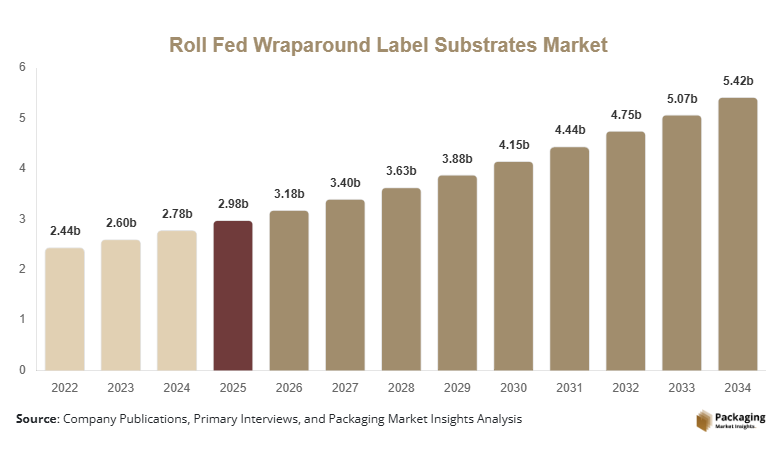
Roll Fed Wraparound Label Substrates market size is projected at USD 3.18 billion in 2026 and is expected to hit USD 5.42 billion by 2034 with a CAGR of 6.90%. The report provides comprehensive analysis of production capacity, consumption patterns, pricing structures, technological advancements, segmentation analysis, and competitive positioning of key manufacturers. The study evaluates market opportunities across packaging industries while analyzing demand trends, material innovations, and regional expansion strategies influencing the global Roll Fed Wraparound Label Substrates Market.
The Roll Fed Wraparound Label Substrates Market includes flexible labeling materials designed for high-speed packaging applications across bottles, containers, cans, and other rigid packaging formats. Global production exceeded 42 billion label units in 2025, with consumption reaching nearly 40.5 billion units, representing a utilization rate of 96.4%. Paper substrates accounted for approximately 52% of total demand, plastic film substrates contributed nearly 38%, and specialty composite materials represented around 10%. Food and beverage packaging generated nearly 61% of total application demand, followed by personal care packaging at 21% and household & industrial packaging at 18%, strengthening the Roll Fed Wraparound Label Substrates Market.
Explore more data points, trends and opportunities Download Free Sample Report
Roll Fed Wraparound Label Substrates Trends
Increasing Adoption of Sustainable and High-Speed Labeling Solutions
The shift toward recyclable and lightweight packaging solutions is accelerating innovation in roll fed wraparound label substrates. Global production of sustainable label materials exceeded 18 billion units in 2025, accounting for nearly 43% of total output. Manufacturers are introducing thinner substrates that reduce material consumption by 12–20% while maintaining print quality and durability. Demand for recyclable paper-based labeling increased by approximately 15%, especially among food, beverage, and personal care brands, supporting the Roll Fed Wraparound Label Substrates Market.
Advanced printing technologies, including digital hybrid printing and high-definition flexography, are improving labeling efficiency and customization capabilities. Automated labeling systems now represent nearly 48% of packaging production lines, improving throughput by 22% and reducing material waste by approximately 14%. Increasing adoption of premium graphics and brand differentiation strategies continues driving the Roll Fed Wraparound Label Substrates Market.
Roll Fed Wraparound Label Substrates Drivers
Expansion of Packaged Beverage and Consumer Goods Industries
Rising demand for bottled beverages and packaged consumer products is a major growth factor for roll fed wraparound label substrates. Global beverage production exceeded 1.9 trillion liters in 2025, with more than 65% of rigid beverage containers utilizing wraparound labeling solutions. Food and beverage companies accounted for approximately 61% of substrate consumption, while personal care packaging demand increased by nearly 9% annually, supporting Roll Fed Wraparound Label Substrates Market growth.
Roll Fed Wraparound Label Substrates Restraints
Volatility in Raw Material Prices and Supply Chain Challenges
Fluctuating costs of paper pulp, polymers, and specialty coatings create pricing pressure for substrate manufacturers. Paper raw material prices experienced variations of approximately 8–13% during recent years, while polymer film costs fluctuated by nearly 10%. Supply chain disruptions increased manufacturing lead times by 12%, affecting inventory planning and profitability across the Roll Fed Wraparound Label Substrates Market.
Roll Fed Wraparound Label Substrates Opportunities
Growth in Sustainable Packaging and Premium Branding
Increasing demand for eco-friendly packaging provides significant opportunities for substrate manufacturers. More than 70% of global consumer brands have introduced sustainability targets, creating demand for recyclable label materials. Premium packaging applications increased by approximately 17%, while customized labeling solutions grew by 20% in 2025, creating new opportunities within the Roll Fed Wraparound Label Substrates Market.
Challenges in Roll Fed Wraparound Label Substrates Market
Increasing Competition from Alternative Label Technologies
Pressure-sensitive labels, shrink sleeves, and in-mold labels create competitive challenges for roll fed wraparound substrates. Alternative labeling formats captured nearly 35% of new packaging projects in 2025. Manufacturers must invest in advanced printing, adhesive compatibility, and sustainability improvements, with technology upgrades increasing operational costs by approximately 8–12% across the Roll Fed Wraparound Label Substrates Market.
Report Scope
| Report Metric | Details |
|---|---|
| Market Size in 2025 | USD 2.98 billion |
| Market Size in 2026 | USD 3.18 billion |
| Market Size in 2034 | USD 5.42 billion |
| CAGR | 6.90% (2026-2034) |
| Base Year for Estimation | 2025 |
| Historical Data | 2022-2024 |
| Forecast Period | 2026-2034 |
| Report Coverage | Revenue Forecast, Competitive Landscape, Supply Chain Disruption, Growth Factors, Environment & Regulatory Landscape and Trends |
| Geographies Covered | North America, Europe, APAC, Middle East and Africa, LATAM |
| Countries Covered | U.S., Canada, U.K., Germany, France, Spain, Italy, Russia, Nordic, Benelux, Rest of Europe, China, South Korea, Japan, India, Australia, Singapore, Taiwan, South East Asia, Rest of Asia-Pacific, UAE, Turky, Saudi Arabia, South Africa, Egypt, Nigeria, Rest of MEA, Brazil, Mexico, Argentina, Chile, Colombia, Rest of LATAM |
Explore more data points, trends and opportunities Download Free Sample Report
Roll Fed Wraparound Label Substrates Market Segmentation
The Roll Fed Wraparound Label Substrates Market is segmented by type and application based on material characteristics and packaging requirements. Paper substrates dominate with approximately 52% share due to recyclability and cost advantages, while food and beverage packaging remains the largest application segment with nearly 61% demand contribution.
By Type
Paper Substrates
Paper substrates accounted for approximately 52% market share in 2025, with production exceeding 21 billion label units. These substrates are widely used due to recyclability, print compatibility, and cost efficiency. Common grades include coated paper, kraft paper, and wet-strength paper with thickness ranges between 60–120 microns.
Plastic Film Substrates
Plastic film substrates represented nearly 38% of global demand, producing more than 16 billion units annually. Materials such as polypropylene (PP), polyethylene (PE), and polyester provide moisture resistance, durability, and superior graphics. Film thickness typically ranges from 30–80 microns, supporting high-speed packaging applications.
Specialty Composite Substrates
Specialty composite substrates contributed around 10% share with production exceeding 4 billion units. These materials combine multiple layers to enhance barrier properties, chemical resistance, and premium appearance for specialty packaging requirements.
By Application
Food & Beverage Packaging
Food and beverage packaging dominated with nearly 61% share and consumption exceeding 24 billion label units in 2025. Beverage bottles, dairy containers, sauces, and processed food products widely use wraparound labels due to high-speed application capability and cost efficiency.
Personal Care Packaging
Personal care packaging represented approximately 21% market share with usage exceeding 8 billion units. Cosmetic bottles, shampoo containers, and hygiene products utilize premium printed substrates for brand visibility and product differentiation.
Household & Industrial Packaging
Household and industrial applications accounted for around 18% share, consuming more than 7 billion units annually. Chemical containers, cleaning products, and industrial goods require durable labels with resistance to moisture, abrasion, and temperature variations.
Roll Fed Wraparound Label Substrates Market Segmentations
Type
- Paper Substrates
- Plastic Film Substrates
- Specialty Composite Substrates
Application
- Food & Beverage Packaging
- Personal Care Packaging
- Household & Industrial Packaging
Roll Fed Wraparound Label Substrates Regional Outlook
North America
North America accounted for approximately 26% of global market revenue in 2025. The United States contributed nearly 80% of regional demand, supported by beverage, food processing, and consumer goods industries. Regional consumption exceeded 10 billion units, with beverage applications representing nearly 55% of usage.
Europe
Europe represented around 30% market share, led by Germany, France, Italy, and the United Kingdom. Regional production exceeded 12 billion units, supported by sustainability regulations and adoption of recyclable paper substrates exceeding 50% among major packaging producers.
Asia-Pacific
Asia-Pacific dominated production with approximately 34% share. China, India, Japan, and South Korea collectively produced more than 14 billion label units in 2025. Expanding beverage manufacturing and consumer goods industries significantly supported regional growth.
Latin America
Latin America contributed nearly 7% of global demand. Brazil and Mexico accounted for more than 75% of regional consumption, driven by food and beverage packaging expansion.
Middle East & Africa
The Middle East & Africa region represented approximately 3% share, with consumption exceeding 1.2 billion units. Growing packaged food consumption and industrial development supported market expansion.
Top players in Roll Fed Wraparound Label Substrates Market
- Avery Dennison Corporation
- CCL Industries Inc.
- UPM Raflatac
- Mondi Group
- Huhtamaki Oyj
- Amcor plc
- Constantia Flexibles
- Coveris Group
- Rengo Co., Ltd.
- Multi-Color Corporation
- Fort Dearborn Company
- Resource Label Group
Avery Dennison Corporation
-
Estimated global market share: 10–12%.
-
Avery Dennison maintains a leading position through advanced labeling materials, sustainable substrate solutions, and global manufacturing capabilities.
-
The company focuses on recyclable paper and film-based label substrates designed for beverage, food, and personal care packaging.
-
Its investment in digital printing technologies and sustainable material development strengthens its competitive positioning in the Roll Fed Wraparound Label Substrates Market.
CCL Industries Inc.
-
Estimated global market share: 8–10%.
-
CCL Industries provides customized labeling solutions across consumer packaging, healthcare, and industrial sectors.
-
The company emphasizes high-performance substrates, advanced printing technologies, and sustainable packaging solutions.
-
Its extensive global production network enables strong customer penetration across developed and emerging markets.