Fibre Film Market Size
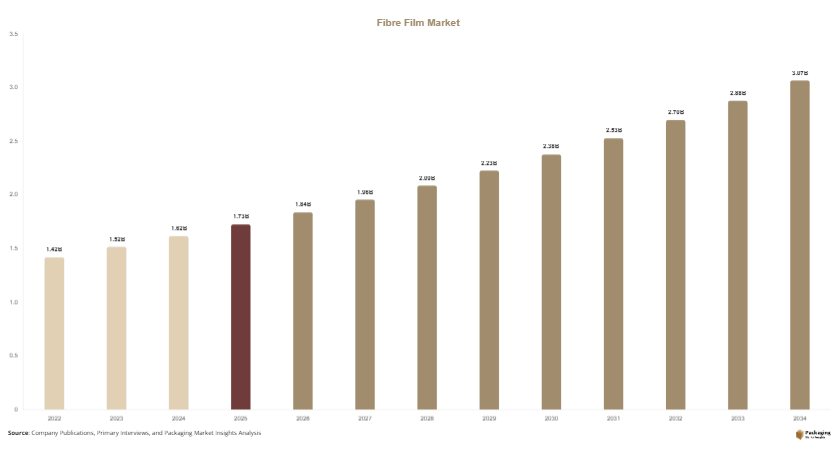
The fiber film market size is projected at USD 1.84 billion in 2026 and is expected to hit USD 3.08 billion by 2034 with a CAGR of 6.6%.
The market is expanding steadily due to increasing demand for sustainable packaging materials, growing regulations against single-use plastics, and rising investments in bio-based packaging technologies. The report provides comprehensive market data covering segmentation, production capacity, competitive landscape, technological developments, and regional analysis across the fiber film market.
"Fibre film" refers to biodegradable and renewable packaging films manufactured from cellulose, wood pulp, and agricultural fibers for flexible packaging applications. Global fiber film production exceeded 2.4 million metric tons in 2025, while sustainable packaging adoption surpassed 39% among consumer goods manufacturers. Cellulose fiber film represented approximately 49% of total production, wood pulp fiber film accounted for 33%, and agricultural fiber film contributed 18%. Rising demand for recyclable packaging solutions continues supporting the fiber film market.
Explore more data points, trends and opportunities Download Free Sample Report
Fibre Film Market Trends
Increasing Adoption of Bio-Based Flexible Packaging Materials
Packaging manufacturers are replacing petroleum-based plastic films with renewable fiber-based alternatives to meet sustainability targets. More than 2.6 million metric tons of fiber films were produced globally during 2025, while recyclable flexible packaging adoption increased by 27%. Compostable fiber films now account for nearly 36% of new sustainable packaging developments, reinforcing the fiber film market.
Advancements in barrier coating technologies and multilayer fiber film structures are improving moisture resistance, oxygen barrier performance, and shelf life. Approximately 44% of newly introduced fiber films utilize advanced bio-coatings, while production efficiency improved by nearly 19% across modern manufacturing facilities. Food packaging demand increased by 22% year over year, strengthening the fiber film market.
Fibre Film Market Drivers
Growing Demand for Sustainable and Plastic-Free Packaging
Governments, retailers, and brand owners are increasingly adopting fiber-based packaging to reduce plastic waste. Global sustainable packaging investments exceeded USD 95 billion, while recyclable packaging adoption increased by 31% during recent years. More than 68% of consumer product companies have established plastic reduction targets, accelerating demand for renewable fiber films and supporting the fiber film market.
Fibre Film Market Restraints
Higher Manufacturing Costs Compared with Conventional Plastic Films
Production of fiber films requires advanced pulping, coating, and processing technologies, resulting in higher manufacturing expenses. Fibre film production costs remain approximately 18–25% higher than conventional plastic films, while specialty coatings increase processing expenses by nearly 12%. Limited economies of scale continue restricting wider adoption across price-sensitive industries, affecting the fiber film market.
Fibre Film Market Opportunities
Expansion of Circular Economy and Eco-Friendly Packaging Regulations
Growing legislation promoting biodegradable and recyclable packaging creates significant opportunities for fiber film manufacturers. More than 80 countries have introduced restrictions on single-use plastics, while sustainable packaging investments continue expanding by approximately 15% annually. Consumer preference for environmentally friendly packaging exceeds 71%, creating favorable opportunities for the fiber film market.
Challenges in the Fiber Film Market
Achieving High Barrier Performance and Moisture Resistance
Maintaining barrier performance comparable to multilayer plastic films remains a major technical challenge. Nearly 52% of packaging manufacturers prioritize improved moisture resistance and oxygen barrier technologies for fiber films. Research and development investments increased by approximately 17%, while advanced coating costs continue rising, creating ongoing challenges within the fiber film market.
Report Scope
| Report Metric | Details |
|---|---|
| Market Size in 2025 | USD 1.73 Billion |
| Market Size in 2026 | USD 1.84 Billion |
| Market Size in 2034 | USD 3.08 Billion |
| CAGR | 6.6% (2026-2034) |
| Base Year for Estimation | 2025 |
| Historical Data | 2022-2024 |
| Forecast Period | 2026-2034 |
| Report Coverage | Revenue Forecast, Competitive Landscape, Supply Chain Disruption, Growth Factors, Environment & Regulatory Landscape and Trends |
| Geographies Covered | North America, Europe, APAC, Middle East and Africa, LATAM |
| Countries Covered | U.S., Canada, U.K., Germany, France, Spain, Italy, Russia, Nordic, Benelux, Rest of Europe, China, South Korea, Japan, India, Australia, Singapore, Taiwan, South East Asia, Rest of Asia-Pacific, UAE, Turkey, Saudi Arabia, South Africa, Egypt, Nigeria, Rest of MEA, Brazil, Mexico, Argentina, Chile, Colombia, Rest of LATAM |
Explore more data points, trends and opportunities Download Free Sample Report
Fibre Film Market Segmentation
The market is segmented by type and end-use industry based on material composition, functional performance, sustainability characteristics, and industrial applications. Cellulose fiber films account for approximately 49% of global production, while food packaging contributes nearly 46% of overall demand.
By Type
Cellulose fiber film dominates with approximately 49% market share. Transparent cellulose films, coated cellulose films, compostable films, and high-barrier cellulose films are widely used in food and consumer packaging. Annual production exceeded 1.2 million metric tons, providing excellent biodegradability and printability.
Wood pulp fiber film accounts for nearly 33% of the market. Kraft pulp films, bleached pulp films, multilayer fiber films, and coated paper-based films offer enhanced mechanical strength and packaging flexibility. Production exceeded 790,000 metric tons, supporting industrial and retail packaging applications.
Agricultural fiber film contributes approximately 18% of global demand. Bagasse-based films, bamboo fiber films, wheat straw films, and agricultural residue films support circular economy initiatives. Production surpassed 430,000 metric tons, delivering renewable alternatives for sustainable packaging.
By End-use Industry
Food packaging represents approximately 46% of market demand. Snack packaging, bakery products, confectionery, fresh produce, and ready-to-eat meals increasingly utilize fiber films. Annual consumption exceeded 1.1 million metric tons, while sustainable packaging penetration surpassed 41% across food manufacturers.
Consumer goods packaging accounts for nearly 32% of the market. Personal care, cosmetics, household products, stationery, and electronics accessories increasingly adopt fiber-based flexible packaging. Production exceeded 770,000 metric tons, supported by strong sustainability initiatives.
Industrial packaging contributes approximately 22% of market demand. Protective wraps, shipping materials, industrial liners, bulk packaging, and specialty packaging applications consumed over 530,000 metric tons of fiber films annually.
Fibre Film Market Segmentations
Type
- Cellulose Fibre Film
- Wood Pulp Fibre Film
- Agricultural Fibre Film
End-use Industry
- Food Packaging
- Consumer Goods Packaging
- Industrial Packaging
Fibre Film Market Regional/Counties Outlook
North America
North America accounts for approximately 28% of the global market. The United States contributes nearly 79% of regional production, while Canada continues expanding sustainable packaging investments. Fiber film production exceeds 670,000 metric tons annually.
Europe
Europe represents approximately 31% of global demand. Germany, France, Italy, Sweden, and the United Kingdom lead fiber-based packaging production. Sustainable packaging adoption exceeds 58%, while annual production surpasses 740,000 metric tons.
Asia-Pacific
Asia-Pacific holds approximately 34% of the global market and remains the fastest-growing region. China, Japan, India, and South Korea account for nearly 81% of regional production. Fiber film manufacturing exceeds 820,000 metric tons annually.
Latin America
Latin America contributes approximately 4% of global demand. Brazil, Chile, and Mexico continue investing in renewable packaging materials supported by expanding pulp production industries.
Middle East & Africa
The Middle East & Africa account for approximately 3% of market demand. South Africa, Saudi Arabia, and the UAE continue increasing investments in sustainable packaging technologies and fiber-based packaging production.
Top Players In The Fiber Film Market
- Futamura Group
- Stora Enso Oyj
- UPM-Kymmene Corporation
- Sappi Limited
- Billerud AB
- Mondi plc
- Nippon Paper Industries Co., Ltd.
- Ahlstrom Corporation
- Walki Group Oy
- Smurfit Westrock plc
- Huhtamaki Oyj
- Koehler Paper SE
- Oji Holdings Corporation
- Graphic Packaging International LLC
- DS Smith plc
Futamura Group
- Estimated global market share: 13–15%
- Global leader in cellulose-based compostable film manufacturing.
- Strong product portfolio serving food packaging, labels, and flexible packaging applications.
- Operates advanced manufacturing facilities across Europe, Asia, and North America.
- Continuous investments in renewable materials, barrier coating technologies, and biodegradable packaging strengthen its competitive leadership in the global market.
Stora Enso Oyj
- Estimated global market share: 10–12%
- Leading supplier of renewable packaging materials and fiber-based solutions.
- Extensive portfolio includes sustainable films, paper packaging, biomaterials, and renewable fiber technologies.
- Strong presence across Europe and expanding operations in Asia-Pacific and North America.
- Significant investments in bioeconomy innovation and circular packaging solutions continue enhancing its market position.