PTFE Tapes and Films Market Size and Growth
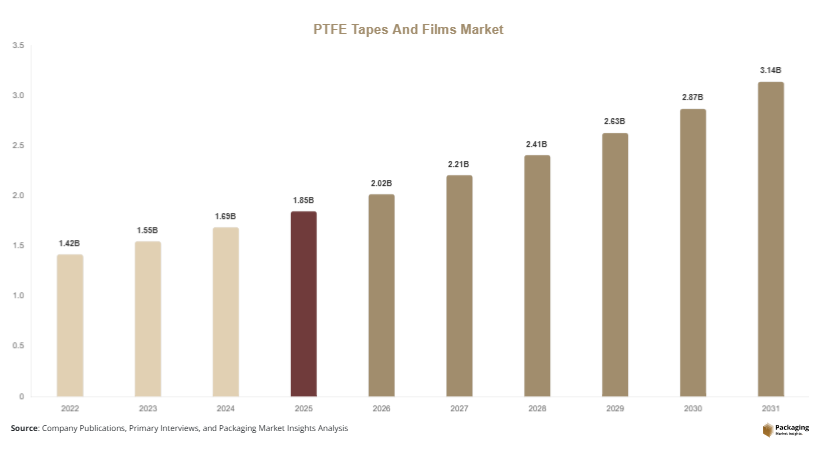
The global PTFE Tapes and Films Market size was valued at approximately USD 1.85 billion in 2025 and is projected to reach USD 3.15 billion by 2031, expanding at a CAGR of 9.2% during the forecast period (2025–2031). The market has experienced steady expansion due to increasing demand across electrical insulation, chemical processing, and industrial sealing applications where high-temperature resistance and chemical inertness are critical.
A key global factor supporting the growth of the PTFE tapes and films market is the rapid industrialization and electrification of manufacturing sectors, particularly in emerging economies. The growing need for high-performance materials in harsh operating environments has accelerated adoption, especially in sectors such as automotive electronics, aerospace, and renewable energy systems.
PTFE tapes and films offer superior dielectric properties, low friction, and excellent thermal stability, making them indispensable in modern engineering applications. As industries shift toward reliability-focused materials, the market outlook remains favorable.
Key Highlights:
- North America dominated the market with a 34.5% share in 2025, while Asia Pacific is expected to register the fastest CAGR of 10.8%
- By product type, PTFE tapes held the leading share (58%), while PTFE films are projected to grow fastest at 10.5% CAGR
- By application, electrical insulation was the dominant segment (36%), whereas automotive applications are forecasted to grow at 11.2% CAGR
- The United States led globally with USD 520 million in 2025 and is estimated to reach USD 560 million in 2026
Explore more data points, trends and opportunities Download Free Sample Report
Market Trends
Increasing Adoption in High-Performance Electrical Systems
The PTFE tapes and films market is witnessing a strong shift toward advanced electrical insulation applications. With the rise of electric vehicles, renewable energy installations, and high-voltage systems, the demand for materials capable of withstanding extreme temperatures and voltages has grown. PTFE’s superior dielectric strength and resistance to thermal degradation make it a preferred choice in cable insulation and electronic component manufacturing. This trend is particularly evident in power transmission infrastructure upgrades and EV battery systems.
Shift Toward Thin-Film and Precision Engineered Materials
Manufacturers are increasingly focusing on producing ultra-thin, precision-engineered PTFE films for specialized applications. These films are being utilized in microelectronics, semiconductors, and medical devices where dimensional accuracy and performance consistency are essential. Innovations in skiving and extrusion technologies have enabled the development of films with enhanced uniformity and mechanical properties. This trend reflects a broader movement toward miniaturization and efficiency in industrial design, which continues to influence the PTFE tapes and films market growth trajectory.
Market Drivers
Growing Demand from Electrical & Electronics Industry
The expansion of the electrical and electronics sector is a major driver for the PTFE tapes and films market. These materials are widely used for insulation due to their high dielectric strength and resistance to extreme temperatures. With increasing deployment of smart grids, consumer electronics, and industrial automation systems, the need for reliable insulation materials has surged. PTFE products ensure operational safety and longevity, making them essential in modern electrical infrastructure.
Rising Use in Chemical Processing Applications
PTFE tapes and films are highly resistant to corrosive chemicals, making them ideal for use in chemical processing industries. They are commonly used for sealing, lining, and gasketing applications in environments exposed to aggressive substances. As global chemical production expands, particularly in Asia Pacific, the demand for durable and chemically inert materials has increased. This has significantly contributed to the overall PTFE tapes and films market growth.
Market Restraints
High Production Cost and Processing Complexity
One of the primary challenges in the PTFE tapes and films market is the high cost associated with production and processing. PTFE is difficult to process due to its high melting point and non-stick characteristics, requiring specialized manufacturing techniques such as paste extrusion and skiving. These processes increase operational costs and limit scalability for smaller manufacturers.
Additionally, the cost of raw materials and energy-intensive production methods contributes to higher product pricing. This can restrict adoption in price-sensitive markets or applications where lower-cost alternatives such as polyethylene or PVC are available. While PTFE offers superior performance, the cost-performance trade-off remains a barrier for widespread use in certain industries.
Market Opportunities
Expansion in Electric Vehicle (EV) Manufacturing
The rapid growth of the electric vehicle industry presents a significant opportunity for the PTFE tapes and films market. These materials are used extensively in battery insulation, wiring systems, and thermal management components. As EV production scales globally, the demand for high-performance insulation materials is expected to increase. PTFE’s ability to withstand high temperatures and electrical stress makes it highly suitable for next-generation mobility solutions.
Increasing Use in Renewable Energy Infrastructure
The global transition toward renewable energy sources such as solar and wind is creating new opportunities for PTFE applications. These materials are used in photovoltaic modules, cable insulation, and sealing systems exposed to harsh environmental conditions. As governments invest in clean energy projects, the need for durable and reliable materials will drive the adoption of PTFE tapes and films. This trend is expected to contribute significantly to market growth over the forecast period.
Report Scope
| Report Metric | Details |
|---|---|
| Market Size in 2025 | USD 1.85 Billion |
| Market Size in 2026 | USD 2.02 Billion |
| Market Size in 2031 | USD 3.15 Billion |
| CAGR | 9.2% (2026-2031) |
| Base Year for Estimation | 2025 |
| Historical Data | 2022-2024 |
| Forecast Period | 2026-2031 |
| Report Coverage | Revenue Forecast, Competitive Landscape, Supply Chain Disruption, Growth Factors, Environment & Regulatory Landscape and Trends |
| Geographies Covered | North America, Europe, APAC, Middle East and Africa, LATAM |
| Countries Covered | U.S., Canada, U.K., Germany, France, Spain, Italy, Russia, Nordic, Benelux, Rest of Europe, China, South Korea, Japan, India, Australia, Singapore, Taiwan, South East Asia, Rest of Asia-Pacific, UAE, Turky, Saudi Arabia, South Africa, Egypt, Nigeria, Rest of MEA, Brazil, Mexico, Argentina, Chile, Colombia, Rest of LATAM |
Explore more data points, trends and opportunities Download Free Sample Report
Segmental Analysis
By Product Type
PTFE tapes dominated the PTFE tapes and films market and accounted for 58% share in 2024. Their widespread use in sealing, insulation, and thread sealing applications across multiple industries contributed to their dominance. Tapes offer ease of application and versatility, making them suitable for both industrial and consumer use.
PTFE films are expected to grow at the fastest CAGR of 10.5%. The increasing use of films in high-precision applications such as electronics and medical devices will drive this growth. Their uniform thickness and superior mechanical properties make them ideal for specialized applications.
By Application
Electrical insulation emerged as the dominant application segment, holding 36% share in 2024. The growing demand for reliable insulation in high-voltage systems and electronic components supported this segment’s growth.
Automotive applications are projected to grow at a CAGR of 11.2%. The shift toward electric vehicles and advanced automotive electronics will increase demand for PTFE materials in wiring and thermal management systems.
By End-Use Industry
The industrial manufacturing segment dominated with a 32% share in 2024. PTFE tapes and films are widely used in machinery, chemical processing, and heavy equipment due to their durability and resistance properties.
The electronics & semiconductor segment is expected to grow at a CAGR of 11.0%. The increasing complexity of electronic devices and the need for high-performance materials will drive demand in this segment.
By Thickness Type
Medium thickness PTFE products held the largest share at 41% in 2024, as they offer a balance between flexibility and durability for general industrial applications.
Ultra-thin PTFE films are expected to grow at a CAGR of 10.9%. Their use in microelectronics and precision applications will drive this growth, supported by advancements in manufacturing technology.
PTFE Tapes And Films Market Segmentations
By Product Type
- PTFE Tapes
- PTFE Films
By Application
- Electrical Insulation
- Sealing & Gasketing
- Surface Protection
- Automotive Components
- Others
By End-Use Industry
- Industrial Manufacturing
- Electronics & Semiconductor
- Automotive
- Aerospace
- Chemical Processing
By Thickness Type
- Ultra-Thin
- Medium Thickness
- Heavy Thickness
Regional Analysis
North America
North America accounted for 34.5% of the PTFE tapes and films market share in 2025 and will expand at a CAGR of 8.7% through 2033. The region’s growth has been driven by strong demand from aerospace, electronics, and chemical processing industries. Advanced manufacturing capabilities and a focus on high-performance materials have supported steady adoption.
The United States dominated the regional market due to its well-established industrial base. The presence of major aerospace and defense manufacturers has increased the demand for PTFE materials in critical applications. Additionally, investments in renewable energy and EV infrastructure have further supported market expansion.
Europe
Europe held approximately 26.8% market share in 2025 and will grow at a CAGR of 8.5% during the forecast period. The region has emphasized sustainability and energy efficiency, which has influenced the adoption of high-performance materials like PTFE.
Germany led the European market due to its strong automotive and industrial manufacturing sectors. The country’s focus on precision engineering and innovation has driven demand for PTFE films in advanced applications such as electronics and machinery.
Asia Pacific
Asia Pacific represented 24.6% of the global market in 2025 and is projected to grow at the fastest CAGR of 10.8% through 2033. Rapid industrialization, urbanization, and infrastructure development have fueled demand for PTFE products.
China emerged as the dominant country due to its large-scale manufacturing capabilities and growing electronics industry. Government initiatives supporting industrial expansion and renewable energy have further accelerated market growth in the region.
Middle East & Africa
The Middle East & Africa held 7.2% market share in 2025 and will grow at a CAGR of 7.9%. The region’s growth has been supported by increasing investments in oil & gas and industrial infrastructure.
Saudi Arabia led the regional market, driven by its expanding petrochemical sector. The need for corrosion-resistant materials in harsh environments has increased the adoption of PTFE tapes and films.
Latin America
Latin America accounted for 6.9% market share in 2025 and is expected to grow at a CAGR of 7.6%. The region has seen moderate growth due to expanding industrial activities and infrastructure development.
Brazil dominated the market, supported by its growing automotive and chemical industries. Increased investment in manufacturing and energy sectors has contributed to steady demand for PTFE materials.
Competitive Landscape
The PTFE tapes and films market is moderately consolidated, with several global and regional players competing on product quality, innovation, and pricing. Leading companies focus on expanding their product portfolios and enhancing manufacturing capabilities to meet evolving industry requirements.
The market leader, Saint-Gobain, has maintained a strong position through continuous product innovation and strategic partnerships. The company recently introduced advanced PTFE film solutions designed for high-temperature and high-voltage applications, strengthening its competitive edge.
Other key players are investing in research and development to improve material performance and reduce production costs. The competitive environment remains dynamic, with companies focusing on sustainability and efficiency to gain market share.
Key Players in the PTFE Tapes and Films Market
- Saint-Gobain Performance Plastics
- 3M Company
- DuPont de Nemours, Inc.
- Rogers Corporation
- Nitto Denko Corporation
- Tesa SE
- Henkel AG & Co. KGaA
- Avery Dennison Corporation
- Lohmann GmbH & Co. KG
- Scapa Group plc
- Berry Global Inc.
- Compagnie de Saint-Gobain
- Parker Hannifin Corporation
- Zeus Industrial Products, Inc.
- Polyflon Technology Limited