Refillable Airless Packaging System Market Size and Growth
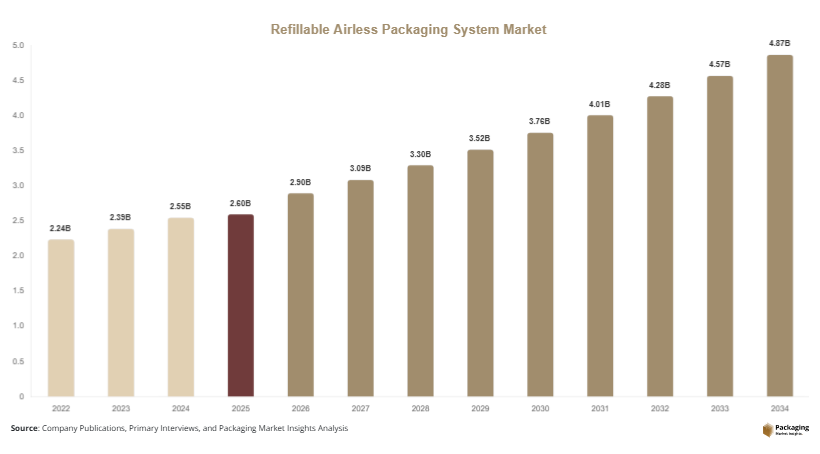
The global refillable airless packaging system market size was valued at approximately USD 2.6 billion in 2025 and is expected to reach USD 2.9 billion in 2026. With increasing demand across cosmetics, personal care, and pharmaceutical applications, the market is projected to grow at a CAGR of 6.7% from 2025 to 2034, reaching nearly USD 5.2 billion by 2034. The refillable airless packaging system market is gaining strong momentum as brands and consumers shift toward sustainable, hygienic, and high-performance packaging solutions.
This growth is driven by several key factors. One major factor is the rising emphasis on sustainability and waste reduction. Refillable airless packaging systems allow consumers to reuse primary containers while replacing inner cartridges, reducing plastic consumption and environmental impact. Another important factor is the increasing demand for product protection and hygiene. Airless packaging prevents contamination and oxidation, making it suitable for sensitive formulations such as serums, creams, and pharmaceutical products. A third factor is the growth of premium personal care and cosmetic products, where packaging plays a critical role in product positioning and user experience.
Key Market Insights
- Asia Pacific dominated the market with a 36.9% share in 2025, while Latin America is projected to grow at the fastest CAGR of 7.1%.
- Bottles and jars led the type segment with a 42.8% share, while refill cartridges are expected to grow at a CAGR of 7.5%.
- Plastic materials dominated with a 54.6% share, while bio-based materials are forecasted to grow at a CAGR of 7.3%.
- Personal care applications led the segment with 48.7% share, while pharmaceutical applications are expected to grow at a CAGR of 7.0%.
- China remained the dominant country with a market size of USD 0.6 billion in 2025 and USD 0.7 billion in 2026.
Explore more data points, trends and opportunities Download Free Sample Report
Market Trends
Increasing Adoption of Sustainable Refill Systems
Sustainability continues to influence the refillable airless packaging system market as brands focus on reducing environmental impact. Refillable packaging systems allow consumers to reuse outer containers, significantly reducing plastic waste. This approach aligns with circular economy principles and helps companies meet regulatory requirements related to packaging waste reduction. Consumers are increasingly choosing brands that offer eco-friendly solutions, which is encouraging manufacturers to invest in refillable technologies.
In addition, companies are developing innovative materials such as recyclable plastics and bio-based polymers to enhance sustainability. These materials maintain the functionality of airless systems while minimizing environmental impact. Retailers and cosmetic brands are also promoting refill programs, encouraging repeat purchases and customer loyalty. As sustainability becomes a key purchasing factor, the adoption of refillable airless packaging systems is expected to increase across various industries.
Growing Demand for Premium and Functional Packaging
The demand for premium packaging solutions is rising, particularly in the cosmetics and personal care industries. Refillable airless packaging systems offer both aesthetic appeal and functional benefits, making them suitable for high-end products. These systems protect formulations from air exposure, ensuring product stability and extending shelf life. As consumers seek high-quality and long-lasting products, the importance of advanced packaging solutions is increasing.
Furthermore, brands are focusing on innovative designs and user-friendly features to enhance consumer experience. Customization options, sleek designs, and efficient dispensing mechanisms are becoming key differentiators in the market. The integration of smart packaging features, such as tracking usage and refill reminders, is also gaining attention. This trend is expected to drive demand for refillable airless packaging systems in premium product segments.
Market Drivers
Rising Demand for Hygienic and Contamination-Free Packaging
The need for hygienic packaging solutions is a major factor driving the refillable airless packaging system market. Airless packaging systems are designed to prevent air exposure, reducing the risk of contamination and oxidation. This is particularly important for products containing active ingredients, such as skincare formulations and pharmaceutical creams. By maintaining product integrity, airless systems help extend shelf life and improve user safety.
Consumers are becoming more aware of product safety and hygiene, especially in the wake of global health concerns. This has increased demand for packaging solutions that offer protection against external contaminants. Manufacturers are responding by developing advanced airless systems that provide precise dispensing and minimize product wastage. As hygiene continues to be a priority, the demand for airless packaging is expected to grow.
Growth of the Cosmetics and Personal Care Industry
The expansion of the cosmetics and personal care industry is significantly contributing to the growth of the refillable airless packaging system market. Increasing consumer spending on skincare and beauty products is driving demand for innovative packaging solutions. Refillable airless systems are widely used for premium products, where packaging plays a key role in product differentiation and brand perception.
In addition, the rising popularity of natural and organic products is influencing packaging requirements. These products often contain sensitive ingredients that require protection from air and light exposure. Airless packaging systems provide an effective solution by preserving product quality. The growth of e-commerce platforms is also supporting market expansion, as brands seek durable and attractive packaging for online sales.
Market Restraint
High Initial Costs and Complex Manufacturing Processes
The high cost associated with refillable airless packaging systems presents a challenge for market growth. These systems require advanced manufacturing processes and specialized components, which can increase production costs compared to traditional packaging solutions. The initial investment needed for developing refillable systems may be a barrier for small and medium-sized enterprises.
Additionally, the complexity of airless packaging designs can impact production efficiency. Ensuring compatibility between refill cartridges and outer containers requires precise engineering and quality control. For example, any inconsistency in pump mechanisms can affect product dispensing and user experience. These challenges may limit adoption among cost-sensitive manufacturers and slow market penetration in certain regions.
Market Opportunities
Innovation in Smart and Connected Packaging
The integration of smart technologies into packaging systems is creating new opportunities in the refillable airless packaging system market. Smart packaging features such as sensors and digital tracking can enhance user experience by providing information on product usage and refill requirements. These innovations enable brands to engage with consumers and offer personalized experiences.
In addition, connected packaging solutions can support supply chain management and improve product traceability. Manufacturers are exploring the use of digital technologies to enhance packaging functionality and create value-added services. As technology continues to evolve, smart packaging is expected to become an important growth area in the market.
Expansion in Emerging Economies
Emerging economies present significant growth opportunities for the refillable airless packaging system market. Rapid urbanization, increasing disposable incomes, and changing consumer preferences are driving demand for premium personal care products in these regions. Countries in Asia Pacific, Latin America, and the Middle East are witnessing growing adoption of advanced packaging solutions.
Companies are expanding their presence in these markets by establishing local production facilities and distribution networks. The increasing awareness of sustainability and hygiene is also supporting the adoption of refillable packaging systems. As consumer demand for high-quality products continues to rise, emerging markets are expected to play a crucial role in market growth.
Report Scope
| Report Metric | Details |
|---|---|
| Market Size in 2025 | USD 2.6 Billion |
| Market Size in 2026 | USD 2.9 Billion |
| Market Size in 2034 | USD 5.2 Billion |
| CAGR | 6.7% (2026-2034) |
| Base Year for Estimation | 2025 |
| Historical Data | 2022-2024 |
| Forecast Period | 2026-2034 |
| Report Coverage | Revenue Forecast, Competitive Landscape, Supply Chain Disruption, Growth Factors, Environment & Regulatory Landscape and Trends |
| Geographies Covered | North America, Europe, APAC, Middle East and Africa, LATAM |
| Countries Covered | U.S., Canada, U.K., Germany, France, Spain, Italy, Russia, Nordic, Benelux, Rest of Europe, China, South Korea, Japan, India, Australia, Singapore, Taiwan, South East Asia, Rest of Asia-Pacific, UAE, Turky, Saudi Arabia, South Africa, Egypt, Nigeria, Rest of MEA, Brazil, Mexico, Argentina, Chile, Colombia, Rest of LATAM |
Explore more data points, trends and opportunities Download Free Sample Report
Segmental Analysis
By Product Type
Bottles and jars dominated the market in 2024, accounting for approximately 42.8% of the total share. These packaging formats are widely used in cosmetics and personal care applications due to their versatility and ease of use. They provide effective protection against air exposure and ensure product stability.
Refill cartridges are expected to grow at the fastest CAGR of 7.5% during the forecast period. The increasing focus on sustainability is driving demand for refillable solutions, which reduce packaging waste and support circular economy practices.
By Material
Plastic materials accounted for approximately 54.6% of the market share in 2024, driven by their durability and cost-effectiveness. Plastic packaging offers flexibility and compatibility with various product formulations.
Bio-based materials are expected to grow at the fastest CAGR of 7.3%. The increasing demand for sustainable packaging solutions is encouraging the adoption of eco-friendly materials.
By End-Use
The personal care segment held the largest share of 48.7% in 2024, supported by high demand for skincare and beauty products. Packaging plays a critical role in maintaining product quality and enhancing consumer experience.
The pharmaceutical segment is expected to grow at a CAGR of 7.0%, driven by the need for hygienic and contamination-free packaging solutions.
Refillable Airless Packaging System Market Segmentations
By Product Type
- Bottles & Jars
- Refill Cartridges
- Airless Pumps
By Material
- Plastic
- Glass
- Bio-based Materials
By End-Use
- Personal Care
- Pharmaceutical
- Others
Regional Analysis
North America
North America accounted for approximately 25.4% of the refillable airless packaging system market share in 2025 and is expected to grow at a CAGR of 6.1% during the forecast period. The region’s strong demand for premium cosmetics and personal care products is driving market growth. Increasing focus on sustainability is encouraging the adoption of refillable packaging solutions.
The United States dominates the regional market due to its advanced manufacturing capabilities and high consumer spending. A key growth factor is the rising demand for eco-friendly packaging solutions, supported by regulatory initiatives and consumer awareness.
Europe
Europe held a market share of around 23.8% in 2025 and is projected to grow at a CAGR of 6.3%. The region is characterized by strict environmental regulations and a strong emphasis on sustainability. The adoption of refillable packaging systems is gaining momentum as companies seek to reduce plastic waste.
Germany leads the European market, supported by its robust manufacturing sector and innovation in packaging technologies. A unique growth factor is the widespread adoption of circular economy practices, which is driving demand for refillable packaging solutions.
Asia Pacific
Asia Pacific dominated the market with a share of 36.9% in 2025 and is expected to grow at the fastest CAGR of 6.9%. Rapid urbanization and increasing disposable incomes are driving demand for premium personal care products in the region.
China is the leading country, supported by its large consumer base and growing cosmetics industry. A key growth factor is the increasing popularity of skincare products, which require advanced packaging solutions to maintain quality.
Middle East & Africa
The Middle East & Africa region accounted for approximately 7.2% of the market share in 2025 and is projected to grow at a CAGR of 6.4%. The increasing demand for luxury cosmetics and personal care products is driving market growth.
The United Arab Emirates is a major market in the region, supported by its strong retail sector. A unique growth factor is the rising demand for premium packaging solutions among high-income consumers.
Latin America
Latin America held a market share of around 6.7% in 2025 and is expected to grow at the fastest CAGR of 7.1%. The region is witnessing increasing demand for personal care products and sustainable packaging solutions.
Brazil dominates the market, driven by its large population and growing beauty industry. A key growth factor is the rising consumer awareness of environmental sustainability, which is encouraging the adoption of refillable packaging systems.
Competitive Landscape
The refillable airless packaging system market is moderately competitive, with several global players focusing on innovation and sustainability. AptarGroup, Inc. is a leading player, known for its advanced dispensing solutions and strong market presence. The company has recently introduced new refillable airless packaging systems to meet growing demand for sustainable solutions.
Other key players include Lumson S.p.A., Quadpack Industries, HCP Packaging, and Silgan Dispensing Systems. These companies are investing in research and development to enhance product functionality and sustainability. Strategic partnerships and product innovations are key strategies adopted by market participants.
Key Players List
- AptarGroup, Inc.
- Lumson S.p.A.
- Quadpack Industries
- HCP Packaging
- Silgan Dispensing Systems
- Fusion Packaging
- Albea Group
- Raepak Ltd.
- Libo Cosmetics Company Ltd.
- RPC Group Plc
- Yonwoo Co., Ltd.
- Berlin Packaging
- Frapak Packaging B.V.
- APackaging Group
- Cosmopak Ltd.