Baby Care Packaging Market Size and Growth
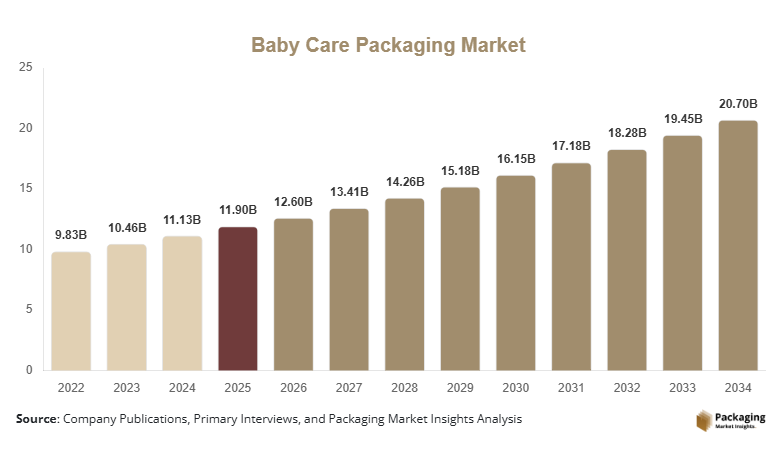
The global baby care packaging market size is estimated at USD 11.9 billion in 2025, while the market is projected to reach approximately USD 12.6 billion in 2026. By 2034, the market is forecasted to attain nearly USD 20.7 billion, registering a CAGR of 6.4% during 2025–2034. The baby care packaging market is witnessing steady growth due to increasing demand for safe, hygienic, and convenient packaging solutions for infant and toddler products. Baby care packaging includes packaging formats used for baby food, baby skincare products, diapers, wipes, feeding accessories, infant formula, and healthcare products. Manufacturers are increasingly focusing on durable, lightweight, and sustainable packaging solutions that ensure product protection while improving user convenience for parents. Rising awareness regarding infant hygiene and safety standards is contributing significantly to the expansion of the baby care packaging industry.
One of the major growth factors driving the market is the increasing demand for packaged baby food and infant nutrition products. Urbanization and changing lifestyles have encouraged parents to purchase ready-to-use baby food and convenient feeding solutions. Another important growth factor is the rapid expansion of e-commerce channels for baby products. Online retail platforms require durable and protective packaging solutions that ensure product integrity during transportation and storage. In addition, growing consumer preference for sustainable and recyclable packaging materials is encouraging manufacturers to adopt eco-friendly paperboard, biodegradable plastics, and reusable packaging formats.
Key Highlights
- Asia Pacific dominated the market with a 39.6% share in 2025.
- Latin America is projected to grow at the fastest CAGR of 6.9%.
- Flexible packaging led the packaging type segment with a 47.3% share.
- Plastic materials dominated with a 54.8% share.
- Baby food applications led the market with a 42.5% share.
- The US remained the dominant country with a market size of USD 2.2 billion in 2025 and USD 2.4 billion in 2026.
Explore more data points, trends and opportunities Download Free Sample Report
Market Trends
Rising Demand for Sustainable and Recyclable Packaging
Sustainability has become a major trend in the baby care packaging market as parents increasingly prefer environmentally responsible products for infant care. Manufacturers are introducing recyclable pouches, paperboard cartons, compostable wipes packaging, and bio-based plastics to reduce environmental impact. Regulatory pressure regarding single-use plastic reduction is also encouraging packaging producers to adopt renewable materials. In addition, baby product brands are promoting sustainable packaging as part of their brand identity to attract environmentally conscious consumers. Companies are investing in lightweight packaging solutions and refillable formats that minimize material consumption while maintaining product safety and convenience for caregivers.
Growth of Smart and Convenience-Oriented Packaging Solutions
The increasing demand for convenience among modern parents is driving innovation in smart baby care packaging formats. Packaging companies are introducing easy-open closures, resealable pouches, tamper-evident seals, and portion-controlled baby food containers to improve product usability. Smart labeling technologies, including QR codes and traceability features, are also becoming increasingly common in infant formula and baby healthcare packaging. These technologies help parents verify product authenticity and access nutritional information quickly. In addition, e-commerce growth is encouraging manufacturers to develop durable and leak-resistant packaging solutions capable of protecting sensitive baby products during transportation and storage.
Market Drivers
Increasing Consumption of Packaged Baby Food Products
The growing demand for packaged baby food and infant nutrition products is a major factor driving the baby care packaging market. Working parents and urban households are increasingly purchasing ready-to-eat baby meals, powdered formula, and nutritional snacks that require safe and hygienic packaging. Baby food packaging must provide contamination protection, product freshness, and convenient handling while meeting strict infant safety regulations. As consumer awareness regarding nutrition and infant health continues to increase, manufacturers are expanding premium baby food product offerings that require advanced packaging solutions. In addition, rising retail penetration and online distribution are contributing to higher consumption of packaged baby care products worldwide.
Expansion of E-Commerce Distribution Channels
The rapid growth of e-commerce platforms for baby products is significantly supporting the expansion of the baby care packaging market. Parents increasingly purchase diapers, wipes, baby skincare products, and infant formula through online retail channels due to convenience and product availability. This trend is creating demand for durable and protective packaging capable of preventing leakage, contamination, and product damage during transportation. Packaging manufacturers are developing lightweight yet strong materials suitable for shipping and long-distance logistics. In addition, subscription-based delivery services for baby products are encouraging innovation in reusable and compact packaging formats designed for efficient storage and transportation.
Market Restraint
Stringent Safety Regulations and Rising Packaging Compliance Costs
One of the primary restraints affecting the baby care packaging market is the increasing complexity of safety regulations and packaging compliance requirements. Baby care products require strict testing for chemical migration, contamination resistance, tamper protection, and material safety because infant products are highly sensitive to harmful substances. Regulatory agencies across North America and Europe enforce rigorous standards regarding packaging composition and labeling, which can increase production costs for manufacturers. For example, companies producing infant formula packaging often need to invest in specialized food-grade materials and contamination-free production systems to comply with safety standards. Small and medium-sized packaging manufacturers may face operational challenges due to high certification costs and complex testing procedures. In addition, rising demand for sustainable materials can increase manufacturing expenses because biodegradable and recyclable materials may require advanced processing technologies and supply chain adjustments.
Market Opportunities
Development of Biodegradable and Compostable Packaging
The growing consumer preference for eco-friendly infant products is creating significant opportunities for biodegradable and compostable baby care packaging solutions. Parents are increasingly concerned about plastic waste generated from diapers, wipes, and baby food packaging, encouraging manufacturers to adopt renewable and recyclable materials. Packaging companies are developing compostable films, plant-based plastics, and recyclable paper containers that reduce environmental impact while maintaining product safety. In addition, retailers are supporting sustainable packaging initiatives by prioritizing environmentally responsible brands. This transition toward biodegradable packaging is expected to create new revenue opportunities for packaging manufacturers over the forecast period.
Rising Demand for Premium Baby Care Products
The increasing popularity of premium baby care products is creating new growth opportunities for advanced packaging solutions. Premium infant formula, organic baby food, and luxury baby skincare products require visually attractive and high-performance packaging that enhances brand value and product protection. Manufacturers are therefore investing in innovative packaging designs, premium labeling technologies, and resealable containers that improve consumer experience. In addition, rising disposable income in emerging economies is supporting demand for imported and specialized baby products packaged in high-quality materials. Companies focusing on premium and personalized packaging formats are expected to benefit from changing consumer preferences and rising brand competition.
Report Scope
| Report Metric | Details |
|---|---|
| Market Size in 2025 | USD 11.9 Billion |
| Market Size in 2026 | USD 12.6 Billion |
| Market Size in 2034 | USD 20.7 Billion |
| CAGR | 6.4% (2026-2034) |
| Base Year for Estimation | 2025 |
| Historical Data | 2022-2024 |
| Forecast Period | 2026-2034 |
| Report Coverage | Revenue Forecast, Competitive Landscape, Supply Chain Disruption, Growth Factors, Environment & Regulatory Landscape and Trends |
| Geographies Covered | North America, Europe, APAC, Middle East and Africa, LATAM |
| Countries Covered | U.S., Canada, U.K., Germany, France, Spain, Italy, Russia, Nordic, Benelux, Rest of Europe, China, South Korea, Japan, India, Australia, Singapore, Taiwan, South East Asia, Rest of Asia-Pacific, UAE, Turky, Saudi Arabia, South Africa, Egypt, Nigeria, Rest of MEA, Brazil, Mexico, Argentina, Chile, Colombia, Rest of LATAM |
Explore more data points, trends and opportunities Download Free Sample Report
Segmental Analysis
By Packaging Type
Flexible packaging dominated the baby care packaging market in 2024, accounting for approximately 47.3% of the total market share. Flexible packaging formats such as pouches, sachets, and wraps are widely used for baby food, wipes, diapers, and skincare products because they provide lightweight handling, reduced material consumption, and convenient storage. Manufacturers prefer flexible packaging due to lower transportation costs and improved shelf visibility. In addition, resealable pouches and easy-open features improve convenience for caregivers while maintaining product freshness and hygiene. The growing popularity of travel-friendly baby products and single-use packaging solutions is also contributing to the dominance of this segment.
Biodegradable packaging is projected to be the fastest-growing subsegment, expanding at a CAGR of 7.2% during the forecast period. Rising environmental awareness among consumers and increasing regulations regarding plastic waste are encouraging manufacturers to develop compostable and recyclable packaging materials. Biodegradable packaging solutions are increasingly used for baby wipes, skincare products, and food packaging applications. Packaging companies are investing in plant-based polymers and recyclable paper materials that reduce environmental impact while meeting infant safety standards. In addition, premium baby product brands are adopting eco-friendly packaging to strengthen brand positioning and attract environmentally conscious consumers.
By Material
Plastic materials dominated the market in 2024 with a share of approximately 54.8%. Plastic packaging remains widely used because of its durability, flexibility, lightweight performance, and cost efficiency. Products such as baby bottles, wipes containers, lotion tubes, and diaper packaging commonly use polyethylene and polypropylene materials for moisture protection and product safety. Manufacturers also prefer plastic materials because they support various packaging designs and high-speed production processes. Despite sustainability concerns, plastic packaging continues to maintain strong demand due to its convenience and barrier protection capabilities across baby care applications.
Paper-based packaging materials are expected to witness the fastest growth, registering a CAGR of 6.8% during the forecast period. Increasing demand for recyclable and renewable packaging solutions is encouraging manufacturers to adopt paperboard cartons and fiber-based packaging formats. Paper packaging is increasingly used for baby food cartons, diaper boxes, and retail packaging because it improves sustainability performance and supports eco-friendly branding strategies. In addition, technological advancements in moisture-resistant coatings and biodegradable laminates are improving the functionality of paper-based baby care packaging products.
By Application
Baby food applications accounted for the dominant market share of approximately 42.5% in 2024 within the baby care packaging market. Rising demand for infant nutrition products, ready-to-eat meals, and powdered formula is significantly contributing to packaging consumption. Baby food packaging requires strong barrier protection, contamination resistance, and convenient dispensing features to maintain product quality and safety. Manufacturers are increasingly introducing single-serve pouches, resealable containers, and portion-controlled packaging formats to improve convenience for parents. Growth in organic baby food products and premium nutrition categories is also supporting innovation in advanced packaging solutions.
Baby skincare packaging is expected to register the fastest CAGR of 6.7% during the forecast period. Products such as lotions, creams, oils, powders, and shampoos require protective and user-friendly packaging systems that ensure hygiene and prevent leakage. Increasing awareness regarding infant skincare and rising demand for premium organic skincare products are supporting segment growth. Packaging manufacturers are introducing airless pumps, recyclable tubes, and tamper-evident closures to improve safety and product usability. In addition, growth in online retail distribution is increasing demand for durable and leak-resistant skincare packaging solutions.
Baby Care Packaging Market Segmentations
By Packaging Type
- Flexible Packaging
- Rigid Packaging
- Biodegradable Packaging
- Paper-Based Packaging
- Glass Packaging
By Material
- Plastic
- Paper & Paperboard
- Glass
- Metal
- Biodegradable Materials
By Application
- Baby Food Packaging
- Infant Formula Packaging
- Baby Skincare Packaging
- Baby Wipes Packaging
- Diaper Packaging
Regional Analysis
North America
North America accounted for approximately 28.1% of the global baby care packaging market share in 2025 and is projected to grow at a CAGR of 5.9% during the forecast period. The region benefits from high consumption of packaged baby food, strong retail distribution networks, and increasing demand for premium infant care products. Packaging manufacturers are increasingly introducing sustainable and child-safe packaging materials to comply with strict safety regulations. Growth in e-commerce sales for baby products is also supporting demand for durable and protective packaging solutions across the region.
The United States dominates the North American market due to strong consumer spending on infant nutrition and baby healthcare products. One unique growth factor is the increasing demand for organic and premium baby food packaging requiring advanced barrier protection and convenient dispensing features. Manufacturers in the country are also investing in recyclable packaging solutions to meet consumer sustainability expectations.
Europe
Europe represented nearly 24.7% of the global market share in 2025 and is expected to expand at a CAGR of 5.7% during the forecast period. The region is characterized by strict packaging safety standards and strong environmental regulations supporting recyclable packaging adoption. European consumers increasingly prefer eco-friendly baby products packaged in renewable materials with minimal plastic usage. Growth in baby skincare products and infant healthcare packaging is also contributing to market expansion. In addition, increasing adoption of smart labeling technologies is improving transparency and consumer trust across the region.
Germany remains the dominant country in the European market because of its advanced packaging industry and high demand for premium infant products. A unique growth factor is the rapid adoption of biodegradable baby wipes and sustainable diaper packaging solutions supported by environmental awareness initiatives. Packaging companies in Germany are focusing on lightweight recyclable materials and refillable packaging systems to support circular economy goals.
Asia Pacific
Asia Pacific dominated the baby care packaging market with a 39.6% share in 2025 and is projected to register a CAGR of 6.8% during the forecast period. Rising birth rates, urbanization, and increasing disposable income are major drivers supporting regional market growth. Countries such as China, India, Japan, and Indonesia are experiencing strong demand for packaged baby food, infant formula, and baby hygiene products. Expansion of organized retail and online distribution channels is also increasing consumption of packaged baby products across urban and semi-urban areas.
China dominates the regional market due to its large infant population and rapidly expanding baby food industry. One unique growth factor is the increasing demand for imported infant nutrition products packaged in high-quality and tamper-resistant materials. Chinese consumers place strong emphasis on product safety and authenticity, encouraging packaging manufacturers to invest in smart labeling and traceability technologies.
Middle East & Africa
The Middle East & Africa region accounted for approximately 3.8% of the global market share in 2025 and is projected to grow at a CAGR of 6.1% during the forecast period. Rising healthcare awareness, increasing urban populations, and growth in packaged infant nutrition products are supporting market expansion across the region. Baby care packaging demand is also increasing due to higher retail penetration and rising availability of international baby brands. In addition, demand for moisture-resistant and durable packaging solutions is growing because of high regional temperatures.
Saudi Arabia dominates the regional market due to strong demand for infant formula and imported baby care products. One unique growth factor is the increasing investment in modern retail infrastructure supporting wider availability of packaged baby nutrition products. Packaging manufacturers are focusing on leak-proof and contamination-resistant packaging solutions suitable for long-distance transportation and storage.
Latin America
Latin America represented nearly 3.8% of the global baby care packaging market share in 2025 and is expected to grow at the fastest CAGR of 6.9% during the forecast period. Increasing birth rates, rising middle-class populations, and growth in organized retail channels are supporting demand for packaged baby products across the region. Manufacturers are introducing cost-effective flexible packaging formats to improve product affordability while maintaining safety standards. In addition, increasing awareness regarding infant hygiene and nutrition is contributing to market expansion.
Brazil dominates the Latin American market because of its large consumer base and expanding baby food manufacturing industry. A unique growth factor is the growing demand for affordable packaged baby nutrition products distributed through supermarkets and healthcare programs. Packaging producers are investing in lightweight and flexible packaging formats that reduce transportation costs and improve retail efficiency.
Competitive Landscape
The baby care packaging market is moderately competitive, with key companies focusing on sustainable packaging innovation, child-safe designs, and lightweight materials. Market participants are investing in recyclable packaging technologies, premium packaging aesthetics, and smart labeling systems to strengthen market presence. Companies are also expanding production capacity and collaborating with baby product manufacturers to improve supply chain efficiency and product customization.
Amcor plc remains one of the leading companies in the market due to its broad portfolio of flexible and sustainable packaging solutions for baby care products. In 2024, the company introduced recyclable flexible packaging materials designed for baby food and infant nutrition applications. Other major players include Berry Global Inc., Sonoco Products Company, Mondi Group, and Sealed Air Corporation. These companies are focusing on eco-friendly materials, advanced barrier protection technologies, and lightweight packaging innovations to meet changing consumer and regulatory requirements.
Key Players List
- Amcor plc
- Berry Global Inc.
- Mondi Group
- Sonoco Products Company
- Sealed Air Corporation
- Huhtamaki Oyj
- Constantia Flexibles
- ProAmpac LLC
- DS Smith Plc
- AptarGroup, Inc.
- Gerresheimer AG
- WestRock Company
- Silgan Holdings Inc.
- Winpak Ltd.
- International Paper Company