Pvc Packaging Tape Printing Market Size and Growth
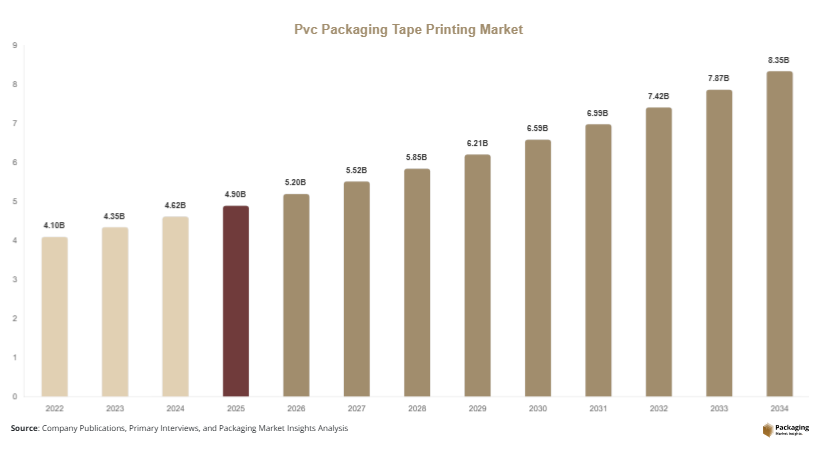
The global PVC packaging tape printing market size was valued at approximately USD 4.9 billion in 2025 and is expected to reach USD 5.2 billion in 2026. By 2034, the market is projected to reach nearly USD 8.8 billion, registering a CAGR of 6.1% during 2025–2034. The PVC packaging tape printing market is witnessing stable expansion due to increasing demand for branded and secure packaging solutions across logistics, e-commerce, manufacturing, retail, food distribution, and industrial sectors. PVC packaging tapes are widely used for carton sealing, shipment identification, product branding, tamper evidence, and warehouse management. Printed PVC tapes provide additional advantages such as company logo visibility, warning instructions, promotional messaging, and counterfeit prevention.
One of the major growth factors driving the PVC packaging tape printing market is the rapid expansion of global e-commerce and logistics industries. Online retail companies increasingly require customized packaging tapes for brand promotion, inventory handling, and secure transportation. Another significant factor is the growing demand for tamper-evident and identification packaging in industrial and pharmaceutical applications. Printed PVC tapes help improve supply chain visibility while supporting product safety and traceability requirements. Additionally, increasing international trade and warehouse automation are contributing to rising usage of printed sealing tapes across commercial packaging operations.
Key Highlights
- Asia Pacific dominated the market with a 40.4% share in 2025.
- Latin America is projected to grow at the fastest CAGR of 6.8%.
- Solvent-based printed PVC tapes led the type segment with a 35.7% share.
- Industrial packaging applications dominated with a 38.6% share.
- Logistics and transportation led the end-use segment with 33.8% share.
- The US remained the dominant country with a market size of USD 1.1 billion in 2025 and USD 1.2 billion in 2026.
Explore more data points, trends and opportunities Download Free Sample Report
Market Trends
Increasing Adoption of Customized Branding Tapes
Customized branding solutions are becoming a significant trend in the PVC packaging tape printing market as businesses seek cost-effective methods to improve brand visibility during product transportation. Printed PVC tapes featuring logos, promotional messages, handling instructions, and QR codes are increasingly used across e-commerce, retail, and industrial packaging sectors. Companies are adopting custom tape printing as part of broader packaging marketing strategies to create stronger customer recognition and improve package authenticity. Digital printing technologies are enabling short-run and high-resolution customization with faster turnaround times. This trend is especially prominent among direct-to-consumer brands that focus on customer experience and packaging presentation as part of their competitive positioning.
Shift Toward Sustainable Printing Technologies
Sustainability-focused printing technologies are influencing developments in the PVC packaging tape printing market. Manufacturers are increasingly adopting water-based inks, low-VOC adhesives, and recyclable packaging materials to comply with environmental standards and customer expectations. Companies are also investing in energy-efficient printing equipment and solvent recovery systems to reduce production emissions. The demand for eco-friendly printing solutions is particularly increasing among multinational consumer goods companies that have established sustainability targets. In addition, improvements in biodegradable coatings and recyclable tape cores are supporting environmentally responsible packaging operations. The transition toward sustainable printing technologies is expected to create new innovation opportunities across the packaging tape industry.
Market Drivers
Rapid Growth of E-Commerce and Logistics Operations
The rapid expansion of e-commerce and logistics industries is a primary driver of the PVC packaging tape printing market. Online retail businesses require durable and customized packaging tapes to secure shipments, improve brand identity, and streamline warehouse handling operations. Printed PVC tapes are widely used for labeling, promotional branding, and shipment tracking across distribution centers and fulfillment facilities. Increasing cross-border trade and rising parcel delivery volumes are also supporting higher consumption of packaging tapes. Furthermore, logistics providers are adopting automated packaging systems that require high-performance tapes compatible with machine applications. The growing importance of secure and visually identifiable packaging is expected to sustain market growth throughout the forecast period.
Increasing Demand for Tamper-Evident Packaging Solutions
The rising need for tamper-evident and secure packaging is another key factor driving the PVC packaging tape printing market. Industries such as pharmaceuticals, electronics, and food processing increasingly use printed tapes to indicate package integrity and prevent unauthorized handling during transportation. Printed warning messages, authentication marks, and security patterns improve product traceability and reduce counterfeiting risks. Regulatory requirements regarding transportation safety and product labeling are also encouraging adoption of specialized printed tapes. In addition, manufacturers are introducing high-adhesion and moisture-resistant tape formulations to improve packaging durability under challenging storage and shipping conditions.
Market Restraint
Environmental Concerns Related to PVC Material Usage
One of the major restraints affecting the PVC packaging tape printing market is the growing environmental concern regarding PVC material usage and disposal. PVC tapes are valued for their durability and flexibility, but they also face criticism because of recycling challenges and environmental impact associated with plastic waste generation. Governments and environmental organizations are increasingly promoting restrictions on certain plastic-based products and encouraging adoption of recyclable alternatives. Compliance with environmental regulations can increase operational costs for manufacturers because they must invest in sustainable materials, low-emission adhesives, and recycling technologies. For example, packaging companies operating in Europe may face stricter waste management standards related to plastic packaging disposal and chemical additives. In addition, consumer preference for environmentally responsible packaging solutions may encourage some businesses to shift toward paper-based or biodegradable tape products. These factors can limit growth opportunities for conventional PVC packaging tapes, particularly in environmentally regulated markets where sustainability performance has become a critical purchasing factor.
Market Opportunities
Expansion of Smart and Trackable Packaging Solutions
The increasing adoption of smart packaging technologies presents significant opportunities for the PVC packaging tape printing market. Companies are integrating QR codes, barcodes, and RFID-compatible printing features into packaging tapes to improve shipment tracking and supply chain visibility. Smart printed tapes help businesses monitor product movement, authenticate shipments, and improve warehouse management efficiency. Logistics providers and e-commerce companies are increasingly investing in intelligent packaging systems to reduce operational errors and improve customer satisfaction. Advancements in digital printing technology are also enabling cost-effective production of customized smart tapes with variable data printing capabilities. This opportunity is expected to support innovation across logistics and industrial packaging applications.
Growth in Emerging Industrial and Retail Markets
Emerging economies are creating strong growth opportunities for the PVC packaging tape printing market due to increasing industrialization, retail expansion, and rising packaged goods consumption. Developing countries in Asia Pacific, Latin America, and the Middle East are experiencing rapid growth in logistics infrastructure and e-commerce operations, increasing demand for packaging materials. Small and medium-sized businesses are also adopting custom-printed tapes to strengthen brand recognition and improve packaging efficiency. Investments in warehouse automation and organized retail distribution are further contributing to demand for advanced packaging tape solutions. As industrial packaging standards improve globally, manufacturers are expected to expand production capacities in emerging regional markets.
Report Scope
| Report Metric | Details |
|---|---|
| Market Size in 2025 | USD 4.9 Billion |
| Market Size in 2026 | USD 5.2 Billion |
| Market Size in 2034 | USD 8.8 Billion |
| CAGR | 6.1% (2026-2034) |
| Base Year for Estimation | 2025 |
| Historical Data | 2022-2024 |
| Forecast Period | 2026-2034 |
| Report Coverage | Revenue Forecast, Competitive Landscape, Supply Chain Disruption, Growth Factors, Environment & Regulatory Landscape and Trends |
| Geographies Covered | North America, Europe, APAC, Middle East and Africa, LATAM |
| Countries Covered | U.S., Canada, U.K., Germany, France, Spain, Italy, Russia, Nordic, Benelux, Rest of Europe, China, South Korea, Japan, India, Australia, Singapore, Taiwan, South East Asia, Rest of Asia-Pacific, UAE, Turky, Saudi Arabia, South Africa, Egypt, Nigeria, Rest of MEA, Brazil, Mexico, Argentina, Chile, Colombia, Rest of LATAM |
Explore more data points, trends and opportunities Download Free Sample Report
Segmental Analysis
By Type
Solvent-based printed PVC tapes dominated the PVC packaging tape printing market in 2024, accounting for approximately 35.7% of total market revenue. These tapes are widely preferred because they provide strong adhesion performance, moisture resistance, and durability under different environmental conditions. Solvent-based printed tapes are extensively used in industrial packaging, export shipments, and heavy-duty carton sealing applications where reliable bonding strength is essential. Manufacturers are increasingly improving printing clarity and adhesive formulations to support high-speed packaging operations. In addition, these tapes are compatible with automated carton sealing equipment commonly used across logistics and warehouse facilities. Their ability to maintain print quality and adhesion during long-distance transportation continues to support demand across industrial and commercial packaging sectors.
Water-based printed PVC tapes are projected to be the fastest-growing subsegment, expanding at a CAGR of 7.0% during the forecast period. These tapes are gaining popularity because they offer lower environmental impact and reduced volatile organic compound emissions compared to solvent-based alternatives. Companies are increasingly adopting water-based printing technologies to comply with environmental regulations and sustainability commitments. Water-based tapes are particularly suitable for retail packaging and consumer goods applications where eco-friendly packaging solutions are becoming more important. Advancements in water-based adhesive performance and print durability are also improving product quality and market acceptance. The transition toward environmentally responsible packaging materials is expected to support long-term growth within this subsegment.
By Application
Industrial packaging dominated the PVC packaging tape printing market in 2024 with a revenue share of approximately 38.6%. Industrial packaging operations require durable and highly visible sealing tapes capable of protecting products during storage and transportation. Printed PVC tapes are widely used for carton sealing, pallet packaging, warning identification, and export labeling across manufacturing and logistics sectors. Companies are increasingly using customized tapes to improve shipment tracking and strengthen brand recognition within commercial supply chains. The growth of international trade and industrial manufacturing activities continues to drive demand for high-performance packaging tape solutions. Furthermore, advancements in automated packaging equipment are encouraging the use of machine-compatible printed tapes with consistent adhesive and printing quality.
E-commerce packaging is expected to witness the fastest growth, registering a CAGR of 7.2% through 2034. Online retailers are increasingly using printed packaging tapes to improve customer experience, shipment identification, and promotional branding. The rapid expansion of direct-to-consumer business models is creating strong demand for customized packaging materials that enhance package presentation during delivery. E-commerce companies are also adopting tamper-evident tapes to improve shipment security and reduce fraud risks. Digital printing technologies are enabling cost-effective customization and short-run production for online retail packaging operations. As parcel delivery volumes continue to rise globally, demand for advanced printed packaging tapes is expected to increase significantly.
By End-Use Industry
The logistics and transportation segment dominated the PVC packaging tape printing market in 2024, accounting for approximately 33.8% of total revenue. Logistics providers require durable printed tapes for shipment handling, warehouse organization, and package identification. Printed PVC tapes help improve operational efficiency by displaying handling instructions, tracking information, and security warnings directly on shipping cartons. The growth of global trade and fulfillment center operations is supporting strong demand for customized tape printing solutions. In addition, transportation companies are increasingly using machine-applied printed tapes compatible with automated packaging systems. Investments in warehouse modernization and inventory management technologies are expected to continue supporting demand from this segment.
Pharmaceutical packaging is anticipated to grow at the fastest CAGR of 6.9% during the forecast period. Pharmaceutical manufacturers require tamper-evident and highly secure packaging materials to maintain product integrity during storage and distribution. Printed PVC tapes are increasingly used for authentication labeling, warning instructions, and shipment traceability across healthcare supply chains. Regulatory requirements regarding pharmaceutical transportation safety and counterfeit prevention are encouraging adoption of specialized printed tape solutions. Manufacturers are also introducing low-contamination adhesives and high-resolution printing technologies suitable for healthcare packaging applications. The increasing global distribution of medicines and healthcare products is expected to create sustained demand for advanced pharmaceutical packaging tapes.
Pvc Packaging Tape Printing Market Segmentations
By Type
- Solvent-Based Printed PVC Tapes
- Water-Based Printed PVC Tapes
- Hot Melt Printed PVC Tapes
By Application
- Industrial Packaging
- E-Commerce Packaging
- Food & Beverage Packaging
- Consumer Goods Packaging
By End-Use Industry
- Logistics & Transportation
- Pharmaceuticals
- Retail & E-Commerce
- Manufacturing
- Electronics
By Distribution Channel
- Direct Sales
- Industrial Distributors
- Online Packaging Suppliers
- Retail Packaging Stores
Regional Analysis
North America
North America accounted for approximately 28.3% of the global PVC packaging tape printing market share in 2025 and is projected to grow at a CAGR of 5.8% during the forecast period. The region benefits from advanced logistics infrastructure, high e-commerce penetration, and increasing demand for branded packaging solutions. Companies are adopting automated carton sealing systems and customized printed tapes to improve operational efficiency and packaging security. Sustainability initiatives are also encouraging manufacturers to invest in eco-friendly printing technologies and low-emission adhesive solutions.
The United States dominates the North American market due to its extensive retail and logistics industries. One unique growth factor is the rapid expansion of warehouse automation systems across fulfillment centers. Automated packaging lines require durable and machine-compatible printed PVC tapes capable of supporting high-speed packaging operations and accurate shipment identification across large-scale distribution networks.
Europe
Europe held approximately 23.1% of the PVC packaging tape printing market share in 2025 and is expected to grow at a CAGR of 5.5% through 2034. Strict environmental regulations and increasing demand for sustainable packaging solutions are influencing market growth across the region. Packaging manufacturers are investing in recyclable tape materials, water-based inks, and energy-efficient printing technologies. The expansion of pharmaceutical exports and industrial packaging activities is also contributing to increasing tape consumption.
Germany remains the dominant country in the European market because of its strong manufacturing and logistics sectors. One unique growth factor is the growing use of custom-printed tapes in export-oriented industrial packaging. German manufacturers are increasingly using branded and tamper-evident tape solutions to improve packaging security and product traceability during international shipments.
Asia Pacific
Asia Pacific dominated the PVC packaging tape printing market with a 40.4% share in 2025 and is forecast to grow at a CAGR of 6.9% during the assessment period. Rapid industrialization, rising online shopping activity, and expanding logistics networks are major drivers supporting regional market growth. Packaging companies are increasing investments in high-volume tape production and digital printing technologies to meet rising demand from e-commerce and manufacturing industries.
China is the leading country in the Asia Pacific market due to its large manufacturing base and expanding export activities. One unique growth factor is the rapid growth of cross-border e-commerce operations requiring customized packaging solutions for international shipments. Companies are increasingly adopting printed PVC tapes with multilingual branding and tracking features to improve packaging efficiency and global product distribution.
Middle East & Africa
The Middle East & Africa region accounted for approximately 4.7% of the global market share in 2025 and is expected to grow at a CAGR of 6.0% during the forecast period. Increasing retail development, industrial expansion, and logistics infrastructure investments are supporting market growth. Governments are encouraging modernization of warehousing and transportation systems, increasing demand for secure packaging materials and printed identification tapes.
Saudi Arabia dominates the regional market because of its expanding retail distribution and industrial manufacturing sectors. One unique growth factor is the growth of regional logistics hubs supporting import and export activities. Packaging suppliers are increasingly introducing durable printed tape solutions designed to withstand high-temperature transportation and storage conditions within the region.
Latin America
Latin America represented nearly 3.5% of the PVC packaging tape printing market share in 2025 and is projected to grow at the fastest CAGR of 6.8% during the forecast period. Rising e-commerce penetration, improving transportation networks, and growth in packaged consumer goods industries are contributing to market expansion. Businesses are increasingly adopting branded packaging materials to improve customer engagement and shipment identification across retail supply chains.
Brazil leads the Latin American market due to its strong retail and industrial packaging industries. One unique growth factor is the increasing use of custom-printed packaging tapes in food and beverage distribution operations. Companies are focusing on branded packaging and secure transportation solutions to improve product visibility and handling efficiency across regional distribution networks.
Competitive Landscape
The PVC packaging tape printing market is moderately competitive, with key players focusing on printing innovation, adhesive technology, and sustainable production methods. Companies are investing in digital printing systems, eco-friendly inks, and automated manufacturing technologies to strengthen product quality and operational efficiency. Strategic partnerships with logistics providers and e-commerce companies are also supporting market expansion across commercial packaging applications.
3M Company remains one of the leading players in the market due to its broad industrial adhesive portfolio and global distribution network. In 2024, the company introduced advanced custom-printed PVC tapes with enhanced moisture resistance and high-speed printing compatibility for automated packaging operations. Other major companies include Tesa SE, Intertape Polymer Group, Shurtape Technologies, and Nitto Denko Corporation. These companies are increasingly focusing on sustainable adhesive formulations, recyclable tape materials, and high-resolution printing technologies to address changing customer and regulatory requirements.
Key Players List
- 3M Company
- Tesa SE
- Intertape Polymer Group
- Shurtape Technologies
- Nitto Denko Corporation
- Berry Global Inc.
- Scapa Group plc
- Advance Tapes International
- Vibac Group S.p.A.
- Pro Tapes & Specialties Inc.
- Adhesive Applications Inc.
- Lohmann GmbH & Co. KG
- Atlas Tapes S.A.
- DeWAL Industries
- CCT Tapes