Chemical Packaging Material Market Size and Growth
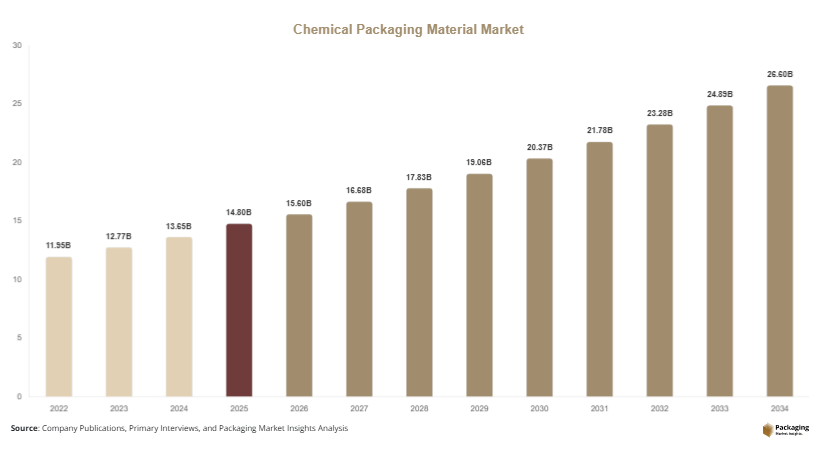
The global chemical packaging material market is valued at approximately USD 14.8 billion in 2025 and is projected to reach USD 15.6 billion in 2026. By 2034, the market is expected to reach around USD 26.9 billion, expanding at a CAGR of 6.9% during 2025–2034. The global chemical packaging material market is experiencing steady growth, supported by rising demand for safe transportation and storage of hazardous and non-hazardous chemicals across industrial, agricultural, and specialty chemical sectors.
The growth of the market is primarily driven by increasing global chemical production, expansion of cross-border chemical trade, and rising safety regulations for hazardous material handling. Additionally, the demand for high-performance packaging materials that ensure chemical stability, leak resistance, and contamination protection is significantly boosting market adoption.
Key Highlights
- Europe dominated the market with a 36.8% share in 2025.
- Asia Pacific is projected to grow at the fastest CAGR of 8.6% (2025–2034).
- Plastic-based chemical packaging materials led the market with a 46.5% share in 2025.
- Drums and barrels accounted for 39.8% share in 2025.
- The chemicals end-use industry dominated the market with a 51.2% share in 2025.
- The US market reached USD 1.35 billion in 2025 and USD 1.46 billion in 2026.
Explore more data points, trends and opportunities Download Free Sample Report
Market Trends
Shift toward High-Performance Polymer-Based Packaging
The chemical packaging material market is witnessing a strong shift toward advanced polymer-based packaging solutions designed for enhanced chemical resistance and durability. Materials such as HDPE, polypropylene, and multilayer composites are increasingly replacing traditional metal and glass packaging in many industrial applications. These materials provide superior resistance to corrosion, leakage, and chemical degradation, making them ideal for hazardous chemical storage and transportation. Additionally, innovations in barrier technologies are enabling longer shelf life and improved safety standards. This trend is further supported by growing industrial safety regulations and demand for lightweight packaging solutions that reduce transportation costs.
Rising Adoption of Sustainable and Reusable Packaging Systems
Sustainability is becoming a key focus area in chemical packaging, with companies increasingly adopting reusable drums, refillable IBCs, and recyclable polymer containers. Environmental concerns and regulatory pressure are pushing manufacturers to reduce plastic waste and carbon emissions across supply chains. Closed-loop packaging systems are gaining traction, where containers are collected, cleaned, and reused multiple times. Additionally, bio-based polymers and recyclable composites are being developed for non-hazardous chemical applications. This trend is particularly strong in Europe and North America, where sustainability regulations are highly stringent.
Market Drivers
Expansion of Global Chemical Manufacturing Industry
The continuous expansion of the global chemical manufacturing sector is one of the primary drivers of the chemical packaging material market. Rapid industrialization, especially in emerging economies, is increasing production of petrochemicals, specialty chemicals, and agrochemicals. These chemicals require safe and standardized packaging solutions to ensure secure storage and transportation. Growing export-import activities in chemical trade are further increasing demand for UN-certified packaging materials. Additionally, increasing investments in chemical production facilities across Asia Pacific are significantly contributing to market growth.
Stringent Safety and Transportation Regulations
The chemical packaging industry is heavily influenced by strict safety and transportation regulations imposed by international bodies. Regulations such as OSHA guidelines, REACH compliance in Europe, and UN recommendations for hazardous material packaging are driving the adoption of certified and high-performance packaging materials. These regulations require leak-proof, impact-resistant, and chemically stable packaging formats to minimize risks during transportation. As a result, manufacturers are increasingly investing in advanced packaging technologies that ensure compliance while maintaining operational efficiency.
Market Restraint
High Cost of Advanced Packaging Materials
One of the key restraints in the chemical packaging material market is the high cost associated with advanced and certified packaging solutions. High-performance materials such as multilayer polymers, corrosion-resistant coatings, and UN-certified containers significantly increase packaging costs for chemical manufacturers. Small and medium-sized enterprises often face challenges in adopting these solutions due to budget constraints. Additionally, fluctuating raw material prices, particularly in petrochemical-based plastics, create cost instability in the supply chain. This limits widespread adoption, especially in price-sensitive markets.
Market Opportunities
Growth in Smart and Traceable Packaging Systems
The integration of smart technologies in chemical packaging presents a major growth opportunity. RFID tags, QR codes, and IoT-enabled sensors are increasingly being used to track chemical shipments, monitor temperature, and ensure safety compliance. These technologies help reduce risks of leakage, theft, and mishandling during transportation. With increasing demand for supply chain transparency, smart packaging solutions are expected to gain strong traction in industrial chemical logistics. This trend is particularly relevant for high-value and hazardous chemical shipments.
Expansion in Emerging Industrial Economies
Emerging economies in Asia Pacific, Latin America, and the Middle East offer significant growth opportunities for chemical packaging material manufacturers. Rapid industrial expansion, increasing foreign investments in chemical production, and rising exports are driving demand for safe packaging solutions. Countries such as India, China, Brazil, and Saudi Arabia are witnessing strong growth in chemical manufacturing capacity. Additionally, infrastructure development in logistics and warehousing is further supporting adoption of standardized packaging materials.
Report Scope
| Report Metric | Details |
|---|---|
| Market Size in 2025 | USD 14.8 Billion |
| Market Size in 2026 | USD 15.6 Billion |
| Market Size in 2034 | USD 26.9 Billion |
| CAGR | 6.9% (2026-2034) |
| Base Year for Estimation | 2025 |
| Historical Data | 2022-2024 |
| Forecast Period | 2026-2034 |
| Report Coverage | Revenue Forecast, Competitive Landscape, Supply Chain Disruption, Growth Factors, Environment & Regulatory Landscape and Trends |
| Geographies Covered | North America, Europe, APAC, Middle East and Africa, LATAM |
| Countries Covered | U.S., Canada, U.K., Germany, France, Spain, Italy, Russia, Nordic, Benelux, Rest of Europe, China, South Korea, Japan, India, Australia, Singapore, Taiwan, South East Asia, Rest of Asia-Pacific, UAE, Turky, Saudi Arabia, South Africa, Egypt, Nigeria, Rest of MEA, Brazil, Mexico, Argentina, Chile, Colombia, Rest of LATAM |
Explore more data points, trends and opportunities Download Free Sample Report
Segmental Analysis
By Material Type
Plastic-based packaging dominated the market with approximately 46.5% share in 2024, primarily due to its chemical resistance, lightweight nature, and cost-effectiveness. HDPE drums, jerry cans, and intermediate bulk containers (IBCs) are widely used for transporting industrial chemicals, agrochemicals, and cleaning agents. The segment benefits from high durability and compatibility with corrosive substances, making it the preferred choice across chemical industries globally.
This segment is also supported by continuous innovation in multilayer barrier plastics and fluorination technologies that enhance chemical resistance. Plastic-based chemical packaging is widely adopted in North America and Asia Pacific due to its scalability and lower production cost. Increasing demand from bulk chemical transportation and industrial cleaning sectors is further strengthening its dominance.
Bio-based and recyclable plastic packaging is expected to grow at a CAGR of 9.2% during 2025–2034, driven by sustainability regulations and corporate ESG commitments. Industries are shifting toward biodegradable polymers, recycled HDPE, and plant-based resins for reducing carbon footprint in chemical logistics.
Europe is leading this transition due to strict environmental regulations and circular economy policies. A key growth factor is increasing investment in bio-polymer research and development, enabling safer and more durable alternatives for chemical storage and transport.
By Product Type
Drums and barrels accounted for 39.8% share in 2024, making them the most widely used product type in chemical packaging. Their high capacity, stackability, and compliance with international hazardous material transport regulations make them essential for bulk chemical storage. Steel and HDPE drums are widely used in petrochemical and industrial chemical sectors.
The demand is particularly strong in North America and the Middle East due to large-scale oil, gas, and chemical production facilities. Their robustness and long lifecycle make them suitable for repeated industrial usage, reducing overall logistics costs.
FIBCs are expected to grow at a CAGR of 8.5% during 2025–2034, driven by rising demand for cost-efficient bulk transport solutions. These containers are increasingly used in powder chemicals, fertilizers, and specialty chemicals due to their flexibility and ease of handling.
Asia Pacific is witnessing strong adoption due to rapid expansion of chemical exports and manufacturing activities. A key growth factor is improved strength-to-weight ratio innovations that enhance load capacity while reducing transportation costs.
By End-Use Industry
The chemicals industry dominated with 51.2% share in 2024, as chemical packaging materials are primarily used for industrial, specialty, and hazardous chemical storage and transport. Demand is driven by petrochemicals, industrial cleaners, and specialty chemical manufacturers requiring compliant and durable packaging solutions.
Strict safety regulations for chemical handling and transportation further reinforce demand. Growth is especially strong in developed economies where compliance standards are stringent and safety audits are mandatory across supply chains.
Agrochemicals are expected to grow at a CAGR of 8.1% during 2025–2034, supported by rising global food demand and increased agricultural productivity initiatives. Fertilizers, pesticides, and herbicides require specialized chemical packaging materials to ensure safety and stability.
Latin America and Asia Pacific are leading growth due to large agricultural economies. A key growth driver is increasing adoption of precision farming, which is boosting demand for specialized chemical packaging formats suitable for controlled chemical application.
Chemical Packaging Material Market Segmentations
By Material Type
- Plastic
- Metal
- Glass
- Paper & Paperboard
By Product Type
- Drums
- Bottles & Containers
- IBCs
- Flexitanks
By End-Use Industry
- Industrial Chemicals
- Agrochemicals
- Pharmaceuticals
- Oil & Gas
Regional Analysis
North America
North America accounted for nearly 32.4% of the chemical packaging material market in 2025, supported by strong demand from chemical manufacturing, specialty chemicals, and industrial logistics sectors. The region is expected to grow at a CAGR of 6.1% during 2025–2034, driven by strict regulatory frameworks for hazardous chemical handling and increasing adoption of advanced packaging materials such as multilayer HDPE containers, fluorinated drums, and corrosion-resistant liners. Growth is also supported by automation in chemical warehousing and increasing cross-border chemical trade between the U.S., Canada, and Mexico.
The United States remains the dominant country in North America, with strong demand from petrochemical plants, industrial cleaning chemical manufacturers, and agrochemical companies. A key growth factor in the U.S. market is the expansion of shale-based chemical production, which has increased the requirement for safe, leak-proof, and compliant packaging materials. Canada is also witnessing steady growth due to rising exports of industrial chemicals and increased focus on environmentally safe packaging systems compliant with transportation safety regulations.
Europe
Europe held approximately 28.7% market share in 2025, driven by stringent environmental regulations such as REACH compliance and circular economy initiatives. The region is projected to expand at a CAGR of 5.8% from 2025 to 2034, supported by rising demand for recyclable and bio-based chemical packaging materials. Increasing investment in sustainable packaging solutions and strong chemical manufacturing presence in Germany, France, and the Netherlands are key supporting factors.
Germany dominates the European market due to its large chemical production base and strong export orientation in industrial chemicals. A unique growth factor in Germany is the integration of advanced polymer engineering for high-barrier chemical containers that improve safety during transport of corrosive substances. France and the UK are also witnessing steady growth, supported by pharmaceutical chemical packaging demand and stricter sustainability mandates across industrial supply chains.
Asia Pacific
Asia Pacific is projected to hold 25.6% market share in 2025, while emerging as the fastest-growing region with a CAGR of 8.9% during 2025–2034. Rapid industrialization, expansion of chemical manufacturing hubs in China and India, and increasing exports of industrial and specialty chemicals are key drivers. The region also benefits from low-cost manufacturing capabilities for chemical packaging materials such as HDPE drums, jerry cans, and flexible IBC liners.
China dominates the Asia Pacific market due to its massive chemical production capacity and strong export infrastructure. A major growth factor is the expansion of the domestic petrochemical industry and increasing investments in safety-compliant packaging systems for hazardous materials. India is also witnessing rapid growth supported by agrochemical expansion and government initiatives promoting chemical manufacturing under “Make in India,” increasing demand for cost-effective yet durable packaging solutions.
Middle East & Africa
Middle East & Africa accounted for 7.9% market share in 2025, with a projected CAGR of 6.7% from 2025 to 2034. Growth in this region is primarily driven by oil & gas chemical production, petrochemical exports, and increasing industrial diversification in Gulf countries. The demand for chemical packaging materials is strongly linked to upstream and downstream petroleum industries, requiring high-strength, heat-resistant packaging solutions.
Saudi Arabia leads the regional market due to its massive petrochemical sector under Vision 2030 industrial expansion programs. A key growth factor is the development of integrated chemical complexes such as SABIC-supported industrial zones, which require large-scale packaging for hazardous and bulk chemicals. The UAE is also expanding due to logistics and re-export of chemical products through global trade hubs.
Latin America
Latin America held around 5.4% share in 2025, with expected CAGR of 5.9% during 2025–2034. Growth is supported by agricultural chemical demand, mining-related chemical usage, and increasing industrial manufacturing activities in Brazil and Mexico. Rising awareness about safe chemical transportation is also pushing demand for certified packaging materials in the region.
Brazil dominates the Latin American market due to strong agricultural chemical consumption and large-scale fertilizer usage. A unique growth factor in Brazil is the expansion of agribusiness exports, which requires compliant packaging for pesticides and agrochemicals. Mexico is also growing steadily due to its integration with North American supply chains and expansion of chemical manufacturing clusters.
Competitive Landscape
The chemical packaging material market is moderately consolidated with key players focusing on sustainability, durability, and regulatory compliance. Major companies include Greif Inc., Mauser Packaging Solutions, Berry Global Inc., Schütz GmbH & Co. KGaA, and Mondi Group.
Greif Inc. is a leading player due to its strong global presence in industrial packaging solutions. Recently, the company expanded its reusable IBC production capacity to support rising demand for sustainable chemical logistics solutions.
Key Players List
- Greif Inc.
- Mauser Packaging Solutions
- Berry Global Inc.
- Schütz GmbH & Co. KGaA
- Mondi Group
- Amcor plc
- Sonoco Products Company
- Sealed Air Corporation
- CL Smith Company
- Nampak Ltd.
- Time Technoplast Ltd.
- DS Smith plc
- Great Western Containers Inc.
- Myers Industries Inc.
- Bulk Handling Australia