Mono Material Barrier Packaging Market Size and Growth
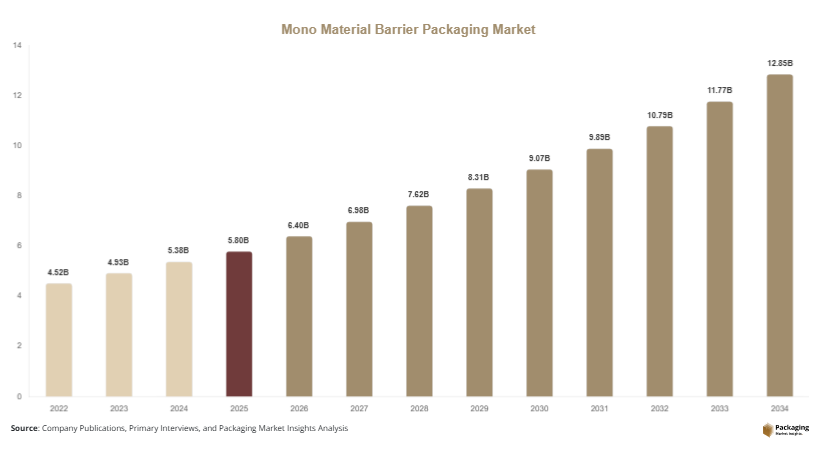
The mono material barrier packaging market is gaining steady traction as industries transition toward recyclable and sustainable packaging solutions. The market size was estimated at USD 5.8 billion in 2025 and is projected to reach approximately USD 6.4 billion in 2026. With increasing regulatory pressure and sustainability commitments from major brands, the market is forecast to expand to USD 13.9 billion by 2034, registering a compound annual growth rate (CAGR) of 9.1% during 2025–2034. This growth reflects a broader shift in the packaging industry toward circular economy principles and reduced material complexity.
Mono material barrier packaging refers to packaging solutions made from a single type of polymer, such as polyethylene (PE) or polypropylene (PP), while still offering high barrier properties against oxygen, moisture, and contaminants. These solutions are designed to simplify recycling processes and improve material recovery rates compared to multi-layer packaging structures. The growing awareness among consumers regarding environmental sustainability and the need for eco-friendly alternatives is driving demand for these solutions across food, beverage, pharmaceutical, and personal care industries.
Key Highlights:
Explore more data points, trends and opportunities Download Free Sample Report
Market Trends
Shift Toward Recyclable Flexible Packaging Solutions
The mono material barrier packaging market is witnessing a growing trend toward recyclable flexible packaging formats. Manufacturers are increasingly replacing multi-layer laminates with mono polymer structures that can be easily processed within existing recycling systems. This shift is supported by improvements in material engineering, allowing single-material films to deliver similar barrier properties as traditional multi-material packaging. Industries such as food and beverage are adopting these solutions to reduce environmental impact while maintaining product shelf life. The trend is further reinforced by global sustainability targets set by major brands aiming for 100% recyclable packaging by the next decade.
Integration of Advanced Barrier Technologies
Another key trend is the integration of advanced barrier technologies into mono material packaging. Companies are investing in innovative coatings, plasma treatments, and nanotechnology to enhance oxygen and moisture resistance without compromising recyclability. These advancements enable mono material packaging to be used for sensitive products such as pharmaceuticals and high-value food items. The trend also reflects the industry's focus on maintaining product integrity while transitioning to sustainable solutions. Continuous research and development activities are expected to further improve performance characteristics, making mono material barrier packaging more competitive with conventional alternatives.
Market Drivers
Increasing Regulatory Pressure for Sustainable Packaging
Government regulations aimed at reducing plastic waste are a major driver of the mono material barrier packaging market. Policies promoting recycling and restricting the use of multi-layer, non-recyclable materials are encouraging manufacturers to adopt mono material solutions. Regulatory frameworks in regions such as Europe and North America are setting clear targets for recyclability and waste reduction, pushing companies to innovate and comply. This regulatory environment not only drives demand but also fosters technological advancements, as companies invest in research to meet compliance requirements while maintaining performance standards.
Growing Consumer Preference for Eco-Friendly Packaging
Consumer awareness regarding environmental issues is significantly influencing packaging choices. End-users increasingly prefer products packaged in recyclable and sustainable materials, prompting brands to adopt mono material barrier packaging. This shift in consumer behavior is particularly evident in the food and beverage and personal care sectors, where packaging plays a crucial role in purchasing decisions. Companies are leveraging sustainable packaging as a differentiating factor in competitive markets. The alignment of consumer preferences with sustainability goals is expected to continue driving market growth over the forecast period.
Market Restraint
Performance Limitations Compared to Multi-Layer Packaging
Despite its advantages, mono material barrier packaging faces challenges related to performance limitations when compared to traditional multi-layer structures. Multi-layer packaging combines different materials to achieve superior barrier properties, making it suitable for highly sensitive products. In contrast, mono material solutions may struggle to match these performance levels, particularly in applications requiring extended shelf life or protection against extreme environmental conditions. This limitation can restrict adoption in certain industries, such as pharmaceuticals and high-value food products.
The industry is actively addressing this challenge through technological innovations, but the cost of advanced coatings and treatments can be high. For example, achieving oxygen barrier performance comparable to multi-layer films often requires specialized coatings, which increase production costs. This creates a trade-off between sustainability and performance, impacting adoption rates. As a result, some manufacturers remain hesitant to transition fully to mono material solutions, especially in price-sensitive markets.
Market Opportunities
Expansion in Emerging Economies
Emerging economies present significant growth opportunities for the mono material barrier packaging market. Rapid urbanization, increasing disposable income, and expanding retail sectors are driving demand for packaged goods in regions such as Asia Pacific and Latin America. As these markets develop, there is a growing emphasis on sustainable practices, creating opportunities for mono material packaging solutions. Governments in these regions are also introducing policies to manage plastic waste, further supporting market growth. Companies entering these markets can benefit from early adoption and establish strong market presence.
Innovation in High-Barrier Mono Materials
Continuous innovation in polymer science and barrier technologies offers substantial opportunities for market expansion. The development of high-barrier mono materials that can match or exceed the performance of multi-layer packaging is a key focus area. Advances in nanotechnology and coating techniques are enabling the production of films with enhanced barrier properties while maintaining recyclability. These innovations open new application areas, including pharmaceuticals and premium food products. Companies investing in research and development are likely to gain a competitive advantage by offering high-performance sustainable solutions.
Report Scope
| Report Metric | Details |
|---|---|
| Market Size in 2025 | USD 5.8 Billion |
| Market Size in 2026 | USD 6.4 Billion |
| Market Size in 2034 | USD 13.9 Billion |
| CAGR | 9.1% (2026-2034) |
| Base Year for Estimation | 2025 |
| Historical Data | 2022-2024 |
| Forecast Period | 2026-2034 |
| Report Coverage | Revenue Forecast, Competitive Landscape, Supply Chain Disruption, Growth Factors, Environment & Regulatory Landscape and Trends |
| Geographies Covered | North America, Europe, APAC, Middle East and Africa, LATAM |
| Countries Covered | U.S., Canada, U.K., Germany, France, Spain, Italy, Russia, Nordic, Benelux, Rest of Europe, China, South Korea, Japan, India, Australia, Singapore, Taiwan, South East Asia, Rest of Asia-Pacific, UAE, Turky, Saudi Arabia, South Africa, Egypt, Nigeria, Rest of MEA, Brazil, Mexico, Argentina, Chile, Colombia, Rest of LATAM |
Explore more data points, trends and opportunities Download Free Sample Report
Segmental Analysis
By Material Type
The polyethylene (PE) segment dominated the mono material barrier packaging market in 2024, accounting for approximately 48% of the market share. PE-based packaging is widely used due to its flexibility, durability, and cost-effectiveness. It is commonly applied in food and beverage packaging, where moisture resistance and lightweight properties are essential. The dominance of PE is also attributed to its compatibility with existing recycling systems, making it a preferred choice for sustainable packaging solutions.
The polypropylene (PP) segment is expected to be the fastest-growing, registering a CAGR of 10.2% during the forecast period. PP offers superior heat resistance and mechanical strength, making it suitable for applications requiring higher durability. The growth of this segment is driven by increasing demand in the pharmaceutical and personal care industries, where packaging must withstand varying environmental conditions while maintaining product integrity.
By Application
The food and beverage segment held the largest market share in 2024, accounting for approximately 52%. This dominance is driven by the need for effective barrier properties to preserve product freshness and extend shelf life. Mono material packaging is increasingly being adopted in this sector to meet sustainability goals while ensuring product safety and quality.
The pharmaceutical segment is expected to grow at the fastest CAGR of 9.8% during the forecast period. The growth is attributed to the increasing demand for safe and sustainable packaging solutions in the healthcare industry. Innovations in barrier technologies are enabling mono material packaging to meet stringent requirements for pharmaceutical applications, driving segment growth.
By End-Use Industry
The food processing industry dominated the market in 2024, with a share of approximately 46%. The demand for packaged and processed food products is increasing globally, driving the adoption of mono material barrier packaging. This segment benefits from the need for efficient packaging solutions that ensure product quality and safety while reducing environmental impact.
The e-commerce segment is projected to grow at the fastest CAGR of 10.8% during the forecast period. The rapid expansion of online retail is increasing demand for lightweight and durable packaging solutions. Mono material packaging offers advantages such as reduced shipping costs and improved recyclability, making it an ideal choice for e-commerce applications.
Mono Material Barrier Packaging Market Segmentations
Material Type
- Polyethylene (PE)
- Polypropylene (PP)
- Others
Application
- Food & Beverage
- Pharmaceuticals
- Personal Care
- Others
End-Use Industry
- Food Processing
- Healthcare
- E-commerce
- Retail
Regional Analysis
North America
The North America mono material barrier packaging market accounted for approximately 28% of the global market share in 2025 and is expected to grow at a CAGR of 8.7% through 2034. The region benefits from well-established recycling infrastructure and strong regulatory frameworks promoting sustainable packaging. Increasing investments by packaging companies in research and development are driving innovation and adoption of mono material solutions across various industries.
The United States dominates the regional market due to its advanced packaging industry and strong presence of major brands. A key growth factor is the rising adoption of sustainable packaging in the food and beverage sector, driven by consumer demand and corporate sustainability goals. Companies are actively transitioning to recyclable packaging formats to enhance brand image and meet regulatory requirements.
Europe
Europe held a market share of around 30% in 2025 and is projected to register a CAGR of 9.3% during the forecast period. The region is at the forefront of sustainability initiatives, with stringent regulations aimed at reducing plastic waste. The European Union’s policies on circular economy and packaging waste management are significantly influencing market growth.
Germany leads the European market due to its strong manufacturing base and focus on environmental sustainability. A unique growth factor is the widespread implementation of extended producer responsibility (EPR) programs, which encourage companies to adopt recyclable packaging solutions. This regulatory environment is accelerating the shift toward mono material barrier packaging.
Asia Pacific
Asia Pacific accounted for approximately 25% of the market share in 2025 and is expected to grow at the fastest CAGR of 10.5% through 2034. The region’s growth is driven by rapid industrialization, urbanization, and increasing demand for packaged goods. Expanding retail and e-commerce sectors are also contributing to market expansion.
China dominates the Asia Pacific market due to its large manufacturing sector and growing focus on sustainability. A key growth factor is government initiatives to reduce plastic waste and promote recycling. These initiatives are encouraging manufacturers to adopt mono material packaging solutions, creating significant growth opportunities.
Middle East & Africa
The Middle East & Africa region held a market share of around 9% in 2025 and is projected to grow at a CAGR of 8.2% during the forecast period. The market is gradually evolving as awareness regarding sustainable packaging increases. Investments in infrastructure and industrial development are supporting market growth.
The United Arab Emirates is a leading country in the region, driven by its focus on sustainability and innovation. A unique growth factor is the increasing adoption of eco-friendly packaging in the hospitality and retail sectors. Government initiatives aimed at reducing plastic waste are also contributing to market expansion.
Latin America
Latin America accounted for approximately 8% of the market share in 2025 and is expected to grow at a CAGR of 8.9% through 2034. The region is experiencing steady growth due to increasing demand for packaged food and beverages. Economic development and urbanization are key drivers of market expansion.
Brazil dominates the regional market due to its large consumer base and growing packaging industry. A key growth factor is the rising awareness of environmental sustainability among consumers and businesses. This is encouraging the adoption of recyclable packaging solutions, including mono material barrier packaging.
Competitive Landscape
The mono material barrier packaging market is moderately competitive, with several global and regional players focusing on innovation and sustainability. Companies are investing in research and development to enhance barrier properties and improve recyclability. Strategic collaborations, mergers, and acquisitions are common strategies used to strengthen market position.
Amcor Plc is considered a leading player in the market, driven by its strong focus on sustainable packaging solutions and extensive product portfolio. The company has recently introduced advanced mono material packaging solutions designed to meet recyclability standards while maintaining high performance. Other key players are also focusing on expanding their product offerings and geographic presence to capture a larger market share.
Key Players List
- Amcor Plc
- Berry Global Inc.
- Mondi Group
- Sealed Air Corporation
- Sonoco Products Company
- Huhtamaki Oyj
- Coveris Holdings S.A.
- Constantia Flexibles
- Uflex Ltd.
- Winpak Ltd.
- Clondalkin Group
- ProAmpac
- Transcontinental Inc.
- Sigma Plastics Group
- Bischof + Klein SE & Co. KG