Premium Packaging Market Size and Growth
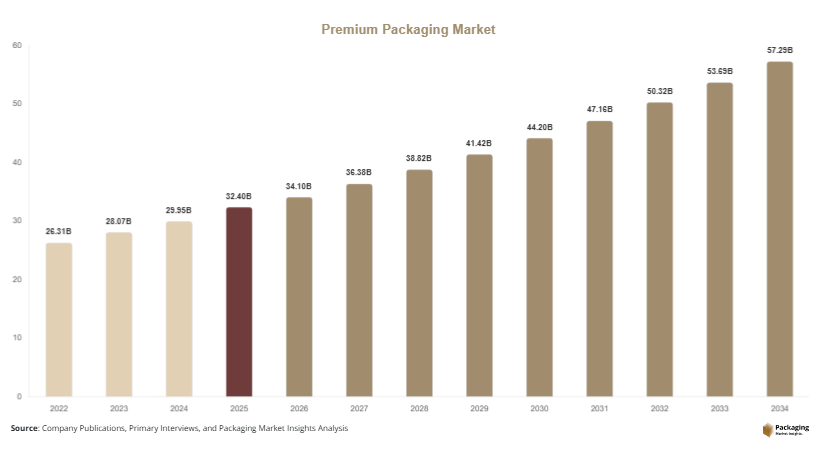
The global premium packaging market size is estimated at USD 32.4 billion in 2025, and it is projected to reach USD 34.1 billion in 2026. By 2034, the market is expected to attain approximately USD 57.8 billion, registering a CAGR of 6.7% during the forecast period (2025–2034). The consistent growth reflects rising demand for aesthetic differentiation, sustainable luxury packaging, and enhanced unboxing experiences in both retail and e-commerce channels. The premium packaging market is expanding steadily as brands across luxury goods, cosmetics, electronics, gourmet food, and high-end beverages increasingly invest in packaging that enhances perceived product value and consumer experience.
One of the key growth factors is the rapid expansion of luxury and premium consumer goods. High-income consumer segments are increasingly valuing packaging as part of brand identity, especially in cosmetics, perfumes, and premium spirits. Another important driver is the growth of e-commerce luxury retail, where packaging plays a crucial role in delivering brand experience digitally. Third, sustainability trends are reshaping material choices, with brands adopting recyclable rigid boxes, biodegradable laminates, and reusable packaging formats without compromising visual appeal.
Key Highlights:
- Asia Pacific dominated the market with a 37.4% share in 2025.
- Latin America is projected to grow at the fastest CAGR of 6.2%.
- Rigid boxes led the type segment with a 29.6% share.
- Paperboard packaging dominated with a 52.3% share.
- Cosmetics & personal care led applications with a 43.1% share.
- The US remained the dominant country, with a market size of USD 5.1 billion in 2025 and USD 5.4 billion in 2026.
Explore more data points, trends and opportunities Download Free Sample Report
Market Trends
Rise of Sustainable Luxury Packaging
Sustainability is becoming a defining trend in the premium packaging market as luxury brands integrate eco-conscious materials into high-end packaging designs. Companies are shifting from traditional plastic-heavy structures to recyclable paperboard, molded fiber, and biodegradable laminates while maintaining premium aesthetics. For example, luxury cosmetics brands are introducing refillable perfume bottles with decorative outer cartons made from FSC-certified paper. This transition is driven by consumer demand for environmentally responsible luxury experiences. In the future, sustainability will not only be a compliance requirement but also a branding strategy, where eco-friendly packaging becomes a symbol of prestige and responsibility.
Growth of Personalized and Digital Printing Technologies
Personalization is transforming premium packaging as brands increasingly adopt digital printing, variable data printing, and customization techniques. This allows companies to create limited-edition packaging, seasonal designs, and customer-specific branding experiences. For instance, premium chocolate brands now offer personalized packaging with names or messages printed on boxes for gifting purposes. The trend is also supported by advancements in AI-driven design tools and short-run production capabilities. In the long term, personalization will strengthen consumer engagement and brand loyalty while enabling companies to differentiate in highly competitive premium product segments.
Market Drivers
Expansion of Luxury Consumer Goods Industry
The growing global demand for luxury goods is a major driver of the premium packaging market. Rising disposable incomes, especially in emerging economies, are increasing consumption of high-end cosmetics, fashion accessories, premium beverages, and gourmet foods. These products rely heavily on packaging to communicate exclusivity and brand value. For example, luxury skincare brands use embossed rigid boxes with magnetic closures to enhance perceived value. As competition intensifies in the luxury sector, companies are investing more in packaging innovation to influence consumer purchasing decisions and strengthen brand positioning.
Increasing Influence of E-commerce Luxury Retail
E-commerce has become a significant growth driver for premium packaging, particularly in luxury fashion, cosmetics, and specialty food delivery. Unlike traditional retail, online luxury purchases depend entirely on packaging to deliver brand experience. High-end unboxing experiences, protective packaging, and visually appealing designs are essential for customer satisfaction. For instance, luxury watch brands now use layered packaging systems with velvet interiors and branded outer cartons for online shipments. The continued expansion of digital luxury retail platforms is expected to further accelerate demand for premium packaging solutions.
Market Restraint
High Cost of Premium Materials and Production Techniques
One of the primary restraints in the premium packaging market is the high cost associated with advanced materials and manufacturing processes. Premium packaging often requires specialized techniques such as embossing, foil stamping, UV coating, and custom structural design, which significantly increase production costs. Additionally, sustainable materials like biodegradable paperboard or molded fiber are often more expensive than conventional plastics. This cost burden can limit adoption among small and mid-sized brands, especially in price-sensitive markets. For example, boutique cosmetic companies may reduce packaging complexity to control costs, which can restrict overall market penetration. Furthermore, fluctuating raw material prices and supply chain disruptions add uncertainty to production planning, impacting profitability for packaging manufacturers.
Market Opportunities
Expansion in Emerging Luxury Markets
Emerging economies present significant opportunities for the premium packaging market as rising middle-class populations adopt luxury consumption habits. Countries in Asia Pacific, Latin America, and the Middle East are witnessing rapid growth in premium retail sectors, including cosmetics, fashion, and gourmet food. Brands entering these markets are increasingly investing in high-quality packaging to establish brand identity and attract aspirational consumers. For example, international perfume brands entering India and Brazil use region-specific premium packaging designs to enhance cultural relevance and consumer engagement. This trend is expected to accelerate demand for localized premium packaging solutions.
Integration of Smart and Interactive Packaging
The integration of smart technologies into premium packaging is creating new opportunities for innovation. Features such as NFC tags, QR codes, and augmented reality experiences are being incorporated into luxury packaging to enhance consumer engagement. For instance, premium wine brands are using smart labels that provide vineyard history and tasting notes when scanned. This not only enhances brand storytelling but also builds authenticity and traceability. As digital interaction becomes a core part of luxury consumption, smart premium packaging is expected to become a key differentiator in the market.
Report Scope
| Report Metric | Details |
|---|---|
| Market Size in 2025 | USD 32.4 Billion |
| Market Size in 2026 | USD 34.1 Billion |
| Market Size in 2034 | USD 57.8 Billion |
| CAGR | 6.7% (2026-2034) |
| Base Year for Estimation | 2025 |
| Historical Data | 2022-2024 |
| Forecast Period | 2026-2034 |
| Report Coverage | Revenue Forecast, Competitive Landscape, Supply Chain Disruption, Growth Factors, Environment & Regulatory Landscape and Trends |
| Geographies Covered | North America, Europe, APAC, Middle East and Africa, LATAM |
| Countries Covered | U.S., Canada, U.K., Germany, France, Spain, Italy, Russia, Nordic, Benelux, Rest of Europe, China, South Korea, Japan, India, Australia, Singapore, Taiwan, South East Asia, Rest of Asia-Pacific, UAE, Turky, Saudi Arabia, South Africa, Egypt, Nigeria, Rest of MEA, Brazil, Mexico, Argentina, Chile, Colombia, Rest of LATAM |
Explore more data points, trends and opportunities Download Free Sample Report
Segmental Analysis
By Type
Rigid boxes dominated the premium packaging market in 2024 with a 31.8% share, primarily due to their widespread use in luxury goods such as perfumes, watches, chocolates, and electronics. These boxes offer structural strength, premium aesthetics, and high customization potential through embossing, magnetic closures, and textured finishes. Luxury brands prefer rigid boxes because they enhance unboxing experiences and reinforce brand identity. For example, premium smartphone brands use rigid packaging with layered compartments and matte finishes to create a high-end perception. Their durability also ensures product protection, which is critical for high-value items.
Flexible premium packaging is expected to be the fastest-growing subsegment with a CAGR of 6.9%, driven by demand for lightweight, cost-efficient, and sustainable packaging formats. Innovations in high-quality flexible films, metallic finishes, and digital printing have enabled flexible packaging to achieve premium appeal. This is particularly evident in gourmet food and premium snack segments, where resealable flexible packs are gaining traction. The shift toward sustainability and reduced material usage further supports growth, as brands look for environmentally efficient yet visually appealing packaging solutions.
By Material
Paperboard dominated the market in 2024 with a 52.1% share, supported by its versatility, printability, and strong alignment with sustainability goals. Paperboard is widely used in luxury cosmetics, fashion accessories, and premium food packaging due to its ability to support complex designs, embossing, and high-resolution printing. Brands like premium chocolate manufacturers and skincare companies rely heavily on paperboard cartons to communicate luxury and environmental responsibility simultaneously.
Bio-based and sustainable materials are expected to be the fastest-growing segment with a CAGR of 7.3%. These materials include molded fiber, biodegradable plastics, and plant-based coatings. The growth is driven by regulatory pressure and consumer demand for eco-friendly packaging. Luxury brands are increasingly adopting compostable packaging for limited-edition product lines, signaling long-term transition toward sustainable premium packaging ecosystems.
By End-Use
Cosmetics & personal care dominated the end-use segment in 2024 with a 44.5% share, as packaging plays a critical role in product differentiation and brand storytelling. Luxury skincare, perfumes, and makeup products rely heavily on visually appealing packaging designs, often incorporating metallic finishes, glass containers, and rigid boxes. The sensory appeal of packaging strongly influences purchase decisions in this segment.
Premium food & beverage is the fastest-growing end-use segment with a CAGR of 6.8%, driven by rising demand for gourmet chocolates, organic snacks, and artisanal beverages. Brands are investing in packaging that combines sustainability with premium aesthetics, such as recyclable cartons and elegant glass bottles with embossed labeling. This segment is expected to grow further with the expansion of gourmet retail chains and online premium food delivery platforms.
Premium Packaging Market Segmentations
By Type
- Rigid Boxes
- Flexible Packaging
- Folding Cartons
- Luxury Labels & Sleeves
By Material
- Paperboard
- Glass
- Metal
- Bio-based & Sustainable Materials
By End-User
- Cosmetics & Personal Care
- Food & Beverage (Premium Segment)
- Luxury Fashion & Accessories
- Electronics & High-End Consumer Goods
Regional Analysis
North America
North America accounted for approximately 28.6% share of the premium packaging market in 2025, with a projected CAGR of 6.2% during 2025–2034. The region’s growth is supported by strong demand for luxury cosmetics, premium beverages, and high-end food products. Consumers in the United States and Canada place high importance on packaging aesthetics and sustainability, driving innovation in material design and structural packaging formats. The region also benefits from advanced printing technologies and strong retail infrastructure, which support premium brand positioning across both offline and online channels.
The United States dominates the North American market due to its large luxury goods sector and high consumer spending power. A unique growth driver is the rapid expansion of direct-to-consumer luxury brands, particularly in cosmetics and wellness products. These brands rely heavily on distinctive packaging to establish identity in digital marketplaces, leading to increased demand for customized rigid boxes and sustainable packaging formats.
Europe
Europe held a 25.4% share in 2025 and is expected to grow at a CAGR of 6.5%. The region is characterized by a strong heritage in luxury fashion, perfumes, and premium beverages. Strict environmental regulations are also shaping the market, pushing companies toward recyclable and reusable packaging solutions. European consumers are highly brand-conscious and value premium packaging as part of product authenticity and luxury experience.
France leads the European market, driven by its dominance in perfumes, fashion, and luxury cosmetics. A key growth factor is the integration of traditional craftsmanship with modern sustainable packaging technologies. French luxury brands are increasingly combining handcrafted packaging elements with eco-friendly materials to maintain heritage appeal while aligning with environmental expectations.
Asia Pacific
Asia Pacific dominated the market with a 37.4% share in 2025, and is projected to grow at a CAGR of 7.4%. Rapid urbanization, rising disposable income, and expanding luxury retail channels are key drivers. Countries like China, India, and Japan are experiencing strong demand for premium cosmetics, packaged foods, and luxury fashion goods. The region is also witnessing rapid growth in e-commerce luxury platforms.
China remains the dominant country due to its large consumer base and expanding high-income population. A unique growth driver is the rapid growth of social commerce platforms, where premium packaging plays a critical role in influencing online purchasing decisions and brand perception.
Middle East & Africa
The Middle East & Africa region accounted for 7.8% share in 2025 and is expected to grow at a CAGR of 6.8%. Growth is driven by strong demand for luxury perfumes, premium confectionery, and high-end retail products. The region has a strong cultural preference for ornate and visually rich packaging designs.
The United Arab Emirates leads the regional market due to its status as a luxury retail hub. A key growth factor is the expansion of tourism-driven retail consumption, where premium packaging is used to enhance gifting culture and luxury purchasing experiences.
Latin America
Latin America held a 5.8% market share in 2025 and is projected to grow at the fastest CAGR of 7.0%. Growth is supported by rising middle-class income and increasing adoption of premium consumer goods. Brazil and Mexico are key markets for cosmetics and premium food packaging.
Brazil dominates the region due to its large consumer base. A unique growth driver is the expansion of premium beauty and personal care brands targeting young urban consumers, driving demand for visually appealing and cost-effective luxury packaging solutions.
Competitive Landscape
The premium packaging market is moderately fragmented, with global and regional players focusing on design innovation, sustainability, and customization capabilities. Key companies include Amcor plc, WestRock Company, DS Smith Plc, Smurfit Kappa Group, and Crown Holdings Inc. Among these, Amcor plc is considered a leading player due to its strong global footprint and extensive sustainable packaging portfolio.
Companies are increasingly investing in digital printing technologies, smart packaging solutions, and eco-friendly materials to strengthen their market position. Strategic collaborations with luxury brands are also common, enabling packaging firms to co-develop customized solutions that enhance brand identity. For example, WestRock has expanded its premium packaging division to cater specifically to cosmetics and luxury retail brands. Similarly, DS Smith focuses on circular economy packaging models, integrating recyclable materials into high-end packaging designs.
Mergers, acquisitions, and R&D investments are key strategies shaping competitive dynamics, with firms aiming to improve design capabilities and expand into emerging luxury markets.
Key Players List
- Amcor plc
- WestRock Company
- DS Smith Plc
- Smurfit Kappa Group
- Crown Holdings Inc.
- Sonoco Products Company
- Huhtamaki Oyj
- Sealed Air Corporation
- Mayr-Melnhof Karton AG
- Ardagh Group
- Stora Enso Oyj
- Mondi Group
- GPA Global
- Rengo Co. Ltd.
- Shanghai Zijiang Enterprise Group