Parchment Paper Market Size
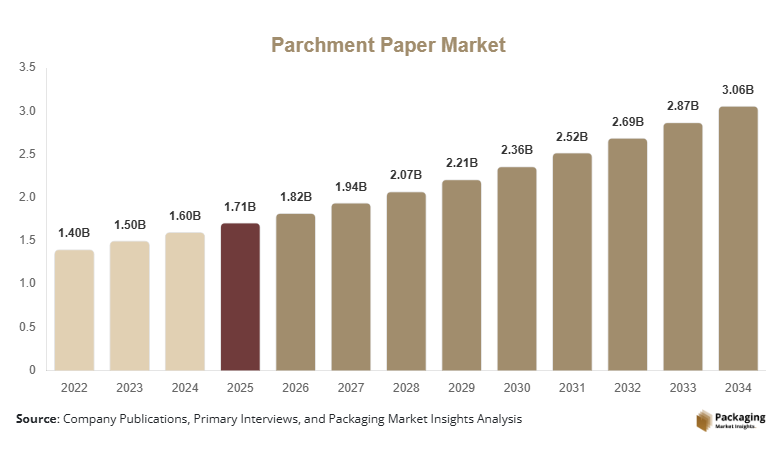
Parchment paper market size is projected at USD 1.82 billion in 2026 and is expected to hit USD 3.05 billion by 2034 with a CAGR of 6.7%. The market analysis evaluates production capacity, material innovations, consumer demand patterns, application expansion, regional performance, and competitive strategies. The study provides detailed segmentation analysis and industry insights covering manufacturers, suppliers, technology developments, and evolving food packaging requirements.
Parchment paper is a cellulose-based specialty paper treated with silicone coating to provide non-stick properties, heat resistance, moisture control, and grease resistance. Global parchment paper production exceeded 2.1 million tons in 2025, with food-related applications accounting for approximately 78% of total consumption. Silicone-coated parchment paper represented nearly 64% of demand, while household baking applications contributed around 52% of overall usage. Growing adoption in commercial bakeries, restaurants, and sustainable food packaging solutions continues strengthening the parchment paper market.
Explore more data points, trends and opportunities Download Free Sample Report
Parchment Paper Market Trends
Rising Demand for Sustainable and Compostable Food Contact Materials
The shift toward eco-friendly packaging alternatives is increasing parchment paper consumption across food and retail industries. Global production exceeded 2.2 million tons in 2026, while sustainable paper-based packaging adoption increased by 24% among food manufacturers. Compostable parchment paper solutions gained approximately 31% adoption in premium food packaging segments, supported by reduced plastic usage and environmental regulations, driving the parchment paper market.
Technological advancements in coating processes, heat-resistant treatments, and recyclable paper structures are transforming parchment paper manufacturing. Advanced silicone coating technologies improved grease resistance by 18%, automated production capacity increased by 21%, and premium baking applications expanded by 16%. Foodservice providers accounted for nearly 45% of new demand due to increased bakery and ready-to-eat food consumption, supporting the Parchment Paper Market.
Parchment Paper Market Drivers
Growing Bakery Industry and Rising Household Cooking Applications
Increasing bakery product consumption and home cooking trends are major factors supporting market expansion. Global bakery production increased by 7.5%, commercial bakery facilities consumed more than 850 thousand tons of parchment paper annually, and household baking adoption increased by 19% across developed markets. The demand for nonstick, heat-resistant, and food-safe materials continues accelerating the parchment paper market.
Parchment Paper Market Restraints
Availability of Alternative Food Packaging Materials
Competition from aluminum foil, coated papers, and reusable baking sheets limits market expansion. Alternative packaging materials captured nearly 28% of baking-related applications, while raw material price fluctuations increased manufacturing costs by 11%. Rising cellulose pulp prices and coating expenses continue creating cost pressure for manufacturers operating in the parchment paper market.
Parchment Paper Market Opportunities
Expansion of Sustainable Packaging and Food Delivery Services
Growth in food delivery, premium bakery products, and sustainable packaging solutions creates new opportunities. Online food delivery packaging demand increased by 22%, sustainable food contact material adoption exceeded 42%, and specialty parchment paper production expanded by 18%. Manufacturers investing in recyclable and biodegradable solutions are expected to gain opportunities within the parchment paper market.
Challenges in Parchment Paper Market
Raw Material Supply Constraints and Manufacturing Cost Pressure
The industry faces challenges from fluctuations in wood pulp availability, energy costs, and coating material prices. Pulp price volatility reached 14%, manufacturing expenses increased by 9%, and supply chain disruptions affected approximately 15% of producers. Maintaining consistent quality while managing production costs remains a key challenge for the parchment paper market.
Report Scope
| Report Metric | Details |
|---|---|
| Market Size in 2025 | USD 1.71 Billion |
| Market Size in 2026 | USD 1.82 Billion |
| Market Size in 2034 | USD 3.05 Billion |
| CAGR | 6.7% (2026-2034) |
| Base Year for Estimation | 2025 |
| Historical Data | 2022-2024 |
| Forecast Period | 2026-2034 |
| Report Coverage | Revenue Forecast, Competitive Landscape, Supply Chain Disruption, Growth Factors, Environment & Regulatory Landscape and Trends |
| Geographies Covered | North America, Europe, APAC, Middle East and Africa, LATAM |
| Countries Covered | U.S., Canada, U.K., Germany, France, Spain, Italy, Russia, Nordic, Benelux, Rest of Europe, China, South Korea, Japan, India, Australia, Singapore, Taiwan, South East Asia, Rest of Asia-Pacific, UAE, Turkey, Saudi Arabia, South Africa, Egypt, Nigeria, Rest of MEA, Brazil, Mexico, Argentina, Chile, Colombia, Rest of LATAM |
Explore more data points, trends and opportunities Download Free Sample Report
Parchment Paper Market Segmentation
The market is segmented by type and application, with silicone-coated parchment paper dominating approximately 64% of demand due to superior non-stick performance and temperature resistance. Baking and cooking applications accounted for nearly 52% market contribution, followed by food packaging at 34% and industrial applications at 14%.
By Type
Bleached parchment paper accounted for approximately 22% of market demand with annual production exceeding 460 thousand tons. It provides high brightness, smooth surface quality, and improved printing performance. The segment is widely used in premium baking products and food presentation applications.
Unbleached parchment paper represented nearly a 14% market share with production exceeding 290 thousand tons. Increasing preference for natural-looking packaging has expanded adoption among organic food brands. These products provide natural fiber appearance and maintain food-contact safety standards.
Silicone-coated parchment paper dominated with approximately 64% share and production exceeding 1.35 million tons annually. The product offers heat resistance up to 220°C–250°C, grease resistance, moisture protection, and non-stick properties, making it preferred for baking and food processing applications.
By Application
Baking and cooking applications represented approximately 52% of market demand with consumption exceeding 1.1 million tons annually. Bakeries, restaurants, confectionery manufacturers, and households use parchment paper for cakes, pastries, cookies, and roasting applications due to its heat resistance and easy release properties.
Food packaging accounted for nearly 34% share with production exceeding 720 thousand tons. Parchment paper is utilized for bakery wrapping, fast-food packaging, sandwich wraps, and grease-resistant food containers. Adoption among sustainable packaging users exceeded 43% due to reduced plastic dependency.
Industrial Applications
Industrial applications contributed around a 14% share with consumption exceeding 300 thousand tons. The segment includes electrical insulation, manufacturing processes, and specialized applications requiring heat resistance, moisture protection, and controlled release properties.
Parchment Paper Market Segmentations
Type
- Bleached Parchment Paper
- Unbleached Parchment Paper
- Silicone Coated Parchment Paper
Application
- Baking & Cooking
- Food Packaging
- Industrial Applications
Parchment Paper Market Regional Outlook
North America
North America accounted for approximately 32% of global market revenue, producing more than 670 thousand tons annually. The United States contributed nearly 82% of regional demand due to strong bakery industries, foodservice expansion, and household baking trends.
Europe
Europe represented approximately 34% market share, with production exceeding 710 thousand tons. Germany, France, Italy, and the United Kingdom contributed more than 73% of regional consumption. Sustainable packaging regulations and premium bakery demand support market development.
Asia-Pacific
The Asia-Pacific held nearly a 25% share, with production exceeding 520 thousand tons. China contributed around 45% of regional output, followed by India at 20%, Japan at 13%, and South Korea at 8%. Rising urbanization, food delivery growth, and bakery industry expansion support regional demand.
Latin America
Latin America contributed approximately 6% of global consumption. Brazil represented nearly 48% of regional demand, followed by Mexico at 28%, supported by expanding food processing and retail bakery sectors.
Middle East & Africa
The Middle East & Africa accounted for approximately 3% of global demand. Saudi Arabia, the UAE, South Africa, and Egypt are increasing parchment paper usage through growing hospitality, bakery, and packaged food industries.
Top Players In The Parchment Paper Market
- Ahlstrom-Munksjö Oyj
- Metsä Tissue Corporation
- Nordic Paper Holding AB,
- Krpa Holding CZ,
- Delfort Group AG,
- Expera Specialty Solutions,
- Dispapali S.r.l.,
- Paterson Pacific Parchment Company,
- Qingdao Dehong Paper Co., Ltd.,
- AMOL Paper Mills Pvt. Ltd.
Ahlstrom-Munksjö Oyj holds an estimated 18% market share globally. Maintains leadership through advanced specialty paper manufacturing, sustainable cellulose solutions, and high-performance parchment paper technologies. The company provides grease-resistant, heat-resistant, and food-safe paper solutions for bakery, food packaging, and industrial applications. Continuous investments in renewable materials and coating technologies strengthen its position in the global parchment paper market. Metsä Tissue Corporation accounts for approximately 12% market share. Strengthens its position through sustainable tissue and specialty paper production capabilities, renewable fiber sourcing, and advanced manufacturing processes. The company focuses on environmentally responsible parchment solutions, efficient production systems, and customized food-grade paper products serving household and commercial users worldwide.