Paperboard Tray Market Size
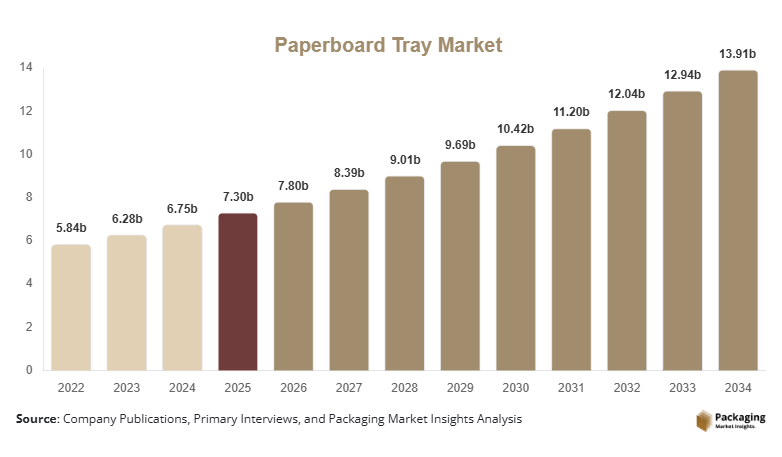
Paperboard Tray market size is projected at USD 7.8 billion in 2026 and is expected to hit USD 13.9 billion by 2034 with a CAGR of 7.5%. Increasing adoption of sustainable packaging solutions, regulatory restrictions on single-use plastics, and growing demand from foodservice industries are supporting market expansion. Detailed segmentation by product type and application, together with competitive benchmarking and production analysis, provides comprehensive insights into the industry landscape.
The Paperboard Tray market comprises molded and folding paperboard trays manufactured from virgin fibers, recycled fibers, and coated paperboard for packaging food, consumer products, and healthcare items. Global production exceeded 56.4 billion trays in 2025, with food packaging accounting for nearly 63% of total demand, retail packaging contributing 22%, and healthcare packaging representing approximately 9%. Sustainable paperboard packaging penetration surpassed 48% across developed economies, while recycled fiber utilization exceeded 58%, reinforcing the Paperboard Tray market.
Explore more data points, trends and opportunities Download Free Sample Report
Paperboard Tray Market Trends
Growing Adoption of Sustainable Fiber-Based Packaging
Manufacturers are increasing investments in recyclable and compostable paperboard tray production to meet environmental regulations and consumer preferences. Annual production of recyclable paperboard trays surpassed 37 billion units in 2025, while compostable coating adoption increased by 27% year-over-year. Water-based barrier coatings now account for nearly 35% of newly introduced tray products, strengthening the Paperboard Tray market.
Automation and digital converting technologies continue transforming production efficiency across packaging facilities. More than 620 manufacturing plants globally upgraded high-speed die-cutting and thermoforming equipment during 2025, improving production output by 18% while reducing material waste by 14%. Smart quality inspection systems have increased defect detection rates above 96%, supporting the Paperboard Tray market.
Paperboard Tray Drivers
Increasing Demand for Eco-Friendly Food Packaging Solutions
Food delivery, ready-to-eat meals, and fresh produce packaging continue generating strong demand for paperboard trays. More than 31 billion food trays were consumed globally during 2025, while sustainable food packaging adoption increased by 21%. Government regulations restricting plastic packaging across over 80 countries continue accelerating the Paperboard Tray market.
Paperboard Tray Restraints
Limited Moisture Resistance Compared to Plastic Alternatives
Traditional paperboard trays remain susceptible to moisture and grease without specialty coatings. Barrier-coated products can increase manufacturing costs by 12%–18%, while high-performance laminated grades cost nearly 20% more than conventional paperboard. These pricing challenges affect adoption across cost-sensitive applications.
Paperboard Tray Opportunities
Expansion of Circular Packaging and Recycled Fiber Utilization
Recycled paperboard production exceeded 190 million tons globally during 2025, creating favorable opportunities for tray manufacturers. Brand owners targeting 100% recyclable packaging and recycled content above 50% are driving investments exceeding USD 3.4 billion in sustainable paper packaging technologies, creating new opportunities across the Paperboard Tray market.
Challenges in Paperboard Tray
Maintaining Barrier Performance While Preserving Recyclability
Manufacturers must balance grease resistance, moisture protection, and recyclability. High-barrier coatings require precise application thickness between 8–20 microns, while maintaining recycling recovery rates above 90%. Continuous innovation and compliance with food-contact regulations increase product development costs by approximately 11%.
Report Scope
| Report Metric | Details |
|---|---|
| Market Size in 2025 | USD 7.3 billion |
| Market Size in 2026 | USD 7.8 billion |
| Market Size in 2034 | USD 13.9 billion |
| CAGR | 7.5% (2026-2034) |
| Base Year for Estimation | 2025 |
| Historical Data | 2022-2024 |
| Forecast Period | 2026-2034 |
| Report Coverage | Revenue Forecast, Competitive Landscape, Supply Chain Disruption, Growth Factors, Environment & Regulatory Landscape and Trends |
| Geographies Covered | North America, Europe, APAC, Middle East and Africa, LATAM |
| Countries Covered | U.S., Canada, U.K., Germany, France, Spain, Italy, Russia, Nordic, Benelux, Rest of Europe, China, South Korea, Japan, India, Australia, Singapore, Taiwan, South East Asia, Rest of Asia-Pacific, UAE, Turky, Saudi Arabia, South Africa, Egypt, Nigeria, Rest of MEA, Brazil, Mexico, Argentina, Chile, Colombia, Rest of LATAM |
Explore more data points, trends and opportunities Download Free Sample Report
Paperboard Tray Market Segmentation
The market is segmented by product type and application, with Virgin Paperboard Trays accounting for approximately 44% of industry demand, while Food Packaging remains the largest application with nearly 63% market share.
By Type
Virgin Paperboard Trays
Virgin paperboard trays contribute around 44% of market demand with annual production exceeding 24 billion units. They provide superior stiffness, food safety compliance, and high printability, making them suitable for premium food and retail packaging applications.
Recycled Paperboard Trays
Holding nearly 36% market share, recycled paperboard trays exceeded 20 billion units in annual production. These trays reduce carbon emissions by up to 35% compared with virgin alternatives while supporting circular packaging initiatives.
Coated Paperboard Trays
Coated paperboard trays account for approximately 20% of demand with production exceeding 11 billion units annually. Water-based, bio-based, and dispersion coatings improve grease and moisture resistance while maintaining recyclability for food packaging.
By Application
Food Packaging
Food packaging dominates with approximately 63% market share and annual consumption exceeding 35 billion units. Applications include fresh produce, meat, bakery products, ready meals, and takeaway packaging requiring food-grade compliance and enhanced barrier performance.
Retail Packaging
Retail packaging contributes around 22% of total demand with production exceeding 12 billion units annually. Paperboard trays are widely used for electronics, cosmetics, and household products owing to their lightweight construction and premium presentation.
Healthcare Packaging
Healthcare packaging represents nearly 9% of the market and consumes over 5 billion units annually. Paperboard trays support pharmaceutical products, medical devices, and diagnostic kits while offering organized product protection and sustainable packaging alternatives.
Paperboard Tray Market Segmentations
Type
- Virgin Paperboard Trays
- Recycled Paperboard Trays
- Coated Paperboard Trays
Application
- Food Packaging
- Retail Packaging
- Healthcare Packaging
Paperboard Tray Regional Outlook
North America
North America accounts for approximately 29% of global demand, supported by production exceeding 15 billion trays annually. The United States contributes nearly 84% of regional consumption, driven by foodservice packaging and retail applications.
Europe
Europe represents around 33% of global demand due to stringent sustainability regulations. Germany, France, Italy, and the United Kingdom collectively contribute more than 65% of regional production, supported by advanced paper recycling infrastructure.
Asia-Pacific
Asia-Pacific holds approximately 31% market share, led by China, Japan, India, and South Korea. Regional production exceeded 18 billion trays during 2025, supported by expanding packaged food industries and increasing investments in fiber-based packaging.
Middle East & Africa and South America
These regions collectively account for nearly 7% of global demand. Brazil, Saudi Arabia, the UAE, and South Africa continue increasing food processing capacity and sustainable packaging adoption, supporting steady market expansion.
Top players in Paperboard Tray
- Huhtamaki Oyj
- Stora Enso Oyj
- WestRock Company
- Graphic Packaging International LLC
- Mondi plc
- DS Smith Plc
- Smurfit Westrock plc
- Sonoco Products Company
- Mayr-Melnhof Karton AG
- Pactiv Evergreen Inc.
- UFP Technologies Inc.
- Genpak LLC
Huhtamaki Oyj
-
Estimated market share: 12%–14%
-
Global leader in sustainable food packaging and fiber-based tray solutions.
-
Extensive manufacturing footprint across Europe, Asia-Pacific, and North America.
-
Strong investments in recyclable barrier technologies and molded fiber innovations position the company among the industry's leading suppliers.
WestRock Company
-
Estimated market share: 10%–12%
-
Major supplier of paperboard packaging solutions serving foodservice, retail, and healthcare industries.
-
Advanced converting capabilities and integrated paperboard production enhance manufacturing efficiency.
-
Continuous investment in sustainable packaging innovation and recycled fiber utilization strengthens its competitive position across global markets.