Paper Napkin Converting Lines Market Size
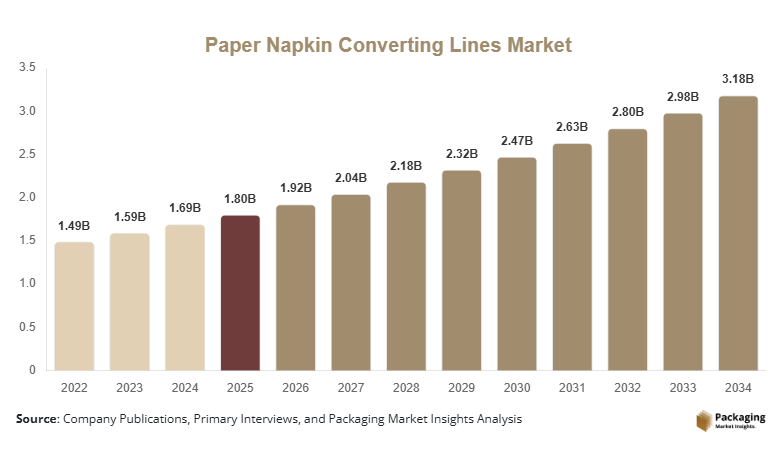
Paper Napkin Converting Lines Market size is projected at USD 1.92 billion in 2026 and is expected to hit USD 3.18 billion by 2034 with a CAGR of 6.5%. Growing investments in tissue converting automation, production efficiency, and sustainable manufacturing continue to strengthen market expansion. The report evaluates production capacity, technology adoption, segmentation analysis, competitive landscape, and regional manufacturing developments to provide a comprehensive assessment of industry performance.
Paper napkin converting lines are integrated production systems that convert tissue parent rolls into finished folded napkins through embossing, printing, folding, cutting, stacking, and packaging processes. Global production capacity exceeded 9,800 converting lines during 2025, producing more than 1.45 trillion paper napkins annually. Automatic equipment accounted for approximately 61% of installed systems, while commercial tissue manufacturers contributed nearly 56% of total equipment demand. Automation penetration surpassed 69% among large-scale manufacturers, reinforcing the paper napkin converting lines market.
Explore more data points, trends and opportunities Download Free Sample Report
Paper Napkin Converting Lines Market Trends
Adoption of High-Speed Intelligent Converting Systems
Manufacturers continue upgrading production facilities with servo-driven automation, digital monitoring, and energy-efficient converting equipment. More than 2,300 high-speed converting lines were installed globally during 2025, with operating speeds exceeding 1,600 napkins per minute. Smart control systems improved production efficiency by 18%, while automated defect detection achieved adoption of nearly 42%, supporting continuous modernization across the paper napkin converting lines market.
Increasing demand for customized printed napkins and environmentally sustainable tissue products is accelerating investment in flexible converting technologies. Digital printing installations expanded by 24%, recycled tissue utilization exceeded 37%, and production of premium embossed napkins increased by 15% year-over-year. Multi-size converting systems now represent approximately 46% of new equipment installations, strengthening the paper napkin converting lines market.
Paper Napkin Converting Lines Market Drivers
Growing Consumption of Tissue Products Across Commercial and Household Sectors
Expanding hospitality, food service, healthcare, and retail industries continue to drive demand for advanced tissue converting machinery. Global tissue consumption increased by 6.8%, hospitality demand expanded by 11%, commercial foodservice establishments accounted for 39% of equipment purchases, and automated production improved manufacturing throughput by 22%, supporting the paper napkin converting lines market.
Paper Napkin Converting Lines Market Restraints
High Capital Investment and Equipment Maintenance Costs
Advanced converting lines require significant investment in automation, printing, embossing, and packaging technologies. Initial installation costs increased by 12%, maintenance expenditures rose 8%, skilled labor shortages affected 21% of manufacturers, and spare parts expenses increased by 10%, creating operational constraints within the paper napkin converting lines market.
Paper Napkin Converting Lines Market Opportunities
Expansion of Sustainable Tissue Manufacturing and Private Label Production
Growing consumer preference for eco-friendly tissue products and expanding retail private labels create new opportunities for equipment suppliers. Recycled fiber utilization increased by 27%, private-label tissue production expanded by 19%, energy-efficient machinery adoption reached 44%, and export-oriented converting facilities increased by 14%, accelerating innovation throughout the paper napkin converting lines market.
Challenges in Paper Napkin Converting Lines Market
Raw Material Price Volatility and Supply Chain Disruptions
Fluctuating pulp prices, transportation costs, and electronic component shortages continue affecting machinery manufacturing. Tissue pulp prices fluctuated by 15%; logistics expenses increased 9%; electronic component lead times expanded by 18%; and production scheduling delays impacted approximately 16% of equipment manufacturers operating in the paper napkin converting lines market.
Report Scope
| Report Metric | Details |
|---|---|
| Market Size in 2025 | USD 1.80 Billion |
| Market Size in 2026 | USD 1.92 Billion |
| Market Size in 2034 | USD 3.18 Billion |
| CAGR | 6.5% (2026-2034) |
| Base Year for Estimation | 2025 |
| Historical Data | 2022-2024 |
| Forecast Period | 2026-2034 |
| Report Coverage | Revenue Forecast, Competitive Landscape, Supply Chain Disruption, Growth Factors, Environment & Regulatory Landscape and Trends |
| Geographies Covered | North America, Europe, APAC, Middle East and Africa, LATAM |
| Countries Covered | U.S., Canada, U.K., Germany, France, Spain, Italy, Russia, Nordic, Benelux, Rest of Europe, China, South Korea, Japan, India, Australia, Singapore, Taiwan, South East Asia, Rest of Asia-Pacific, UAE, Turky, Saudi Arabia, South Africa, Egypt, Nigeria, Rest of MEA, Brazil, Mexico, Argentina, Chile, Colombia, Rest of LATAM |
Explore more data points, trends and opportunities Download Free Sample Report
Paper Napkin Converting Lines Market Segmentation
The market is segmented by type and application, with automatic converting lines accounting for approximately 61% of equipment installations owing to higher production efficiency and reduced labor requirements. Household tissue manufacturing represented nearly 48% of total equipment demand, followed by commercial tissue manufacturing at 34% and private label production at 18%.
By Type
Automatic converting lines represented approximately 61% of market demand with more than 5,900 installed systems worldwide. These systems operate at speeds exceeding 1,600 napkins per minute, integrate servo controls, automatic stacking, and digital monitoring, and minimize material waste below 3%.
Semi-automatic converting lines accounted for nearly 27% of installations with over 2,600 production systems. They provide flexible production capacities ranging from 500 to 1,000 napkins per minute, making them suitable for medium-sized tissue manufacturers requiring lower capital investment.
Manual converting lines contributed around 12% of total installations with approximately 1,300 systems. These machines primarily serve small manufacturers, specialty tissue producers, and emerging markets while delivering economical production for limited-volume applications.
By Application
Household tissue manufacturing held approximately 48% of market demand and utilized more than 4,700 converting lines globally. High-volume production, multiple folding configurations, premium embossing, and printed napkin manufacturing continue supporting this application.
Commercial tissue manufacturing represented approximately 34% of total installations with annual production exceeding 490 billion napkins. Hotels, restaurants, healthcare facilities, airlines, and institutional catering services require consistent quality, hygiene compliance, and high-speed production.
Private label production accounted for nearly 18% of market demand while exceeding 260 billion napkins annually. Retail chains increasingly invest in customized converting lines capable of rapid product changeovers, digital printing, and flexible packaging configurations.
Paper Napkin Converting Lines Market Segmentations
Automatic Converting Lines
A PHP Error was encountered
Severity: Notice
Message: Undefined offset: 0
Filename: reportpages/rd.php
Line Number: 435
Backtrace:
File: /var/www/packagingintel/application/views/frontend/reportpages/rd.php
Line: 435
Function: _error_handler
File: /var/www/packagingintel/application/controllers/FrontendReportController.php
Line: 484
Function: view
File: /var/www/packagingintel/index.php
Line: 315
Function: require_once
Semi-Automatic Converting Lines
A PHP Error was encountered
Severity: Notice
Message: Undefined offset: 1
Filename: reportpages/rd.php
Line Number: 435
Backtrace:
File: /var/www/packagingintel/application/views/frontend/reportpages/rd.php
Line: 435
Function: _error_handler
File: /var/www/packagingintel/application/controllers/FrontendReportController.php
Line: 484
Function: view
File: /var/www/packagingintel/index.php
Line: 315
Function: require_once
Manual Converting Lines
A PHP Error was encountered
Severity: Notice
Message: Undefined offset: 2
Filename: reportpages/rd.php
Line Number: 435
Backtrace:
File: /var/www/packagingintel/application/views/frontend/reportpages/rd.php
Line: 435
Function: _error_handler
File: /var/www/packagingintel/application/controllers/FrontendReportController.php
Line: 484
Function: view
File: /var/www/packagingintel/index.php
Line: 315
Function: require_once
Paper Napkin Converting Lines Market Regional Outlook
North America
North America accounted for approximately 31% of global revenue with more than 2,700 converting lines in operation. The United States contributed nearly 82% of regional equipment demand, supported by advanced automation and premium tissue production.
Europe
Europe represented approximately 34% of the market and operated more than 3,100 converting systems. Italy, Germany, France, and the United Kingdom collectively contributed over 74% of regional manufacturing, supported by strong machinery exports and sustainable production technologies.
Asia-Pacific
Asia-Pacific held nearly 28% of global demand with over 2,800 installed converting lines. China accounted for 45% of regional production capacity, followed by India at 20%, Japan at 13%, and South Korea at 8% due to expanding tissue consumption and manufacturing investments.
Latin America
Latin America contributed approximately 4% of total market revenue. Brazil represented nearly 49% of regional demand, followed by Mexico at 27%, driven by growing foodservice and hospitality sectors.
Middle East & Africa
The Middle East & Africa accounted for approximately 3% of global installations. Saudi Arabia, the UAE, South Africa, and Egypt continue to invest in modern tissue-converting facilities to meet increasing regional consumption.
Top Players In The Paper Napkin Converting Lines Market
- Körber AG (Tissue Business),
- Futura S.p.A.,
- Maflex S.r.l.,
- OMET S.r.l.,
- Baosuo Paper Machinery Manufacture Co., Ltd.,
- Winkler+Dünnebier GmbH
- Jori Machine Co., Ltd.
- Finetech Tissue Machines
- Delta Paper Machine
- Beston Group
- A.Celli Paper S.p.A.,
- Hobema Machine Factory
Körber AG (Tissue Business) estimated global market share of approximately 16%. Maintains leadership through high-speed converting technologies, integrated digital automation, advanced embossing solutions, complete production line offerings, extensive global service networks, and continuous investment in sustainable tissue converting equipment. The company serves major tissue manufacturers with intelligent production systems designed for high productivity, low waste generation, predictive maintenance, and flexible product customization across global manufacturing facilities. Futura S.p.A. Estimated global market share of approximately 11%. Recognized for innovative automatic converting lines, energy-efficient production technologies, modular equipment architecture, and advanced digital control systems. The company focuses on high-capacity tissue production, rapid changeover capabilities, reduced operating costs, improved line efficiency, and customized converting solutions supporting premium tissue manufacturers and private-label production facilities across multiple international markets.