Oxo Biodegradable Bag Market Size and Growth
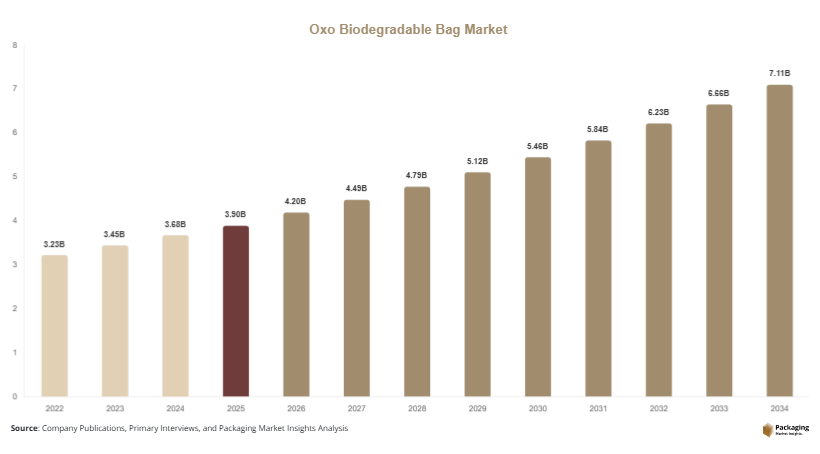
The global oxo biodegradable bag market was valued at USD 3.9 billion in 2025 and is projected to reach USD 4.2 billion in 2026. By 2034, the market is expected to attain approximately USD 7.1 billion, registering a CAGR of 6.8% during the forecast period (2025–2034). Market expansion is being driven by increasing regulatory pressure to reduce plastic waste, growing consumer awareness regarding sustainable packaging solutions, and rising adoption of environmentally responsible materials by retailers and commercial establishments.
The oxo biodegradable bag market is experiencing notable growth as governments, retailers, manufacturers, and consumers seek alternatives to conventional plastic bags. Oxo biodegradable bags are produced using conventional polymer materials combined with pro-degradant additives that accelerate oxidation and fragmentation when exposed to oxygen, heat, and ultraviolet light. These bags are widely used across retail, food service, waste management, agriculture, and industrial applications due to their convenience, durability, and relatively lower environmental impact compared to traditional plastic bags.
Key Market Highlights
- Asia Pacific dominated the market with a 39.8% share in 2025.
- Latin America is projected to grow at the fastest CAGR of 7.4%.
- T-shirt bags led the type segment with a 34.2% share.
- Polyethylene-based oxo biodegradable materials dominated with a 61.5% share.
- Retail applications led the market with a 42.7% share.
- The US remained the dominant country with a market size of USD 0.78 billion in 2025 and USD 0.83 billion in 2026.
Explore more data points, trends and opportunities Download Free Sample Report
Market Trends
Increasing Integration of Sustainable Retail Packaging Programs
Retailers across developed and emerging economies are increasingly integrating oxo biodegradable bags into broader sustainability programs. Large supermarket chains, convenience stores, and fashion retailers are replacing conventional single-use plastic bags with alternatives designed to reduce long-term environmental impact. This trend is being supported by consumer demand for environmentally responsible shopping experiences and retailer commitments to waste reduction targets. For example, several regional grocery chains have introduced oxo biodegradable checkout bags as part of sustainability initiatives aimed at reducing plastic waste. Looking forward, the trend is expected to encourage greater investment in advanced biodegradable formulations, helping retailers meet environmental objectives while maintaining packaging performance and affordability.
Technological Improvements in Oxo Biodegradable Additives
Manufacturers are investing heavily in additive technologies that improve degradation efficiency without compromising product strength. New additive systems are designed to enhance oxidation processes under specific environmental conditions while maintaining shelf life and durability during use. Industry participants are also developing formulations tailored to regional climate conditions and regulatory requirements. For example, packaging suppliers are introducing additive-enhanced bags that offer improved performance for retail and waste management applications. Future advancements in additive chemistry are expected to increase product acceptance, expand application areas, and support market growth by addressing concerns regarding degradation timelines and environmental compatibility.
Market Drivers
Growing Government Regulations on Plastic Waste Reduction
Government initiatives aimed at reducing plastic waste are a major driver of the oxo biodegradable bag market. Many countries have introduced restrictions, taxes, or bans on conventional plastic bags, encouraging businesses to adopt environmentally responsible alternatives. As regulations become stricter, retailers and packaging users increasingly seek solutions that align with sustainability objectives. For example, municipalities and retail associations have implemented programs promoting biodegradable shopping bags to reduce landfill waste. This regulatory pressure creates consistent demand for oxo biodegradable bags and encourages manufacturers to invest in product innovation. The cause-and-effect relationship between legislation and alternative packaging adoption continues to strengthen market growth worldwide.
Rising Consumer Awareness of Environmental Sustainability
Consumers are becoming more conscious of the environmental impact associated with traditional plastic products. This shift in consumer behavior is influencing purchasing decisions and encouraging businesses to adopt sustainable packaging solutions. Retailers using biodegradable bags often leverage sustainability messaging to strengthen brand perception and customer loyalty. For example, food retailers and supermarkets increasingly promote eco-friendly packaging initiatives as part of broader environmental commitments. As environmental education and awareness campaigns continue expanding globally, demand for biodegradable bag solutions is expected to rise across both commercial and residential applications.
Market Restraint
Regulatory Uncertainty and Debate Regarding Environmental Performance
One of the key restraints affecting the oxo biodegradable bag market is the ongoing regulatory debate regarding the environmental effectiveness of oxo biodegradable materials. Different regions maintain varying standards and policies regarding biodegradability, compostability, and plastic degradation technologies. This inconsistency creates uncertainty for manufacturers and end users, potentially limiting adoption in certain markets.
The issue also affects investment decisions and product development strategies. Some environmental organizations and regulatory bodies continue evaluating the long-term environmental impact of oxo biodegradable plastics, leading to policy changes in specific regions. For example, manufacturers may face challenges when exporting products to markets with differing biodegradability requirements. Compliance costs, testing requirements, and certification processes can further increase operational complexity. As a result, market participants must continuously adapt product formulations and regulatory strategies to remain competitive while addressing evolving environmental expectations.
Market Opportunities
Expansion of Waste Collection and Municipal Applications
Municipal waste management programs present a significant opportunity for oxo biodegradable bag manufacturers. Local governments increasingly seek waste collection solutions that support environmental objectives while remaining cost-effective. Oxo biodegradable garbage bags and waste liners offer practical benefits for residential and commercial waste handling operations. Several municipalities are exploring biodegradable alternatives to conventional waste bags as part of broader sustainability programs. Future opportunities are expected to emerge from urbanization trends, expanding waste management infrastructure, and increasing investment in environmentally responsible public services.
Growth of Emerging Retail Markets
Emerging economies offer considerable growth opportunities for the oxo biodegradable bag market. Rapid urbanization, retail modernization, and rising consumer spending are increasing demand for shopping bags and packaging solutions. Retail chains entering developing markets often prioritize sustainable packaging initiatives to align with global corporate objectives. For example, supermarkets and convenience stores in Southeast Asia, Latin America, and parts of Africa are increasingly introducing biodegradable bag options. As retail networks continue expanding and environmental awareness improves, demand for oxo biodegradable bags is expected to accelerate significantly across these regions.
Report Scope
| Report Metric | Details |
|---|---|
| Market Size in 2025 | USD 3.9 Billion |
| Market Size in 2026 | USD 4.2 Billion |
| Market Size in 2034 | USD 7.1 Billion |
| CAGR | 6.8% (2026-2034) |
| Base Year for Estimation | 2025 |
| Historical Data | 2022-2024 |
| Forecast Period | 2026-2034 |
| Report Coverage | Revenue Forecast, Competitive Landscape, Supply Chain Disruption, Growth Factors, Environment & Regulatory Landscape and Trends |
| Geographies Covered | North America, Europe, APAC, Middle East and Africa, LATAM |
| Countries Covered | U.S., Canada, U.K., Germany, France, Spain, Italy, Russia, Nordic, Benelux, Rest of Europe, China, South Korea, Japan, India, Australia, Singapore, Taiwan, South East Asia, Rest of Asia-Pacific, UAE, Turky, Saudi Arabia, South Africa, Egypt, Nigeria, Rest of MEA, Brazil, Mexico, Argentina, Chile, Colombia, Rest of LATAM |
Explore more data points, trends and opportunities Download Free Sample Report
Segmental Analysis
By Type
T-shirt bags dominated the oxo biodegradable bag market in 2024, accounting for approximately 34.2% of total revenue. These bags are widely used in supermarkets, convenience stores, pharmacies, and retail outlets due to their practicality and cost-effectiveness. Their lightweight design, carrying capacity, and ease of storage make them the preferred packaging solution across numerous commercial applications. Retailers benefit from their affordability while consumers appreciate their convenience for everyday purchases. Industry examples include grocery chains and local retailers that distribute millions of T-shirt bags annually. Continued demand from organized retail and expanding consumer markets supports the segment's leading position across global regions.
Garbage bags are projected to be the fastest-growing type segment, registering a CAGR of 7.6% through 2034. Growth is being driven by increasing demand from residential, commercial, and municipal waste management sectors. Urbanization and population growth continue generating larger volumes of waste, creating demand for environmentally responsible waste disposal solutions. Manufacturers are developing stronger biodegradable garbage bags capable of handling heavy waste loads while maintaining degradation performance. Future opportunities are expected to emerge from municipal sustainability programs, expanding waste collection infrastructure, and increasing adoption of biodegradable products by businesses and households.
By Material
Polyethylene-based oxo biodegradable materials held the largest market share of approximately 61.5% in 2024. These materials remain widely utilized because they offer favorable mechanical properties, durability, flexibility, and cost efficiency. Polyethylene-based bags are suitable for a broad range of applications including retail shopping, food packaging, and waste collection. Packaging manufacturers continue refining additive technologies to enhance degradation performance while preserving strength and usability. Industry examples include supermarket checkout bags and commercial packaging products that rely on polyethylene formulations for consistent performance and large-scale production efficiency.
Recycled polymer blends are expected to witness the fastest growth, expanding at a CAGR of 7.8% during the forecast period. Rising sustainability objectives are encouraging manufacturers to combine recycled content with oxo biodegradable technologies. These materials help reduce virgin plastic consumption while supporting environmental goals. Future growth will be driven by regulatory incentives, corporate sustainability commitments, and increasing demand for circular economy solutions. Advancements in recycled material processing are expected to improve product quality and expand commercial adoption.
By End-Use
Retail applications accounted for the largest market share of approximately 42.7% in 2024. The segment includes supermarkets, convenience stores, department stores, and specialty retailers that distribute shopping bags to consumers. Retailers continue adopting oxo biodegradable bags to strengthen sustainability initiatives and comply with environmental regulations. Industry examples include grocery chains introducing biodegradable checkout bags and fashion retailers offering environmentally friendly shopping options. Strong consumer demand and expanding retail infrastructure support the segment's leadership position within the overall market.
Food service applications are anticipated to register the fastest CAGR of 7.2% through 2034. Restaurants, takeaway services, and food delivery platforms increasingly require packaging solutions that align with sustainability objectives. Growing demand for food delivery services and takeaway meals is creating significant opportunities for biodegradable bag suppliers. Future growth is expected to be supported by environmental regulations, consumer preferences for sustainable packaging, and innovation in food-safe biodegradable materials designed specifically for food service operations.
Oxo Biodegradable Bag Market Segmentations
By Type
- T-Shirt Bags
- Garbage Bags
- Produce Bags
- Shopping Bags
- Industrial Bags
By Material
- Polyethylene-Based Oxo Biodegradable Materials
- Recycled Polymer Blends
- High-Density Polyethylene (HDPE)
- Low-Density Polyethylene (LDPE)
- Additive-Enhanced Polymer Materials
By End-User
- Retail
- Food Service
- Waste Management
- Industrial Applications
- Agriculture
Regional Analysis
North America
North America accounted for approximately 24.9% of the global oxo biodegradable bag market in 2025 and is expected to register a CAGR of 6.1% through 2034. The region benefits from strong environmental awareness, increasing retailer sustainability initiatives, and growing demand for alternative packaging products. Commercial establishments are actively exploring solutions that reduce dependence on conventional plastics while maintaining cost efficiency. Demand is particularly strong within retail, food service, and waste management sectors. Market growth is further supported by technological innovation and investments in biodegradable packaging manufacturing capabilities across the region.
The United States remains the dominant country within North America. A unique growth driver is the expansion of corporate sustainability commitments among large retail chains and consumer goods companies. Many organizations have established plastic reduction targets and are incorporating biodegradable bags into operational strategies. Recent industry trends indicate increasing adoption of alternative bag solutions by supermarkets and retail franchises seeking to enhance environmental credentials and meet consumer expectations.
Europe
Europe represented approximately 21.8% of global market revenue in 2025 and is forecast to grow at a CAGR of 5.8% during the forecast period. The region benefits from extensive environmental regulations and strong public awareness regarding waste management. Businesses are increasingly adopting sustainable packaging alternatives to comply with environmental policies and support circular economy goals. Demand remains particularly strong within retail and commercial sectors. Packaging innovation and ongoing research into biodegradable materials continue supporting market development across European countries.
Germany dominates the European market. A unique growth driver is the country's strong commitment to waste reduction and recycling programs. Retailers and packaging suppliers are investing in alternative bag technologies to align with environmental objectives. Industry trends indicate growing adoption of biodegradable shopping bags by food retailers and consumer goods distributors seeking environmentally responsible packaging solutions that support sustainability targets.
Asia Pacific
Asia Pacific dominated the oxo biodegradable bag market with a 39.8% share in 2025 and is projected to expand at a CAGR of 7.1% through 2034. Rapid urbanization, population growth, and expanding retail infrastructure continue driving demand throughout the region. Governments are introducing measures to reduce plastic pollution, encouraging adoption of alternative bag solutions. Increasing environmental awareness among consumers and businesses is also contributing to market growth. The region's large manufacturing base supports extensive production and distribution of biodegradable bag products.
China remains the dominant country in Asia Pacific. A unique growth driver is the implementation of nationwide initiatives targeting plastic waste reduction. Retailers and e-commerce companies are increasingly adopting biodegradable packaging products to align with environmental policies. Industry trends show growing investment in biodegradable material production facilities, supporting market expansion and improving product availability throughout the country.
Middle East & Africa
The Middle East & Africa accounted for approximately 5.4% of the global market in 2025 and is expected to grow at a CAGR of 6.5% through 2034. Rising environmental awareness, urban development, and modernization of retail sectors are supporting market demand. Governments and private organizations are gradually introducing sustainability programs that encourage the use of environmentally responsible packaging solutions. Increasing population growth and retail activity further contribute to expanding demand for biodegradable bags throughout the region.
The United Arab Emirates leads the regional market. A unique growth driver is the country's focus on environmental sustainability initiatives and waste reduction programs. Retail establishments increasingly offer biodegradable shopping bags as part of broader sustainability strategies. Recent trends indicate rising collaboration between retailers and packaging suppliers to introduce environmentally friendly alternatives across commercial sectors.
Latin America
Latin America represented approximately 8.1% of global market revenue in 2025 and is expected to achieve the fastest CAGR of 7.4% through 2034. Market growth is supported by expanding retail networks, increasing environmental awareness, and government initiatives aimed at reducing plastic waste. Growing urban populations and rising consumer spending are generating strong demand for shopping bags and packaging products. Retail modernization and sustainability programs continue creating opportunities for biodegradable bag manufacturers across the region.
Brazil remains the dominant country in Latin America. A unique growth driver is the expansion of organized retail and supermarket chains throughout urban centers. Many retailers are introducing environmentally responsible packaging alternatives to enhance brand image and comply with evolving sustainability expectations. Industry trends suggest increasing adoption of biodegradable shopping bags among grocery retailers and commercial establishments.
Competitive Landscape
The oxo biodegradable bag market is characterized by the presence of international packaging manufacturers, regional suppliers, and specialized biodegradable product developers. Competition is largely focused on product innovation, sustainability performance, regulatory compliance, and pricing strategies.
Symphony Environmental Technologies Plc is recognized as a leading participant due to its expertise in oxo biodegradable additive technologies and extensive international presence. The company continues investing in advanced degradation solutions and strategic partnerships with packaging manufacturers. Recently, the company expanded its additive portfolio to address evolving sustainability requirements in retail and packaging applications.
Other notable companies include Willow Ridge Plastics, EPI Environmental Products Inc., Bio-Tec Environmental LLC, and Wells Plastics Ltd. These companies focus on research and development, material innovation, and expanding production capabilities. Industry participants are increasingly investing in recycled-content formulations, customized biodegradable solutions, and partnerships with retailers and waste management organizations.
As sustainability regulations continue evolving globally, manufacturers are expected to prioritize innovation, certification compliance, and environmentally responsible product development to strengthen competitive positioning.
Key Players List
- Symphony Environmental Technologies Plc
- EPI Environmental Products Inc.
- Willow Ridge Plastics Ltd.
- Wells Plastics Ltd.
- Bio-Tec Environmental LLC
- BASF SE
- Novolex Holdings LLC
- International Plastics Inc.
- RKW Group
- BioBag International AS
- Dagoplast AS
- Armando Alvarez Group
- Polystar Plastics Ltd.
- Europlast Ltd.
- Bulldog Bag Ltd.
- Sahachit Watana Plastic Industry Co., Ltd.
- EnviGreen Biotech India Pvt. Ltd.