Recyclable Carrier Bags Market Size and Growth
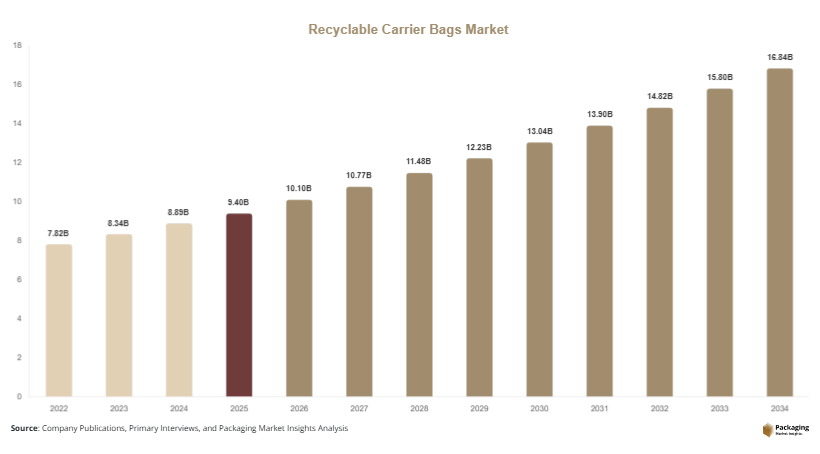
The global recyclable carrier bags market is projected to grow from USD 9.4 billion in 2025 to USD 16.8 billion by 2034, registering a CAGR of 6.6% during 2025–2034. In 2026, the market size is estimated at USD 10.1 billion, driven by regulatory restrictions on plastic usage and increasing adoption of sustainable retail packaging solutions.
Several key growth factors are shaping the market. First, strict government regulations banning single-use plastic bags are forcing retailers to adopt recyclable alternatives. Second, rising environmental awareness among consumers is increasing demand for eco-friendly shopping solutions. Third, expansion of organized retail and supermarket chains is boosting large-scale procurement of recyclable carrier bags.
Key Highlights
- Asia Pacific dominated the market with a 37.4% share in 2025.
- Latin America is projected to grow at the fastest CAGR of 6.2%.
- Paper-based recyclable bags led the material segment with a 44.9% share.
- Retail grocery applications dominated with a 51.2% share.
- Supermarkets accounted for 58.3% of demand, while online retail distribution is growing steadily.
- The US remained the dominant country with a market size of USD 11.2 billion in 2025 and USD 11.9 billion in 2026.
Explore more data points, trends and opportunities Download Free Sample Report
Market Trends
Shift Toward Reusable Multi-Use Carrier Bags
A major trend in the recyclable carrier bags market is the increasing shift toward reusable multi-use carrier bags. Retailers and governments are encouraging consumers to replace single-use bags with durable alternatives that can be reused multiple times. For example, supermarkets in Europe and North America have introduced thick recycled plastic and woven fabric bags designed for long-term use. These bags are often sold rather than given free, reducing unnecessary consumption. This shift is driven by regulatory bans on plastic bags and rising consumer awareness. In countries like Germany and the UK, reusable bag adoption has become mainstream in grocery shopping. In the future, smart reusable bags with tracking or loyalty integration features may emerge, further enhancing sustainability initiatives.
Growth of Paper-Based and Compostable Carrier Bags
Another key trend is the rising adoption of paper-based and compostable carrier bags. Retailers are replacing plastic-based bags with kraft paper and biodegradable alternatives to meet sustainability goals. For instance, fast-food chains in the United States and Japan have transitioned to paper-based carrier bags for takeaway packaging. These bags are recyclable and align with global ESG targets. In Europe, paper-based bags are widely used in fashion retail and grocery stores due to strong recycling infrastructure. However, improvements in coating technology are needed to enhance durability and moisture resistance. In the future, hybrid paper-biopolymer bags are expected to gain traction, offering both strength and environmental benefits.
Market Drivers
Government Regulations and Plastic Bag Bans
Government regulations banning single-use plastic bags are a primary driver of the recyclable carrier bags market. Countries such as India, France, and Canada have implemented strict policies limiting plastic usage in retail environments. For example, India’s nationwide plastic ban has significantly increased demand for paper and recycled plastic carrier bags in supermarkets and local retail stores. Similarly, European Union directives have reduced plastic bag consumption across member states. These regulations force retailers to transition toward recyclable alternatives, directly driving market expansion.
Rising Consumer Demand for Sustainable Retail Solutions
Consumer awareness regarding environmental sustainability is another key driver. Shoppers increasingly prefer stores that offer eco-friendly packaging solutions. For example, major retail chains in the U.S. and Australia promote recyclable bag usage through discount incentives and loyalty programs. This behavioral shift is influencing retailers to adopt sustainable carrier bag solutions to maintain brand reputation and customer loyalty. As sustainability becomes a purchasing factor, demand for recyclable bags is expected to rise steadily.
Market Restraint
A key restraint in the recyclable carrier bags market is the higher production cost of sustainable materials compared to conventional plastic bags. Recycled polymers, paper-based materials, and biodegradable alternatives require more complex processing and sourcing, increasing manufacturing expenses.
Additionally, inconsistent recycling infrastructure across developing regions limits large-scale adoption. For example, in parts of Africa and Southeast Asia, lack of efficient waste collection systems reduces the effectiveness of recyclable carrier bag programs. This creates challenges for market expansion in cost-sensitive economies.
Market Opportunities
Expansion of Circular Economy Systems
The development of circular economy systems presents a significant opportunity for the recyclable carrier bags market. Governments and corporations are investing in recycling infrastructure that supports the collection, processing, and reuse of carrier bag materials. For example, European cities are implementing closed-loop recycling systems where used bags are collected and reprocessed into new products. This reduces waste and improves resource efficiency.
Growth in E-Commerce Packaging Applications
E-commerce expansion presents another major opportunity. Online retail platforms are increasingly adopting recyclable carrier bags for last-mile delivery. For instance, fashion and grocery delivery services are using branded recyclable bags for packaging lightweight goods. This trend is expected to grow as online shopping continues to expand globally, especially in emerging markets.
Report Scope
| Report Metric | Details |
|---|---|
| Market Size in 2025 | USD 9.4 Billion |
| Market Size in 2026 | USD 10.1 Billion |
| Market Size in 2034 | USD 16.8 Billion |
| CAGR | 6.6% (2026-2034) |
| Base Year for Estimation | 2025 |
| Historical Data | 2022-2024 |
| Forecast Period | 2026-2034 |
| Report Coverage | Revenue Forecast, Competitive Landscape, Supply Chain Disruption, Growth Factors, Environment & Regulatory Landscape and Trends |
| Geographies Covered | North America, Europe, APAC, Middle East and Africa, LATAM |
| Countries Covered | U.S., Canada, U.K., Germany, France, Spain, Italy, Russia, Nordic, Benelux, Rest of Europe, China, South Korea, Japan, India, Australia, Singapore, Taiwan, South East Asia, Rest of Asia-Pacific, UAE, Turky, Saudi Arabia, South Africa, Egypt, Nigeria, Rest of MEA, Brazil, Mexico, Argentina, Chile, Colombia, Rest of LATAM |
Explore more data points, trends and opportunities Download Free Sample Report
Segmental Analysis
Type
The reusable woven carrier bags segment dominated with a 2024 market share of 46.7%, driven by strong durability, multiple-use capability, and regulatory encouragement. These bags are widely used in supermarkets and retail chains as long-term alternatives to single-use plastics. For example, grocery stores in Europe and North America sell woven polypropylene bags designed for repeated use, reducing overall waste generation.
Paper carrier bags are also widely used but are more common in lightweight retail applications due to limited durability.
The fastest-growing segment is biodegradable carrier bags, with a CAGR of 7.3%, driven by environmental regulations and consumer preference for compostable solutions. These bags are increasingly used in food delivery and retail packaging. Future growth will be supported by advancements in bio-based materials and improved strength coatings.
Material
Recycled plastic materials dominated with a 2024 share of 42.5%, due to cost efficiency and strong recycling infrastructure in developed markets. These materials are widely used in durable carrier bags for retail applications.
Paper-based materials are widely used but limited by moisture resistance issues.
The fastest-growing segment is biodegradable polymers, driven by sustainability regulations and innovation in compostable materials. CAGR stands at 7.1%, supported by improvements in material strength and expanding composting infrastructure.
End-Use
Retail grocery applications dominated with a 2024 share of 51.2%, driven by high-volume daily usage of carrier bags in supermarkets. For example, grocery chains in Europe and Asia heavily rely on recyclable bags for packaging fresh produce and consumer goods.
E-commerce is the fastest-growing segment, driven by rising online shopping trends. CAGR stands at 6.9%, supported by demand for lightweight and sustainable packaging solutions.
Recyclable Carrier Bags Market Segmentations
By Type
- Reusable Woven Bags
- Paper Carrier Bags
- Biodegradable Carrier Bags
By Material
- Recycled Plastic
- Paper
- Biodegradable Polymers
By End-User
- Retail Grocery
- E-commerce
- Food Service
- Fashion Retail
Regional Analysis
North America
North America accounted for approximately 26.1% share of the recyclable carrier bags market in 2025, with a projected CAGR of 6.2% through 2034. The region benefits from strong environmental awareness, regulatory initiatives, and widespread adoption of sustainable retail packaging. The United States and Canada are leading markets due to advanced retail infrastructure and strong consumer demand for eco-friendly products.
A key growth factor is the increasing adoption of plastic bag bans at state and municipal levels. For example, several U.S. states have introduced legislation restricting single-use plastic bags, leading supermarkets to switch to recyclable paper and reusable alternatives. Canada has also implemented nationwide restrictions on plastic bag usage, accelerating demand for sustainable carrier bags.
The United States dominates the region due to its large retail sector. A unique growth driver is the integration of sustainability programs in major supermarket chains, where customers are encouraged to bring reusable bags through incentive programs. For instance, loyalty discounts and eco-reward systems are being used to reduce plastic consumption in retail shopping environments.
Europe
Europe held around 28.4% market share in 2025, growing at a CAGR of 6.7%. The region is a global leader in sustainability regulations and circular economy initiatives. Countries such as Germany, France, Italy, and the UK are major contributors to demand.
A key growth factor is strict EU environmental legislation targeting plastic waste reduction. For example, supermarkets across Europe have eliminated free plastic bags and replaced them with recyclable paper and reusable alternatives. Retailers are also required to meet packaging sustainability targets.
Germany dominates the region due to strong recycling infrastructure. A unique growth driver is the widespread adoption of closed-loop recycling systems, where used carrier bags are collected, processed, and reused in new packaging products. This system significantly enhances material efficiency.
Asia Pac ific
Asia Pacific dominated with a 37.4% share in 2025, and is projected to grow at a CAGR of 7.1%. The region benefits from rapid urbanization, expanding retail sectors, and increasing government bans on plastic bags in countries such as China, India, and Thailand.
A key growth factor is strong government intervention in plastic waste reduction. For example, India’s plastic ban has led to a surge in demand for paper and reusable bags in retail and food service sectors. China is also investing in large-scale recycling infrastructure.
China dominates the region due to its massive manufacturing base. A unique driver is expansion of eco-retail initiatives in urban supermarkets, where recyclable carrier bags are promoted as standard packaging options.
Middle East & Africa
Middle East & Africa accounted for 5.8% share in 2025, with a CAGR of 5.9%. Growth is driven by increasing environmental awareness and gradual regulatory adoption.
A key growth factor is rising sustainability initiatives in urban retail sectors. For example, UAE supermarkets are introducing recyclable bags as part of national sustainability programs.
The UAE dominates the region due to its strong retail and tourism industries. A unique driver is the adoption of eco-friendly packaging in hospitality and retail tourism sectors, where branded recyclable carrier bags are used extensively.
Latin America
Latin America held around 2.3% share in 2025, and is projected to grow at the fastest CAGR of 6.2%. Brazil and Mexico dominate due to expanding retail networks and increasing environmental awareness.
A key growth factor is rising adoption of plastic bag bans in urban areas. For example, Brazil’s supermarkets are increasingly shifting toward paper-based and reusable carrier bags.
Brazil dominates the region due to its large consumer base. A unique driver is the expansion of modern retail chains implementing sustainability programs that replace plastic bags with recyclable alternatives.
Competitive Landscape
The recyclable carrier bags market is moderately fragmented with strong participation from packaging manufacturers and retail suppliers. Major companies include Mondi Group, Novolex, Smurfit Kappa, BioBag International, and International Paper. Among these, Mondi Group leads due to its strong global presence and diversified portfolio of sustainable packaging solutions.
Companies are focusing on recycled material innovation, expansion of production capacity, and partnerships with retail chains. Strategic initiatives include investment in circular economy systems and development of high-strength biodegradable materials.
Key Players List
- Mondi Group
- Novolex
- Smurfit Kappa Group
- International Paper
- BioBag International AS
- WestRock Company
- Amcor plc
- DS Smith
- Huhtamaki
- Stora Enso
- Sonoco Products Company
- Berry Global Inc.
- Sabert Corporation
- ProAmpac
- EcoEnclose