Micro Perforated Food Packaging Market Size and Growth
The global micro perforated food packaging market size is estimated at USD 4.2 billion in 2025, and it is projected to reach USD 4.5 billion in 2026. By 2034, the market is forecasted to attain approximately USD 8.9 billion, registering a compound annual growth rate (CAGR) of 8.1% during 2025–2034. The micro perforated food packaging market is experiencing steady expansion as food manufacturers and retailers increasingly prioritize extended shelf life, improved product freshness, and reduced food waste across global supply chains.
Growth in this market is primarily driven by the rising consumption of fresh produce, bakery products, and ready-to-eat meals, all of which require controlled atmospheric packaging. Micro perforated films allow regulated oxygen and moisture exchange, helping maintain food texture and freshness while reducing spoilage. Another major growth factor is the expansion of modern retail formats such as supermarkets, hypermarkets, and online grocery platforms, where packaged fresh food demand is increasing rapidly. The third important driver is technological advancement in film extrusion and laser perforation processes, enabling manufacturers to design highly customized permeability levels for different food types.
Key Highlights:
- Asia Pacific dominated the market with a 38.6% share in 2025.
- Latin America is projected to grow at the fastest CAGR of 8.7%.
- Polyethylene-based films led the material segment with a 44.3% share.
- Fresh fruits and vegetables dominated the application segment with a 41.8% share.
- Retail packaging dominated with a 46.1% share.
- The US remained the dominant country with a market size of USD 1.05 billion in 2025 and USD 1.12 billion in 2026.
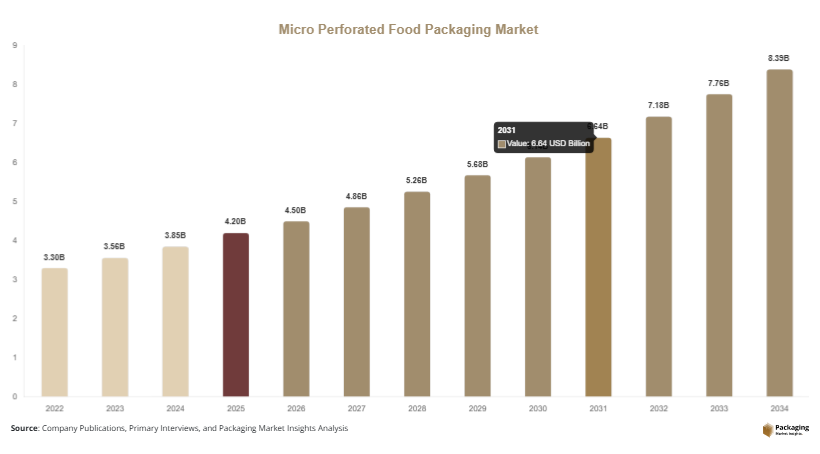
Explore more data points, trends and opportunities Download Free Sample Report
Market Trends
Rising Adoption of Modified Atmosphere Packaging Integration
A key trend shaping the micro perforated food packaging market is the integration of micro perforation technology with modified atmosphere packaging (MAP) systems. Food producers are increasingly combining controlled gas exchange with perforated films to optimize shelf life and preserve sensory quality. This hybrid approach allows better regulation of oxygen and carbon dioxide levels, particularly for fresh produce and bakery items. Manufacturers are investing in advanced perforation technologies that allow precise control over hole size, density, and distribution. This trend is particularly strong in developed markets where food waste reduction and quality preservation are high priorities for retailers and consumers.
Shift Toward Sustainable and Bio-Based Films
Another significant trend is the shift toward sustainable and bio-based micro perforated packaging materials. Environmental concerns related to plastic waste are pushing manufacturers to develop recyclable polyethylene alternatives and compostable biofilms. These materials maintain the required gas exchange properties while reducing environmental impact. Food brands are increasingly adopting sustainable packaging to meet regulatory requirements and improve brand image. In addition, governments in Europe and parts of Asia are encouraging reduced plastic usage, which is accelerating innovation in biodegradable perforated film solutions.
Market Drivers
Growing Demand for Fresh and Convenient Food Products
The increasing global demand for fresh, minimally processed, and convenience foods is a major driver of the micro perforated food packaging market. Consumers are shifting toward ready-to-eat meals, pre-cut fruits, and packaged bakery goods that require extended freshness without preservatives. Micro perforated films help maintain product respiration balance, preventing moisture buildup and spoilage. Retail chains and food service providers are adopting these solutions to reduce waste and enhance product appeal. The expansion of urban lifestyles and busy consumption patterns is further strengthening demand across developed and emerging economies.
Expansion of Organized Retail and E-Commerce Grocery Channels
The rapid growth of organized retail and online grocery platforms is significantly driving market expansion. Supermarkets and e-commerce platforms require packaging solutions that can preserve product quality during extended storage and transportation cycles. Micro perforated packaging provides controlled airflow, ensuring that fresh produce remains visually appealing and safe for consumption. The rise of direct-to-consumer grocery delivery services has further amplified demand for high-performance packaging solutions. Logistics optimization and long-distance food distribution networks are also increasing reliance on breathable packaging technologies.
Market Restraint
One of the primary restraints in the micro perforated food packaging market is the relatively high production cost associated with precision perforation technologies and advanced film materials. Manufacturing micro perforated films requires specialized equipment such as laser perforation systems and controlled extrusion lines, which significantly increase capital expenditure. Additionally, ensuring consistent perforation quality across large production volumes presents operational challenges. Small and medium-sized packaging manufacturers often struggle to adopt these technologies due to cost constraints.
For example, in developing regions, food producers may opt for conventional plastic packaging instead of micro perforated alternatives to reduce packaging costs, even if it compromises shelf life. This cost sensitivity limits adoption in price-driven markets, particularly in low-margin food segments. Furthermore, lack of awareness among small-scale food producers about the benefits of micro perforation technology also slows market penetration in certain regions.
Market Opportunities
Expansion in Fresh Produce Export Markets
The growing international trade of fresh fruits, vegetables, and horticultural products presents a significant opportunity for micro perforated packaging solutions. Exporters require packaging that maintains freshness over long transit times while preventing condensation and spoilage. Micro perforated films help regulate respiration rates, making them ideal for long-distance shipping. Emerging economies in Asia and Latin America are increasing agricultural exports, which is expected to boost demand for advanced packaging solutions. Cold chain expansion further supports adoption in export-oriented supply chains.
Innovation in Smart and Functional Packaging Films
Another major opportunity lies in the development of smart and functional micro perforated packaging films. Manufacturers are exploring integration of freshness indicators, humidity sensors, and antimicrobial coatings into perforated packaging systems. These innovations allow real-time monitoring of food quality and enhance safety throughout the supply chain. The combination of active packaging and micro perforation technology is expected to create new value-added applications, particularly in premium food segments such as organic produce and specialty bakery products.
Report Scope
| Report Metric | Details |
|---|---|
| Market Size in 2025 | USD 4.2 Billion |
| Market Size in 2026 | USD 4.5 Billion |
| Market Size in 2034 | USD 8.9 Billion |
| CAGR | 8.1% (2026-2034) |
| Base Year for Estimation | 2025 |
| Historical Data | 2022-2024 |
| Forecast Period | 2026-2034 |
| Report Coverage | Revenue Forecast, Competitive Landscape, Supply Chain Disruption, Growth Factors, Environment & Regulatory Landscape and Trends |
| Geographies Covered | North America, Europe, APAC, Middle East and Africa, LATAM |
| Countries Covered | U.S., Canada, U.K., Germany, France, Spain, Italy, Russia, Nordic, Benelux, Rest of Europe, China, South Korea, Japan, India, Australia, Singapore, Taiwan, South East Asia, Rest of Asia-Pacific, UAE, Turky, Saudi Arabia, South Africa, Egypt, Nigeria, Rest of MEA, Brazil, Mexico, Argentina, Chile, Colombia, Rest of LATAM |
Explore more data points, trends and opportunities Download Free Sample Report
Segmental Analysis
By Material Type
Polyethylene-based films dominated the market in 2024, accounting for approximately 44.3% share. These materials are widely used due to their flexibility, cost efficiency, and compatibility with perforation technologies. They are commonly applied in fresh produce and bakery packaging due to their ability to maintain product respiration balance while offering durability during transportation and storage. Manufacturers prefer polyethylene because it supports high-speed production processes and allows precise control of perforation density. Additionally, its adaptability across different food applications makes it the most widely adopted material in the market.
Biodegradable and compostable films are expected to be the fastest-growing subsegment, with a CAGR of 9.2%. This growth is driven by increasing environmental concerns and regulatory pressure to reduce plastic waste. Food brands are shifting toward sustainable packaging alternatives that maintain performance while reducing ecological impact. Technological improvements in biofilm extrusion and plant-based polymers are enabling better permeability control, making them suitable for fresh food applications. Rising consumer awareness regarding eco-friendly packaging is further accelerating adoption.
By Application
Fresh fruits and vegetables dominated the application segment in 2024 with a 41.8% share. This dominance is attributed to the high perishability of produce, which requires controlled oxygen exchange to maintain freshness and prevent spoilage. Micro perforated packaging is widely used in retail supermarkets and export supply chains for maintaining quality during storage and transportation. The ability to reduce condensation and microbial growth makes it highly suitable for leafy greens, berries, and cut vegetables.
Bakery and confectionery products are expected to grow at the fastest CAGR of 8.5%. The increasing consumption of packaged baked goods such as bread, pastries, and snacks is driving demand. Micro perforation helps maintain crust texture while preventing moisture accumulation inside packaging. The expansion of convenience food culture and café-style bakery chains is further boosting adoption across urban markets.
By Distribution Channel
Retail packaging dominated the market in 2024, accounting for 46.1% share. Supermarkets and hypermarkets rely heavily on micro perforated packaging for fresh produce display and shelf-life extension. The visual appeal and freshness retention offered by these films make them highly suitable for retail environments where product appearance influences purchasing decisions.
E-commerce food packaging is expected to grow at the fastest CAGR of 9.0%. The rapid expansion of online grocery delivery platforms is driving demand for packaging that maintains product integrity during transportation. Micro perforated films help regulate moisture and prevent spoilage during last-mile delivery, making them increasingly important in digital retail ecosystems.
Micro Perforated Food Packaging Market Segmentations
By Material Type
- Polyethylene (PE) Films
- Polypropylene (PP) Films
- Biodegradable & Compostable Films
- Multilayer Barrier Films
By Application
- Fresh Fruits & Vegetables
- Bakery & Confectionery Products
- Ready-to-Eat Meals
- Salads & Fresh-Cut Produce
- Dairy Products
By Distribution Channel
- Supermarkets & Hypermarkets
- Convenience Stores
- Online Grocery Platforms
- Food Service & HoReCa
- Specialty Food Retailers
Regional Analysis
North America
North America accounted for approximately 28.9% of the global market share in 2025 and is projected to grow at a CAGR of 7.6%. The region benefits from advanced food processing infrastructure and high consumer demand for packaged fresh foods. Strong retail networks and widespread adoption of convenience foods further support market expansion.
The United States dominates the regional market due to its large food manufacturing base. A key growth factor is the increasing demand for fresh-cut produce and ready-to-eat meals in urban households, which drives adoption of breathable packaging solutions.
Europe
Europe held a 26.4% market share in 2025 and is expected to grow at a CAGR of 7.8%. Strict food safety regulations and strong emphasis on reducing food waste are driving adoption. Sustainable packaging initiatives also support market growth.
Germany leads the European market, supported by its advanced packaging technology sector. A unique growth factor is the strong regulatory push for recyclable and compostable packaging materials in food retail chains.
Asia Pacific
Asia Pacific dominated the market with a 38.6% share in 2025 and is projected to grow at a CAGR of 8.9%. Rising urbanization, expanding retail networks, and increasing consumption of packaged fresh foods are key drivers. The region also benefits from strong agricultural production.
China is the dominant country, driven by its large food retail sector. A key growth factor is the rapid expansion of online grocery platforms, which significantly increases demand for breathable packaging solutions.
Middle East & Africa
The region accounted for 3.8% market share in 2025 and is expected to grow at a CAGR of 7.4%. Growth is driven by increasing food imports and development of retail infrastructure.
The United Arab Emirates leads the region, supported by strong food import dependency. A unique growth factor is the expansion of premium supermarket chains offering packaged fresh foods.
Latin America
Latin America held a 2.3% share in 2025 and is projected to grow at a CAGR of 8.7%. Agricultural exports and rising supermarket penetration are key growth drivers.
Brazil dominates the region due to its strong agricultural export base. A key growth factor is increasing demand for packaging solutions in fruit and vegetable exports.
Competitive Landscape
The micro perforated food packaging market is moderately fragmented, with several global and regional players focusing on innovation and material development. Key companies include Amcor plc, Sealed Air Corporation, Mondi Group, Coveris Holdings, and Berry Global. These companies are investing in advanced perforation technologies and sustainable film materials to strengthen their market position.
Amcor plc remains one of the leading participants, focusing on recyclable micro perforated packaging solutions for fresh food applications. Recently, the company expanded its production capacity in Europe to support growing demand for sustainable packaging solutions in the retail food sector.
Key Players List
- Amcor plc
- Sealed Air Corporation
- Mondi Group
- Berry Global Inc.
- Coveris Holdings
- Winpak Ltd.
- Plastipak Holdings
- Huhtamaki Group
- Uflex Ltd.
- Clondalkin Group
- Schur Flexibles Group
- Bischof + Klein
- Transcontinental Inc.
- PPC Flexible Packaging
- Interflex Group