Modified Atmosphere Packaging Trays Market Size and Growth
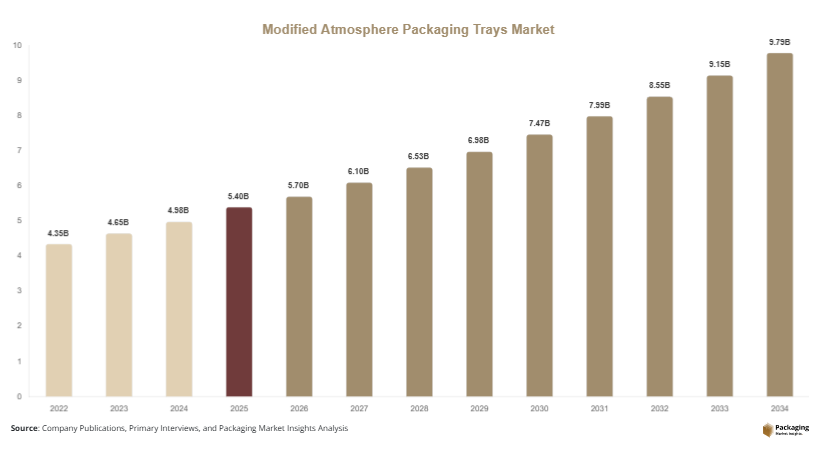
The global modified atmosphere packaging trays market is projected to exhibit steady growth during the forecast period, with the market size estimated at USD 5.4 billion in 2025. By 2026, the market is expected to reach approximately USD 5.7 billion, with a forecasted value of USD 10.2 billion by 2034, representing a CAGR of 7.0% between 2025 and 2034. This growth is largely driven by the increasing demand for fresh, minimally processed, and packaged food products across retail, foodservice, and e-commerce channels globally. Modified atmosphere packaging (MAP) trays are increasingly preferred for extending shelf life, maintaining food quality, and reducing food waste.
The growth is also supported by evolving consumer preferences for fresh, ready-to-eat, and convenient meals. MAP trays allow manufacturers to preserve freshness while maintaining the taste, texture, and nutritional content of food products. Additionally, the rising trend of online grocery shopping and home delivery services has increased demand for packaging solutions that ensure product integrity during transportation.
Key Highlights:
- The global modified atmosphere packaging trays market is projected to reach USD 10.2 billion by 2034, reflecting steady expansion across key regions. This growth is supported by increasing adoption in food retail, foodservice, and online delivery sectors.
- A CAGR of 7.0% is anticipated from 2025 to 2034, indicating consistent market growth over the forecast period. Advancements in packaging technology and rising demand for extended shelf-life solutions are contributing to this trend.
- There is a rising demand for fresh, minimally processed, and ready-to-eat meals among consumers. MAP trays help preserve product freshness, taste, and nutritional value, making them suitable for modern food consumption patterns.
- Growth in e-commerce and home delivery services is driving the adoption of advanced packaging solutions. MAP trays ensure product protection, maintain quality during transit, and enhance overall customer satisfaction.
- Regulatory emphasis on food safety and waste reduction is promoting the use of MAP trays. Governments and industry bodies are encouraging packaging solutions that minimize spoilage and ensure compliance with safety standards.
Explore more data points, trends and opportunities Download Free Sample Report
Market Trends
Adoption of Sustainable and Biodegradable Trays
A notable trend in the modified atmosphere packaging trays market is the increased use of biodegradable and recyclable materials for tray production. Manufacturers are integrating eco-friendly polymers, molded pulp, and bio-based plastics to reduce environmental impact while maintaining product durability and food safety. Consumers are becoming more environmentally conscious and prefer products with minimal carbon footprints, which has prompted food manufacturers to adopt sustainable MAP trays. Companies are also exploring compostable options that comply with global sustainability standards. This trend aligns with broader industry efforts to reduce plastic waste and supports regulatory initiatives promoting greener packaging solutions.
Integration of Smart Packaging Solutions
Another emerging trend is the integration of smart packaging technologies in MAP trays, including time-temperature indicators, QR codes, and freshness sensors. These digital features allow consumers and retailers to monitor product quality and shelf life, enhancing food safety and reducing waste. Smart packaging provides real-time information on storage conditions, expiration, and traceability, which is increasingly important in retail and foodservice sectors. The adoption of smart MAP trays is expected to expand rapidly due to growing interest in connected packaging solutions, particularly in developed markets with technologically advanced supply chains.
Market Drivers
Rising Demand for Fresh and Ready-to-Eat Food Products
The primary driver of the modified atmosphere packaging trays market is the global shift toward fresh, minimally processed, and ready-to-eat meals. Consumers increasingly prefer products that offer convenience without compromising quality or nutritional value. MAP trays enable manufacturers to package perishable foods such as meat, seafood, dairy, and fresh produce while preserving freshness, taste, and texture. The convenience of ready-to-eat and meal-kit solutions has accelerated the adoption of MAP trays, particularly in urban and high-income regions where busy lifestyles drive consumer demand for easy-to-consume food products.
Expansion of Retail and E-Commerce Channels
The growing penetration of organized retail and online grocery platforms is a key factor driving market growth. As e-commerce and food delivery services expand, the need for packaging solutions that can maintain product integrity during storage and transportation has become critical. MAP trays protect perishable foods from spoilage, oxygen exposure, and moisture loss, ensuring high-quality products reach consumers. Retailers and manufacturers are increasingly leveraging MAP trays to enhance product appeal, extend shelf life, and reduce waste, supporting market growth in both developed and emerging economies.
Market Restraint
High Manufacturing Costs and Specialized Equipment Requirements
One of the key restraints affecting the modified atmosphere packaging trays market is the high cost of manufacturing and equipment required for production. MAP trays require specialized machinery for tray forming, sealing, and gas flushing, which represents a significant capital investment for small and mid-sized manufacturers. Additionally, precise control over gas mixtures and packaging conditions is essential to maintain product quality and safety, increasing operational complexity. For instance, perishable foods like seafood require tightly controlled oxygen and carbon dioxide levels during packaging. While large-scale producers can absorb these costs, smaller manufacturers may face barriers to entry, particularly in price-sensitive regions. High production costs may also limit widespread adoption in developing markets where affordability is critical for consumer acceptance.
Market Opportunities
Growing Demand in Emerging Markets
Emerging economies in Asia Pacific, Latin America, and the Middle East are presenting significant growth opportunities for the MAP trays market. Rising disposable incomes, urbanization, and expanding retail infrastructure are driving demand for packaged fresh and ready-to-eat foods. Consumers in these regions are increasingly prioritizing convenience, safety, and longer shelf-life products, encouraging manufacturers to adopt MAP solutions. Partnerships with local distributors and investment in localized manufacturing units provide opportunities to capture market share while addressing regional preferences and regulatory requirements.
Innovation in Customized and Multi-Compartment Trays
Manufacturers are exploring opportunities in designing customized MAP trays with multi-compartment layouts, offering portion control and meal customization. Multi-compartment trays are particularly popular for ready-to-eat meals, bento boxes, and meal kits, providing convenience and enhanced product presentation. These trays also allow for the separation of ingredients that may have different shelf-life requirements or sensitivity to gas composition. As consumer demand for variety and personalization in meal packaging grows, customized MAP trays represent a significant opportunity for innovation and differentiation in the competitive market.
Report Scope
| Report Metric | Details |
|---|---|
| Market Size in 2025 | USD 5.4 Billion |
| Market Size in 2026 | USD 5.7 Billion |
| Market Size in 2034 | USD 10.2 Billion |
| CAGR | 7.0% (2026-2034) |
| Base Year for Estimation | 2025 |
| Historical Data | 2022-2024 |
| Forecast Period | 2026-2034 |
| Report Coverage | Revenue Forecast, Competitive Landscape, Supply Chain Disruption, Growth Factors, Environment & Regulatory Landscape and Trends |
| Geographies Covered | North America, Europe, APAC, Middle East and Africa, LATAM |
| Countries Covered | U.S., Canada, U.K., Germany, France, Spain, Italy, Russia, Nordic, Benelux, Rest of Europe, China, South Korea, Japan, India, Australia, Singapore, Taiwan, South East Asia, Rest of Asia-Pacific, UAE, Turky, Saudi Arabia, South Africa, Egypt, Nigeria, Rest of MEA, Brazil, Mexico, Argentina, Chile, Colombia, Rest of LATAM |
Explore more data points, trends and opportunities Download Free Sample Report
Segmental Analysis
Type Segment
The MAP trays market is segmented into rigid trays, semi-rigid trays, and flexible trays. Rigid trays dominate the market, accounting for approximately 50% share in 2024. They provide superior protection, maintain structural integrity, and are ideal for transporting delicate food products such as meat, seafood, and ready-to-eat meals. Rigid trays can withstand gas flushing and sealing processes effectively, ensuring enhanced shelf life and food quality.
Semi-rigid trays are the fastest-growing segment, projected to expand at a CAGR of 7.8% from 2025–2034. They combine durability with lightweight design, offering cost efficiency and convenience for retail and foodservice applications. Semi-rigid trays also support advanced sealing and gas composition control, enabling better preservation of perishable products.
Application Segment
By application, the market is segmented into meat & seafood, fruits & vegetables, ready-to-eat meals, and dairy & bakery products. Meat & seafood dominate with a 40% share in 2024, as these perishable items require controlled oxygen and carbon dioxide levels for freshness preservation. Retailers and foodservice providers prefer MAP trays for these categories due to their ability to extend shelf life and maintain sensory quality.
Ready-to-eat meals are the fastest-growing application segment, projected to grow at a CAGR of 8.0% between 2025–2034. Increased demand for convenience, home meal kits, and online food delivery services is driving the adoption of MAP trays in this category. Customizable tray compartments allow for portion control and separation of ingredients with different shelf-life requirements.
End-Use Segment
The market is segmented into retail, foodservice, and online delivery channels. Retail dominates the end-use segment with a 55% share in 2024, driven by supermarkets and hypermarkets increasingly stocking fresh and pre-packaged perishable items. MAP trays in retail help reduce food spoilage, ensure product quality, and meet consumer expectations for fresh products.
Foodservice and online delivery are the fastest-growing segments, expected to expand at a CAGR of 7.9% from 2025–2034. Growth is supported by meal-kit services, restaurant chains, and food delivery platforms that require reliable packaging to maintain food freshness, texture, and presentation during transport.
Modified Atmosphere Packaging Trays Market Segmentations
By Type
- Rigid Trays
- Semi-Rigid Trays
- Flexible Trays
By Application
- Meat & Seafood
- Fruits & Vegetables
- Ready-to-Eat Meals
- Dairy & Bakery Products
By End-Use
- Retail
- Foodservice
- Online Delivery
Regional Analysis
North America
North America held approximately 32% of the global modified atmosphere packaging trays market share in 2025, with a forecasted CAGR of 6.5% during 2025–2034. Growth is supported by mature food retail and foodservice industries, increasing consumer demand for fresh, ready-to-eat meals, and stringent food safety regulations. The presence of leading food manufacturers and packaging solution providers in the U.S. and Canada drives adoption of advanced MAP tray technologies.
The United States dominates the region due to its highly organized retail sector and technologically advanced food supply chains. A unique growth factor is the widespread adoption of online grocery and meal-kit delivery services, which rely heavily on MAP trays to maintain food freshness during transit.
Europe
Europe accounted for roughly 28% of the global market in 2025, expected to grow at a CAGR of 6.8% through 2034. The market is driven by a well-established retail sector, consumer preference for fresh and minimally processed foods, and government regulations on food safety and waste reduction. MAP trays are widely adopted for meat, seafood, fruits, and vegetables across supermarkets and foodservice providers.
Germany leads the European market, with a unique growth factor being the high consumer preference for pre-packaged fresh meals and ready-to-eat products. Innovation in tray design, including recyclable and biodegradable materials, supports market expansion in the country.
Asia Pacific
Asia Pacific held approximately 25% of the global market in 2025, with a forecasted CAGR of 7.5% during 2025–2034. Rising urbanization, growing disposable income, and increasing demand for packaged and convenience foods are major growth drivers. Countries such as China, India, and Japan are witnessing significant adoption of MAP trays in retail and foodservice segments.
China dominates the region due to rapid industrialization of the food sector and expansion of organized retail. A unique growth factor is the government’s emphasis on modernizing cold chain infrastructure, enabling the distribution of perishable goods over long distances while maintaining freshness.
Middle East & Africa
The Middle East & Africa contributed around 6% of the global market in 2025, projected to grow at a CAGR of 6.2% through 2034. Market growth is driven by increasing urban populations, modernization of retail and foodservice channels, and rising disposable income. MAP trays are increasingly used for fresh meat, poultry, and ready-to-eat foods in supermarkets and hypermarkets.
The UAE leads the regional market, with a unique growth factor being the rapid development of food import and retail infrastructure. The demand for high-quality, ready-to-eat foods is encouraging manufacturers to adopt MAP trays for enhanced shelf life and product presentation.
Latin America
Latin America accounted for approximately 5% of the global market share in 2025, projected to grow at a CAGR of 7.0% through 2034. Growth is fueled by increasing urbanization, rising demand for convenience foods, and the modernization of retail channels. MAP trays are increasingly adopted in supermarkets, hypermarkets, and foodservice outlets to maintain product freshness and reduce waste.
Brazil dominates the Latin American market, with a unique growth factor being government initiatives promoting food safety and cold chain logistics. Adoption of MAP trays in meat and poultry sectors is increasing, supporting the overall growth of the packaging market in the region.
Competitive Landscape
The modified atmosphere packaging trays market is moderately competitive with key players including Berry Global, Sealed Air Corporation, Amcor plc, Huhtamaki Oyj, and Winpak Ltd. Berry Global is a market leader, recently introducing recyclable and multi-compartment MAP trays designed for ready-to-eat meals and meal kits. Other companies focus on innovative tray designs, biodegradable materials, and integration with smart packaging technologies. Strategic acquisitions, partnerships with food manufacturers, and expansion into emerging markets are common strategies to capture market share. Advanced gas-flushing techniques, improved sealing technology, and sustainability initiatives serve as differentiators in this market.
Key Players List
- Berry Global
- Sealed Air Corporation
- Amcor plc
- Huhtamaki Oyj
- Winpak Ltd.
- RPC Group
- Bemis Company, Inc.
- Constantia Flexibles
- Innovia Films Ltd.
- Mondi Group
- DS Smith Plc
- AptarGroup, Inc.
- Huhtamaki Flexible Packaging
- Sonoco Products Company
- Smurfit Kappa Group