Meat Poultry And Seafood Packaging Market Size and Growth
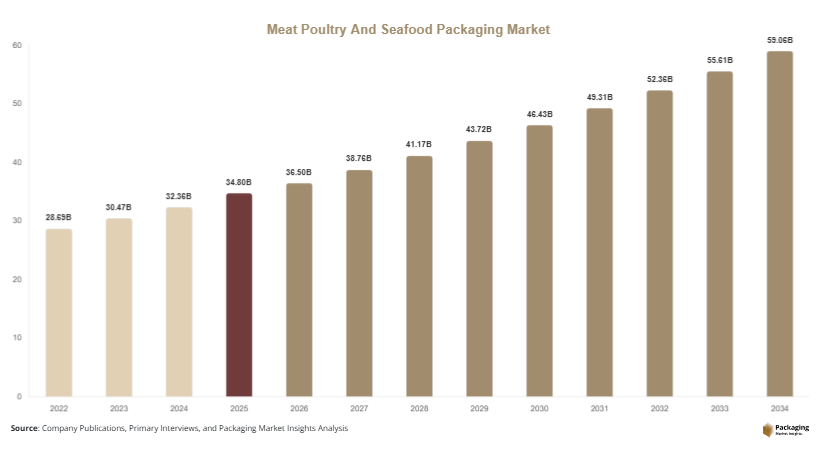
The global meat poultry and seafood packaging market size was valued at approximately USD 34.8 billion in 2025 and is expected to reach USD 36.5 billion in 2026. By 2034, the market is projected to grow to nearly USD 58.9 billion, registering a CAGR of 6.2% during 2025–2034. The growing importance of food safety, shelf-life extension, and sustainable packaging innovations continues to support market development across developed and emerging economies. The meat poultry and seafood packaging market is experiencing steady expansion due to rising consumption of processed protein products, increasing demand for hygienic packaging solutions, and the rapid development of cold chain logistics.
One of the primary growth factors driving the market is the increasing global consumption of packaged meat, poultry, and seafood products. Urbanization and changing dietary preferences are encouraging consumers to purchase ready-to-cook and processed protein products that require advanced packaging solutions. Modified atmosphere packaging, vacuum packaging, and thermoformed trays are becoming widely used to maintain freshness and reduce contamination risks.
Key Highlights
- Asia Pacific dominated the market with a 36.7% share in 2025.
- Latin America is projected to grow at the fastest CAGR of 6.8%.
- Flexible packaging led the packaging type segment with a 44.2% share.
- Plastic materials dominated the material segment with a 58.5% share.
- Poultry applications led the end-use segment with 39.8% share.
- The US remained the dominant country with a market size of USD 7.4 billion in 2025 and USD 7.8 billion in 2026.
Explore more data points, trends and opportunities Download Free Sample Report
Market Trends
Rising Adoption of Sustainable Packaging Materials
Sustainability has become a major trend in the meat poultry and seafood packaging market as food manufacturers and retailers seek to reduce environmental impact. Companies are increasingly introducing recyclable films, biodegradable trays, and mono-material flexible packaging solutions to meet environmental regulations and consumer expectations. Retailers are also focusing on lightweight packaging designs to reduce transportation costs and carbon emissions. Many packaging suppliers are investing in paper-based alternatives and recycled polyethylene materials suitable for chilled and frozen food applications. Consumer awareness regarding plastic pollution is encouraging brands to promote eco-friendly packaging solutions. This trend is expected to influence product development strategies and supply chain investments throughout the forecast period.
Increasing Use of Smart and Active Packaging Technologies
The adoption of smart and active packaging technologies is growing steadily across the meat poultry and seafood packaging market. Packaging manufacturers are integrating oxygen absorbers, freshness indicators, antimicrobial films, and QR-based traceability systems into packaging products to improve food safety and shelf-life performance. These technologies help reduce spoilage, improve inventory management, and enhance consumer confidence regarding product freshness. Food retailers are increasingly using intelligent labels and temperature-sensitive indicators to monitor cold chain efficiency during transportation and storage. Smart packaging solutions are also supporting regulatory compliance by improving traceability and reducing contamination risks. As global food safety standards continue to tighten, active packaging technologies are expected to gain broader commercial adoption.
Market Drivers
Growing Demand for Processed and Packaged Protein Products
The increasing consumption of processed meat, poultry, and seafood products is a major driver supporting the growth of the meat poultry and seafood packaging market. Urban lifestyles and changing dietary habits are encouraging consumers to purchase ready-to-cook, frozen, and packaged protein products. These products require durable packaging that can preserve freshness, prevent contamination, and extend shelf life. Supermarkets and food delivery platforms are expanding their packaged meat offerings, creating additional demand for advanced packaging materials. Manufacturers are also introducing portion-controlled and convenience-oriented packaging formats to attract busy consumers. The continued growth of protein-rich diets across developing economies is expected to strengthen long-term packaging demand.
Expansion of Cold Chain and Food Retail Infrastructure
The expansion of global cold chain logistics and organized food retail infrastructure is another important driver for market growth. Refrigerated transportation and storage systems are becoming increasingly important for preserving meat and seafood quality during distribution. Retail chains and e-commerce grocery companies require high-barrier packaging capable of maintaining freshness across extended supply chains. Investments in refrigerated warehousing facilities and frozen food transportation are supporting packaging demand in emerging economies. In addition, food safety regulations are encouraging retailers to adopt packaging solutions that minimize leakage, spoilage, and bacterial contamination. These infrastructure developments are improving packaged food accessibility and contributing to market expansion worldwide.
Market Restraint
Volatility in Raw Material Prices and Environmental Concerns
One of the key restraints affecting the meat poultry and seafood packaging market is the volatility in raw material prices, particularly for plastic resins and specialty barrier materials. Packaging manufacturers face rising production costs due to fluctuations in petroleum-based raw material prices, which can impact profitability and pricing strategies. Environmental concerns regarding single-use plastics also create challenges for market participants. Governments across several regions are introducing strict regulations on plastic packaging waste, requiring companies to invest in recyclable and biodegradable alternatives. For example, seafood exporters relying heavily on multilayer plastic films may face higher operational costs when transitioning to sustainable materials. These cost pressures can limit adoption among smaller processors and increase overall supply chain complexity.
Market Opportunities
Growth of E-commerce Grocery and Meal Delivery Services
The rapid expansion of e-commerce grocery platforms and meal delivery services presents significant opportunities for the meat poultry and seafood packaging market. Consumers are increasingly purchasing chilled and frozen protein products through online retail channels due to convenience and wider product availability. This trend is creating demand for insulated, leak-proof, and tamper-evident packaging solutions capable of maintaining freshness during transportation. Packaging manufacturers are developing lightweight and durable materials suitable for home delivery applications. Meal kit providers are also adopting portion-controlled vacuum packaging formats to improve product presentation and reduce food waste. As digital grocery shopping continues to expand globally, packaging suppliers are expected to benefit from increasing order volumes and specialized packaging requirements.
Development of Recyclable High-Barrier Packaging
The development of recyclable high-barrier packaging materials offers strong growth opportunities for industry participants. Traditional multilayer packaging structures provide excellent barrier performance but are often difficult to recycle. Manufacturers are now investing in mono-material films and recyclable barrier technologies that maintain freshness while improving sustainability performance. Food processors and retailers are increasingly adopting these solutions to comply with environmental regulations and corporate sustainability goals. Advances in polymer science are enabling the production of recyclable films with improved oxygen and moisture resistance. As governments introduce stricter recycling targets, demand for environmentally responsible high-barrier packaging solutions is expected to increase significantly across meat, poultry, and seafood applications.
Report Scope
| Report Metric | Details |
|---|---|
| Market Size in 2025 | USD 34.8 Billion |
| Market Size in 2026 | USD 36.5 Billion |
| Market Size in 2034 | USD 58.9 Billion |
| CAGR | 6.2% (2026-2034) |
| Base Year for Estimation | 2025 |
| Historical Data | 2022-2024 |
| Forecast Period | 2026-2034 |
| Report Coverage | Revenue Forecast, Competitive Landscape, Supply Chain Disruption, Growth Factors, Environment & Regulatory Landscape and Trends |
| Geographies Covered | North America, Europe, APAC, Middle East and Africa, LATAM |
| Countries Covered | U.S., Canada, U.K., Germany, France, Spain, Italy, Russia, Nordic, Benelux, Rest of Europe, China, South Korea, Japan, India, Australia, Singapore, Taiwan, South East Asia, Rest of Asia-Pacific, UAE, Turky, Saudi Arabia, South Africa, Egypt, Nigeria, Rest of MEA, Brazil, Mexico, Argentina, Chile, Colombia, Rest of LATAM |
Explore more data points, trends and opportunities Download Free Sample Report
Segmental Analysis
By Packaging Type
Flexible packaging dominated the market in 2024, accounting for approximately 44.2% of total market share. Flexible packaging products such as pouches, films, and vacuum bags are widely used because they are lightweight, cost-effective, and capable of providing strong barrier protection against moisture and oxygen. Meat processors and seafood exporters increasingly prefer flexible packaging due to lower transportation costs and improved shelf-life performance. Advances in multilayer film technologies have enhanced durability and sealing performance, making flexible packaging suitable for chilled and frozen food applications. Retailers also favor flexible packaging because it improves product visibility and supports attractive branding strategies within supermarket environments.
Vacuum skin packaging is projected to be the fastest-growing packaging type segment, registering a CAGR of 7.1% during the forecast period. This packaging format provides close product contact and enhanced shelf presentation while reducing oxygen exposure and leakage risks. Vacuum skin packaging is increasingly used for premium meat cuts and seafood products because it improves freshness and extends storage duration. Food retailers are adopting this technology to reduce spoilage and improve merchandising quality. Manufacturers are also developing recyclable vacuum skin films to align with sustainability requirements. The growing demand for premium packaged protein products and longer shelf-life solutions is expected to support rapid adoption of vacuum skin packaging technologies.
By Material
Plastic materials dominated the market in 2024 with approximately 58.5% share due to their strong barrier properties, flexibility, and cost efficiency. Polyethylene, polypropylene, and polyethylene terephthalate are widely used across meat poultry and seafood packaging applications because they provide durability and resistance to moisture contamination. Plastic packaging remains highly preferred in frozen food distribution due to its lightweight structure and compatibility with automated packaging systems. Manufacturers are continuously improving plastic packaging performance through multilayer technologies and enhanced sealing properties. Despite environmental concerns, plastic materials continue to dominate because they maintain food safety standards and extend product shelf life across global cold chain networks.
Recyclable paper-based packaging is anticipated to witness the fastest growth, expanding at a CAGR of 6.9% during the forecast period. Growing environmental regulations and retailer sustainability commitments are encouraging adoption of fiber-based packaging alternatives. Paper trays combined with recyclable barrier coatings are increasingly used for fresh poultry and processed meat products in retail supermarkets. Packaging manufacturers are investing in moisture-resistant paper technologies capable of supporting refrigerated food applications. Consumer preference for sustainable packaging is also strengthening demand for recyclable paper solutions. As governments continue introducing restrictions on plastic waste, paper-based packaging adoption is expected to accelerate across food retail and food service channels.
By Application
Poultry packaging dominated the application segment in 2024, accounting for approximately 39.8% of total market share. Rising global poultry consumption and increasing affordability compared to other protein sources continue to support demand for poultry packaging products. Processed chicken products, frozen poultry meals, and ready-to-cook items require hygienic and temperature-resistant packaging solutions to maintain freshness and prevent contamination. Retail chains and food delivery operators are also increasing packaged poultry offerings to meet urban consumer demand. Packaging manufacturers are introducing leak-proof trays, resealable pouches, and modified atmosphere packaging systems specifically designed for poultry applications. These developments are contributing to strong market growth across both developed and emerging economies.
Seafood packaging is projected to register the fastest CAGR of 6.7% during the forecast period due to rising international seafood trade and growing consumer preference for frozen seafood products. Seafood products require advanced barrier packaging capable of controlling moisture, odor, and temperature exposure during transportation. Exporters are increasingly using vacuum packaging and insulated packaging systems to maintain product quality during long-distance shipping. The expansion of aquaculture production and online seafood retail platforms is also supporting demand for innovative seafood packaging solutions. In addition, smart labeling and freshness monitoring technologies are gaining popularity within premium seafood packaging applications.
Meat Poultry And Seafood Packaging Market Segmentations
By Packaging Type
- Flexible Packaging
- Rigid Packaging
- Vacuum Skin Packaging
- Modified Atmosphere Packaging
By Material
- Plastic
- Paper & Paperboard
- Aluminum
- Biodegradable Materials
By Application
- Meat
- Poultry
- Seafood
Regional Analysis
North America
North America accounted for approximately 30.2% of the global meat poultry and seafood packaging market share in 2025 and is projected to grow at a CAGR of 5.7% during the forecast period. The region benefits from strong cold chain infrastructure, advanced food processing industries, and high consumption of packaged protein products. Retail supermarkets and online grocery platforms continue to increase demand for vacuum packaging, thermoformed trays, and modified atmosphere packaging solutions designed to improve food safety and shelf life.
The United States dominates the North American market due to its large processed food industry and extensive retail distribution networks. A unique growth factor is the increasing demand for portion-controlled packaging formats among health-conscious consumers. Food manufacturers are introducing smaller package sizes and resealable packaging solutions to improve convenience and reduce food waste in households.
Europe
Europe held approximately 25.1% of the global market share in 2025 and is expected to register a CAGR of 5.5% during the forecast period. The regional market is supported by strict food safety regulations and growing consumer preference for sustainable packaging materials. Meat processors and retailers are increasingly adopting recyclable flexible packaging and paper-based trays to comply with environmental targets. Demand for premium packaged seafood products is also contributing to packaging innovation across European countries.
Germany remains the leading country within the European market due to its advanced food processing sector and strong retail packaging industry. A unique growth factor is the expansion of sustainable supermarket initiatives focused on reducing plastic packaging waste. Retail chains are collaborating with packaging manufacturers to introduce recyclable packaging formats for meat and seafood applications.
Asia Pacific
Asia Pacific dominated the meat poultry and seafood packaging market with a 36.7% share in 2025 and is projected to grow at a CAGR of 6.9% through 2034. Rapid urbanization, rising disposable income, and increasing consumption of packaged food products are driving regional market growth. Expanding cold storage infrastructure and the growth of online grocery platforms are further increasing demand for advanced food packaging solutions across developing economies.
China leads the Asia Pacific market due to its large meat processing industry and expanding retail food sector. A unique growth factor is the rapid development of frozen seafood exports and domestic chilled food distribution networks. Packaging manufacturers are investing in high-barrier flexible packaging and smart labeling technologies to support food safety and export compliance requirements.
Middle East & Africa
The Middle East & Africa region accounted for approximately 4.8% of the global market share in 2025 and is expected to grow at a CAGR of 5.9% over the forecast period. Rising urbanization and increasing consumption of packaged frozen food products are supporting regional market expansion. Investments in refrigerated transportation and modern retail infrastructure are also improving access to packaged meat and seafood products across several countries.
Saudi Arabia dominates the regional market due to strong demand for halal meat products and expanding supermarket chains. A unique growth factor is the growing investment in domestic food processing facilities aimed at reducing import dependence. These developments are increasing the need for durable and temperature-resistant packaging solutions suitable for frozen and chilled food applications.
Latin America
Latin America represented approximately 3.2% of the global market share in 2025 and is forecasted to grow at the fastest CAGR of 6.8% during the assessment period. Rising consumption of processed poultry and seafood products, combined with improving retail distribution systems, is supporting market growth across the region. Food exporters are also increasing demand for high-performance packaging materials that maintain product quality during international transportation.
Brazil remains the dominant country in the Latin American market due to its strong poultry export industry and expanding food processing sector. A unique growth factor is the increasing international demand for packaged frozen poultry products. Export-oriented producers are investing in vacuum packaging and high-barrier films to meet international quality and transportation standards.
Competitive Landscape
The meat poultry and seafood packaging market is moderately competitive, with global and regional players focusing on sustainability, product innovation, and advanced barrier technologies to strengthen market presence. Companies are investing in recyclable packaging materials, smart packaging systems, and automation-compatible packaging formats to address evolving industry requirements. Strategic partnerships with food processors and retail chains are also becoming common across the market.
Amcor plc remains one of the leading companies in the market due to its extensive product portfolio and strong global manufacturing network. In 2024, the company introduced a recyclable high-barrier packaging solution designed specifically for fresh meat and seafood applications. Other major players including Sealed Air Corporation, Berry Global, Mondi Group, and Winpak Ltd. continue investing in advanced flexible packaging and sustainable material technologies. Companies are also expanding production capacity in emerging economies to meet increasing demand for packaged protein products and cold chain packaging solutions.
Key Players List
- Amcor plc
- Sealed Air Corporation
- Berry Global Inc.
- Mondi Group
- Winpak Ltd.
- Sonoco Products Company
- Coveris Holdings S.A.
- Smurfit Kappa Group
- Constantia Flexibles
- DS Smith Plc
- ULMA Packaging
- Bemis Manufacturing Company
- Klöckner Pentaplast
- LINPAC Packaging
- ProAmpac