Micro Perforated Films For Packaging Market Size
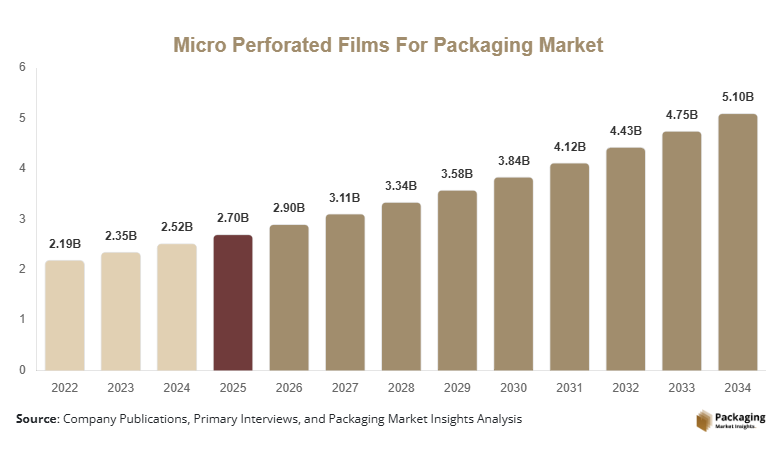
The microperforated films for packaging market size is projected at USD 2.9 billion in 2026 and is expected to hit USD 5.1 billion by 2034 with a CAGR of 7.3%. The market continues to expand due to increasing demand for breathable food packaging, extended shelf-life solutions, and advanced polymer processing technologies. The report provides detailed quantitative analysis of market segmentation, production trends, competitive landscape, technological developments, and regional performance across the forecast period.
Microperforated films are specialized packaging materials engineered with microscopic perforations that regulate oxygen, carbon dioxide, and moisture exchange to preserve food freshness. Global production exceeded 18.5 billion square meters in 2025 and is expected to surpass 30.8 billion square meters by 2034. Fresh produce packaging contributes approximately 46% of total consumption, while bakery applications account for nearly 28% and ready-to-eat food applications contribute around 26%. Adoption among organized food packaging companies has crossed 68%, supported by increasing investments in modified atmosphere packaging technologies, reinforcing the microperforated films for the packaging market.
Explore more data points, trends and opportunities Download Free Sample Report
Microperforated Films For Packaging Market Trends
Rising adoption of breathable packaging technologies
Manufacturers are increasingly integrating laser micro-perforation systems capable of producing over 400 perforations per square meter with precision below 120 microns. Automated converting lines increased by 18% during 2025, while sustainable polymer processing capacity expanded by 14%. Food processors continue replacing conventional films with breathable alternatives across fresh vegetables, fruits, and bakery products, strengthening the microperforated films for the packaging market.
Growing investments in recyclable polymers and smart converting technologies are reshaping production capabilities. Nearly 62% of newly commissioned production facilities now utilize automated inspection systems, while digital quality monitoring improves production efficiency by approximately 17%. Demand for retail-ready packaging and premium food packaging applications continues expanding across developed and emerging economies, supporting the microperforated films for packaging market.
Micro-Perforated Films For Packaging Drivers
Growing demand for longer shelf-life food packaging
Rising consumption of packaged fresh food, increasing supermarket penetration above 72%, and expanding cold-chain logistics have accelerated demand for breathable packaging films. Food waste reduction initiatives targeting over 20% lower spoilage rates encourage adoption of microperforated structures capable of extending product freshness by 3–7 days. Annual production capacity additions exceeded 1.4 billion square meters in 2025, supporting the microperforated films for the packaging market.
Microperforated Films For Packaging Restraints
Volatility in polymer raw material prices
Frequent fluctuations in polyethylene, polypropylene, and PET resin prices ranging between 8% and 15% annually increase manufacturing costs. Energy expenses account for nearly 24% of total production expenditure, while precision laser perforation equipment raises capital investment by approximately 18%. These cost pressures reduce profitability for smaller converters and moderately affect the microperforated films for the packaging market.
Micro Perforated Films For Packaging Opportunities
Expansion of sustainable food packaging solutions
Demand for recyclable mono-material packaging continues rising, with sustainable packaging investments increasing by 21% in 2025. Bio-based polymer adoption exceeded 11% of newly launched breathable films, while exports of fresh packaged food grew by approximately 9% globally. Continuous innovation in recyclable high-barrier structures creates substantial opportunities for microperforated films for the packaging market.
Challenges in Microperforated Films For Packaging Market
Maintaining precise perforation consistency
Manufacturers must maintain perforation diameters within tolerances below ±10 microns to ensure optimal gas transmission. Quality rejection rates of 2–4%, increasing equipment maintenance costs, and stringent food safety compliance requirements create operational challenges. Scaling production while maintaining consistent film performance remains a key technical hurdle for the microperforated films for the packaging market.
Report Scope
| Report Metric | Details |
|---|---|
| Market Size in 2025 | USD 2.7 Billion |
| Market Size in 2026 | USD 2.9 Billion |
| Market Size in 2034 | USD 5.1 Billion |
| CAGR | 7.3% (2026-2034) |
| Base Year for Estimation | 2025 |
| Historical Data | 2022-2024 |
| Forecast Period | 2026-2034 |
| Report Coverage | Revenue Forecast, Competitive Landscape, Supply Chain Disruption, Growth Factors, Environment & Regulatory Landscape and Trends |
| Geographies Covered | North America, Europe, APAC, Middle East and Africa, LATAM |
| Countries Covered | U.S., Canada, U.K., Germany, France, Spain, Italy, Russia, Nordic, Benelux, Rest of Europe, China, South Korea, Japan, India, Australia, Singapore, Taiwan, South East Asia, Rest of Asia-Pacific, UAE, Turkey, Saudi Arabia, South Africa, Egypt, Nigeria, Rest of MEA, Brazil, Mexico, Argentina, Chile, Colombia, Rest of LATAM |
Explore more data points, trends and opportunities Download Free Sample Report
Microperforated Films For Packaging Market Segmentation
Material innovations and application diversity define market segmentation. Polyethylene films account for nearly 48% of total revenue, polypropylene contributes 31%, and PET represents approximately 21%. Fresh produce applications remain the dominant demand center because of high-volume consumption.
By Material
Polyethylene dominates with approximately 48% market share and annual production exceeding 8.8 billion square meters. The material offers high flexibility, moisture resistance, and cost efficiency, making it suitable for fruits, vegetables, and salad packaging with perforation sizes ranging from 60–200 microns.
Polypropylene contributes nearly 31% of global demand. Production surpassed 5.6 billion square meters, supported by excellent heat resistance, transparency, and mechanical strength. PP films are widely used in bakery packaging requiring controlled moisture release and improved shelf stability.
PET accounts for roughly a 21% share with production above 4.1 billion square meters. Superior dimensional stability, clarity, and barrier performance make PET suitable for premium packaged foods requiring high-performance breathable packaging.
By Application
Fresh produce represents approximately 46% of demand with annual consumption exceeding 8.4 billion square meters. Microperforated films regulate oxygen and carbon dioxide exchange, extending freshness while reducing condensation inside retail packaging.
Bakery applications contribute around 28% market share. Production exceeds 5.2 billion square meters, helping maintain product texture through balanced moisture transmission and controlled ventilation during distribution.
Ready-to-eat food packaging accounts for nearly 26% of demand with production surpassing 4.9 billion square meters. Breathable films improve food preservation, reduce package swelling, and support extended refrigerated storage across institutional and retail food sectors.
Micro Perforated Films For Packaging Market Segmentations
Material
- Polyethylene (PE)
- Polypropylene (PP)
- Polyethylene Terephthalate (PET)
Application
- Fresh Produce Packaging
- Bakery & Confectionery Packaging
- Ready-to-Eat Food Packaging
Microperforated Films for Packaging Regional Outlook
North America
North America accounts for approximately 29% of global revenue. The United States contributes nearly 81% of regional demand, supported by packaged food production exceeding 115 million tonnes annually and strong retail packaging adoption.
Europe
Europe represents roughly a 31% share, led by Germany, France, Italy, and the United Kingdom. Sustainable packaging regulations and food preservation initiatives support annual production exceeding 5.9 billion square meters across the region.
Asia-Pacific
Asia-Pacific holds nearly 32% of the market and records the fastest expansion. China contributes approximately 43% of regional production, followed by India, Japan, and South Korea. Rapid food processing investments and urbanization continue driving demand.
Latin America
Latin America contributes approximately 5% of global demand. Brazil and Mexico dominate regional consumption with expanding fresh produce exports and increasing organized retail packaging investments.
Middle East & Africa
The Middle East & Africa account for around 3% market share. Food security initiatives, cold-chain infrastructure expansion, and packaged food imports continue supporting steady market development.
Top Players In Microperforated Films For Packaging
- Amcor plc
- Mondi plc
- Sealed Air Corporation
- Berry Global Inc.
- Coveris Holdings S.A.
- Winpak Ltd.
- Constantia Flexibles
- Cosmo First Limited,
- Innovia Films,
- UFlex Ltd.
Amcor plc has an estimated market presence of approximately 12% globally. Strong manufacturing footprint across North America, Europe, and Asia-Pacific. Focuses on recyclable breathable packaging technologies, advanced film engineering, precision laser perforation systems, and food-grade sustainable materials. The company continues expanding production efficiency through digital manufacturing, automated inspection systems, and investments in high-performance flexible packaging solutions serving fresh produce, bakery, and ready-to-eat food industries. Mondi plc has an estimated global market presence of around 9%. Leading supplier of sustainable flexible packaging solutions. Expands recyclable film portfolios through integrated converting facilities and advanced polymer technologies. The company emphasizes circular economy initiatives, lightweight packaging, high-quality perforation accuracy, and customized breathable packaging solutions for food manufacturers while strengthening regional production capabilities across Europe and emerging markets.