Single Use Plastic Packaging Market Size and Growth
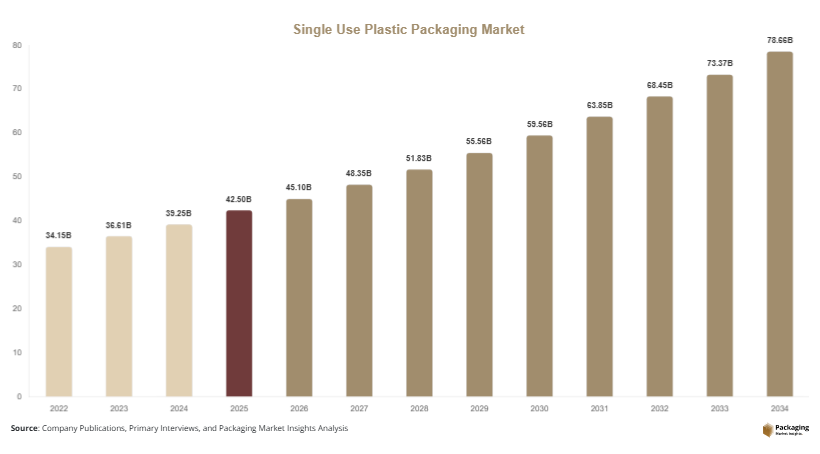
In 2025, the global single use plastic packaging market size is estimated at USD 42.5 billion, reflecting strong consumption of lightweight, cost-effective, and durable packaging solutions. By 2026, the market is projected to reach USD 45.1 billion, driven by rising urbanization and growth in packaged food consumption. Looking ahead, the market is forecasted to reach USD 78.9 billion by 2034, expanding at a CAGR of 7.2% during 2025–2034.
Key growth is influenced by several macroeconomic and industry-specific factors. First, the rapid expansion of e-commerce and last-mile delivery systems has significantly increased demand for protective and disposable packaging formats. Second, the global foodservice industry’s reliance on takeaway and ready-to-eat meals continues to boost consumption of single-use containers, wraps, and pouches. Third, pharmaceutical and healthcare sectors are increasingly adopting sterile, tamper-proof packaging formats to ensure product safety and compliance.
Key Highlights:
- The Single Use Plastic Packaging Market size in 2025 is USD 42.5 billion. This reflects strong demand from food delivery services, e-commerce packaging, and FMCG applications, where cost efficiency and convenience remain key priorities.
- In 2026, the market is projected to reach USD 45.1 billion, supported by steady growth in online retail penetration and increasing use of disposable packaging in urban consumption patterns across both developed and emerging economies.
- By 2034, the market is expected to attain a value of USD 78.9 billion, driven by expanding packaging requirements in food, healthcare, and logistics industries along with continuous material innovation.
- The market is forecasted to grow at a CAGR of 7.2% during 2025–2034, indicating consistent long-term expansion supported by structural shifts in consumer buying behavior and supply chain modernization.
- Strong demand from food delivery and e-commerce sectors continues to accelerate market growth, as businesses prioritize lightweight, protective, and low-cost packaging solutions for fast-moving supply chains.
- Additionally, increasing adoption in pharmaceutical packaging applications is contributing to market expansion, as the need for sterile, tamper-proof, and compliance-driven packaging solutions continues to rise globally.
Explore more data points, trends and opportunities Download Free Sample Report
Market Trends
Shift Toward Lightweight and Material-Efficient Packaging
One of the most prominent trends in the single use plastic packaging market is the shift toward lightweight and material-efficient packaging designs. Manufacturers are increasingly focusing on reducing plastic thickness while maintaining structural integrity and barrier properties. This trend is driven by cost optimization pressures and regulatory expectations aimed at reducing plastic waste. Companies are integrating advanced polymer blends that allow for reduced material usage without compromising durability. In addition, innovations in multilayer film technology are enabling better moisture and oxygen resistance, making lightweight packaging suitable for food, beverage, and healthcare applications. This shift also helps logistics providers reduce transportation costs due to lower package weight, thereby improving overall supply chain efficiency.
Integration of Smart and Functional Packaging Features
Another significant trend is the integration of smart and functional features into single-use plastic packaging formats. These include QR codes, freshness indicators, temperature sensors, and traceability tags that enhance consumer engagement and supply chain transparency. Food and pharmaceutical companies are adopting such features to ensure product authenticity and safety. This trend is also being fueled by digital transformation across retail and logistics sectors, where real-time tracking and product verification have become essential. As consumer awareness increases, packaging is evolving from a passive container into an interactive information platform, improving both brand communication and regulatory compliance.
Market Drivers
Expansion of E-commerce and Online Food Delivery
The rapid expansion of e-commerce and online food delivery platforms is a major driver of the single use plastic packaging market. Increasing consumer preference for doorstep delivery has created strong demand for durable, leak-proof, and lightweight packaging solutions. Single-use plastics are widely used in packaging food containers, courier bags, bubble wraps, and protective films due to their cost efficiency and versatility. The growth of quick-commerce services has further intensified demand for high-speed packaging solutions that ensure product safety during rapid transit. Additionally, small and medium businesses entering online retail ecosystems are adopting affordable plastic packaging formats to reduce operational costs and improve delivery efficiency.
Growth in Packaged Food and Pharmaceutical Industries
The increasing consumption of packaged and processed foods, along with the expansion of the pharmaceutical industry, is significantly boosting market growth. Single-use plastic packaging provides essential benefits such as hygiene, contamination prevention, and extended shelf life. In the pharmaceutical sector, blister packs, sterile wrappers, and disposable medical packaging are critical for maintaining drug integrity and patient safety. Rising global health awareness and increasing demand for over-the-counter medicines further support this trend. Additionally, food manufacturers are relying on plastic packaging for portion control, convenience, and branding purposes, making it a vital component of modern supply chains.
Market Restraint
Environmental Regulations and Plastic Waste Concerns
The primary restraint impacting the single use plastic packaging market is the growing implementation of environmental regulations aimed at reducing plastic waste. Governments across Europe, North America, and parts of Asia are introducing bans, taxes, and extended producer responsibility (EPR) policies targeting single-use plastics. These regulations are increasing compliance costs for manufacturers and encouraging a shift toward biodegradable and reusable alternatives. For example, several countries have restricted plastic straws, cutlery, and lightweight packaging films, directly impacting demand. Additionally, rising consumer awareness regarding environmental sustainability is pushing brands to adopt eco-friendly packaging solutions. This shift creates operational challenges for traditional plastic packaging manufacturers, requiring investment in recycling technologies and alternative materials to remain competitive in a tightening regulatory environment.
Market Opportunities
Development of Recyclable and Hybrid Plastic Materials
A significant opportunity in the market lies in the development of recyclable and hybrid plastic materials that combine performance with environmental compliance. Manufacturers are investing in advanced polymer engineering to produce plastics that are easier to recycle or partially biodegradable while retaining durability. These innovations are particularly important in food and pharmaceutical applications where safety standards are strict. The adoption of mono-material packaging structures is gaining traction as it simplifies recycling processes. Companies that successfully develop cost-effective sustainable alternatives are expected to gain a competitive advantage, especially in regions with strict environmental regulations.
Growth in Emerging Economies and Retail Expansion
Emerging economies present strong growth opportunities due to rapid urbanization, rising disposable income, and expanding retail infrastructure. Countries in Asia Pacific, Latin America, and parts of Africa are experiencing increased demand for packaged consumer goods, driving the need for affordable and scalable packaging solutions. Single-use plastic packaging remains widely adopted in these regions due to its low cost and availability. Additionally, the growth of organized retail and supermarket chains is increasing packaged product penetration. This creates a favorable environment for packaging manufacturers to expand production capacity and distribution networks in high-growth developing markets.
Report Scope
| Report Metric | Details |
|---|---|
| Market Size in 2025 | USD 42.5 Billion |
| Market Size in 2026 | USD 45.1 Billion |
| Market Size in 2034 | USD 78.9 Billion |
| CAGR | 7.2% (2026-2034) |
| Base Year for Estimation | 2025 |
| Historical Data | 2022-2024 |
| Forecast Period | 2026-2034 |
| Report Coverage | Revenue Forecast, Competitive Landscape, Supply Chain Disruption, Growth Factors, Environment & Regulatory Landscape and Trends |
| Geographies Covered | North America, Europe, APAC, Middle East and Africa, LATAM |
| Countries Covered | U.S., Canada, U.K., Germany, France, Spain, Italy, Russia, Nordic, Benelux, Rest of Europe, China, South Korea, Japan, India, Australia, Singapore, Taiwan, South East Asia, Rest of Asia-Pacific, UAE, Turky, Saudi Arabia, South Africa, Egypt, Nigeria, Rest of MEA, Brazil, Mexico, Argentina, Chile, Colombia, Rest of LATAM |
Explore more data points, trends and opportunities Download Free Sample Report
Segmental Analysis
By Material Type
Polyethylene dominates the market with approximately 38% share in 2024, driven by its flexibility, durability, and cost efficiency. It is widely used in packaging films, bags, and wraps across food and retail industries. Its adaptability to different packaging formats makes it the preferred choice among manufacturers.
Polypropylene is the fastest-growing subsegment with a CAGR of 7.9%, supported by its high heat resistance and suitability for microwave-safe food packaging. Rising demand for ready-to-eat meals and convenience food products is significantly boosting polypropylene adoption across global markets.
By Packaging Type
Plastic films hold the dominant share of 41% in 2024, driven by extensive use in wrapping, sealing, and protective packaging applications. Their lightweight structure and barrier properties make them essential in food and industrial packaging.
Plastic containers are the fastest-growing subsegment with a CAGR of 7.5%, fueled by rising demand from food delivery services and takeaway packaging. The expansion of quick-service restaurants is further strengthening container demand.
By End-Use Industry
Food & Beverage leads with 46% market share in 2024, driven by high consumption of packaged food, beverages, and frozen products. Plastic packaging ensures hygiene, shelf-life extension, and cost efficiency.
E-commerce is the fastest-growing subsegment with a CAGR of 8.3%, supported by rapid expansion of online retail platforms and increasing demand for protective shipping materials.
Single Use Plastic Packaging Market Segmentations
By Material Type
- Polyethylene
- Polypropylene
- PVC
- Others
By Packaging Type
- Bags
- Films
- Containers
- Wraps
- Pouches
By End-Use Industry
- Food & Beverage
- Healthcare
- E-commerce
- Retail
- Industrial
Regional Analysis
North America
North America holds approximately 25% market share in 2025, with a projected CAGR of 6.8% during the forecast period. The region benefits from advanced logistics infrastructure and strong demand from e-commerce and food delivery sectors. High consumption of packaged food and beverages further supports market expansion across the United States and Canada.
The United States dominates the regional market due to its large retail ecosystem and high penetration of online food delivery services. A key growth factor is the increasing adoption of convenience-driven packaging formats in urban households, where on-the-go consumption is widely prevalent.
Europe
Europe accounts for nearly 22% market share in 2025, growing at a CAGR of 6.2%. The region’s market is influenced by strict environmental regulations, which are shaping product innovation and material substitution trends. Despite regulatory pressure, demand remains steady in pharmaceuticals and food packaging sectors.
Germany leads the European market due to its strong manufacturing base. A key growth factor is the increasing investment in recyclable plastic technologies aimed at aligning with EU sustainability directives.
Asia Pacific
Asia Pacific dominates with 34% market share in 2025 and is expected to grow at a CAGR of 8.1%. Rapid urbanization, population growth, and expansion of retail and e-commerce sectors are major growth drivers. The region also benefits from cost-effective manufacturing capabilities.
China is the leading country in this region due to its massive packaging production ecosystem. A key growth factor is the rapid expansion of online retail platforms and food delivery services.
Middle East & Africa
The Middle East & Africa region holds around 10% market share in 2025, with a CAGR of 6.5%. Growth is driven by increasing retail penetration and tourism-related consumption of packaged goods. Infrastructure development is also supporting packaging demand.
The United Arab Emirates dominates the region due to its advanced retail and hospitality sectors. A key growth factor is the rising demand for convenient packaged food in urban centers and tourist destinations.
Latin America
Latin America accounts for 9% market share in 2025, growing at a CAGR of 6.7%. Expansion of supermarkets and growing food processing industries are key contributors to market growth. Brazil and Mexico are the leading markets in the region.
Brazil leads due to its strong agricultural and food export industry. A key growth factor is the increasing demand for packaged and processed food products in urban households.
Competitive Landscape
The single use plastic packaging market is moderately fragmented with strong participation from global and regional players. Key companies include Amcor Plc, Berry Global Inc., Sealed Air Corporation, Mondi Group, and Huhtamaki Oyj. Among these, Amcor Plc remains a leading player due to its extensive product portfolio and global manufacturing footprint. The company continues to invest in recyclable packaging solutions and lightweight material innovation to align with sustainability trends. Recent developments include expansion of sustainable flexible packaging facilities and partnerships with FMCG brands to improve recyclability rates across product lines.
Key Players List
- Amcor Plc
- Berry Global Inc.
- Sealed Air Corporation
- Mondi Group
- Huhtamaki Oyj
- Coveris Holdings
- Plastipak Holdings
- Winpak Ltd.
- Constantia Flexibles
- Uflex Ltd.
- Novolex Holdings
- Clondalkin Group
- Sigma Plastics Group
- Greif Inc.
- Pactiv Evergreen Inc.
- DS Smith Plc