Flexible Films Market Size and Growth
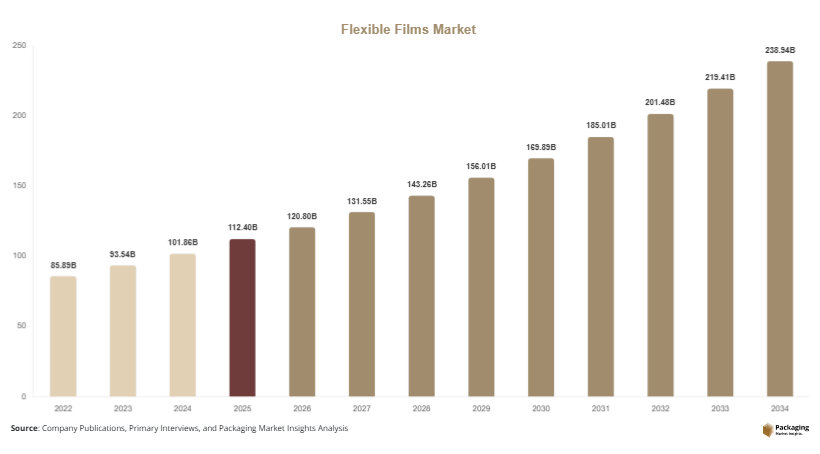
In 2025, the global flexible films market size is estimated at approximately USD 112.4 billion. By 2026, it is expected to reach around USD 120.8 billion, reflecting stable growth driven by packaging demand recovery and expansion in e-commerce logistics. By 2034, the market is projected to reach nearly USD 235.6 billion, growing at a CAGR of 8.9% from 2025 to 2034. The flexible films market is experiencing steady expansion due to rising demand from packaging-intensive industries such as food and beverages, pharmaceuticals, personal care, and industrial goods. Flexible films, which include plastic-based and biodegradable thin films, are widely used for packaging, lamination, wrapping, and protective applications due to their lightweight nature, durability, and cost efficiency.
Several growth factors are contributing to this market expansion. First, the rapid rise of online retail and home delivery services is increasing demand for protective and tamper-resistant packaging films. Second, growing consumption of packaged food products is driving adoption of high-barrier flexible films that extend shelf life and maintain product freshness. Third, advancements in material science, including bio-based polymers and recyclable multilayer films, are supporting sustainable packaging transitions across industries.
Key Highlights:
- Market size (2025): USD 112.4 billion, driven by strong demand from food packaging, e-commerce logistics, and increasing adoption of flexible and lightweight packaging materials across global industries. Growth is supported by expanding manufacturing capacity.
- Market size (2026): USD 120.8 billion, reflecting steady expansion due to rising consumption of packaged goods and increased use of high-performance flexible films in industrial and retail applications. Infrastructure improvements also support this growth.
- Forecast size (2034): USD 235.6 billion, indicating strong long-term expansion as sustainable packaging, recyclable films, and advanced multilayer technologies become widely adopted across multiple end-use industries globally.
- CAGR (2025–2034): 8.9%, supported by continuous innovation in biodegradable materials, rising e-commerce penetration, and increasing demand for cost-effective and high-barrier packaging solutions across developed and emerging markets.
- Strong growth in sustainable and recyclable film materials, driven by environmental regulations and corporate sustainability commitments. Manufacturers are increasingly shifting toward bio-based polymers and recyclable mono-material structures.
- Rising demand from food, beverage, and e-commerce sectors, supported by increasing consumption of packaged goods and rapid expansion of online retail platforms requiring durable and protective packaging solutions.
- Increasing adoption of high-barrier and multilayer films, due to their ability to enhance shelf life, preserve product quality, and provide resistance against moisture, oxygen, and external contamination.
Explore more data points, trends and opportunities Download Free Sample Report
Market Trends
Shift Toward Sustainable and Bio-Based Flexible Films
The flexible films market is witnessing a significant shift toward sustainable and bio-based materials driven by environmental regulations and consumer preference for eco-friendly packaging. Manufacturers are increasingly adopting biodegradable polymers, compostable films, and recyclable mono-material structures to reduce environmental impact. This transition is particularly strong in Europe and North America, where strict packaging waste regulations are in place. Companies are investing in R&D to develop films with comparable strength and barrier properties to conventional plastics. This trend is also supported by FMCG brands committing to reduce virgin plastic usage and increase recycled content in packaging formats across product portfolios.
Growth of High-Barrier and Multilayer Film Technologies
Another major trend is the growing adoption of high-barrier multilayer flexible films designed to enhance product protection and shelf life. These films combine different polymer layers to provide resistance against moisture, oxygen, and light, making them ideal for food, pharmaceuticals, and sensitive industrial applications. The demand for longer shelf life and reduced food wastage is accelerating the use of advanced barrier films. Additionally, innovations in co-extrusion and nanotechnology-based coatings are improving film performance without significantly increasing thickness or material usage. This trend is helping manufacturers achieve both cost efficiency and performance optimization.
Market Drivers
Expanding Food and Beverage Packaging Demand
The food and beverage industry is one of the strongest drivers of the flexible films market, as packaged food consumption continues to rise globally. Urbanization, changing lifestyles, and increasing demand for convenience foods are contributing to higher usage of flexible packaging solutions. Flexible films are widely used for snack packaging, frozen foods, dairy products, and ready-to-eat meals due to their lightweight structure and ability to preserve freshness. The growing demand for hygienic and tamper-proof packaging is further strengthening adoption. In emerging economies, rising disposable incomes are also increasing consumption of packaged goods, thereby expanding the demand for flexible film packaging materials.
Expansion of E-commerce and Logistics Packaging
The rapid growth of e-commerce platforms is significantly driving demand for flexible films used in protective packaging applications. Online retail requires durable, lightweight, and cost-effective packaging materials to ensure product safety during transit. Flexible films are widely used in courier bags, bubble wraps, shrink films, and protective laminates. The increase in cross-border e-commerce and last-mile delivery services is further boosting consumption. Additionally, logistics companies are focusing on reducing shipping costs by adopting lightweight packaging materials, which directly benefits flexible film manufacturers. This trend is expected to remain strong as digital commerce continues to expand globally.
Market Restraint
One of the major restraints affecting the flexible films market is the environmental concern associated with plastic waste accumulation and regulatory restrictions on single-use plastics. Governments across multiple regions are implementing strict policies that limit the use of non-recyclable plastic films, creating challenges for traditional flexible film manufacturers. For instance, bans on single-use plastic packaging in several countries are forcing companies to redesign their product portfolios and invest in sustainable alternatives, which increases production costs. Additionally, recycling infrastructure limitations in developing regions reduce the efficiency of flexible film waste management. These factors collectively create operational and compliance challenges, slowing down market growth in certain segments despite increasing demand for packaging solutions.
Market Opportunities
Development of Advanced Recyclable Mono-Material Films
The growing demand for sustainable packaging presents a strong opportunity in the flexible films market through the development of recyclable mono-material films. These films are designed using a single polymer type, making them easier to recycle compared to traditional multilayer structures. Companies are investing in advanced polymer engineering to maintain barrier performance while ensuring recyclability. This innovation is gaining traction in food and FMCG packaging applications where sustainability targets are becoming mandatory. As regulatory pressure increases, mono-material flexible films are expected to replace conventional multi-layer non-recyclable formats, creating long-term growth potential for manufacturers.
Expansion in Emerging Economies Packaging Industry
Emerging economies offer substantial growth opportunities due to rapid industrialization, urbanization, and expansion of organized retail. Countries in Asia Pacific, Latin America, and Africa are witnessing increasing demand for packaged food, pharmaceuticals, and consumer goods, all of which rely heavily on flexible films. Additionally, improvements in cold chain logistics and retail infrastructure are supporting wider adoption of flexible packaging solutions. Local manufacturers are also expanding production capabilities to meet rising domestic demand. With increasing foreign investments and government support for packaging industries, these regions are expected to become key growth hubs for flexible film manufacturers.
Report Scope
| Report Metric | Details |
|---|---|
| Market Size in 2025 | USD 112.4 Billion |
| Market Size in 2026 | USD 120.8 Billion |
| Market Size in 2034 | USD 235.6 Billion |
| CAGR | 8.9% (2026-2034) |
| Base Year for Estimation | 2025 |
| Historical Data | 2022-2024 |
| Forecast Period | 2026-2034 |
| Report Coverage | Revenue Forecast, Competitive Landscape, Supply Chain Disruption, Growth Factors, Environment & Regulatory Landscape and Trends |
| Geographies Covered | North America, Europe, APAC, Middle East and Africa, LATAM |
| Countries Covered | U.S., Canada, U.K., Germany, France, Spain, Italy, Russia, Nordic, Benelux, Rest of Europe, China, South Korea, Japan, India, Australia, Singapore, Taiwan, South East Asia, Rest of Asia-Pacific, UAE, Turky, Saudi Arabia, South Africa, Egypt, Nigeria, Rest of MEA, Brazil, Mexico, Argentina, Chile, Colombia, Rest of LATAM |
Explore more data points, trends and opportunities Download Free Sample Report
Segmental Analysis
By Material Type
Polyethylene (PE) films dominate the flexible films market with approximately 41% share in 2024 due to their versatility, low cost, and wide usage in packaging applications. PE films are extensively used in food wrapping, industrial packaging, and retail bags. Their flexibility and moisture resistance make them highly suitable for mass-market packaging solutions.
The fastest-growing subsegment is biodegradable and bio-based films, projected to grow at a CAGR of 11.6%, driven by environmental regulations and increasing demand for sustainable packaging alternatives across FMCG and food industries.
By Application
Packaging applications dominate the market with around 58% share in 2024, supported by rising demand for flexible packaging in food, beverage, and healthcare sectors. Flexible films provide durability, protection, and extended shelf life, making them essential in packaging solutions.
Shrink films represent the fastest-growing subsegment with a CAGR of 9.8%, driven by increasing use in logistics, product bundling, and tamper-evident packaging in retail and e-commerce sectors.
By End-Use Industry
The food and beverage industry dominates with approximately 44% share in 2024 due to high consumption of packaged food products and demand for extended shelf-life solutions. Flexible films are widely used for snacks, frozen foods, and beverages.
The e-commerce sector is the fastest-growing end-use segment, expanding at a CAGR of 10.5% due to rising online retail penetration and increasing demand for protective and lightweight packaging materials.
Flexible Films Market Segmentations
By Material Type
- Polyethylene (PE) Films
- Polypropylene (PP) Films
- Polyvinyl Chloride (PVC) Films
- Polyester (PET) Films
- Biodegradable & Bio-Based Films
By Application
- Packaging Films
- Shrink Films
- Stretch Films
- Lamination Films
- Protective Films
By End-Use Industry
- Food & Beverage
- Healthcare & Pharmaceuticals
- E-commerce & Retail
- Industrial Packaging
- Personal Care & Cosmetics
Regional Analysis
North America
North America holds approximately 27% market share in 2025 and is projected to grow at a CAGR of 8.4%. The region benefits from advanced packaging technologies and strong demand from food and pharmaceutical sectors.
The United States dominates the market, driven by strong e-commerce growth and increasing adoption of sustainable packaging films in FMCG and retail industries.
Europe
Europe accounts for around 29% market share in 2025 with a CAGR of 8.7%. Strict environmental regulations and circular economy initiatives are key growth drivers in the region.
Germany leads the market due to strong chemical and packaging manufacturing capabilities and increasing adoption of recyclable mono-material flexible films.
Asia Pacific
Asia Pacific holds nearly 32% market share in 2025 and is expected to grow at a CAGR of 10.2%, the fastest globally.
China dominates the region, supported by large-scale packaging production, growing e-commerce penetration, and expanding food processing industries.
Middle East & Africa
Middle East & Africa accounts for about 7% market share in 2025 with a CAGR of 8.5%. Growth is driven by retail expansion and improving packaging infrastructure.
The UAE leads the region due to strong logistics development and increasing investment in modern food packaging and retail distribution systems.
Latin America
Latin America holds around 5% market share in 2025 and is projected to grow at a CAGR of 8.8%. Rising packaged food consumption and retail modernization are supporting growth.
Brazil dominates the region due to its strong food processing industry and increasing demand for flexible packaging materials in consumer goods.
Competitive Landscape
The flexible films market is highly competitive with the presence of global packaging giants and regional manufacturers focusing on innovation and capacity expansion. Key players include Amcor plc, Berry Global Inc., Sealed Air Corporation, Mondi Group, and Huhtamaki Oyj. Amcor plc remains a leading player due to its extensive global footprint and strong focus on sustainable packaging solutions. Recently, the company expanded its recyclable flexible film portfolio through new mono-material product launches and strategic partnerships with FMCG brands, strengthening its position in the sustainable packaging ecosystem.
Key Players List
- Amcor plc
- Berry Global Inc.
- Sealed Air Corporation
- Mondi Group
- Huhtamaki Oyj
- Constantia Flexibles
- Coveris Holdings
- Uflex Ltd.
- Toray Industries Inc.
- Jindal Poly Films Ltd.
- Winpak Ltd.
- Cosmo Films Ltd.
- Mitsubishi Chemical Group
- Taghleef Industries
- Polyplex Corporation Ltd.