Market Overview
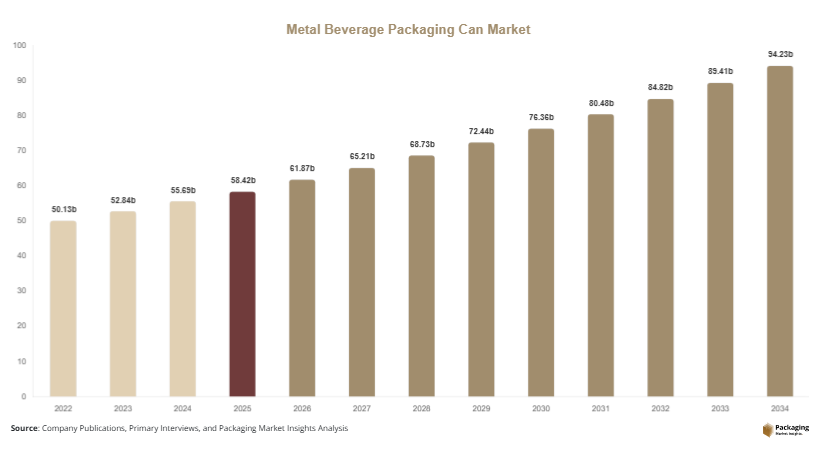
The global metal beverage packaging can market size was valued at USD 58.42 billion in 2025 and is estimated to reach USD 61.87 billion in 2026, growing further to USD 94.16 billion by 2034, expanding at a compound annual growth rate (CAGR) of 5.4% from 2025 to 2034. Metal beverage cans, primarily manufactured from aluminum and tinplate steel, remain a preferred packaging format across carbonated soft drinks, beer, energy drinks, ready-to-drink coffee and tea, and hard seltzer categories. The market's steady growth trajectory reflects a combination of consumer preference shifts, sustainability mandates, and continuous innovation in can design, coating technology, and lightweighting.
Rising environmental consciousness among consumers and regulators stands as a foundational growth factor, since metal cans are widely recognized as one of the most recyclable packaging formats available, supporting circular economy initiatives across developed and emerging economies. A second growth factor is the accelerating global demand for on-the-go and convenience beverages, particularly among younger demographics who favor portable, resealable, and easily chillable packaging over glass bottles. A third growth factor stems from beverage manufacturers actively transitioning away from plastic packaging in response to extended producer responsibility regulations and plastic tax frameworks introduced across Europe, parts of Asia Pacific, and North America. Additionally, the craft beer and premium alcoholic beverage segments increasingly favor cans for their branding flexibility, UV protection, and reduced breakage during transport, further reinforcing market expansion.
Key Highlights:
- North America dominated the metal beverage packaging can market with the largest market share of 34.62% in 2025.
- Asia Pacific is expected to be the fastest-growing regional market during the forecast period, registering a CAGR of 7.18%.
- The aluminum segment dominated the market by material type, accounting for 68.45% of the market share in 2025.
- The standard/regular cans segment led the market by can type with a 54.27% share in 2025.
- The beer segment accounted for the largest application share at 38.91% in 2025.
- Off-trade retail channels dominated the market by end-use distribution, holding a 61.33% share in 2025.
- The U.S. metal beverage packaging can market was valued at USD 16.72 billion in 2025 and is projected to reach USD 17.64 billion in 2026.
Explore more data points, trends and opportunities Download Free Sample Report
Market Trends
Rising Adoption of Slim and Sleek Can Formats for Premium Positioning
Beverage brands across energy drinks, hard seltzers, and premium alcoholic categories are increasingly adopting slim and sleek can formats to create shelf differentiation and appeal to style-conscious consumers. These formats allow for enhanced graphic real estate, improved ergonomic grip, and a premium unboxing experience compared to standard cylindrical cans. Manufacturers are responding by expanding tooling capabilities to accommodate multiple can heights and diameters within a single production line. This trend is particularly visible in urban retail environments and convenience store cooler sets, where visual distinctiveness directly influences purchase decisions, prompting can suppliers to prioritize flexible manufacturing over pure volume output.
Integration of Smart and Interactive Packaging Technologies
Metal can producers are incorporating QR codes, augmented reality triggers, and near-field communication (NFC) tags directly onto can surfaces to strengthen consumer engagement and traceability. These smart packaging features enable brands to share sourcing information, run interactive marketing campaigns, and support anti-counterfeiting efforts, particularly within the premium spirits and craft beverage segments. This trend is gaining traction alongside growing investments in digital printing presses that allow variable data printing at commercial scale, giving beverage companies the ability to launch limited-edition and regionally customized can designs without disrupting existing production economics or extending lead times significantly.
Market Drivers
Stringent Plastic Packaging Regulations Accelerating Metal Can Substitution
Government-led restrictions on single-use plastics, including extended producer responsibility fees and plastic packaging taxes across the European Union, United Kingdom, and select Asia Pacific markets, are compelling beverage manufacturers to reassess packaging portfolios. Metal cans, with recycling rates exceeding those of most plastic alternatives, offer a compliant and consumer-accepted substitution pathway. Major beverage companies have publicly committed to increasing recycled content and reducing virgin plastic usage, directing incremental volumes toward aluminum and tinplate steel cans. This regulatory-driven substitution is expected to sustain double-digit growth in select product categories through the forecast period, reinforcing the metal beverage packaging can market's structural expansion.
Expanding Craft Beer, Hard Seltzer, and Ready-to-Drink Beverage Categories
The proliferation of craft breweries, hard seltzer brands, and ready-to-drink cocktail and coffee products has created substantial incremental demand for metal cans, particularly in North America and Europe. Cans offer superior protection against light and oxygen exposure compared to glass, preserving flavor integrity for hop-forward and carbonated beverages while reducing spoilage risk during distribution. Smaller and independent beverage producers also favor cans due to lower minimum order quantities, faster co-packing turnaround, and reduced logistics costs from lighter weight and stackability. This category diversification broadens the addressable customer base for can manufacturers beyond traditional soft drink and mainstream beer clients.
Market Restraint
Volatility in Aluminum and Tinplate Raw Material Prices
Fluctuating prices of aluminum and tinplate steel, driven by global commodity market instability, energy cost variability, and geopolitical trade tensions, represent a persistent restraint on the metal beverage packaging can market. Aluminum, which accounts for the majority share of raw material input in can manufacturing, is subject to price swings linked to bauxite mining disruptions, smelting energy costs, and international tariff policies. These fluctuations compress profit margins for can manufacturers operating on long-term fixed-price supply contracts with beverage companies, limiting their ability to pass cost increases downstream without renegotiation delays. For example, tariff adjustments on imported aluminum in major consuming economies have previously triggered short-term cost spikes exceeding double-digit percentages within a single fiscal quarter, forcing manufacturers to absorb losses or accelerate hedging strategies. Smaller regional can producers with limited procurement scale face heightened exposure to these price shocks compared to vertically integrated global players, creating competitive imbalances. Additionally, recycled aluminum supply constraints in certain regions add further unpredictability, as demand for recycled content packaging often outpaces available scrap aluminum processing capacity, indirectly elevating input costs and complicating long-term production planning for manufacturers across both developed and emerging markets.
Market Opportunities
Expansion of Can Manufacturing Infrastructure in Emerging Economies
Rapid urbanization, rising disposable incomes, and growing modern retail penetration across Southeast Asia, Latin America, and parts of Africa present substantial opportunities for can manufacturers to establish localized production facilities. Beverage consumption patterns in these regions are shifting toward packaged and branded products, reducing dependence on unbranded or bulk beverage formats. Local manufacturing investment reduces import dependency, lowers transportation costs, and enables faster response to regional flavor and format preferences. Global can producers entering joint ventures with regional beverage bottlers can capture first-mover advantages in markets where per-capita can consumption remains considerably below levels observed in mature economies, indicating substantial headroom for volume growth.
Growth of Recycled and Low-Carbon Aluminum Can Production
Increasing beverage brand commitments to sustainability targets are creating opportunities for can manufacturers that can supply high-recycled-content or low-carbon aluminum cans. Investments in advanced sorting, cleaning, and remelting technologies allow producers to increase recycled aluminum utilization while maintaining structural and aesthetic quality standards required for premium branding. Manufacturers that develop closed-loop recycling partnerships with beverage companies and municipal recycling programs can secure long-term supply agreements and premium pricing positioning. This opportunity is particularly relevant as corporate sustainability disclosures become standardized, prompting beverage companies to favor suppliers capable of verifying recycled content percentages and carbon footprint reductions across their packaging supply chains.
Report Scope
| Report Metric | Details |
|---|---|
| Market Size in 2025 | USD 58.42 billion |
| Market Size in 2026 | USD 61.87 billion |
| Market Size in 2034 | USD 94.16 billion |
| CAGR | 5.4% (2026-2034) |
| Base Year for Estimation | 2025 |
| Historical Data | 2022-2024 |
| Forecast Period | 2026-2034 |
| Report Coverage | Revenue Forecast, Competitive Landscape, Supply Chain Disruption, Growth Factors, Environment & Regulatory Landscape and Trends |
| Geographies Covered | North America, Europe, APAC, Middle East and Africa, LATAM |
| Countries Covered | U.S., Canada, U.K., Germany, France, Spain, Italy, Russia, Nordic, Benelux, Rest of Europe, China, South Korea, Japan, India, Australia, Singapore, Taiwan, South East Asia, Rest of Asia-Pacific, UAE, Turky, Saudi Arabia, South Africa, Egypt, Nigeria, Rest of MEA, Brazil, Mexico, Argentina, Chile, Colombia, Rest of LATAM |
Explore more data points, trends and opportunities Download Free Sample Report
Segmental Analysis
By Material Type
The aluminum segment dominated the metal beverage packaging can market with a share of 68.45% in 2025, driven by its lightweight properties, superior recyclability, and widespread compatibility with high-speed canning lines used across global beverage manufacturing facilities. Aluminum cans offer beverage companies significant advantages including reduced transportation costs due to lower material weight, faster chilling times that enhance consumer convenience, and strong barrier protection against light and oxygen that preserves product freshness. The segment's dominance is further reinforced by extensive recycling infrastructure already established across North America and Europe, where aluminum can recovery rates substantially exceed those of competing packaging materials, making it the preferred choice for sustainability-focused beverage brands.
The tinplate steel segment is projected to register a comparatively higher niche growth rate within select regional markets, supported by cost advantages in certain emerging economies where aluminum supply chains remain less developed. Growth in this subsegment, expected at a CAGR of approximately 4.2% through the forecast period, is driven by continued steel can usage in energy drink and specialty beverage categories across parts of Asia Pacific and Eastern Europe, where existing manufacturing infrastructure and lower relative material costs support continued production despite the broader industry shift toward aluminum formats among multinational beverage brands.
By Can Type
The standard/regular cans segment dominated the market with a share of 54.27% in 2025, reflecting its widespread use across mainstream carbonated soft drink and beer categories where established sizing standards align with existing retail shelf configurations and vending infrastructure. Standard cans benefit from manufacturing economies of scale, as high-volume production lines optimized for consistent dimensions reduce per-unit costs for beverage companies operating across broad distribution networks. This segment's continued dominance is supported by strong consumer familiarity and retailer preference for standardized packaging that simplifies inventory management and shelf planning across grocery, convenience, and foodservice channels globally.
The slim and sleek cans segment is projected to expand at the fastest CAGR of 6.8% through 2034, driven by rising demand for premium positioning within energy drink, hard seltzer, and functional beverage categories. Growth in this subsegment is fueled by beverage brands seeking differentiated shelf presence and improved ergonomic appeal among younger consumer demographics who associate slimmer formats with premium and lifestyle-oriented products. Manufacturers are increasingly investing in flexible tooling capable of producing multiple can profiles, enabling faster market response to evolving brand packaging strategies without requiring dedicated production lines for each format variation.
By Application
The beer segment dominated the metal beverage packaging can market with a share of 38.91% in 2025, supported by the format's established role in the global brewing industry and its growing adoption among craft and independent breweries seeking cost-efficient, portable packaging alternatives to glass bottles. Cans offer brewers enhanced protection against light-induced flavor degradation while reducing breakage risk during distribution, making them particularly suitable for outdoor events, sports venues, and recreational settings. The segment's continued leadership is reinforced by major global brewing companies expanding canned product lines across both mainstream and premium beer categories in response to shifting consumer packaging preferences worldwide.
The energy drinks and functional beverages segment is projected to grow at the fastest CAGR of 6.5% through the forecast period, driven by rising global consumer interest in performance, wellness, and functional beverage categories among younger and health-conscious demographics. Growth in this subsegment is supported by expanding product innovation including added vitamins, adaptogens, and low-sugar formulations, which beverage companies package predominantly in cans due to the format's compatibility with vibrant branding and portability requirements. Rising disposable incomes across emerging markets further support increased consumption frequency within this rapidly expanding beverage category.
Metal Beverage Packaging Can Market Segmentations
Material Type
- Aluminum
- Tinplate Steel
Can Type
- Standard/Regular Cans
- Slim Cans
- Sleek Cans
- Specialty/Shaped Cans
Application
- Beer
- Carbonated Soft Drinks
- Energy Drinks and Functional Beverages
- Ready-to-Drink Coffee and Tea
- Hard Seltzers and Alcoholic RTDs
Distribution Channel
- Off-Trade (Retail, Supermarkets, Convenience Stores)
- On-Trade (Bars, Restaurants, Hospitality)
Region
- North America
- Europe
- Asia Pacific
- Middle East & Africa
- Latin America
Regional Analysis
North America
North America held a market share of 34.62% in 2025 and is projected to expand at a CAGR of 4.6% through 2034, supported by established beverage industry infrastructure and high per-capita can consumption. The region benefits from mature recycling systems, widespread retail distribution networks, and strong consumer familiarity with canned beverage formats across multiple categories including soft drinks, beer, and functional beverages.
The United States dominates the regional market, driven by the rapid expansion of hard seltzer, energy drink, and craft beer segments alongside strong retailer preference for lightweight, stackable packaging that reduces shipping costs. Growing consumer demand for sustainable packaging alternatives has further encouraged major beverage brands to shift additional product lines from plastic bottles to aluminum cans across grocery and convenience retail channels nationwide.
Europe
Europe accounted for a market share of 24.15% in 2025, with a projected CAGR of 5.1% during the forecast period, reflecting the region's aggressive sustainability regulations and circular economy commitments. Extended producer responsibility schemes and deposit return systems implemented across multiple European countries have strengthened aluminum can recycling infrastructure, reinforcing the format's environmental credentials among regulators and consumers alike.
Germany leads the regional market, supported by its established deposit return scheme and high consumer recycling participation rates that exceed most global benchmarks. The country's strong beer culture, combined with growing demand for canned non-alcoholic and functional beverages, continues to drive incremental volume growth across both domestic production and export-oriented beverage manufacturing facilities.
Asia Pacific
Asia Pacific held a market share of 26.78% in 2025 and is expected to register the fastest CAGR of 7.18% through 2034, driven by rising urbanization, expanding modern retail infrastructure, and growing middle-class beverage consumption. The region's large population base and increasing preference for packaged beverages over traditional formats provide substantial long-term volume growth potential for can manufacturers.
China dominates the regional market, supported by extensive domestic beverage manufacturing capacity and government initiatives promoting recyclable packaging materials over single-use plastics. Rising disposable incomes and expanding convenience store networks across Chinese urban centers continue to accelerate demand for canned soft drinks, ready-to-drink tea, and emerging functional beverage categories among younger consumers.
Middle East & Africa
Middle East & Africa represented a market share of 7.24% in 2025, with a projected CAGR of 5.9% through the forecast period, reflecting gradual modernization of regional beverage retail infrastructure and rising foreign direct investment in local bottling operations. Growing tourism-driven beverage consumption and expanding hospitality sectors further support incremental demand across key urban markets in the region.
Saudi Arabia leads regional consumption, supported by large-scale infrastructure investments and a rapidly growing non-alcoholic beverage sector driven by demographic youth trends. Government economic diversification programs promoting local manufacturing capacity have encouraged beverage companies to establish domestic canning facilities, reducing reliance on imported packaged beverage products across the broader Gulf Cooperation Council region.
Latin America
Latin America accounted for a market share of 7.21% in 2025 and is projected to grow at a CAGR of 5.3% through 2034, supported by strong regional beer consumption traditions and expanding soft drink manufacturing capacity. Rising middle-class populations across major economies continue to drive increased packaged beverage consumption relative to informal or unbranded alternatives.
Brazil dominates the regional market, supported by its position as one of the largest global beer-producing nations and growing consumer preference for canned formats over returnable glass bottles. Expanding recycling infrastructure investment and government-backed sustainability initiatives across Brazilian municipalities continue to strengthen the long-term viability of aluminum can adoption throughout the broader Latin American beverage industry.
Competitive Landscape
The metal beverage packaging can market features a moderately consolidated competitive structure, with a small number of globally integrated manufacturers accounting for a substantial share of total production capacity, alongside numerous regional and specialty can producers serving localized beverage industry demand. Leading companies compete primarily on manufacturing scale, sustainability credentials, recycled content capabilities, and design innovation, including specialty formats and advanced printing technologies that support premium brand positioning.
Ball Corporation maintains a leading position within the global market, supported by extensive manufacturing capacity across multiple continents and continued investment in sustainable aluminum sourcing partnerships. The company recently expanded production capabilities at select facilities to support growing demand from energy drink and hard seltzer beverage clients, reinforcing its position as a preferred supplier among multinational beverage brands seeking reliable, high-volume can production alongside verified recycled content offerings across diverse regional markets.
Key Players
- Ball Corporation
- Crown Holdings, Inc.
- Ardagh Group S.A.
- CANPACK Group
- Toyo Seikan Group Holdings, Ltd.
- Envases Universales de Mexico
- Nampak Ltd.
- CPMC Holdings Limited
- Silgan Holdings Inc.
- Kingcan Holdings Limited
- Universal Can Corporation
- Trivium Packaging
- Show-Ho Manufacturing Co., Ltd.
- Colep Packaging
- Baosteel Packaging Co., Ltd.
- Massilly Group
- Boway Alloy Aluminum