Meat Packaging Market Size
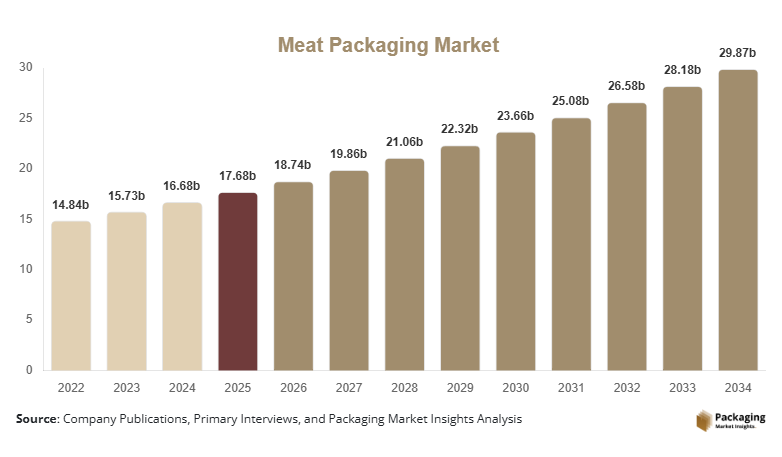
Meat Packaging market size is projected at USD 18.74 billion in 2026 and is expected to hit USD 29.85 billion by 2034 with a CAGR of 6.00%. The market is expanding due to increasing consumption of packaged meat products, stricter food safety regulations, and wider adoption of advanced packaging technologies across retail and foodservice channels. The report evaluates market segmentation, production trends, consumption patterns, competitive landscape, and regional performance across the forecast period.
The meat packaging market comprises packaging materials, machinery, and technologies designed to preserve the freshness, quality, and shelf life of fresh, frozen, and processed meat products. Global meat production exceeded 370 million metric tons, while packaged meat accounts for nearly 68% of organized retail meat sales worldwide. Plastic-based solutions contribute approximately 71% of total packaging consumption, whereas vacuum and modified atmosphere packaging together represent more than 52% of premium meat packaging applications. Growing urbanization, retail penetration above 75% in developed economies, and increasing demand for hygienic packaged meat continue to strengthen the meat packaging market.
Explore more data points, trends and opportunities Download Free Sample Report
Meat Packaging Trends
Rising Adoption of Sustainable and High-Barrier Packaging
Manufacturers are increasingly adopting recyclable mono-material films, high-barrier laminates, and bio-based packaging materials to improve sustainability while maintaining product freshness. More than 210 billion meat packages are produced annually, with recyclable solutions recording adoption rates above 24% in developed markets. High-barrier films reduce oxygen transmission by over 90%, extending product shelf life by 30–60%, reinforcing the meat packaging market.
Automation across packaging facilities is accelerating through robotic sealing, smart inspection systems, and digital traceability. Nearly 58% of large meat processors have integrated automated packaging lines capable of processing over 180 packs per minute, while RFID and QR-enabled labels continue gaining traction for supply-chain visibility. Rising investments in intelligent packaging technologies continue supporting the meat packaging market.
Meat Packaging Drivers
Growing Demand for Safe and Extended Shelf-Life Meat Products
Food safety regulations and consumer preference for hygienically packed meat are major growth drivers. Vacuum packaging can increase refrigerated shelf life from 7 days to over 30 days, while modified atmosphere packaging extends freshness by nearly 50%. More than 65% of packaged meat sold through supermarkets utilizes advanced preservation technologies. Increasing retail meat consumption and exports continue supporting meat packaging market growth.
Meat Packaging Restraints
Volatility in Raw Material Prices
Fluctuations in polyethylene, polypropylene, aluminum, and paperboard prices increase production costs for manufacturers. Polymer prices have experienced annual fluctuations of 10–25%, while logistics costs increased by approximately 12% in several regions. Compliance with evolving environmental regulations also raises operational expenditures, creating pricing pressure across the meat packaging market.
Meat Packaging Opportunities
Expansion of E-commerce and Premium Meat Distribution
Online grocery platforms and direct-to-consumer meat delivery services continue creating new packaging requirements. Global online grocery penetration has exceeded 18%, while insulated and leak-proof packaging demand has increased by over 20% annually. Premium meat exports, temperature-controlled logistics, and customized packaging solutions present substantial opportunities for the meat packaging market.
Challenges in Meat Packaging
Balancing Sustainability with Product Protection
Replacing conventional multilayer plastics with recyclable alternatives without compromising barrier performance remains challenging. Sustainable materials currently account for approximately 16% of total meat packaging production, while advanced recyclable structures often increase packaging costs by 15–30%. Maintaining food safety, mechanical strength, and extended shelf life simultaneously remains a significant challenge for the meat packaging market.
Report Scope
| Report Metric | Details |
|---|---|
| Market Size in 2025 | USD 17.68 billion |
| Market Size in 2026 | USD 18.74 billion |
| Market Size in 2034 | USD 29.85 billion |
| CAGR | 6.00% (2026-2034) |
| Base Year for Estimation | 2025 |
| Historical Data | 2022-2024 |
| Forecast Period | 2026-2034 |
| Report Coverage | Revenue Forecast, Competitive Landscape, Supply Chain Disruption, Growth Factors, Environment & Regulatory Landscape and Trends |
| Geographies Covered | North America, Europe, APAC, Middle East and Africa, LATAM |
| Countries Covered | U.S., Canada, U.K., Germany, France, Spain, Italy, Russia, Nordic, Benelux, Rest of Europe, China, South Korea, Japan, India, Australia, Singapore, Taiwan, South East Asia, Rest of Asia-Pacific, UAE, Turky, Saudi Arabia, South Africa, Egypt, Nigeria, Rest of MEA, Brazil, Mexico, Argentina, Chile, Colombia, Rest of LATAM |
Explore more data points, trends and opportunities Download Free Sample Report
Meat Packaging Market Segmentation
Plastic packaging dominates with nearly 71% market share owing to excellent barrier properties, lightweight construction, and cost efficiency. Flexible packaging contributes approximately 54% of total packaging demand because of lower material consumption and transportation efficiency.
By Material
Plastic remains the leading material with nearly 71% market share. Annual production exceeds 150 billion packages using polyethylene, polypropylene, PET, and multilayer barrier films. Oxygen transmission rates below 2 cc/m²/day improve preservation while reducing food waste.
Paper-based packaging represents approximately 18% of the market. Annual production exceeds 30 billion trays and cartons supported by recyclable coatings and improved moisture resistance for secondary packaging applications.
Metal packaging accounts for nearly 11% of the market, primarily serving canned meat products. Steel and aluminum containers offer shelf lives exceeding 24 months and maintain excellent product integrity during transportation.
By Packaging Type
Flexible packaging holds around 54% of the market owing to vacuum pouches, shrink bags, and barrier films. Production exceeds 110 billion units annually while reducing packaging weight by nearly 40% compared to rigid alternatives.
Rigid trays and containers contribute approximately 29% market share. PET and PP trays are widely used in supermarkets with sealing technologies achieving leak-proof performance above 99%.
Vacuum packaging represents nearly 17% of demand and continues expanding in premium meat processing. Oxygen removal exceeding 99% significantly delays microbial growth and extends refrigerated storage.
Meat Packaging Market Segmentations
Material
- Plastic
- Paper & Paperboard
- Metal
Packaging Type
- Flexible Packaging
- Rigid Packaging
- Vacuum Packaging
End User
- Fresh Meat Packaging
- Processed Meat Packaging
- Frozen Meat Packaging
- Ready-to-Cook Meat Products
Meat Packaging Regional Outlook
North America
North America accounts for approximately 34% of global revenue. The United States dominates regional demand with packaged meat penetration above 85%, supported by large-scale meat processing facilities producing over 55 million metric tons annually. Canada contributes through premium meat exports and sustainable packaging adoption.
Europe
Europe represents nearly 28% of the market. Germany, France, Italy, and the United Kingdom lead consumption with strict food safety regulations and recycling targets. Sustainable packaging adoption exceeds 30% across several European countries.
Asia-Pacific
Asia-Pacific holds around 29% of the market and records the fastest expansion. China, Japan, India, Australia, and South Korea drive production through rising meat consumption, expanding supermarket chains, and increasing cold-chain investments exceeding USD 15 billion annually.
Latin America
Latin America contributes approximately 6% of global revenue. Brazil and Argentina remain leading meat exporters, increasing demand for export-grade vacuum packaging and temperature-resistant barrier films.
Middle East & Africa
The Middle East & Africa account for nearly 3% of the market. Growth is supported by expanding food retail infrastructure, increasing frozen meat imports, and investments in modern cold-chain logistics.
Top players in Meat Packaging
- Amcor plc
- Sealed Air Corporation
- Berry Global Inc.
- Mondi plc
- Sonoco Products Company
- Winpak Ltd.
- Coveris Holdings S.A.
- Smurfit WestRock
- Constantia Flexibles
- DS Smith plc
- Huhtamaki Oyj
- ProAmpac LLC
- ULMA Packaging
- Multivac Group
- Cryovac
Amcor plc
-
Holds an estimated 8–10% share of the global meat packaging industry.
-
Strong presence in flexible and recyclable high-barrier packaging solutions.
-
Extensive manufacturing footprint across more than 40 countries with continuous investments in sustainable packaging innovations and mono-material technologies for meat processors.
Sealed Air Corporation
-
Commands approximately 7–9% market share globally.
-
Industry leader in Cryovac vacuum packaging technologies.
-
Offers advanced barrier films, automated packaging systems, and food safety solutions serving processors, retailers, and export-oriented meat manufacturers with high-performance packaging products.