Vented Stretch Wrap Market Size
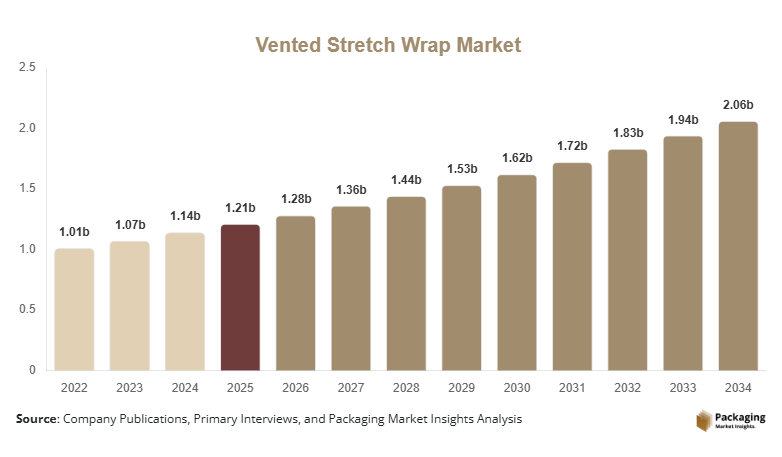
Vented Stretch Wrap market size is projected at USD 1.28 billion in 2026 and is expected to hit USD 2.05 billion by 2034 with a CAGR of 6.1%. The study evaluates comprehensive market data, production capacity, end-user demand, product segmentation, technological advancements, and the competitive landscape across major global manufacturers. The report provides quantitative analysis covering revenue, shipment volume, pricing trends, and regional developments to support strategic decision-making.
Vented stretch wrap is a specialized packaging film designed with perforations that provide airflow while maintaining load stability during storage and transportation. Global production exceeded 5.4 billion square meters in 2025, with food and agricultural applications accounting for nearly 71% of total consumption. Machine-grade products represented approximately 58% of global demand, while penetration across cold-chain logistics surpassed 46%. Increasing adoption in fresh produce transportation and temperature-sensitive packaging continues supporting the Vented Stretch Wrap market.
Explore more data points, trends and opportunities Download Free Sample Report
Vented Stretch Wrap Market Trends
Growing Adoption of Ventilated Packaging for Cold Chain Logistics
The expansion of cold-chain logistics and fresh produce exports is increasing demand for vented stretch wrap worldwide. More than 780 million pallet loads were secured using ventilated stretch films during 2025, representing annual growth of 8.7%. Adoption among fresh fruit and vegetable exporters exceeded 61%, while improved airflow technology reduced product spoilage by nearly 22%. These developments continue strengthening the Vented Stretch Wrap market.
Manufacturers are introducing thinner yet stronger polyethylene films with enhanced puncture resistance and optimized ventilation patterns. Multi-layer extrusion technologies now account for nearly 49% of newly manufactured products, while recyclable resin utilization has increased to approximately 37%. Food processing facilities increased purchases of ventilated stretch films by 11% during 2025, reinforcing the Vented Stretch Wrap market.
Vented Stretch Wrap Drivers
Rising Demand for Fresh Produce Packaging
Global consumption of fresh fruits, vegetables, dairy products, and refrigerated foods continues to increase demand for ventilated pallet packaging. International fresh produce trade exceeded 215 million metric tons during 2025, while cold-chain logistics investments surpassed USD 320 billion. Approximately 68% of exporters prefer ventilated stretch films to improve airflow and minimize moisture accumulation, supporting Vented Stretch Wrap growth.
Vented Stretch Wrap Restraints
Volatility in Polyethylene Resin Prices
Fluctuating raw material prices remain a challenge for manufacturers. Polyethylene resin accounts for nearly 62% of production costs, while raw material prices experienced annual fluctuations exceeding 14% during recent years. Transportation costs also increased by approximately 9%, affecting manufacturing margins and slowing Vented Stretch Wrap growth among price-sensitive buyers.
Vented Stretch Wrap Opportunities
Expansion of Sustainable Packaging Solutions
Demand for recyclable and downgauged packaging films continues to create growth opportunities. More than 42% of packaging manufacturers are investing in recyclable vented stretch films, while recycled polymer utilization increased by 18% in 2025. Growing sustainability initiatives across retail and food logistics sectors continue generating opportunities for the Vented Stretch Wrap market.
Challenges in Vented Stretch Wrap
Maintaining Film Strength with Higher Ventilation
Balancing ventilation efficiency with load stability remains a major engineering challenge. Increasing vent density can reduce tensile strength by nearly 12%, requiring advanced resin formulations and optimized extrusion technologies. Manufacturers continue investing in multilayer films and performance testing to maintain packaging reliability while supporting Vented Stretch Wrap.
Report Scope
| Report Metric | Details |
|---|---|
| Market Size in 2025 | USD 1.21 billion |
| Market Size in 2026 | USD 1.28 billion |
| Market Size in 2034 | USD 2.05 billion |
| CAGR | 6.1% (2026-2034) |
| Base Year for Estimation | 2025 |
| Historical Data | 2022-2024 |
| Forecast Period | 2026-2034 |
| Report Coverage | Revenue Forecast, Competitive Landscape, Supply Chain Disruption, Growth Factors, Environment & Regulatory Landscape and Trends |
| Geographies Covered | North America, Europe, APAC, Middle East and Africa, LATAM |
| Countries Covered | U.S., Canada, U.K., Germany, France, Spain, Italy, Russia, Nordic, Benelux, Rest of Europe, China, South Korea, Japan, India, Australia, Singapore, Taiwan, South East Asia, Rest of Asia-Pacific, UAE, Turky, Saudi Arabia, South Africa, Egypt, Nigeria, Rest of MEA, Brazil, Mexico, Argentina, Chile, Colombia, Rest of LATAM |
Explore more data points, trends and opportunities Download Free Sample Report
Vented Stretch Wrap Market Segmentation
The market is segmented by product type and application based on packaging performance, airflow requirements, and end-user industries. Machine vented stretch wrap contributes approximately 58% of global revenue, while food & beverage remains the leading application with nearly 44% market share.
By Type
Machine Vented Stretch Wrap dominates the market with nearly 58% share. Annual production exceeds 3.1 billion square meters, offering consistent wrapping tension, improved pallet stability, and high-speed compatibility exceeding 120 pallets per hour.
Hand Vented Stretch Wrap accounts for approximately 27% of demand. Production surpassed 1.4 billion square meters during 2025 and is widely used by small warehouses, retail distribution centers, and agricultural exporters due to its flexibility and lower equipment requirements.
Blown Vented Stretch Wrap represents around 15% of the market. The product provides superior puncture resistance, excellent load retention, and enhanced tear strength, making it suitable for irregular pallet loads and demanding logistics operations.
By Application
Food & Beverage represents approximately 44% of global demand. More than 2.3 billion square meters of vented stretch wrap are consumed annually for transporting fresh fruits, vegetables, dairy products, beverages, and frozen foods while maintaining airflow and minimizing condensation.
Agriculture accounts for nearly 34% of market consumption. Produce exporters increasingly use vented stretch films for palletized crops, flowers, and fresh produce, achieving adoption rates exceeding 57% in export-oriented farming operations.
Pharmaceuticals contribute around 12% of demand. Temperature-sensitive medicines and healthcare products require secure pallet wrapping with improved ventilation during transportation, particularly within regulated cold-chain distribution networks.
Vented Stretch Wrap Market Segmentations
Product Type
- Machine Vented Stretch Wrap
- Hand Vented Stretch Wrap
- Blown Vented Stretch Wrap
- Cast Vented Stretch Wrap
- Pre-Stretched Vented Stretch Wrap
Application
- Food & Beverage
- Agriculture
- Pharmaceuticals
- Cold Chain Logistics
- Industrial Packaging
Distribution Channel
- Direct Sales
- Packaging Distributors
- Online Sales
- Industrial Supply Stores
- Wholesale Dealers
Vented Stretch Wrap Regional Outlook
North America
North America accounts for approximately 31% of global revenue. The United States contributes nearly 81% of regional demand, supported by advanced cold-chain infrastructure and food logistics. Annual production exceeds 1.5 billion square meters across regional manufacturing facilities.
Europe
Europe represents nearly 29% of the market. Germany, France, Italy, Spain, and the Netherlands dominate regional consumption, supported by strong agricultural exports and food processing industries. Sustainable packaging adoption exceeds 48% across major retailers.
Asia-Pacific
Asia-Pacific holds approximately 32% of global demand and remains the fastest-growing regional market. China, India, Japan, South Korea, and Australia collectively produce more than 2.2 billion square meters annually, supported by expanding food exports and refrigerated logistics.
Latin America, Middle East & Africa
These regions collectively account for approximately 8% of market revenue. Brazil, Mexico, South Africa, Saudi Arabia, and the UAE continue investing in agricultural exports and cold-chain logistics, with packaging demand increasing at annual rates above 7%.
Top players in Vented Stretch Wrap
- Berry Global Inc.
- Inteplast Group
- Sigma Stretch Film Corporation
- Intertape Polymer Group
- Coveris Holdings S.A.
- Manuli Stretch S.p.A.
- DUO PLAST AG
- Bolloré Group
- Paragon Films Inc.
- POLIFILM Group
- Thrace Group
- Anchor Packaging LLC
Berry Global Inc.
-
Holds an estimated 12–14% global market share.
-
Leading manufacturer of stretch films, specialty packaging, and sustainable polymer solutions.
-
Operates extensive manufacturing facilities across North America, Europe, and Asia.
-
Invests heavily in recyclable packaging technologies, downgauged films, and advanced extrusion processes, enabling strong positioning across food, industrial, and logistics packaging markets.
Inteplast Group
-
Accounts for approximately 9–11% global market share.
-
Offers machine and hand-grade vented stretch films for food distribution, agriculture, and industrial logistics.
-
Maintains diversified manufacturing capabilities and integrated resin processing operations.
-
Focuses on product innovation, cost optimization, and sustainable packaging materials to strengthen its competitive presence in global packaging markets.