Flow Wrap Packaging Market Size
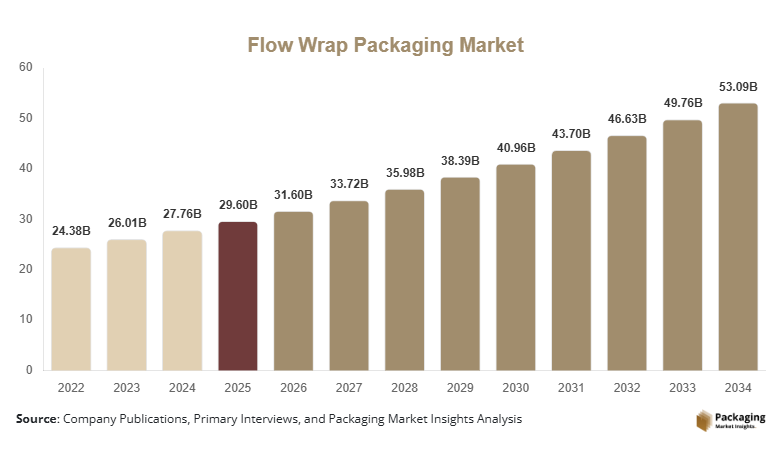
Flow wrap packaging market size is projected at USD 31.6 billion in 2026 and is expected to hit USD 52.9 billion by 2034 with a CAGR of 6.7%.
The report provides a comprehensive analysis of production volumes, technology adoption, segmentation, regional developments, and the competitive landscape across the global flow wrap packaging industry. It evaluates manufacturing capacity, demand patterns, and investment opportunities across major end-use sectors.
Flow wrap packaging is a high-speed horizontal packaging process that encloses products within flexible films before sealing both ends for protection and shelf-life extension. Global production exceeded 2.34 trillion flow-wrapped packages during 2025, while manufacturing utilization remained above 90%. Food & beverage applications accounted for approximately 68.4% of total consumption, pharmaceuticals represented 17.3%, and personal care contributed 14.3%. More than 76% of packaged snack manufacturers utilize flow wrap systems, reinforcing the flow wrap packaging market.
Explore more data points, trends and opportunities Download Free Sample Report
Flow Wrap Packaging Market Trends
Sustainable Flexible Packaging and High-Speed Automation
Manufacturers continue investing in recyclable mono-material films, compostable packaging solutions, and automated wrapping systems. Sustainable flow wrap production exceeded 612 billion packages during 2025, while recyclable film adoption increased by 18.7%. High-speed machinery capable of processing over 1,200 packs per minute expanded by 14.2%, strengthening the flow wrap packaging market.
Digital printing, machine vision inspection, and intelligent packaging technologies continue improving manufacturing efficiency. Smart production systems reduced packaging waste by approximately 16%, while automated quality inspection improved defect detection rates above 98%. Demand for customized printed flow wrap packaging increased by 15.9%, supporting the flow wrap packaging market.
Flow Wrap Packaging Market Drivers
Growing Consumption of Packaged Food Products
Increasing demand for convenience foods, bakery products, confectionery, and ready-to-eat meals continues driving market expansion. Food packaging production exceeded 1.60 trillion wrapped units during 2025, while packaged snack consumption increased by 11.8%. Modern retail distribution expanded by 13.4%, supporting long-term expansion of the flow wrap packaging market.
Flow Wrap Packaging Market Restraints
Volatile Flexible Film Raw Material Costs
Fluctuations in polymer resin, aluminum foil, and specialty laminate prices continue affecting manufacturing profitability. Plastic film costs increased by approximately 8.2% during 2025, while transportation expenses rose nearly 7.5%. Raw material volatility continues influencing production planning across the flow wrap packaging market.
Flow Wrap Packaging Market Opportunities
Expansion of Sustainable Packaging Solutions
Growing regulatory support for recyclable and compostable packaging continues creating new opportunities. Bio-based flexible film production increased by 19.1% during 2025, while paper-based flow wrap adoption expanded by 16.8%. Investments in sustainable converting facilities accelerated across Europe and Asia-Pacific, benefiting the flow wrap packaging market.
Challenges in Flow Wrap Packaging Market
Recycling Infrastructure and Material Compatibility
Manufacturers continue facing challenges associated with multilayer film recycling and waste collection systems. Nearly 38% of flexible packaging still utilizes multi-material laminates, while recycling rates remained below 30% in several developing markets. Compliance costs increased by approximately 9.4%, creating operational challenges within the flow wrap packaging market.
Report Scope
| Report Metric | Details |
|---|---|
| Market Size in 2025 | USD 29.6 Billion |
| Market Size in 2026 | USD 31.6 Billion |
| Market Size in 2034 | USD 52.9 Billion |
| CAGR | 6.7% (2026-2034) |
| Base Year for Estimation | 2025 |
| Historical Data | 2022-2024 |
| Forecast Period | 2026-2034 |
| Report Coverage | Revenue Forecast, Competitive Landscape, Supply Chain Disruption, Growth Factors, Environment & Regulatory Landscape and Trends |
| Geographies Covered | North America, Europe, APAC, Middle East and Africa, LATAM |
| Countries Covered | U.S., Canada, U.K., Germany, France, Spain, Italy, Russia, Nordic, Benelux, Rest of Europe, China, South Korea, Japan, India, Australia, Singapore, Taiwan, South East Asia, Rest of Asia-Pacific, UAE, Turkey, Saudi Arabia, South Africa, Egypt, Nigeria, Rest of MEA, Brazil, Mexico, Argentina, Chile, Colombia, Rest of LATAM |
Explore more data points, trends and opportunities Download Free Sample Report
Flow Wrap Packaging Market Segmentation
The market is segmented by material and end use. Plastic films accounted for approximately 61.5% of total production, while food & beverage maintained nearly 68.4% of global consumption due to extensive packaged food manufacturing.
By Material
Plastic films represented approximately 61.5% of total market demand. Production exceeded 1.44 trillion packaged units during 2025. Excellent barrier properties, flexibility, heat-sealing performance, and lightweight construction continue supporting widespread industrial adoption.
Paper-based materials accounted for nearly 22.6% of total production with output exceeding 529 billion packaged units. Recyclability, printability, and renewable sourcing continue driving adoption for confectionery, bakery, and dry food applications.
Aluminum foil laminates contributed approximately 15.9% of market volume, with production surpassing 372 billion packaged units. Superior oxygen, moisture, and light barrier performance make these materials suitable for pharmaceutical and premium food packaging.
By End Use
Food & beverage remained the dominant application, with approximately a 68.4% share. Production exceeded 1.60 trillion packaged units during 2025. Bakery products, confectionery, frozen foods, snacks, and dairy products continue generating significant packaging demand.
Pharmaceuticals represented approximately 17.3% of industry demand with production exceeding 405 billion packaged units. Flow wrap packaging supports medical devices, diagnostic kits, over-the-counter medicines, and sterile healthcare products.
Personal care accounted for approximately 14.3% of market demand, with production surpassing 335 billion packaged units. Products including wipes, soaps, cosmetic accessories, and hygiene products continue supporting steady segment expansion.
Flow Wrap Packaging Market Segmentations
Material
- Plastic Films
- Paper-Based Materials
- Aluminum Foil Laminates
End Use
- Food & Beverage
- Pharmaceuticals
- Personal Care
Flow Wrap Packaging Market Regional Outlook
North America
North America accounted for approximately 29.7% of global demand during 2025. Production exceeded 695 billion packaged units, led by the United States and Canada. Food packaging represented more than 66% of regional consumption.
Europe
Europe contributed nearly 27.6% of global revenue, with production surpassing 646 billion packaged units. Germany, France, Italy, Spain, and the United Kingdom remained major flexible packaging manufacturing centers.
Asia-Pacific
Asia-Pacific represented approximately 35.2% of total production with output exceeding 824 billion packaged units. China, India, Japan, and South Korea dominate regional manufacturing due to expanding food processing and consumer goods industries.
Latin America
Latin America accounted for approximately 4.3% of market demand. Brazil and Mexico remained the largest regional contributors with growing packaged food consumption and retail expansion.
Middle East & Africa
Middle East & Africa represented nearly 3.2% of global consumption. Rising urbanization, food processing investments, and modern retail development continue supporting market expansion.
Top Players In Flow Wrap Packaging Market
- Amcor plc
- Mondi plc
- Berry Global Inc.
- Huhtamaki Oyj
- Constantia Flexibles
- Sonoco Products Company
- Sealed Air Corporation
- ProAmpac LLC
- Coveris Holdings S.A.
- Winpak Ltd.
- UFlex Limited
- Billerud AB
- Clondalkin Group
- Transcontinental Inc.
- Schur Flexibles Group
Amcor plc
- Estimated market presence of approximately 15%.
- Global leader in flexible packaging solutions with a strong portfolio of recyclable flow wrap materials and advanced barrier technologies.
- The company maintains a broad manufacturing footprint, serving food, pharmaceutical, healthcare, and personal care industries. Continuous investments in sustainable packaging, lightweight materials, digital printing, and mono-material structures strengthen its competitive position while supporting long-term customer partnerships across global markets.
Mondi plc
- Estimated market presence of approximately 11%.
- Recognized for sustainable flexible packaging, paper-based flow wrap solutions, and advanced converting technologies.
- The company focuses on recyclable packaging innovation, integrated paper production, and high-performance barrier materials. Strategic investments in eco-friendly packaging technologies, manufacturing expansion, and customer-specific product development continue enhancing its global presence within food and consumer goods packaging markets.