Inlay Paper Market Size
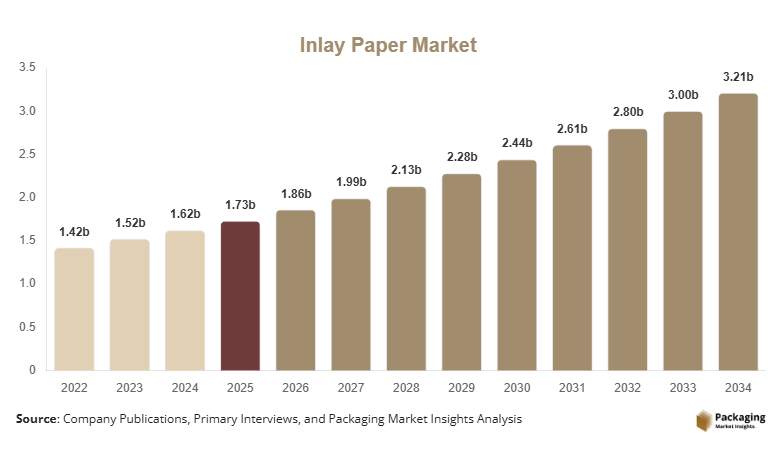
Inlay Paper market size is projected at USD 1.86 billion in 2026 and is expected to hit USD 3.21 billion by 2034 with a CAGR of 7.05%. The report provides detailed evaluation of market valuation, material innovation, production capacity, application analysis, competitive landscape, and regional expansion opportunities. The study focuses on key manufacturers, technological developments, demand patterns, and industry strategies influencing the global Inlay Paper Market.
The Inlay Paper Market includes specialized paper substrates used as intermediate layers in packaging, labels, security documents, decorative products, and smart identification solutions. Global production of inlay paper exceeded 1.15 million tons in 2025, with annual consumption reaching nearly 1.1 million tons. Security inlay paper accounted for approximately 41% of total demand, decorative inlay paper represented around 34%, and RFID inlay paper contributed nearly 25%. Packaging applications generated nearly 45% of consumption, labels and identification applications accounted for 35%, while specialty products contributed approximately 20%, supporting the expansion of the Inlay Paper Market.
Explore more data points, trends and opportunities Download Free Sample Report
Inlay Paper Trends
Increasing Adoption of Smart Packaging and Security-Based Paper Solutions
The growing demand for traceability, authentication, and smart identification technologies is reshaping the Inlay Paper Market. RFID-compatible inlay paper production exceeded 280 thousand tons in 2025, representing nearly 25% of total market consumption. Manufacturers are integrating embedded chips, advanced coatings, and high-strength paper structures to improve durability and data transmission performance. Adoption of RFID-enabled packaging solutions increased by approximately 18% across retail, logistics, and pharmaceutical sectors.
Sustainability and recyclable paper-based materials are becoming major trends in the industry. More than 60% of new inlay paper developments launched in 2025 focused on recyclable or biodegradable materials. Advanced coating technologies improved moisture resistance by nearly 30%, while lightweight paper structures reduced material usage by approximately 15%, strengthening demand across packaging and labeling applications in the Inlay Paper Market.
Inlay Paper Market Drivers
Rising Demand for Secure Identification and Premium Packaging Solutions
Increasing counterfeit protection requirements and growing premium packaging demand are driving adoption of inlay paper solutions. Global anti-counterfeit packaging investments exceeded USD 150 billion in 2025, with security paper solutions accounting for nearly 20% of applications. Pharmaceutical, luxury goods, and consumer product industries increased usage of security inlay papers by approximately 16%, supporting Inlay Paper Market growth.
Inlay Paper Market Restraints
High Manufacturing Costs and Availability of Alternative Materials
Higher production costs associated with specialty coatings and advanced paper treatments limit market expansion. Premium inlay paper manufacturing costs remain approximately 25–35% higher than conventional paper substrates. Raw material price fluctuations affected production expenses by nearly 12% in 2025, while alternative materials such as synthetic films created additional competitive pressure for the Inlay Paper Market.
Inlay Paper Market Opportunities
Expansion of RFID-Based Packaging and Smart Label Applications
The rapid adoption of connected packaging technologies is creating significant opportunities for inlay paper manufacturers. RFID label demand increased by nearly 22% in 2025, with more than 30 billion smart labels produced globally. Growth in e-commerce, inventory management, and pharmaceutical tracking applications is expected to increase demand for advanced inlay paper solutions.
Challenges in Inlay Paper Market
Complex Integration Requirements and Supply Chain Challenges
Integration of smart components and specialized coatings creates operational challenges for manufacturers. Approximately 35% of companies implementing RFID-based paper solutions face compatibility issues during production. Supply chain disruptions increased delivery timelines by nearly 10% in certain regions, requiring manufacturers to invest in advanced production systems and flexible supply networks.
Report Scope
| Report Metric | Details |
|---|---|
| Market Size in 2025 | USD 1.73 billion |
| Market Size in 2026 | USD 1.86 billion |
| Market Size in 2034 | USD 3.21 billion |
| CAGR | 7.05% (2026-2034) |
| Base Year for Estimation | 2025 |
| Historical Data | 2022-2024 |
| Forecast Period | 2026-2034 |
| Report Coverage | Revenue Forecast, Competitive Landscape, Supply Chain Disruption, Growth Factors, Environment & Regulatory Landscape and Trends |
| Geographies Covered | North America, Europe, APAC, Middle East and Africa, LATAM |
| Countries Covered | U.S., Canada, U.K., Germany, France, Spain, Italy, Russia, Nordic, Benelux, Rest of Europe, China, South Korea, Japan, India, Australia, Singapore, Taiwan, South East Asia, Rest of Asia-Pacific, UAE, Turky, Saudi Arabia, South Africa, Egypt, Nigeria, Rest of MEA, Brazil, Mexico, Argentina, Chile, Colombia, Rest of LATAM |
Explore more data points, trends and opportunities Download Free Sample Report
Inlay Paper Market Segmentation
The Inlay Paper Market is segmented by type and application based on material properties and end-use requirements. Security inlay paper dominates with approximately 41% market share due to increasing demand for authentication and anti-counterfeit applications. Packaging remains the leading application segment, accounting for nearly 45% of total consumption.
By Type
Security Inlay Paper
Security inlay paper accounted for approximately 41% of global demand in 2025, with production exceeding 470 thousand tons. These papers are designed with security fibers, watermarks, holographic elements, and authentication features. They are widely used in currency protection, certificates, pharmaceutical packaging, and premium product authentication.
Decorative Inlay Paper
Decorative inlay paper represented nearly 34% market share, with annual production exceeding 390 thousand tons. These papers provide enhanced visual appeal, print quality, and surface finishing capabilities. Thickness typically ranges between 80–250 microns, supporting furniture, packaging, and luxury product applications.
RFID Inlay Paper
RFID inlay paper contributed approximately 25% share, with production exceeding 280 thousand tons. These substrates integrate RFID chips and antenna structures, enabling tracking and identification capabilities. Demand is increasing in logistics, retail, healthcare, and smart packaging industries.
By Application
Packaging
Packaging applications dominated with approximately 45% market share, consuming more than 500 thousand tons of inlay paper in 2025. Food, beverage, cosmetics, pharmaceutical, and luxury product manufacturers use inlay paper for premium presentation, authentication, and smart packaging functions.
Labels & Identification
Labels and identification applications accounted for nearly 35% share, with consumption exceeding 380 thousand tons. RFID labels, barcode systems, security tags, and product tracking solutions represent major usage areas, with adoption exceeding 40% among large-scale logistics operators.
Specialty Products
Specialty products contributed around 20% share, consuming more than 220 thousand tons annually. Applications include decorative materials, security documents, industrial identification, and customized paper solutions requiring high durability and advanced performance.
Inlay Paper Market Segmentations
Type
- Security Inlay Paper
- Decorative Inlay Paper
- RFID Inlay Paper
Application
- Packaging
- Labels & Identification
- Specialty Products
Inlay Paper Market Regional Outlook
North America
North America accounted for approximately 30% of global Inlay Paper Market revenue in 2025. The United States contributed nearly 80% of regional consumption due to strong adoption in security printing, pharmaceuticals, and smart packaging. Regional demand exceeded 330 thousand tons, with RFID-based applications representing nearly 35% of usage.
Europe
Europe represented around 28% market share, supported by Germany, France, Italy, and the United Kingdom. Regional consumption exceeded 300 thousand tons, driven by sustainability regulations and advanced packaging solutions. Germany accounted for nearly 32% of European demand.
Asia-Pacific
Asia-Pacific held the largest growth opportunity with approximately 34% market share. China, Japan, India, and South Korea consumed more than 370 thousand tons in 2025. Expanding packaging industries and increasing RFID adoption supported regional expansion.
Latin America
Latin America contributed nearly 5% of global demand. Brazil and Mexico accounted for approximately 70% of regional consumption, driven by packaging and consumer goods industries.
Middle East & Africa
The Middle East & Africa region represented around 3% share, supported by growing pharmaceutical packaging, security applications, and retail identification requirements.
Top players in Inlay Paper Market
- Fedrigoni Group
- Oji Holdings Corporation
- Mondi Group
- Stora Enso Oyj
- International Paper Company
- UPM-Kymmene Corporation
- Nippon Paper Industries Co., Ltd.
- Glatfelter Corporation
- Smurfit Kappa Group
- Neenah Inc.
Fedrigoni Group
-
Estimated global market share: 8–10%.
-
Fedrigoni maintains a strong position through specialty papers, security papers, and premium labeling solutions.
-
The company focuses on sustainable paper development, advanced coatings, and authentication technologies.
-
Its extensive product portfolio serves luxury packaging, security printing, and industrial identification markets, strengthening its competitive position in the Inlay Paper Market.
Oji Holdings Corporation
-
Estimated global market share: 7–9%.
-
Oji Holdings is a major paper manufacturer providing specialty paper solutions for packaging and identification applications.
-
The company invests in recyclable materials, high-performance coatings, and smart paper technologies.
-
Its global manufacturing network supports increasing demand for sustainable and advanced inlay paper products.