Food And Beverage Packaging Market Size and Growth
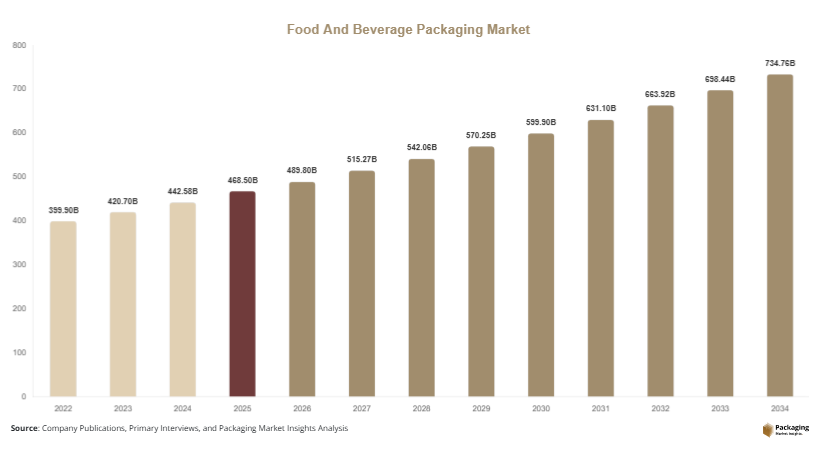
The global food and beverage packaging market size was valued at approximately USD 468.5 billion in 2025 and is projected to reach USD 489.8 billion in 2026. By 2034, the market is forecasted to reach nearly USD 735.6 billion, expanding at a CAGR of 5.2% during 2025–2034. The food and beverage packaging market is experiencing significant growth due to rising food consumption, expanding organized retail sectors, and increasing demand for packaged and convenience foods. Food and beverage packaging includes containers, bottles, cartons, cans, pouches, wraps, trays, and closures designed to preserve product quality, extend shelf life, improve transportation efficiency, and enhance brand visibility. The market is benefiting from changing consumer lifestyles, increasing urbanization, and growing preference for ready-to-eat meals and on-the-go beverage products.
One of the primary growth factors driving the market is the rapid expansion of the processed food industry. Increasing consumption of frozen foods, dairy products, snacks, and packaged beverages is generating strong demand for advanced packaging solutions that ensure safety and freshness. Another major growth factor is the increasing penetration of e-commerce grocery and food delivery services. Food manufacturers and retailers require durable and lightweight packaging solutions capable of protecting products during transportation while maintaining visual appeal. In addition, sustainability concerns are encouraging companies to invest in recyclable, biodegradable, and reusable packaging materials.
Key Highlights
- Asia Pacific dominated the market with a 38.6% share in 2025.
- Latin America is projected to grow at the fastest CAGR of 6.1%.
- Plastic packaging led the material segment with a 44.9% share.
- Flexible packaging dominated the packaging type segment with a 41.3% share.
- Food applications led the segment with 63.7% share.
- The US remained the dominant country with a market size of USD 82.4 billion in 2025 and USD 85.6 billion in 2026.
Explore more data points, trends and opportunities Download Free Sample Report
Market Trends
Rising Adoption of Sustainable and Recyclable Packaging Solutions
Sustainability has become a major trend in the food and beverage packaging market as consumers and regulatory agencies increasingly demand environmentally responsible packaging materials. Food and beverage manufacturers are adopting recyclable plastics, biodegradable films, compostable trays, and paper-based packaging to reduce environmental impact. Companies are also investing in lightweight packaging solutions that lower transportation emissions and material consumption. The growing popularity of reusable beverage containers and refill systems is further influencing packaging innovation. In addition, retailers are encouraging suppliers to reduce single-use plastic packaging and adopt sustainable alternatives. These developments are expected to accelerate the transition toward circular packaging systems across the global food and beverage industry.
Increasing Integration of Smart and Active Packaging Technologies
The adoption of smart and active packaging technologies is expanding rapidly within the food and beverage packaging market. Manufacturers are introducing QR codes, freshness indicators, temperature-sensitive labels, and RFID tracking systems to improve food safety, traceability, and consumer engagement. Active packaging technologies that absorb oxygen, moisture, or ethylene are helping extend product shelf life and reduce food waste. Beverage companies are also integrating digital printing and connected packaging solutions to support promotional campaigns and consumer interaction. As food safety regulations become stricter and supply chain transparency gains importance, smart packaging technologies are expected to become increasingly common across packaged food and beverage applications.
Market Drivers
Expansion of Packaged and Convenience Food Consumption
The increasing demand for packaged and convenience foods is one of the primary drivers supporting the food and beverage packaging market. Urban lifestyles, busy work schedules, and changing dietary preferences are encouraging consumers to purchase ready-to-eat meals, frozen foods, packaged snacks, and bottled beverages. These products require protective packaging solutions that maintain freshness, prevent contamination, and improve shelf life. Manufacturers are investing in advanced barrier packaging materials and resealable formats to improve product usability and safety. The growth of supermarkets, hypermarkets, and online grocery platforms is further supporting demand for attractive and durable food packaging solutions globally.
Growth of E-Commerce and Food Delivery Services
The rapid growth of food delivery platforms and online grocery services is significantly driving the food and beverage packaging market. E-commerce distribution requires lightweight, durable, and leak-resistant packaging capable of maintaining product integrity during transportation. Restaurants, beverage companies, and packaged food brands are increasingly adopting tamper-evident and insulated packaging formats to improve delivery safety and customer satisfaction. Demand for single-serve beverage containers, takeaway food packaging, and protective transit packaging has increased substantially with the expansion of online food retail channels. Packaging companies are also introducing sustainable delivery packaging solutions to address rising environmental concerns among consumers and regulatory agencies.
Market Restraint
Fluctuating Raw Material Costs and Environmental Regulations
One of the major restraints affecting the food and beverage packaging market is the volatility in raw material prices and increasing environmental regulations regarding packaging waste. Packaging materials such as plastic resins, aluminum, paperboard, and glass are subject to price fluctuations caused by energy costs, supply chain disruptions, and geopolitical conditions. These variations can affect production costs and profit margins for packaging manufacturers. In addition, governments across multiple regions are implementing strict regulations to reduce single-use plastic consumption and improve recycling rates. Compliance with sustainability standards often requires significant investments in new manufacturing technologies and recyclable material development. For example, beverage manufacturers transitioning from conventional plastic packaging to biodegradable alternatives may face higher production expenses and supply limitations. These challenges can create operational complexity for both packaging suppliers and food producers.
Market Opportunities
Growth of Biodegradable and Compostable Packaging
The increasing focus on sustainability is creating strong opportunities for biodegradable and compostable packaging solutions within the food and beverage packaging market. Food companies are increasingly adopting plant-based films, molded fiber containers, and compostable trays to reduce environmental impact and comply with evolving regulations. Consumers are also showing greater willingness to purchase products packaged in eco-friendly materials. Packaging manufacturers investing in biodegradable polymers and renewable raw materials are expected to benefit from growing demand across retail and foodservice applications. As global sustainability initiatives continue expanding, eco-friendly food and beverage packaging is expected to become a major area of market growth.
Rising Demand for Premium and Customized Packaging
Premiumization trends within the food and beverage industry are generating opportunities for customized and visually appealing packaging solutions. Beverage brands, confectionery companies, and specialty food manufacturers are increasingly investing in decorative packaging, premium labeling, and unique container designs to strengthen brand recognition and consumer engagement. Personalized packaging campaigns and limited-edition product launches are also becoming more common in competitive retail environments. Advances in digital printing and flexible packaging technologies are enabling cost-effective customization for both large and small production volumes. These developments are expected to support long-term demand for innovative food and beverage packaging formats.
Report Scope
| Report Metric | Details |
|---|---|
| Market Size in 2025 | USD 468.5 Billion |
| Market Size in 2026 | USD 489.8 Billion |
| Market Size in 2034 | USD 735.6 Billion |
| CAGR | 5.2% (2026-2034) |
| Base Year for Estimation | 2025 |
| Historical Data | 2022-2024 |
| Forecast Period | 2026-2034 |
| Report Coverage | Revenue Forecast, Competitive Landscape, Supply Chain Disruption, Growth Factors, Environment & Regulatory Landscape and Trends |
| Geographies Covered | North America, Europe, APAC, Middle East and Africa, LATAM |
| Countries Covered | U.S., Canada, U.K., Germany, France, Spain, Italy, Russia, Nordic, Benelux, Rest of Europe, China, South Korea, Japan, India, Australia, Singapore, Taiwan, South East Asia, Rest of Asia-Pacific, UAE, Turky, Saudi Arabia, South Africa, Egypt, Nigeria, Rest of MEA, Brazil, Mexico, Argentina, Chile, Colombia, Rest of LATAM |
Explore more data points, trends and opportunities Download Free Sample Report
Segmental Analysis
By Material
Plastic packaging dominated the food and beverage packaging market in 2024, accounting for approximately 44.9% of total market revenue. Plastic materials are widely used because they offer lightweight properties, durability, flexibility, and cost efficiency. Bottles, pouches, trays, wraps, and closures made from polyethylene terephthalate, polypropylene, and polyethylene are commonly used across food and beverage applications. Plastic packaging also provides strong barrier protection against moisture and contamination, helping extend shelf life. Manufacturers continue investing in recyclable and lightweight plastic packaging technologies to improve sustainability performance while maintaining affordability and functionality across large-scale food production systems.
Paper-based packaging is expected to witness the fastest growth, registering a CAGR of 6.4% during the forecast period. Increasing environmental concerns and government restrictions on single-use plastics are encouraging food and beverage companies to adopt paper cartons, molded fiber containers, and recyclable paper packaging formats. Paper-based materials provide branding flexibility through high-quality printing and decorative customization options. Quick-service restaurants and beverage manufacturers are increasingly introducing paper cups, cartons, and takeaway packaging to reduce environmental impact. Technological advancements in moisture-resistant coatings and barrier solutions are further supporting growth within this segment.
By Packaging Type
Flexible packaging dominated the food and beverage packaging market in 2024 with a revenue share of approximately 41.3%. Flexible packaging formats such as pouches, wraps, sachets, and films are widely used because of their lightweight structure, lower material usage, and transportation efficiency. Food manufacturers prefer flexible packaging for snacks, frozen foods, dairy products, and beverages because it offers convenience, resealability, and extended shelf life. Flexible packaging also supports cost-effective high-volume production and attractive product presentation. Increasing demand for single-serve and portable food products continues driving adoption across global retail and foodservice sectors.
Smart packaging solutions are projected to grow at the fastest CAGR of 6.8% during the forecast period. Smart packaging technologies improve food safety, traceability, and consumer engagement through digital labels, RFID systems, freshness indicators, and QR codes. Beverage manufacturers are increasingly adopting connected packaging solutions to support promotional campaigns and improve product authentication. Food companies are also using temperature-sensitive labels and oxygen-monitoring systems to reduce spoilage and maintain product quality during distribution. The growing importance of supply chain transparency and food safety compliance is expected to accelerate adoption of smart packaging technologies globally.
By Application
Food applications dominated the food and beverage packaging market in 2024, accounting for approximately 63.7% of total market revenue. Packaged foods including snacks, frozen meals, dairy products, bakery items, and processed foods require protective packaging solutions that preserve freshness and prevent contamination. Manufacturers are increasingly adopting barrier films, vacuum packaging, and modified atmosphere packaging technologies to extend shelf life and improve product quality. Rising demand for convenience foods and ready-to-eat meals continues driving packaging consumption across supermarkets, convenience stores, and e-commerce platforms. Growth in global food processing activities is expected to maintain strong demand within this application segment.
Beverage packaging is expected to grow at the fastest CAGR of 5.9% during the forecast period. Rising consumption of bottled water, carbonated drinks, energy beverages, and ready-to-drink coffee products is supporting packaging demand across both developed and emerging economies. Beverage companies are increasingly investing in lightweight bottles, recyclable aluminum cans, and sustainable carton packaging to improve environmental performance and reduce transportation costs. Growth in premium beverages and functional drinks is also encouraging packaging innovation through decorative labeling and customized container designs. Expansion of convenience retail and online beverage delivery services is expected to support long-term growth within this segment.
Food And Beverage Packaging Market Segmentations
By Material
- Plastic Packaging
- Paper & Paperboard Packaging
- Glass Packaging
- Metal Packaging
By Packaging Type
- Flexible Packaging
- Rigid Packaging
- Semi-Rigid Packaging
- Smart Packaging
By Application
- Food Packaging
- Beverage Packaging
- Dairy Packaging
- Frozen Food Packaging
By Distribution Channel
- Supermarkets & Hypermarkets
- Convenience Stores
- Online Retail
- Foodservice Channels
- Specialty Stores
Regional Analysis
North America
North America accounted for approximately 24.8% of the global food and beverage packaging market share in 2025 and is projected to grow at a CAGR of 4.8% during the forecast period. Strong demand for packaged foods, frozen meals, and bottled beverages is supporting market growth across the region. Companies are increasingly adopting sustainable packaging materials and smart labeling technologies to meet consumer expectations and regulatory requirements. Growth in online grocery shopping and food delivery platforms is also contributing to packaging demand.
The United States dominates the North American market because of its large food processing industry and advanced retail infrastructure. One unique growth factor is the increasing adoption of recyclable beverage containers and sustainable takeaway food packaging. Food manufacturers are investing in lightweight and reusable packaging systems to improve sustainability performance and reduce transportation costs.
Europe
Europe held around 27.5% of the food and beverage packaging market share in 2025 and is expected to grow at a CAGR of 5.0% through 2034. Strict environmental regulations and strong consumer preference for sustainable products are encouraging widespread adoption of recyclable and compostable packaging solutions. Food companies are increasingly introducing paper-based packaging and refill systems to reduce plastic waste. Demand for premium food packaging and smart labeling technologies is also supporting regional market expansion.
Germany remains the dominant country in the European market because of its strong food manufacturing sector and advanced recycling infrastructure. One unique growth factor is the rapid adoption of deposit-return systems for beverage containers, encouraging higher recycling rates and sustainable packaging innovation throughout the food and beverage industry.
Asia Pacific
Asia Pacific represented approximately 38.6% of the global food and beverage packaging market share in 2025 and is projected to grow at a CAGR of 5.8% during the forecast period. Rising urbanization, population growth, and increasing consumption of packaged foods are major factors supporting regional market expansion. Food manufacturers are investing heavily in flexible packaging, aseptic cartons, and lightweight beverage containers to meet growing consumer demand. Expansion of organized retail and e-commerce grocery platforms is further driving packaging consumption.
China dominates the Asia Pacific market because of its extensive food processing industry and rapidly expanding consumer goods sector. One unique growth factor is the growing popularity of ready-to-drink beverages and convenience meals among urban consumers. Domestic packaging manufacturers are increasing production capacity to support rising packaged food demand.
Middle East & Africa
The Middle East & Africa region accounted for nearly 4.9% of the global food and beverage packaging market share in 2025 and is expected to grow at a CAGR of 5.4% during the forecast period. Rising demand for packaged dairy products, bottled water, and convenience foods is supporting packaging consumption across the region. Food companies are increasingly adopting flexible packaging and aseptic beverage cartons to improve product shelf life and transportation efficiency.
Saudi Arabia leads the regional market due to increasing investment in food processing and retail infrastructure. One unique growth factor is the growing consumption of packaged halal food products requiring certified and tamper-evident packaging solutions. Expansion of tourism and hospitality sectors is also contributing to beverage packaging demand.
Latin America
Latin America accounted for approximately 4.2% of the food and beverage packaging market share in 2025 and is projected to grow at the fastest CAGR of 6.1% through 2034. Rising consumption of packaged snacks, bottled beverages, and processed foods is driving market growth across the region. Packaging manufacturers are increasingly introducing affordable flexible packaging formats and lightweight beverage containers to support cost-sensitive consumer markets.
Brazil dominates the Latin American market because of its large food and beverage manufacturing industry. One unique growth factor is the increasing expansion of modern retail chains and convenience stores offering packaged food products. Domestic beverage producers are also investing in recyclable packaging solutions to improve environmental performance and brand positioning.
Competitive Landscape
The food and beverage packaging market is highly competitive, with companies focusing on sustainability, lightweight materials, smart packaging technologies, and regional expansion strategies. Leading manufacturers are investing heavily in recyclable packaging materials, advanced barrier technologies, and automation systems to improve production efficiency and regulatory compliance. Partnerships with food producers and beverage companies are also supporting innovation in customized and sustainable packaging formats.
Amcor plc remains one of the leading companies in the market due to its broad packaging portfolio and strong global manufacturing network. In 2024, the company introduced new recyclable flexible packaging solutions designed for snack and frozen food applications. Other major players include Berry Global Inc., Tetra Pak International S.A., Ball Corporation, and Sealed Air Corporation. These companies continue investing in smart packaging systems, biodegradable materials, and lightweight beverage containers to strengthen competitive positioning and meet evolving consumer expectations.
Key Players List
- Amcor plc
- Berry Global Inc.
- Tetra Pak International S.A.
- Ball Corporation
- Sealed Air Corporation
- Mondi Group
- Crown Holdings, Inc.
- Smurfit Kappa Group
- Sonoco Products Company
- DS Smith Plc
- WestRock Company
- Huhtamaki Oyj
- Ardagh Group S.A.
- Graphic Packaging International, LLC
- Reynolds Consumer Products Inc.