Aseptic Packaging Market Report Size and Growth
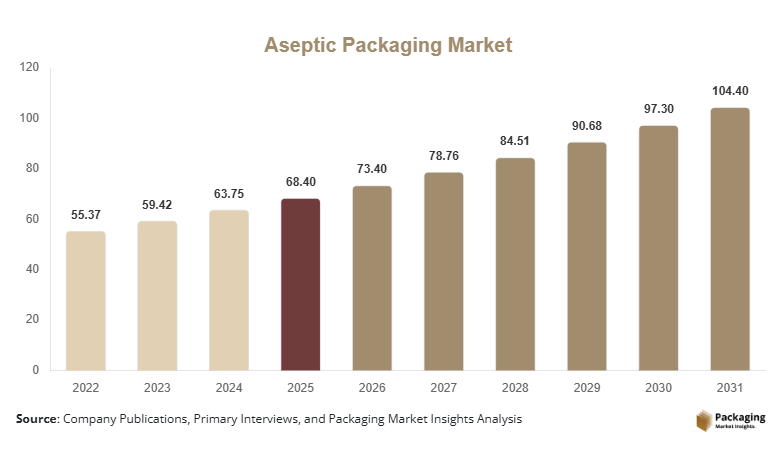
The Aseptic Packaging Market was valued at USD 68.4 billion in 2025 and is projected to reach USD 104.7 billion by 2030, registering a compound annual growth rate (CAGR) of 7.3% during 2025–2031. The market continues to expand steadily as manufacturers and food processors increasingly adopt sterile packaging technologies to enhance product shelf life while maintaining quality and safety. Aseptic packaging allows products such as dairy, beverages, pharmaceuticals, and ready-to-eat meals to be stored without refrigeration for extended periods. This capability has supported the widespread adoption of aseptic systems in global supply chains, particularly in regions where cold storage infrastructure is limited.
One of the key global factors supporting the growth of the Aseptic Packaging Market size is the rising demand for shelf-stable packaged foods and beverages. Urbanization, busy lifestyles, and the growth of modern retail formats have driven consumer demand for convenient products with extended shelf life. Aseptic packaging technologies ensure minimal contamination during filling and sealing processes, making them highly suitable for sensitive products such as milk, juices, soups, and pharmaceutical liquids. The technology also reduces preservatives while maintaining product integrity, which aligns with changing consumer preferences for clean-label food and safe pharmaceutical packaging.
Advancements in packaging materials and filling technologies have further improved operational efficiency in aseptic systems. Manufacturers are investing in high-speed aseptic filling equipment and multilayer packaging materials that provide better barrier protection against oxygen, light, and microorganisms. These innovations continue to expand the application scope of aseptic packaging across food, beverage, and healthcare industries.
Key Highlights
- Asia Pacific dominated the Aseptic Packaging Market with 36.8% share in 2025, while Latin America is expected to register the fastest growth with a CAGR of 8.4%.
- By packaging type, cartons represented the largest share, while aseptic pouches are expected to grow fastest at 8.9% CAGR.
- By material, paperboard-based multilayer materials led the segment, while biopolymer materials are projected to grow at 9.1% CAGR.
- China remained the dominant country market, valued at USD 11.2 billion in 2025 and estimated to reach USD 12.0 billion in 2026.
Explore more data points, trends and opportunities Download Free Sample Report
Market Trends
Expansion of Shelf-Stable Beverage Packaging
One notable trend in the Aseptic Packaging Market is the increasing use of aseptic technology for shelf-stable beverages such as plant-based milk, flavored dairy drinks, and fruit juices. Beverage manufacturers are shifting toward aseptic cartons and bottles to eliminate the need for refrigeration during storage and transportation. This trend has gained momentum as retailers seek packaging solutions that improve supply chain efficiency and reduce product waste. The ability to transport beverages across long distances without compromising quality has strengthened the role of aseptic packaging in global beverage distribution.
Integration of Sustainable Packaging Materials
Sustainability has become an important trend shaping the Aseptic Packaging Market growth. Packaging manufacturers are developing renewable and recyclable multilayer materials that maintain aseptic performance while reducing environmental impact. Paper-based packaging structures with reduced aluminum content and recyclable polymer layers are gaining attention. Companies are also investing in bio-based polymers and recyclable laminates to address regulatory pressure and consumer demand for environmentally responsible packaging solutions. These developments are expected to improve the long-term sustainability outlook of aseptic packaging while supporting market expansion.
Market Drivers
Rising Demand for Long Shelf-Life Food Products
The increasing consumption of packaged food products with extended shelf life has significantly supported the growth of the Aseptic Packaging Market. Urban populations are relying more on ready-to-drink beverages, packaged dairy products, and convenience meals. Aseptic packaging enables manufacturers to deliver these products without refrigeration while maintaining nutritional value and safety. This capability has made aseptic technology an important solution for food processors aiming to expand distribution networks across diverse geographic regions.
Growth of Pharmaceutical and Healthcare Packaging
The healthcare sector has also contributed to the expansion of the Aseptic Packaging Market size. Pharmaceutical liquids, injectable solutions, and biologic products require sterile packaging environments to prevent contamination. Aseptic packaging systems provide controlled filling processes and secure sealing mechanisms that meet regulatory standards for medical packaging. As pharmaceutical production expands globally, the demand for reliable sterile packaging solutions continues to increase. This trend has strengthened the adoption of aseptic packaging technologies across pharmaceutical manufacturing facilities.
Market Restraint
High Capital Investment in Aseptic Processing Systems
Despite steady growth prospects, the Aseptic Packaging Market faces challenges related to the high initial investment required for aseptic processing equipment and infrastructure. Establishing aseptic production lines involves advanced sterilization systems, specialized filling machinery, and controlled environments that comply with strict safety regulations. These systems require substantial capital expenditure and technical expertise.
Small and medium-sized manufacturers often face financial constraints when adopting aseptic technologies, particularly in emerging economies. The complexity of equipment maintenance and the need for skilled technicians further increase operational costs. Additionally, the validation and regulatory compliance processes associated with aseptic production can extend implementation timelines for new packaging facilities.
As a result, some manufacturers continue to rely on traditional packaging technologies that involve refrigeration or preservatives. While aseptic packaging offers long-term efficiency benefits, the high upfront investment remains a barrier to widespread adoption among smaller companies.
Market Opportunities
Expansion of Plant-Based Beverage Packaging
The rapid expansion of plant-based beverages presents a major opportunity for the Aseptic Packaging Market growth. Products such as almond milk, oat milk, and soy beverages require packaging solutions that maintain freshness without refrigeration. Aseptic cartons and bottles provide an effective barrier against contamination and oxidation, making them suitable for these sensitive products. As consumer demand for plant-based nutrition increases globally, packaging companies are expected to benefit from increased adoption of aseptic technologies.
Development of Smart and Digitally Traceable Packaging
Another emerging opportunity in the Aseptic Packaging Market is the integration of smart packaging technologies. Manufacturers are exploring digital labeling, QR codes, and traceability systems that allow consumers and distributors to track product origin and safety. These solutions enhance supply chain transparency while improving quality control. As food safety regulations continue to evolve, digital traceability features are likely to become an important component of aseptic packaging systems.
Report Scope
| Report Metric | Details |
|---|---|
| Market Size in 2025 | USD 68.4 |
| Market Size in 2026 | USD 73.4 |
| Market Size in 2031 | USD 112 |
| CAGR | 7.3% (2026-2031) |
| Base Year for Estimation | 2025 |
| Historical Data | 2022-2024 |
| Forecast Period | 2026-2031 |
| Report Coverage | Revenue Forecast, Competitive Landscape, Supply Chain Disruption, Growth Factors, Environment & Regulatory Landscape and Trends |
| Geographies Covered | North America, Europe, APAC, Middle East and Africa, LATAM |
| Countries Covered | U.S., Canada, U.K., Germany, France, Spain, Italy, Russia, Nordic, Benelux, Rest of Europe, China, South Korea, Japan, India, Australia, Singapore, Taiwan, South East Asia, Rest of Asia-Pacific, UAE, Turky, Saudi Arabia, South Africa, Egypt, Nigeria, Rest of MEA, Brazil, Mexico, Argentina, Chile, Colombia, Rest of LATAM |
Explore more data points, trends and opportunities Download Free Sample Report
Segmental Analysis
By Packaging Type
Cartons represented the dominant subsegment in the Aseptic Packaging Market and accounted for 46.2% share in 2024. Aseptic cartons are widely used for packaging dairy products, juices, and liquid foods. Their multilayer structure provides strong protection against light, oxygen, and microorganisms while maintaining product freshness. Cartons are also lightweight and easy to transport, which has made them a preferred packaging format for large-scale beverage distribution.
Aseptic pouches are expected to be the fastest-growing packaging type and will register a CAGR of 8.9% during the forecast period. The increasing popularity of portable beverage packaging and single-serve food products will support this growth. Pouches offer flexibility, lightweight construction, and efficient material usage, which will make them attractive to manufacturers seeking cost-effective packaging solutions.
By Material
Paperboard-based multilayer materials dominated the Aseptic Packaging Market size and held 42.5% share in 2024. These materials combine paperboard with thin layers of aluminum and polymer to create a strong barrier against contamination and moisture. The structure provides excellent product protection while maintaining lightweight packaging characteristics.
Biopolymer materials are projected to be the fastest-growing segment with a CAGR of 9.1%. The increasing focus on sustainable packaging will drive the development of bio-based polymers derived from renewable resources. These materials will provide environmental benefits while maintaining the functional properties required for aseptic packaging systems.
By Application
The beverages segment dominated the Aseptic Packaging Market share and represented 48.7% of total demand in 2024. Beverage products such as fruit juices, flavored milk, and nutritional drinks require packaging solutions that maintain freshness during long distribution cycles. Aseptic packaging allows these beverages to remain stable without refrigeration, making it a preferred solution for beverage manufacturers.
The pharmaceutical applications segment is expected to grow at the fastest rate with a CAGR of 8.5%. Increasing production of sterile injectable drugs and liquid pharmaceutical formulations will support demand for aseptic packaging systems. Pharmaceutical companies will continue investing in sterile filling technologies that ensure product safety and regulatory compliance.
Aseptic Packaging Market Segmentations
By Packaging Type
- Cartons
- Bottles & Cans
- Pouches
- Bags
By Material
- Paperboard
- Plastic
- Metal
- Glass
- Biopolymers
By Application
- Beverages
- Dairy Products
- Food Products
- Pharmaceuticals
Regional Analysis
North America
North America accounted for 24.5% of the Aseptic Packaging Market share in 2025, reflecting strong demand from food processing and pharmaceutical industries. The region’s market expansion will continue steadily and is projected to grow at a CAGR of 6.8% between 2025 and 2033. Growth will be supported by increasing consumption of packaged beverages, ready-to-drink dairy products, and sterile pharmaceutical liquids. The presence of advanced food manufacturing facilities and strict food safety regulations will further encourage adoption of aseptic packaging technologies across the region.
The United States represented the dominant country in the North American Aseptic Packaging Market. The country has a large packaged food industry and strong demand for long shelf-life beverage products. Manufacturers in the United States are investing in automated aseptic filling lines and advanced packaging materials that improve production efficiency. Additionally, the expansion of plant-based beverage brands and ready-to-consume nutritional drinks is strengthening the demand for aseptic cartons and bottles.
Europe
Europe held 22.1% of the Aseptic Packaging Market share in 2025. The region will continue to expand at a forecast CAGR of 6.5% during 2025–2033. European food manufacturers have widely adopted aseptic packaging technologies for dairy products, soups, and beverages. The presence of strong regulatory frameworks for food safety and environmental sustainability has encouraged packaging companies to develop recyclable and renewable aseptic materials.
Germany represented the leading country market in Europe. The country’s advanced food processing sector and strong export-oriented beverage industry have driven demand for high-quality packaging systems. German packaging manufacturers are focusing on technological innovations such as lightweight multilayer materials and energy-efficient aseptic filling equipment. These developments will support stable growth in the regional market.
Asia Pacific
Asia Pacific dominated the Aseptic Packaging Market with a 36.8% share in 2025. The region will continue to expand rapidly and is projected to register a CAGR of 8.1% between 2025 and 2033. Rising urbanization, expanding middle-class populations, and increasing consumption of packaged beverages have supported strong demand for aseptic packaging solutions in the region.
China emerged as the largest country market in Asia Pacific. The rapid growth of the beverage and dairy industries has increased demand for shelf-stable packaging technologies. Large-scale food manufacturers in China are investing in modern aseptic filling systems to expand distribution across urban and rural markets. The growth of convenience retail stores and e-commerce food distribution channels has further supported market expansion.
Middle East & Africa
The Middle East & Africa represented 8.7% of the global Aseptic Packaging Market share in 2025. The regional market will grow at a CAGR of 7.6% during the forecast period. Increasing demand for packaged beverages and dairy products has encouraged manufacturers to adopt aseptic packaging technologies that can withstand long transportation distances and high ambient temperatures.
Saudi Arabia emerged as the leading market within the region. The country’s expanding dairy production sector and growing food processing industry have increased demand for shelf-stable packaging solutions. Government initiatives supporting food security and domestic food manufacturing will continue to promote the adoption of advanced packaging technologies.
Latin America
Latin America accounted for 7.9% of the Aseptic Packaging Market share in 2025 and is expected to grow at the fastest CAGR of 8.4% through 2033. Rising demand for packaged fruit juices, dairy beverages, and nutritional drinks has supported market expansion. Food manufacturers in the region are increasingly adopting aseptic packaging to improve product shelf life and reduce logistics costs.
Brazil represented the dominant country in the Latin American market. The country’s strong agricultural sector and beverage processing industry have encouraged investment in aseptic packaging infrastructure. Beverage companies in Brazil are expanding production of shelf-stable juices and dairy drinks, which will continue to support regional market growth.
Competitive Landscape
The Aseptic Packaging Market is characterized by the presence of global packaging manufacturers focusing on material innovation and advanced filling technologies. Leading companies are investing in research and development to improve packaging performance, sustainability, and operational efficiency.
Tetra Pak remains one of the most influential companies in the market due to its extensive portfolio of aseptic carton packaging solutions and advanced processing equipment. The company recently introduced new recyclable carton structures designed to reduce aluminum usage while maintaining barrier protection.
Other major players are focusing on strategic collaborations, product development, and regional expansion to strengthen their market position. Packaging manufacturers are also investing in automation technologies and digital monitoring systems to enhance production efficiency in aseptic packaging facilities.
Key Players in the Aseptic Packaging Market
- Tetra Pak
- SIG Combibloc Group
- Amcor plc
- Mondi Group
- Greatview Aseptic Packaging
- Elopak
- Ecolean AB
- Scholle IPN
- Uflex Ltd.
- Printpack Inc.
- DS Smith Plc
- Reynolds Group Holdings
- Billerud AB
- Sealed Air Corporation
- Bosch Packaging Technology