Consumer Packaged Goods Market Size and Growth
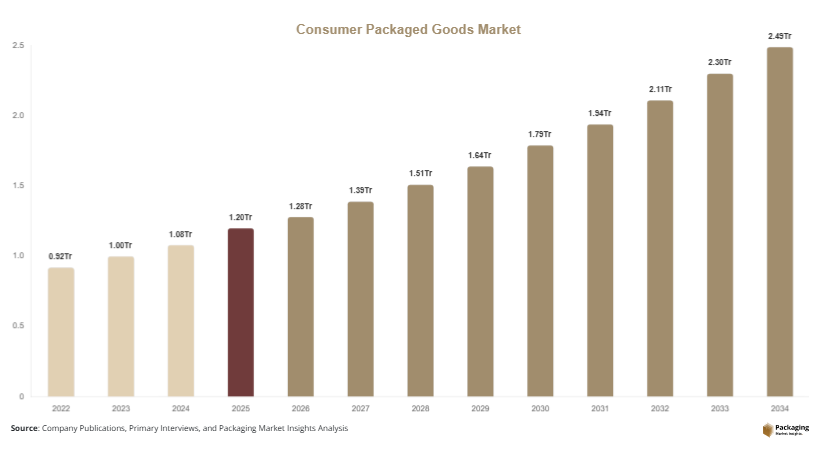
In 2025, the global consumer packaged goods market size is estimated at USD 1.20 trillion, rising to USD 1.28 trillion in 2026. By 2034, the market is projected to reach approximately USD 2.45 trillion, registering a CAGR of 8.7% from 2025 to 2034. This growth reflects a combination of urbanization, rising disposable income, and continuous innovation in product packaging, branding, and distribution systems. The consumer packaged goods market is witnessing steady expansion driven by evolving consumption patterns, digital retail penetration, and increased demand for fast-moving goods across global economies.
One of the primary growth factors is the rapid expansion of e-commerce and omnichannel retailing, which has transformed how consumer goods are distributed and purchased. Another key driver is the increasing preference for convenience-oriented products, including ready-to-eat food, personal care items, and household essentials. Additionally, sustainability initiatives and demand for eco-friendly packaging are reshaping manufacturing strategies across the CPG ecosystem.
Key Highlights:
- Market size in 2025 is estimated at USD 1.20 trillion, reflecting steady global demand for consumer packaged goods across food, beverage, and personal care categories. Growth is supported by expanding retail networks and increasing urban consumption patterns.
- Market size in 2026 is projected to reach USD 1.28 trillion, driven by rising e-commerce penetration and stronger demand for convenience-oriented packaged products. This reflects continued expansion in both developed and emerging economies.
- By 2034, the Consumer Packaged Goods Market is expected to reach USD 2.45 trillion, highlighting sustained long-term growth across global regions. Increasing product innovation and sustainability initiatives further support this expansion trajectory.
- The market is anticipated to grow at a CAGR of 8.7% during 2025–2034, supported by changing consumer lifestyles, digital retail transformation, and increased demand for branded packaged goods.
- Strong growth is primarily driven by rapid expansion of e-commerce platforms and shifting consumer preferences toward convenience-based purchasing behavior. Digital accessibility and home delivery services are accelerating product adoption worldwide.
- Rising demand for sustainable and convenient packaged goods is also fueling market expansion, as consumers increasingly prefer eco-friendly packaging, ready-to-use products, and healthier consumption options across multiple categories.
Explore more data points, trends and opportunities Download Free Sample Report
Market Trends
Digital Transformation and Direct-to-Consumer Expansion
The consumer packaged goods market is increasingly shaped by digital transformation, particularly the shift toward direct-to-consumer (DTC) business models. Brands are investing heavily in digital storefronts, subscription-based delivery systems, and personalized marketing strategies. This transition allows companies to build stronger customer relationships while reducing dependence on traditional retail intermediaries. Advanced analytics, customer behavior tracking, and AI-powered recommendation systems are improving conversion rates and customer retention. The integration of mobile commerce and social media shopping platforms has further accelerated this trend, enabling CPG brands to reach consumers directly and efficiently. Over time, this shift is expected to redefine traditional distribution networks and increase margin optimization across the value chain.
Sustainability and Eco-Friendly Product Innovation
Sustainability has become a central trend influencing the consumer packaged goods market. Companies are increasingly adopting recyclable materials, biodegradable packaging, and reduced plastic usage to meet regulatory requirements and consumer expectations. Environmental awareness among consumers is pushing brands to redesign packaging formats and adopt circular economy principles. Organizations are also investing in carbon-neutral production methods and sustainable sourcing of raw materials. This trend is not only driven by compliance but also by competitive differentiation, as environmentally responsible brands tend to achieve higher consumer loyalty. As sustainability continues to gain momentum, it is expected to significantly reshape product development, packaging design, and supply chain operations across the global CPG industry.
Market Drivers
Rising Urbanization and Changing Lifestyles
Rapid urbanization across developing and developed economies is a major driver of the consumer packaged goods market. As populations migrate to urban centers, consumer behavior shifts toward convenience-oriented products that require minimal preparation time. Busy lifestyles, dual-income households, and increasing work-hour pressures are contributing to higher demand for ready-to-consume food products, packaged beverages, and personal care essentials. Urban consumers also exhibit higher brand awareness and preference for premium packaged goods, further supporting market expansion. Retail infrastructure improvements and modern supermarket penetration are ensuring easier access to a wide range of CPG products, strengthening overall consumption patterns globally.
Expansion of Organized Retail and E-Commerce Channels
The rapid growth of organized retail chains and e-commerce platforms is significantly boosting the consumer packaged goods market. Online marketplaces provide consumers with easy access to a wide variety of products, competitive pricing, and home delivery convenience. This accessibility has increased product penetration across both urban and rural areas. Retail giants are also expanding private-label offerings, intensifying competition and driving innovation in pricing and packaging. Additionally, logistics advancements and last-mile delivery optimization are enabling faster fulfillment cycles. These developments collectively enhance product availability and strengthen overall market demand across diverse consumer segments.
Market Restraint
Regulatory Complexity and Raw Material Price Volatility
One of the key restraints affecting the consumer packaged goods market is the increasing complexity of regulatory frameworks combined with fluctuating raw material costs. Governments across multiple regions are implementing stringent regulations related to packaging waste, food safety, labeling standards, and environmental compliance. While these regulations aim to improve sustainability and consumer safety, they increase operational costs and compliance burdens for manufacturers. Companies must frequently adjust production processes, packaging designs, and supply chain practices to meet evolving standards, which can delay product launches and increase overhead expenses.
In addition, volatility in raw material prices—such as plastics, paper, agricultural inputs, and chemical additives—creates uncertainty in production planning and cost management. Global supply chain disruptions, geopolitical tensions, and climate-related agricultural challenges further intensify price instability. Small and medium-sized manufacturers are particularly impacted due to limited financial flexibility. These combined factors restrict profit margins and may slow down market expansion in cost-sensitive regions, making regulatory and raw material challenges a significant restraint in the industry.
Market Opportunities
Growth in Emerging Economies
Emerging economies present a substantial opportunity for the consumer packaged goods market due to rising incomes, expanding middle-class populations, and increasing urbanization. Countries in Asia, Latin America, and parts of Africa are experiencing rapid economic development, leading to higher consumption of packaged food, beverages, and household products. Retail infrastructure expansion and improved logistics networks are making CPG products more accessible to previously underserved regions. Additionally, increasing smartphone penetration is enabling digital retail adoption, further expanding market reach. Global brands are entering these markets with localized product offerings tailored to cultural preferences and affordability levels. This combination of demographic expansion and improved accessibility creates strong long-term growth potential for CPG manufacturers.
Innovation in Smart Packaging Technologies
Technological advancements in smart packaging present another significant opportunity for the consumer packaged goods market. Smart packaging solutions, including QR-coded labels, freshness indicators, and RFID-enabled tracking systems, are enhancing consumer engagement and supply chain transparency. These innovations allow brands to provide real-time product information, improve inventory management, and reduce food waste. Additionally, smart packaging supports anti-counterfeiting measures, ensuring product authenticity and safety. As consumer demand for transparency increases, companies investing in interactive and intelligent packaging technologies are expected to gain a competitive advantage. The integration of digital technologies into packaging design is likely to redefine product differentiation strategies across the industry.
Report Scope
| Report Metric | Details |
|---|---|
| Market Size in 2025 | USD 1.20 Trillion |
| Market Size in 2026 | USD 1.28 Trillion |
| Market Size in 2034 | USD 2.45 Trillion |
| CAGR | 8.7% (2026-2034) |
| Base Year for Estimation | 2025 |
| Historical Data | 2022-2024 |
| Forecast Period | 2026-2034 |
| Report Coverage | Revenue Forecast, Competitive Landscape, Supply Chain Disruption, Growth Factors, Environment & Regulatory Landscape and Trends |
| Geographies Covered | North America, Europe, APAC, Middle East and Africa, LATAM |
| Countries Covered | U.S., Canada, U.K., Germany, France, Spain, Italy, Russia, Nordic, Benelux, Rest of Europe, China, South Korea, Japan, India, Australia, Singapore, Taiwan, South East Asia, Rest of Asia-Pacific, UAE, Turky, Saudi Arabia, South Africa, Egypt, Nigeria, Rest of MEA, Brazil, Mexico, Argentina, Chile, Colombia, Rest of LATAM |
Explore more data points, trends and opportunities Download Free Sample Report
Segmental Analysis
By Product Type
Food and beverages represent the dominant subsegment, accounting for approximately 46% share in 2024. This segment benefits from consistent demand for packaged snacks, beverages, and ready-to-eat meals across global markets. Strong retail penetration and brand diversification further support its leadership position.
Personal care products are the fastest-growing subsegment with a projected CAGR of 9.4%, driven by rising hygiene awareness, premium skincare demand, and expanding male grooming trends. Increased product innovation and marketing campaigns are further accelerating growth.
By Distribution Channel
Supermarkets and hypermarkets dominate the distribution channel segment with a 42% share in 2024. These outlets offer wide product variety and competitive pricing, making them preferred shopping destinations.
E-commerce is the fastest-growing subsegment, with a CAGR of 11.2%, supported by digital adoption, doorstep delivery convenience, and expanding online grocery platforms.
By End-Use
Household consumption leads the end-use segment with a 51% share in 2024, driven by consistent demand for daily essentials such as food, cleaning products, and personal care items.
Institutional consumption is the fastest-growing subsegment with a CAGR of 8.8%, supported by rising demand from hospitality, healthcare, and corporate sectors.
Consumer Packaged Goods Market Segmentations
By Product Type
- Food & Beverages
- Personal Care
- Household Products
- Healthcare CPG
By Distribution Channel
- Supermarkets & Hypermarkets
- Convenience Stores
- Online Retail
- Specialty Stores
By End-Use
- Household
- Institutional
- Commercial
Regional Analysis
North America
North America accounts for approximately 32% of the global consumer packaged goods market in 2025, with a projected CAGR of 7.9% through 2034. The region benefits from high consumer spending power, advanced retail infrastructure, and strong penetration of organized retail and e-commerce platforms. Demand for premium packaged goods and health-oriented products continues to expand steadily.
The United States dominates the regional market, driven by rapid innovation in product formulations and packaging technologies. A key growth factor is the strong presence of multinational CPG corporations investing in automation, digital marketing, and sustainable packaging solutions.
Europe
Europe holds nearly 25% market share in 2025, with a CAGR of 7.5% expected through 2034. The market is supported by strong regulatory frameworks and high consumer awareness regarding sustainability and product quality. Demand for organic and eco-friendly packaged goods is particularly strong.
Germany leads the regional market, supported by advanced manufacturing capabilities and strong retail distribution networks. A major growth factor is the region’s strict environmental regulations encouraging sustainable packaging innovation.
Asia Pacific
Asia Pacific represents around 28% market share in 2025 and is expected to grow at a CAGR of 10.2%, the highest globally. Rapid urbanization, population growth, and expanding middle-class income levels are driving strong consumption of packaged goods.
China dominates the regional market due to its massive consumer base and expanding e-commerce ecosystem. A key growth factor is the rapid digital retail expansion across Tier 2 and Tier 3 cities.
Middle East & Africa
The Middle East & Africa region holds about 8% market share in 2025, with a CAGR of 8.1%. Growth is driven by increasing urbanization, retail modernization, and rising youth population.
Saudi Arabia leads the market, supported by economic diversification efforts and retail infrastructure development. A key growth factor is increasing demand for imported packaged consumer goods.
Latin America
Latin America accounts for nearly 7% market share in 2025, with a CAGR of 7.8%. Growth is supported by improving economic stability and expanding retail networks.
Brazil dominates the region due to its large consumer base and strong food and beverage industry. A key growth factor is rising adoption of packaged food products in urban areas.
Competitive Landscape
The consumer packaged goods market is highly competitive, dominated by multinational corporations and regional manufacturers. Key players include Procter & Gamble, Nestlé, Unilever, PepsiCo, Coca-Cola, and Colgate-Palmolive. These companies focus on innovation, sustainability, and digital transformation to maintain competitive advantage. Product diversification, brand expansion, and mergers and acquisitions are common strategies across the industry.
Procter & Gamble remains a leading player, supported by its strong global distribution network and continuous investment in product innovation. Recently, the company expanded its sustainable packaging initiatives and introduced recyclable material-based product lines, strengthening its environmental commitment and market positioning.
Key Players List
- Procter & Gamble
- Nestlé
- Unilever
- PepsiCo
- Coca-Cola
- Colgate-Palmolive
- Kimberly-Clark
- Johnson & Johnson
- Reckitt Benckiser
- Danone
- Kraft Heinz
- General Mills
- Mondelez International
- L’Oréal
- Mars Incorporated