Expanded Polystyrene EPS Foam Packaging Market Size and Growth
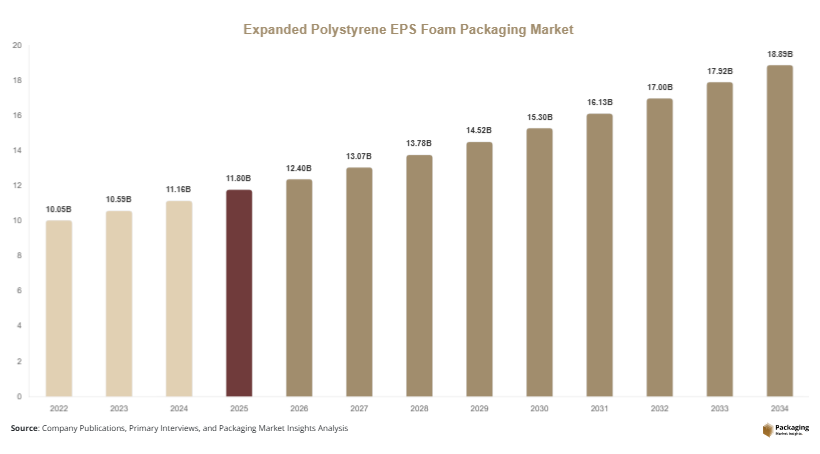
The global expanded polystyrene EPS foam packaging market size was valued at USD 11.8 billion in 2025 and is projected to reach USD 12.4 billion in 2026. The market is expected to attain approximately USD 18.9 billion by 2034, expanding at a CAGR of 5.4% during the forecast period (2025–2034). The expanded polystyrene EPS foam packaging market is experiencing steady growth due to increasing demand for lightweight protective packaging solutions across electronics, food service, pharmaceuticals, and industrial sectors. EPS foam packaging is widely used because of its shock-absorbing properties, thermal insulation capabilities, moisture resistance, and cost efficiency. The material remains a preferred packaging option for products requiring protection during storage and transportation.
Several factors are supporting market growth. First, the rapid expansion of e-commerce activities has increased the need for durable packaging materials capable of protecting products throughout complex supply chains. Second, growing demand for temperature-sensitive product transportation, particularly in pharmaceuticals and food industries, is driving EPS foam packaging adoption due to its excellent insulation properties. Third, increasing shipments of consumer electronics, appliances, and industrial equipment continue to create demand for protective packaging formats.
Key Highlights
- Asia Pacific dominated the market with a 38.1% share in 2025.
- Latin America is projected to grow at the fastest CAGR of 6.3%.
- Molded EPS packaging led the type segment with a 46.8% share.
- Virgin EPS material dominated with a 61.5% share.
- Food & beverage applications led the end-use segment with 35.6% share.
- The US remained the dominant country with a market size of USD 2.1 billion in 2025 and USD 2.2 billion in 2026.
Explore more data points, trends and opportunities Download Free Sample Report
Market Trends
Growing Adoption of Recyclable EPS Packaging Solutions
Sustainability initiatives are encouraging manufacturers to develop recyclable EPS packaging systems. Packaging producers are investing in collection infrastructure, densification technologies, and recycling partnerships to improve material recovery rates. Several food and electronics companies are implementing closed-loop packaging programs to reduce landfill disposal. For example, packaging converters in North America and Europe have expanded EPS take-back programs for industrial users. The future impact of this trend is expected to strengthen market acceptance by addressing environmental concerns while maintaining the performance benefits that make EPS suitable for protective and insulated packaging applications.
Rising Demand for Temperature-Controlled Packaging
The increasing transportation of vaccines, biologics, fresh foods, and meal kits is driving demand for insulated EPS packaging solutions. EPS offers stable temperature management and cost advantages compared with several alternative materials. Pharmaceutical distributors and food delivery providers continue to rely on EPS containers for maintaining product quality during transit. For example, pharmaceutical logistics companies increasingly utilize EPS insulated boxes for regional and international shipments. As healthcare supply chains expand and online grocery sales increase, this trend is expected to create sustained demand for advanced EPS foam packaging products.
Market Drivers
Expansion of E-Commerce and Product Shipping Activities
The continuous growth of e-commerce platforms is increasing demand for protective packaging materials capable of preventing product damage. EPS foam packaging offers excellent cushioning performance while remaining lightweight, reducing transportation costs. Electronics, home appliances, and fragile consumer products frequently require EPS inserts and molded protective components. As online retail penetration rises across Asia Pacific, North America, and Latin America, packaging suppliers are receiving larger orders for customized EPS solutions. This relationship between rising parcel shipments and protective packaging demand remains a key growth driver for the market.
Increasing Demand from Pharmaceutical and Food Industries
Pharmaceutical companies require reliable temperature-controlled packaging for vaccines, biologics, and specialty medicines. Similarly, food manufacturers need insulated packaging to preserve freshness and reduce spoilage. EPS foam provides thermal stability and protection throughout transportation and storage processes. For example, pharmaceutical distributors increasingly use EPS containers during cold-chain shipments, while seafood exporters rely on EPS boxes for maintaining product quality. The growing focus on product integrity and regulatory compliance is encouraging broader adoption of EPS packaging across these industries, supporting long-term market growth.
Market Restraint
Environmental Concerns and Regulatory Restrictions
Despite its functional benefits, EPS packaging faces challenges related to environmental sustainability and waste management. Several governments have introduced restrictions on single-use plastic products, creating uncertainty for EPS packaging manufacturers. Public concerns regarding plastic pollution and recycling limitations have encouraged some end users to explore alternative materials such as molded fiber and paper-based packaging.
The impact of these restrictions varies across regions. In Europe, stricter environmental regulations have increased compliance costs and encouraged material substitution in selected applications. Similarly, some municipalities in North America have implemented limitations on specific EPS products. For example, food-service packaging segments have experienced regulatory pressure in certain urban markets. Although recycling initiatives continue to expand, inconsistent collection infrastructure remains a challenge. These factors may limit market growth in applications where sustainable alternatives become economically viable and widely available.
Market Opportunities
Growth of Pharmaceutical Cold-Chain Logistics
The expansion of biologics, specialty medicines, and vaccine distribution networks is creating significant opportunities for EPS packaging suppliers. Temperature-sensitive pharmaceutical products require reliable insulation during transportation and storage. EPS foam packaging offers cost-effective thermal protection and can be customized according to shipment requirements. Emerging healthcare markets in Asia Pacific, the Middle East, and Latin America are investing heavily in pharmaceutical infrastructure, increasing demand for insulated packaging products. Future opportunities are expected to arise from healthcare modernization initiatives and rising pharmaceutical exports.
Increasing Demand for Recycled EPS Solutions
Growing emphasis on circular economy practices is creating opportunities for manufacturers that develop recycled EPS packaging products. Investments in material recovery facilities and advanced recycling technologies are improving the availability of recycled feedstock. Packaging companies are introducing products containing higher percentages of recycled content while maintaining performance standards. Industrial customers seeking sustainability improvements are increasingly adopting these solutions. As corporate environmental commitments strengthen and recycling systems become more efficient, recycled EPS packaging is expected to gain broader commercial acceptance across multiple industries.
Report Scope
| Report Metric | Details |
|---|---|
| Market Size in 2025 | USD 11.8 Billion |
| Market Size in 2026 | USD 12.4 Billion |
| Market Size in 2034 | USD 18.9 Billion |
| CAGR | 5.4% (2026-2034) |
| Base Year for Estimation | 2025 |
| Historical Data | 2022-2024 |
| Forecast Period | 2026-2034 |
| Report Coverage | Revenue Forecast, Competitive Landscape, Supply Chain Disruption, Growth Factors, Environment & Regulatory Landscape and Trends |
| Geographies Covered | North America, Europe, APAC, Middle East and Africa, LATAM |
| Countries Covered | U.S., Canada, U.K., Germany, France, Spain, Italy, Russia, Nordic, Benelux, Rest of Europe, China, South Korea, Japan, India, Australia, Singapore, Taiwan, South East Asia, Rest of Asia-Pacific, UAE, Turky, Saudi Arabia, South Africa, Egypt, Nigeria, Rest of MEA, Brazil, Mexico, Argentina, Chile, Colombia, Rest of LATAM |
Explore more data points, trends and opportunities Download Free Sample Report
Segmental Analysis
By Type
Molded EPS packaging held the dominant market position in 2024, accounting for approximately 46.8% of total revenue. This segment includes inserts, protective corner blocks, appliance packaging components, and customized cushioning solutions. Its leadership is attributed to widespread use in electronics, appliances, industrial equipment, and consumer goods. Manufacturers prefer molded EPS because it can be designed to fit specific product dimensions while providing excellent shock absorption. The growth of e-commerce and international trade continues to support demand for molded EPS packaging solutions.
Insulated shippers represent the fastest-growing subsegment and are projected to expand at a CAGR of 6.4% through 2034. Growth is driven by increasing demand for pharmaceutical cold-chain logistics and temperature-sensitive food transportation. Advances in insulation performance and package design are improving shipping efficiency. As biologics, vaccines, and online grocery deliveries continue to increase globally, insulated EPS shippers are expected to experience strong adoption across multiple industries.
By Material
Virgin EPS dominated the material segment in 2024 with a market share of approximately 61.5%. The segment maintains leadership because it offers consistent quality, reliable structural integrity, and strong thermal insulation performance. Industries handling sensitive products often prioritize material consistency to ensure packaging reliability. Electronics manufacturers, food processors, and pharmaceutical companies frequently select virgin EPS materials due to their established performance characteristics and compliance capabilities.
Recycled EPS is expected to be the fastest-growing material segment, registering a CAGR of 7.1% during the forecast period. Increasing sustainability initiatives and investments in recycling technologies are driving demand. Packaging manufacturers are incorporating recycled content while maintaining functional performance standards. Improved collection networks and processing capabilities are enhancing material availability. Future growth is likely to be supported by corporate environmental commitments and regulatory encouragement for circular packaging solutions.
By End-Use
Food & beverage emerged as the dominant end-use segment in 2024, accounting for approximately 35.6% of market share. EPS packaging is widely used for seafood, meat, dairy products, fresh produce, and food delivery applications due to its insulation capabilities. The material helps maintain product freshness and reduce spoilage during transportation. Rising global food trade and increasing consumer demand for convenience foods continue to support segment growth.
Pharmaceuticals represent the fastest-growing end-use segment and are forecast to expand at a CAGR of 6.8% through 2034. Growth is driven by increasing shipments of biologics, vaccines, and specialty medicines requiring temperature-controlled transportation. Healthcare supply chains are becoming more complex, increasing the need for reliable insulated packaging solutions. Continued investments in pharmaceutical manufacturing and distribution infrastructure are expected to support long-term demand for EPS foam packaging products.
Expanded Polystyrene EPS Foam Packaging Market Segmentations
By Type
- Molded EPS Packaging
- EPS Sheets & Blocks
- Insulated Shippers
- EPS Containers & Boxes
By Material
- Virgin EPS
- Recycled EPS
By End-User
- Food & Beverage
- Pharmaceuticals
- Electronics
- Industrial Goods
- Consumer Products
Region
- North America
- Europe
- Asia Pacific
- Latin America
- Middle East & Africa
Regional Analysis
North America
North America accounted for approximately 27.5% of the expanded polystyrene EPS foam packaging market share in 2025 and is projected to expand at a CAGR of 5.1% through 2034. The region benefits from a mature packaging industry, strong e-commerce penetration, and substantial demand from food distribution and pharmaceutical sectors. Growing cold-chain logistics activities continue to support market expansion. Investments in packaging automation and customized protective packaging solutions are further strengthening regional demand for EPS foam products.
The United States dominates the regional market. A unique growth driver is the country's advanced pharmaceutical distribution network requiring reliable insulated packaging systems. Healthcare providers and logistics operators increasingly utilize EPS containers for temperature-sensitive products. Additionally, the continued growth of online retail shipments has increased demand for protective molded EPS packaging for electronics and consumer goods, supporting long-term market development.
Europe
Europe held approximately 24.1% market share in 2025 and is anticipated to grow at a CAGR of 4.8% during the forecast period. Demand is supported by food exports, pharmaceutical manufacturing, and industrial packaging applications. Regional manufacturers are investing in recycling technologies to improve EPS sustainability performance. The market also benefits from increasing demand for lightweight packaging materials that help reduce transportation costs and improve supply-chain efficiency.
Germany remains the dominant country within Europe. A unique growth factor is the country's strong industrial manufacturing base, which generates substantial demand for protective packaging solutions. Electronics, machinery, and automotive component manufacturers frequently utilize EPS packaging during domestic and international shipments. Furthermore, Germany's focus on advanced recycling infrastructure supports the development of more sustainable EPS packaging systems.
Asia Pacific
Asia Pacific represented the largest regional market with a 38.1% share in 2025 and is expected to grow at a CAGR of 5.9% through 2034. Rapid industrialization, increasing consumer spending, and expanding e-commerce networks are driving regional demand. The growth of electronics manufacturing hubs across Asia continues to generate substantial requirements for protective EPS packaging. Rising food exports and pharmaceutical production are also contributing to market expansion.
China is the leading country in the region. A unique growth driver is its extensive electronics manufacturing ecosystem. Producers of consumer electronics and household appliances rely heavily on molded EPS packaging to protect products during export shipments. The country's expanding logistics infrastructure and rising demand for temperature-controlled packaging solutions further support EPS packaging consumption across diverse industries.
Middle East & Africa
The Middle East & Africa accounted for approximately 5.8% of market share in 2025 and is forecast to grow at a CAGR of 5.5%. Economic diversification initiatives, industrial development projects, and growing food distribution networks are supporting packaging demand. The expansion of healthcare infrastructure across several countries is also increasing demand for insulated packaging solutions capable of maintaining product integrity throughout transportation.
Saudi Arabia leads the regional market. A unique growth factor is the country's investment in pharmaceutical manufacturing and healthcare modernization programs. As local production of healthcare products expands, demand for temperature-controlled packaging solutions continues to increase. Growth in food imports and organized retail channels is also encouraging greater adoption of EPS packaging throughout regional supply chains.
Latin America
Latin America captured approximately 4.5% market share in 2025 and is projected to register the fastest CAGR of 6.3% during the forecast period. Expanding food exports, improving logistics infrastructure, and increasing industrial activity are supporting market growth. Demand for insulated packaging is rising as regional producers seek to reduce spoilage and maintain product quality during transportation.
Brazil dominates the Latin American market. A unique growth driver is the country's large agricultural and seafood export sector, which requires reliable insulated packaging solutions. Exporters increasingly utilize EPS boxes for maintaining freshness during long-distance shipments. Continued investments in cold-chain logistics and food processing facilities are expected to create additional opportunities for EPS packaging suppliers.
Competitive Landscape
The expanded polystyrene EPS foam packaging market is moderately consolidated, with leading companies focusing on product innovation, recycling initiatives, capacity expansion, and strategic partnerships. Major participants are investing in advanced molding technologies and sustainable EPS solutions to address evolving customer requirements and regulatory expectations.
Sonoco Products Company remains one of the market leaders due to its broad packaging portfolio, global manufacturing footprint, and focus on protective packaging solutions. The company recently expanded its sustainable packaging initiatives by increasing investments in recyclable foam packaging technologies.
Other key companies including Sealed Air Corporation, BASF SE, Storopack Hans Reichenecker GmbH, and DS Smith Plc continue to strengthen their market positions through acquisitions, product development programs, and regional expansion strategies. Competitive differentiation increasingly focuses on insulation performance, recycled content integration, and customized packaging design capabilities. Companies are also collaborating with logistics providers and end users to improve packaging efficiency and sustainability throughout supply chains.
Key Players List
- Sonoco Products Company
- Sealed Air Corporation
- BASF SE
- Storopack Hans Reichenecker GmbH
- DS Smith Plc
- JSP Corporation
- Pregis LLC
- BEWi ASA
- Kaneka Corporation
- ACH Foam Technologies
- Synbra Holding B.V.
- Atlas Molded Products
- Flint Hills Resources
- Epsilyte LLC
- ThermoSafe Brands
- Foamcraft Inc.
- Dart Container Corporation