Eps Container Market Size
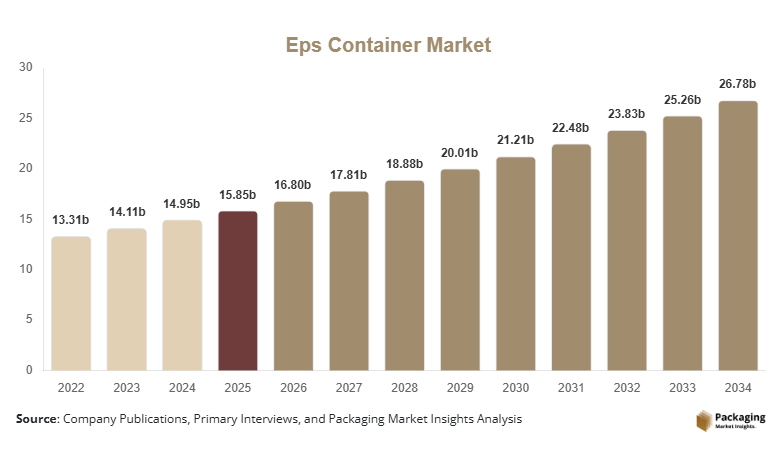
Eps Container market size is projected at USD 16.8 billion in 2026 and is expected to hit USD 26.7 billion by 2034 with a CAGR of 6.0%. The report provides detailed insights into production capacity, raw material consumption, application analysis, technology advancements, pricing trends, and the competitive landscape across leading manufacturers. It evaluates shipment volumes, regional developments, regulatory frameworks, and investment opportunities influencing future market expansion.
EPS (Expanded Polystyrene) containers are lightweight, thermally insulated packaging solutions extensively used for transporting food, pharmaceuticals, seafood, chemicals, and temperature-sensitive products. Global production exceeded 19.2 billion EPS containers during 2025, while food service applications accounted for nearly 56% of total demand. Healthcare and pharmaceutical logistics contributed approximately 18%, and industrial packaging represented 26% of overall consumption. Rising demand for temperature-controlled packaging and protective transportation solutions continues supporting the Eps Container market.
Explore more data points, trends and opportunities Download Free Sample Report
Eps Container Market Trends
Increasing Demand for Temperature-Controlled Packaging
Growing demand for fresh food delivery, seafood exports, and pharmaceutical cold-chain logistics continues driving EPS container adoption. More than 8.7 billion insulated EPS containers were supplied globally during 2025, representing annual growth of 8.5%. Cold-chain logistics utilization increased by 14%, while food delivery packaging demand expanded by 11%. These developments continue strengthening the Eps Container market.
Manufacturers are adopting lightweight molding technologies and recyclable EPS formulations to improve sustainability and operational efficiency. Approximately 42% of manufacturers invested in automated molding systems during 2025, while recycled EPS utilization increased to 19% globally. Improved insulation performance and reduced material consumption continue reinforcing the Eps Container market.
Eps Container Drivers
Growing Cold Chain Logistics and Food Delivery Industry
Expansion of global cold-chain infrastructure and online food delivery services continues accelerating demand for insulated EPS containers. Global cold-chain logistics investments exceeded USD 330 billion during 2025, while online food delivery transactions increased by 13% annually. More than 61% of seafood exports utilize EPS insulated containers, supporting Eps Container growth.
Eps Container Restraints
Environmental Regulations on Expanded Polystyrene
Increasing restrictions on single-use plastic products and EPS waste disposal remain significant challenges. More than 85 countries have introduced stricter packaging waste regulations, while compliance costs increased by approximately 12%. These regulations continue influencing Eps Container growth.
Eps Container Opportunities
Expansion of Pharmaceutical and Vaccine Distribution
The growing transportation of biologics, vaccines, and temperature-sensitive medicines is creating significant opportunities for EPS insulated containers. Pharmaceutical cold-chain shipments exceeded 18 billion units globally during 2025, while healthcare packaging demand increased by 9% annually. These developments continue generating opportunities for the Eps Container market.
Challenges in Eps Container
Recycling Infrastructure and Sustainability Concerns
Limited EPS recycling infrastructure and increasing environmental awareness continue challenging market expansion. Global EPS recycling rates remain below 25%, while collection costs increased by 16% during recent years. Manufacturers continue investing in closed-loop recycling systems and bio-based insulation alternatives to strengthen the Eps Container market.
Report Scope
| Report Metric | Details |
|---|---|
| Market Size in 2025 | USD 15.85 billion |
| Market Size in 2026 | USD 16.8 billion |
| Market Size in 2034 | USD 26.7 billion |
| CAGR | 6.0% (2026-2034) |
| Base Year for Estimation | 2025 |
| Historical Data | 2022-2024 |
| Forecast Period | 2026-2034 |
| Report Coverage | Revenue Forecast, Competitive Landscape, Supply Chain Disruption, Growth Factors, Environment & Regulatory Landscape and Trends |
| Geographies Covered | North America, Europe, APAC, Middle East and Africa, LATAM |
| Countries Covered | U.S., Canada, U.K., Germany, France, Spain, Italy, Russia, Nordic, Benelux, Rest of Europe, China, South Korea, Japan, India, Australia, Singapore, Taiwan, South East Asia, Rest of Asia-Pacific, UAE, Turky, Saudi Arabia, South Africa, Egypt, Nigeria, Rest of MEA, Brazil, Mexico, Argentina, Chile, Colombia, Rest of LATAM |
Explore more data points, trends and opportunities Download Free Sample Report
Eps Container Market Segmentation
The market is segmented by type and application based on insulation performance, end-use industry, and transportation requirements. Food Service Containers account for approximately 49% of total revenue, while Food & Beverage remains the largest application with nearly 56% market share.
By Type
Food Service Containers dominate the market with approximately 49% share. Annual production exceeds 9.4 billion units, offering excellent thermal insulation, lightweight construction, moisture resistance, and cost-effective transportation for restaurants, food delivery, and catering services.
Pharmaceutical Containers account for nearly 29% of demand. Production surpassed 5.6 billion units during 2025, supporting vaccine transportation, biologics distribution, diagnostic kits, and temperature-sensitive medical products.
Industrial Packaging Containers represent approximately 22% of market demand. These containers provide impact protection, thermal insulation, and lightweight transportation for chemicals, electronics, laboratory materials, and industrial components.
By Application
Food & Beverage represents approximately 56% of global demand. More than 10.7 billion EPS containers are utilized annually for seafood, dairy products, meat, frozen foods, fruits, vegetables, and ready-to-eat meals.
Healthcare accounts for nearly 24% of market consumption. Hospitals, pharmaceutical companies, and vaccine distributors increasingly utilize insulated EPS containers to maintain product integrity throughout transportation.
Industrial & Logistics contributes approximately 20% of market demand. EPS containers protect industrial goods, laboratory samples, specialty chemicals, and temperature-sensitive materials during domestic and international shipping.
Eps Container Market Segmentations
Product Type
- Food Service Containers
- Pharmaceutical Containers
- Industrial Packaging Containers
- Seafood & Fish Boxes
- Insulated Shipping Containers
Application
- Food & Beverage
- Healthcare
- Industrial & Logistics
- Seafood Transportation
- Chemical Packaging
Distribution Channel
- Direct Sales
- Packaging Distributors
- Online Sales
- Wholesale Suppliers
- Industrial Supply Dealers
Eps Container Regional Outlook
North America
North America accounts for approximately 31% of global revenue. The United States contributes nearly 81% of regional demand due to advanced food delivery, seafood transportation, and pharmaceutical cold-chain logistics. Annual production exceeds 5.8 billion EPS containers.
Europe
Europe represents nearly 26% of global demand. Germany, France, Italy, Spain, and the United Kingdom dominate regional consumption through food processing, healthcare logistics, and seafood exports.
Asia-Pacific
Asia-Pacific holds approximately 35% of market revenue and remains the fastest-growing region. China, Japan, India, South Korea, and Southeast Asia collectively manufacture more than 7.2 billion EPS containers annually, supported by expanding food processing and pharmaceutical industries.
Latin America, Middle East & Africa
These regions collectively contribute approximately 8% of global revenue. Brazil, Mexico, Saudi Arabia, South Africa, and the UAE continue expanding food exports and cold-chain logistics, increasing EPS container demand across multiple industries.
Top players in Eps Container Market
- Sealed Air Corporation
- Sonoco Products Company
- DS Smith Plc
- Pregis LLC
- Styropack Ltd.
- Jackon Holding AS
- BEWi ASA
- Drew Foam Companies Inc.
- Atlas Molded Products
- FoamCraft Packaging Inc.
- Novipax LLC
- Intelsius Ltd.
Sealed Air Corporation
-
Holds an estimated 12–14% global market share.
-
Offers advanced insulated packaging solutions for food, healthcare, and industrial logistics.
-
Operates a global manufacturing network with continuous investments in sustainable protective packaging technologies.
-
Focuses on lightweight materials, cold-chain innovation, and recyclable packaging solutions to strengthen its global position.
Sonoco Products Company
-
Accounts for approximately 10–12% of global market share.
-
Manufactures insulated protective packaging, temperature-controlled shipping systems, and food-grade packaging solutions.
-
Maintains a strong presence across food processing, pharmaceuticals, and industrial transportation sectors.
-
Continues investing in sustainable packaging materials, automation, and cold-chain packaging innovations to enhance competitiveness.