Plastic Aerosol Packaging Market Size and Growth
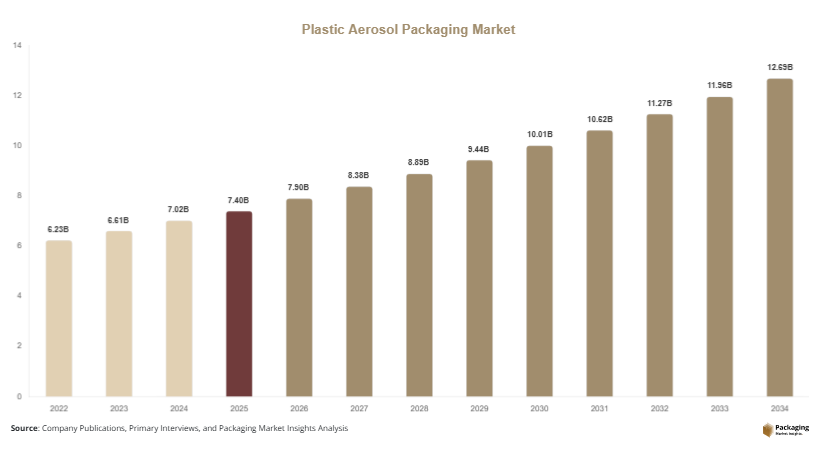
The global plastic aerosol packaging market was valued at USD 7.4 billion in 2025 and is projected to reach approximately USD 7.9 billion in 2026. The market is further forecasted to reach USD 12.6 billion by 2034, expanding at a CAGR of 6.1% during the forecast period from 2025 to 2034. The market is experiencing stable growth due to increasing demand for lightweight and cost-efficient aerosol packaging solutions across personal care, household, healthcare, automotive, and industrial applications. Plastic aerosol packaging offers advantages such as reduced transportation costs, corrosion resistance, improved design flexibility, and compatibility with modern dispensing technologies.
Manufacturers are increasingly shifting toward recyclable and lightweight plastic aerosol containers to reduce packaging waste and improve supply chain efficiency. Polyethylene terephthalate (PET) and polypropylene (PP) aerosol containers are gaining adoption due to their durability and lower carbon footprint compared to traditional metal packaging. The growing popularity of spray-based products in deodorants, hair sprays, room fresheners, disinfectants, and pharmaceutical sprays continues to support long-term market expansion.
Key Highlights
- Asia Pacific dominated the market with a 38.7% share in 2025.
- Latin America is projected to grow at the fastest CAGR of 6.8%.
- PET aerosol containers led the type segment with a 36.4% share.
- Plastic-based aerosol structures dominated the material segment with a 63.2% share.
- Personal care applications led the market with a 44.6% share.
- The US remained the dominant country with a market size of USD 1.6 billion in 2025 and USD 1.7 billion in 2026.
Explore more data points, trends and opportunities Download Free Sample Report
Market Trends
Rising Adoption of Recyclable and Lightweight Aerosol Packaging
Sustainability initiatives are significantly influencing the plastic aerosol packaging market as manufacturers increasingly focus on recyclable and lightweight packaging formats. Brands across personal care and household product industries are reducing material consumption while improving packaging recyclability. PET-based aerosol containers are gaining strong adoption because they offer lightweight properties and compatibility with existing recycling infrastructure. Companies are also investing in mono-material packaging technologies to simplify waste sorting and improve recycling efficiency.
For example, several cosmetic and deodorant manufacturers are replacing aluminum aerosol cans with recyclable PET aerosol bottles to reduce logistics costs and lower greenhouse gas emissions during transportation. Retailers are also prioritizing environmentally responsible packaging solutions to align with changing consumer preferences. Over the forecast period, demand for recyclable plastic aerosol packaging is expected to expand further due to stricter environmental regulations and rising investments in circular packaging systems.
Integration of Advanced Dispensing Technologies
Advanced dispensing systems are becoming an important trend in the market as brands focus on improving user convenience and product performance. Bag-on-valve systems, precision spray technologies, and compressed air dispensing mechanisms are increasingly integrated into plastic aerosol packaging formats. These technologies improve product utilization, reduce chemical propellants, and support safer dispensing applications in healthcare and personal care industries.
Manufacturers are also developing ergonomic aerosol containers with improved spray consistency and leak-proof sealing systems. For instance, pharmaceutical companies are increasingly adopting controlled-dose aerosol sprays for topical treatments and respiratory care applications. Household cleaning brands are also introducing high-pressure trigger spray aerosol systems to improve product efficiency. In the long term, integration of smart dispensing systems and sustainable propellant technologies is expected to reshape innovation across the aerosol packaging industry.
Market Drivers
Growing Demand from Personal Care and Cosmetic Industries
The rapid expansion of personal care and cosmetic product consumption is a major driver supporting market growth. Aerosol packaging is widely used for deodorants, dry shampoos, body sprays, shaving foams, and hair styling products because it provides controlled dispensing and convenience. Rising urbanization and increasing consumer spending on grooming and hygiene products are strengthening aerosol packaging demand globally.
Large cosmetic brands continue to introduce spray-based formulations with attractive packaging designs to improve customer engagement. For example, beauty product manufacturers are investing in transparent PET aerosol containers with digital printing capabilities to strengthen premium product positioning. The growing popularity of travel-friendly packaging formats is also supporting higher adoption of compact aerosol packaging solutions. As global personal care markets continue expanding, demand for plastic aerosol packaging is expected to increase steadily during the forecast period.
Expansion of Household Cleaning and Sanitization Products
Rising demand for disinfectants, air fresheners, and surface cleaning sprays is another major growth driver for the market. Consumers increasingly prefer spray-based household products because they improve convenience and ensure efficient product application. The expansion of hygiene awareness across residential and commercial sectors continues to accelerate demand for aerosol-based packaging formats.
Industrial cleaning product manufacturers are also investing in durable and chemically resistant aerosol containers to improve storage stability. For instance, disinfectant spray producers are adopting multilayer plastic aerosol packaging to extend shelf life and improve transportation safety. Growth in hospitality, healthcare, and institutional cleaning industries is further increasing consumption of aerosol packaging products. The continued expansion of hygiene-focused consumer behavior is expected to create long-term demand opportunities for plastic aerosol packaging manufacturers.
Market Restraint
Environmental Concerns Related to Plastic Waste Generation
Environmental concerns associated with plastic waste and recycling limitations remain a major restraint for the plastic aerosol packaging market. Several countries are introducing regulations targeting single-use plastic packaging and encouraging manufacturers to reduce non-recyclable material consumption. Traditional multilayer aerosol packaging structures often create recycling challenges due to mixed polymer compositions and chemical residue contamination.
Consumer awareness regarding plastic pollution is also influencing purchasing decisions across personal care and household product categories. For example, some premium cosmetic brands are transitioning toward aluminum or paper-based alternatives to strengthen sustainability positioning. In addition, collection and recycling infrastructure for aerosol packaging remains underdeveloped in several emerging economies, limiting material recovery rates.
The market also faces pressure from fluctuating raw material prices and rising compliance costs associated with sustainable packaging regulations. Manufacturers must invest heavily in recyclable materials, eco-friendly propellant systems, and packaging redesign initiatives to maintain competitiveness. These operational challenges may restrict profit margins for smaller packaging companies during the forecast period.
Market Opportunities
Growth of Bio-Based Plastic Aerosol Packaging
The development of bio-based plastic aerosol packaging presents significant growth opportunities for market participants. Packaging companies are increasingly exploring renewable polymer materials derived from sugarcane, corn starch, and plant-based feedstocks to reduce dependence on fossil-fuel-based plastics. Bio-based aerosol containers can help brands achieve sustainability targets while maintaining packaging performance and durability.
Several personal care brands are already testing plant-based aerosol containers for deodorants and skincare products. Demand for bio-based packaging is particularly increasing in Europe and North America due to stricter environmental regulations and rising consumer preference for sustainable products. Future advancements in biodegradable polymer technologies and recyclable bio-plastic structures are expected to create new commercial opportunities across premium aerosol packaging applications.
Expansion of Pharmaceutical and Healthcare Aerosol Applications
The growing healthcare sector is creating new opportunities for plastic aerosol packaging manufacturers. Aerosol packaging is increasingly used for wound care sprays, respiratory inhalers, topical medications, and sanitization products. Rising healthcare expenditure and growing pharmaceutical production capacities are supporting higher demand for specialized aerosol packaging solutions.
Healthcare companies are investing in high-barrier plastic aerosol containers that improve product safety and dispensing precision. For instance, pharmaceutical manufacturers are adopting lightweight plastic aerosol systems for nasal sprays and dermatological treatments due to their portability and controlled dosage capabilities. Emerging economies are also expanding healthcare infrastructure, increasing demand for affordable pharmaceutical aerosol packaging solutions. Over the forecast period, healthcare-focused innovation is expected to become an important revenue-generating segment for market participants.
Report Scope
| Report Metric | Details |
|---|---|
| Market Size in 2025 | USD 7.4 Billion |
| Market Size in 2026 | USD 7.9 Billion |
| Market Size in 2034 | USD 12.6 Billion |
| CAGR | 6.1% (2026-2034) |
| Base Year for Estimation | 2025 |
| Historical Data | 2022-2024 |
| Forecast Period | 2026-2034 |
| Report Coverage | Revenue Forecast, Competitive Landscape, Supply Chain Disruption, Growth Factors, Environment & Regulatory Landscape and Trends |
| Geographies Covered | North America, Europe, APAC, Middle East and Africa, LATAM |
| Countries Covered | U.S., Canada, U.K., Germany, France, Spain, Italy, Russia, Nordic, Benelux, Rest of Europe, China, South Korea, Japan, India, Australia, Singapore, Taiwan, South East Asia, Rest of Asia-Pacific, UAE, Turky, Saudi Arabia, South Africa, Egypt, Nigeria, Rest of MEA, Brazil, Mexico, Argentina, Chile, Colombia, Rest of LATAM |
Explore more data points, trends and opportunities Download Free Sample Report
Segmental Analysis
By Type
PET aerosol containers dominated the type segment with a 36.4% market share in 2024. PET-based aerosol packaging is widely preferred due to its lightweight structure, transparency, durability, and recyclability. Personal care manufacturers extensively use PET aerosol containers for deodorants, body sprays, and cosmetic products because they offer strong visual appeal and lower transportation costs compared to metal alternatives. Packaging companies are also integrating advanced barrier technologies into PET aerosol structures to improve product stability and shelf life. Growth in premium cosmetic packaging and rising demand for sustainable packaging formats continue to strengthen the dominance of PET aerosol containers globally.
Recyclable mono-material aerosol packaging is projected to grow at the fastest CAGR of 7.1% through 2034. Growth is supported by increasing sustainability regulations and rising demand for simplified recycling systems. Manufacturers are developing mono-polymer aerosol structures that improve recyclability while maintaining pressure resistance and dispensing efficiency. Consumer goods companies are increasingly adopting mono-material aerosol packaging for household cleaners and personal care sprays to align with environmental targets. Future advancements in recyclable valve systems and lightweight polymer technologies are expected to further accelerate segment growth.
By Material
Plastic-based aerosol structures held the largest material segment share of 63.2% in 2024. Plastic materials remain dominant because they offer flexibility in design, corrosion resistance, and lower production costs. Polypropylene and polyethylene-based aerosol containers are widely used across personal care, automotive, and industrial applications due to their durability and compatibility with different propellant systems. Manufacturers are increasingly investing in multilayer plastic aerosol packaging technologies that improve chemical resistance and product preservation. Growth in spray-based consumer products and rising demand for lightweight packaging solutions continue to support strong segment expansion globally.
Bio-based plastics are expected to grow at the fastest CAGR of 7.4% during the forecast period. Increasing environmental concerns and corporate sustainability commitments are driving demand for renewable packaging materials. Bio-based aerosol containers derived from plant-based polymers are gaining popularity across premium cosmetic and organic household product categories. Packaging manufacturers are also investing in compostable polymer technologies and recyclable bio-plastic solutions to improve environmental performance. Over the forecast period, innovation in renewable polymer production and government support for sustainable materials are expected to create strong growth opportunities for the segment.
By End-Use
Personal care applications dominated the end-use segment with a 44.6% market share in 2024. Aerosol packaging is extensively used for deodorants, hair sprays, shaving foams, dry shampoos, and skincare products due to its convenience and precise dispensing capabilities. Rising beauty consciousness and increasing spending on grooming products are major factors supporting segment growth. Manufacturers are also investing in visually attractive packaging designs and digital printing technologies to improve shelf visibility and strengthen brand positioning. The growing influence of social media marketing and premium cosmetic product launches continues to increase aerosol packaging demand across personal care industries globally.
Healthcare applications are projected to expand at the fastest CAGR of 6.9% through 2034. Growth is supported by increasing demand for pharmaceutical sprays, sanitization products, wound care solutions, and respiratory inhalers. Healthcare companies are increasingly adopting lightweight plastic aerosol systems that improve portability and dosage precision. Rising investments in medical infrastructure and pharmaceutical manufacturing capacities across emerging economies are also supporting higher demand for aerosol packaging solutions. Future development of advanced sterile aerosol systems and controlled dispensing technologies is expected to strengthen segment growth further.
Plastic Aerosol Packaging Market Segmentations
By Type
- PET Aerosol Containers
- Polypropylene Aerosol Containers
- HDPE Aerosol Containers
- Recyclable Mono-Material Aerosol Packaging
By Material
- Plastic-Based Structures
- Bio-Based Plastics
- Recycled Plastics
- Multilayer Plastic Materials
By End-User
- Personal Care
- Household Products
- Healthcare
- Automotive
- Industrial Applications
Regional Analysis
North America
North America accounted for 27.6% of the global plastic aerosol packaging market share in 2025 and is projected to expand at a CAGR of 5.8% through 2034. The region benefits from strong demand for personal care sprays, household disinfectants, and healthcare aerosol products. Growth in premium cosmetic packaging and increasing investments in sustainable aerosol technologies are supporting regional market expansion. Packaging companies in the United States and Canada are focusing on recyclable PET aerosol containers and low-emission propellant systems to meet regulatory requirements. Rising demand for convenient spray-based cleaning products across commercial and residential sectors is also strengthening consumption of plastic aerosol packaging solutions.
The United States remained the dominant country in North America due to its large consumer goods manufacturing industry and strong retail distribution networks. A major growth driver in the country is the rapid adoption of sustainable packaging innovations across cosmetic and hygiene product categories. Several American packaging companies are investing in lightweight aerosol containers with advanced dispensing technologies. Growth in e-commerce retail and direct-to-consumer beauty brands is also increasing demand for durable and visually attractive aerosol packaging solutions across the country.
Europe
Europe represented 24.9% of the global market share in 2025 and is expected to grow at a CAGR of 5.7% during the forecast period. The regional market is supported by stringent environmental regulations encouraging recyclable packaging adoption. European manufacturers are increasingly investing in mono-material aerosol containers and refillable packaging systems to reduce plastic waste generation. The household cleaning and pharmaceutical industries remain major consumers of aerosol packaging products across the region. Rising investments in sustainable packaging research and circular economy initiatives are also supporting long-term market development.
Germany dominated the European market due to its strong industrial manufacturing base and advanced recycling infrastructure. One unique growth driver in Germany is the increasing use of eco-friendly packaging technologies in premium cosmetic and healthcare applications. Several packaging firms are introducing recyclable aerosol containers made from post-consumer recycled plastics. The country is also witnessing strong demand for low-carbon packaging solutions across automotive maintenance and industrial spray applications, further supporting market expansion.
Asia Pacific
Asia Pacific dominated the plastic aerosol packaging market with a 38.7% share in 2025 and is projected to register a CAGR of 6.6% through 2034. Rapid urbanization, population growth, and rising disposable income are major factors supporting regional market expansion. Countries across Asia Pacific are witnessing increasing consumption of personal care sprays, deodorants, air fresheners, and healthcare aerosol products. The expansion of domestic manufacturing industries and rising retail penetration are also accelerating packaging demand.
China remained the leading country in the region due to its strong packaging manufacturing sector and large consumer goods production capacity. A major growth driver in China is the rapid expansion of domestic cosmetic and household product brands using aerosol packaging formats. Local manufacturers are investing in lightweight PET aerosol technologies and digital printing solutions to improve product differentiation. Growth in export-oriented packaging production and increasing investments in sustainable packaging infrastructure are expected to strengthen regional market competitiveness further.
Middle East & Africa
The Middle East & Africa market accounted for 4.8% of the global share in 2025 and is expected to expand at a CAGR of 5.9% during the forecast period. Rising urban development, increasing household product consumption, and growth in healthcare packaging demand are supporting regional market expansion. Several countries in the region are witnessing higher adoption of spray-based cleaning and personal care products due to changing consumer lifestyles. Investments in retail infrastructure and industrial packaging production are also contributing to market growth.
Saudi Arabia emerged as the dominant country in the region due to increasing demand for aerosol-based personal care and hygiene products. One important growth driver is the expansion of domestic manufacturing supported by industrial diversification initiatives. Regional packaging companies are investing in high-durability plastic aerosol containers for household and industrial cleaning applications. Growth in tourism and hospitality sectors is also supporting higher demand for disinfectant sprays and room fresheners packaged in aerosol formats.
Latin America
Latin America is projected to grow at the fastest CAGR of 6.8% during the forecast period. The regional market is benefiting from rising demand for affordable personal care products and household cleaning sprays. Increasing urban population and growth in middle-income consumers are supporting higher consumption of aerosol-based packaging products. Packaging manufacturers are also expanding local production capacities to reduce import dependency and strengthen supply chain efficiency.
Brazil remained the dominant country in Latin America due to strong cosmetic manufacturing activities and rising consumption of aerosol deodorants and hair care products. A unique growth driver in Brazil is the rapid expansion of domestic beauty and grooming brands targeting younger consumers. Several regional manufacturers are adopting recyclable aerosol packaging solutions to improve sustainability performance and reduce logistics costs. Expansion of retail distribution networks and online consumer product sales is expected to support further market growth.
Competitive Landscape
The plastic aerosol packaging market is moderately competitive, with leading companies focusing on sustainability initiatives, lightweight packaging technologies, and advanced dispensing systems to strengthen market positioning. Companies are investing in recyclable materials, digital printing solutions, and high-performance aerosol valves to improve operational efficiency and product differentiation.
Berry Global Inc. remains one of the leading companies in the market due to its extensive product portfolio and strong global manufacturing network. The company continues to invest in recyclable aerosol packaging technologies and post-consumer recycled plastic solutions. AptarGroup, Inc. is another major player focusing on advanced dispensing systems and sustainable aerosol innovations for healthcare and personal care applications.
ALPLA Group is expanding production capacities for recyclable PET aerosol containers across Europe and Asia Pacific. Plastipak Holdings, Inc. is strengthening investments in lightweight aerosol packaging and circular recycling initiatives. Sonoco Products Company is focusing on sustainable packaging partnerships and customized aerosol container solutions for industrial and consumer goods sectors.
Strategic collaborations, regional manufacturing expansion, and eco-friendly packaging development remain major competitive strategies across the market.
Key Players List
- Berry Global Inc.
- AptarGroup, Inc.
- ALPLA Group
- Plastipak Holdings, Inc.
- Sonoco Products Company
- Trivium Packaging
- CCL Industries Inc.
- Precision Valve Corporation
- Lindal Group
- Graham Packaging Company
- DS Containers, Inc.
- Montebello Packaging
- Toyo Seikan Group Holdings Ltd.
- Nampak Ltd.
- Crown Holdings, Inc.