Empty Coffee Capsules Lids Market Size and Growth
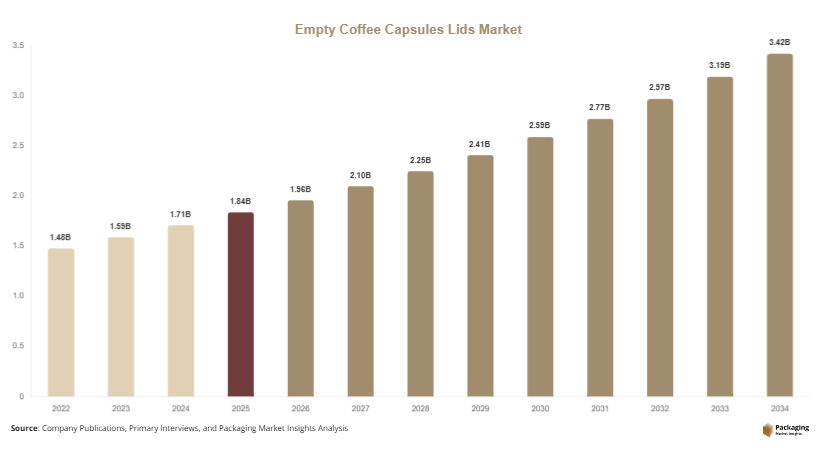
The global empty coffee capsules lids market size was valued at approximately USD 1.84 billion in 2025 and is projected to reach USD 1.96 billion in 2026. The market is anticipated to grow to around USD 3.42 billion by 2034, registering a CAGR of 7.2% during the forecast period (2025–2034). Market expansion is supported by the growing adoption of coffee pods across North America, Europe, and Asia Pacific, coupled with increasing penetration of capsule-based coffee machines in households and offices.
The empty coffee capsules lids market is witnessing consistent growth due to the rising popularity of single-serve coffee systems, increasing consumer preference for premium coffee experiences at home, and growing demand for customized coffee capsule solutions. Empty coffee capsule lids play a critical role in maintaining aroma, freshness, and product integrity by providing effective sealing performance for coffee capsules used in domestic and commercial brewing systems. Manufacturers are increasingly investing in innovative lid materials and sustainable packaging technologies to meet evolving consumer and regulatory requirements.
Key Market Highlights
- Asia Pacific dominated the market with a 35.8% share in 2025.
- Latin America is projected to grow at the fastest CAGR of 8.1%.
- Heat-sealable lids led the type segment with a 46.7% share.
- Aluminum-based lids dominated the material segment with a 58.4% share.
- Coffee roasting companies led the end-use segment with 42.5% share.
- The US remained the dominant country with a market size of USD 196 million in 2025 and USD 209 million in 2026.
Explore more data points, trends and opportunities Download Free Sample Report
Market Trends
Growing Adoption of Compostable and Recyclable Lid Solutions
Sustainability has become a major trend shaping the empty coffee capsules lids market. Coffee brands and packaging manufacturers are increasingly developing recyclable aluminum lids and compostable bio-based alternatives to address environmental concerns associated with single-use coffee capsules. Consumers are actively seeking environmentally responsible coffee packaging, prompting brands to redesign capsule systems. For example, several European coffee brands have introduced industrially compostable capsule lids compatible with existing brewing machines. This trend is expected to accelerate as governments implement stricter packaging waste regulations and retailers prioritize sustainable product portfolios. Future growth will likely focus on advanced barrier technologies that combine environmental benefits with high oxygen and moisture protection performance.
Expansion of Customized Printing and Branding Technologies
Coffee capsule manufacturers are increasingly using advanced digital and flexographic printing technologies to enhance lid customization and brand visibility. Printed lids enable coffee companies to display product information, flavor profiles, brewing instructions, and promotional content directly on capsule packaging. For example, premium coffee brands are adopting high-definition printed lids featuring color-coded designs to differentiate blends and roast levels. This trend is expected to strengthen as private-label coffee production grows globally. Future developments in smart packaging and QR-code integration may further enhance consumer engagement, traceability, and marketing effectiveness, creating additional value for packaging suppliers and coffee brands.
Market Drivers
Rising Global Demand for Single-Serve Coffee Systems
The increasing popularity of single-serve coffee machines is a major driver of market growth. Consumers are increasingly adopting capsule-based brewing systems due to convenience, consistency, and ease of use. This growing installed base directly increases demand for empty coffee capsules and compatible lid solutions. As coffee machine ownership expands across households, offices, hotels, and commercial establishments, manufacturers require large volumes of reliable sealing components. For example, coffee pod consumption continues to increase across Europe and North America as consumers seek café-style coffee experiences at home. This cause-and-effect relationship between machine adoption and packaging demand is expected to remain a key growth catalyst throughout the forecast period.
Growth of Private-Label and Specialty Coffee Brands
The rapid expansion of specialty coffee roasters and private-label coffee brands is creating substantial demand for customized capsule lid solutions. Independent coffee producers increasingly use capsule formats to expand product offerings and access premium consumer segments. As a result, packaging suppliers are developing flexible lid designs, customized graphics, and enhanced barrier materials. For example, regional coffee brands are introducing capsule-compatible products for popular brewing systems while utilizing branded lids to strengthen product recognition. This trend is expected to support long-term market growth as specialty coffee consumption continues to rise across developed and emerging economies.
Market Restraint
Volatility in Raw Material Costs and Sustainability Compliance Requirements
One of the primary restraints affecting the empty coffee capsules lids market is the fluctuation in raw material prices, particularly aluminum foil, specialty films, and multilayer laminate materials. Manufacturers rely heavily on these materials to achieve the barrier properties required for preserving coffee freshness. Price volatility can significantly impact production costs and profit margins, especially for small and medium-sized packaging suppliers.
In addition, evolving environmental regulations are increasing compliance costs for manufacturers. Many countries are introducing packaging waste reduction targets, extended producer responsibility requirements, and recyclability standards. For example, packaging producers serving European markets often need to redesign products to meet changing sustainability guidelines. While these regulations encourage innovation, they also require continuous investment in research, testing, and certification processes. As a result, some manufacturers may face operational challenges and delayed product commercialization, particularly in highly regulated markets.
Market Opportunities
Expansion of Sustainable Capsule Ecosystems
The development of fully sustainable coffee capsule systems represents a significant opportunity for market participants. Coffee brands are increasingly seeking integrated solutions that combine recyclable or compostable capsules with environmentally friendly lid materials. Packaging manufacturers capable of delivering complete sustainable systems are likely to benefit from growing consumer demand and regulatory support. For example, several coffee companies are launching capsule programs featuring compostable bodies and bio-based sealing lids. Future opportunities will emerge as retailers, hospitality businesses, and corporate coffee service providers adopt sustainable procurement practices and prioritize environmentally responsible packaging solutions.
Increasing Demand in Emerging Coffee Markets
Emerging economies across Asia Pacific, Latin America, and the Middle East are creating new growth opportunities for coffee capsule packaging suppliers. Rising disposable incomes, urbanization, and changing consumer lifestyles are contributing to increased consumption of premium coffee products. Coffee machine penetration remains relatively low in many developing countries, providing substantial room for future expansion. For instance, growing café culture and premium coffee consumption in countries such as India, Vietnam, and Brazil are encouraging brands to introduce capsule-based products. This trend is expected to generate significant demand for innovative lid technologies and customized packaging solutions over the forecast period.
Report Scope
| Report Metric | Details |
|---|---|
| Market Size in 2025 | USD 1.84 Billion |
| Market Size in 2026 | USD 1.96 Billion |
| Market Size in 2034 | USD 3.42 Billion |
| CAGR | 7.2% (2026-2034) |
| Base Year for Estimation | 2025 |
| Historical Data | 2022-2024 |
| Forecast Period | 2026-2034 |
| Report Coverage | Revenue Forecast, Competitive Landscape, Supply Chain Disruption, Growth Factors, Environment & Regulatory Landscape and Trends |
| Geographies Covered | North America, Europe, APAC, Middle East and Africa, LATAM |
| Countries Covered | U.S., Canada, U.K., Germany, France, Spain, Italy, Russia, Nordic, Benelux, Rest of Europe, China, South Korea, Japan, India, Australia, Singapore, Taiwan, South East Asia, Rest of Asia-Pacific, UAE, Turky, Saudi Arabia, South Africa, Egypt, Nigeria, Rest of MEA, Brazil, Mexico, Argentina, Chile, Colombia, Rest of LATAM |
Explore more data points, trends and opportunities Download Free Sample Report
Segmental Analysis
By Type
Heat-sealable lids dominated the market in 2024, accounting for approximately 46.7% of total market share. These lids remain widely used due to their compatibility with various capsule formats and their ability to provide effective oxygen and moisture barriers. Manufacturers favor heat-sealable solutions because they support high-speed production processes and ensure consistent sealing performance. Coffee roasting companies and capsule fillers rely heavily on this lid type to preserve freshness and extend shelf life. The segment also benefits from continuous improvements in sealing technologies and multilayer barrier structures. Industry examples include aluminum-laminate lids used across premium coffee capsule platforms where product protection is critical. Strong compatibility with existing filling equipment continues to support segment leadership globally.
Compostable lids represent the fastest-growing subsegment and are projected to expand at a CAGR of 8.6% through 2034. Growth is primarily driven by increasing sustainability requirements and consumer demand for environmentally responsible packaging. Packaging suppliers are introducing plant-based films and biodegradable sealing materials designed to maintain coffee freshness while reducing environmental impact. Future demand is expected to accelerate as governments strengthen packaging waste regulations and coffee brands pursue carbon reduction goals. Continued innovation in bio-based barrier technologies will further support segment expansion.
By Material
Aluminum-based lids held the dominant position in 2024 with approximately 58.4% market share. Their superior barrier properties, sealing performance, and compatibility with coffee capsule filling systems have made them the preferred material across the industry. Aluminum effectively protects coffee from oxygen, moisture, and light exposure, helping maintain product quality during storage and distribution. Major coffee brands continue to utilize aluminum lids for premium capsule offerings due to their reliability and recyclability. The material also supports high-quality printing and branding applications, further strengthening its market position. Investments in aluminum recycling infrastructure are expected to support continued usage despite increasing competition from alternative materials.
Bio-based materials are anticipated to be the fastest-growing segment, recording a CAGR of 8.9% through 2034. Growth is driven by rising environmental awareness, corporate sustainability commitments, and increasing demand for compostable coffee packaging. Manufacturers are developing innovative bio-based films derived from renewable feedstocks that provide competitive barrier performance. Future opportunities will emerge as material technologies improve and production costs become more competitive. Growing adoption among specialty coffee brands is expected to accelerate market penetration.
By End-Use
Coffee roasting companies dominated the end-use segment in 2024, representing approximately 42.5% of market share. These companies are major consumers of capsule lids due to increasing demand for branded single-serve coffee products. Roasters utilize customized lids to enhance product differentiation, preserve freshness, and communicate brand identity. Premium coffee brands frequently invest in high-performance packaging materials to maintain flavor consistency and extend shelf life. Growth in specialty coffee consumption and direct-to-consumer sales channels continues to support strong demand from this segment. Furthermore, increasing investment in capsule-compatible product lines is contributing to long-term market expansion.
Private-label capsule manufacturers are expected to be the fastest-growing end-use category, expanding at a CAGR of 8.3% through 2034. Retailers and contract manufacturers are increasingly launching private-label coffee capsules to meet consumer demand for affordable alternatives. This trend is creating substantial demand for flexible and cost-effective lid solutions. Future growth will be supported by retail expansion, product diversification, and increasing acceptance of private-label coffee products across developed and emerging markets.
Empty Coffee Capsules Lids Market Segmentations
By Type
- Heat-Sealable Lids
- Peelable Lids
- Compostable Lids
- Recyclable Lids
By Material
- Aluminum-Based
- Plastic-Based
- Paper-Based
- Bio-Based Materials
By End-User
- Coffee Roasting Companies
- Private-Label Capsule Manufacturers
- Contract Packaging Companies
- Foodservice Providers
- Hospitality Sector
Regional Analysis
North America
North America accounted for approximately 28.4% of the global empty coffee capsules lids market share in 2025 and is projected to grow at a CAGR of 6.7% through 2034. The region benefits from widespread adoption of single-serve coffee systems, strong consumer spending on premium beverages, and established coffee pod distribution networks. Growing demand for convenient home-brewing solutions continues to support lid consumption. The expansion of subscription-based coffee services and online retail channels is further driving packaging demand. Manufacturers are also introducing recyclable lid solutions to align with sustainability goals and meet changing consumer preferences across the United States and Canada.
The United States dominates the North American market. A unique growth driver is the increasing popularity of direct-to-consumer coffee subscription programs. Many specialty coffee companies are shipping customized capsule products directly to consumers using branded capsule packaging. The trend toward premium home coffee experiences has increased demand for high-performance sealing lids capable of preserving aroma and flavor throughout distribution. This evolving retail model continues to create opportunities for packaging innovation and product differentiation.
Europe
Europe represented approximately 31.2% of global market share in 2025 and is expected to expand at a CAGR of 6.9% during the forecast period. The region has one of the highest per-capita coffee capsule consumption rates globally. Strong consumer awareness regarding coffee quality and sustainability is driving demand for advanced packaging materials. Regulatory support for recyclable packaging and circular economy initiatives is encouraging manufacturers to invest in eco-friendly lid technologies. The growing popularity of premium and specialty coffee blends is also contributing to sustained market growth.
Germany remains the dominant country in Europe. A unique growth driver is the increasing demand for private-label capsule products distributed through supermarkets and discount retail chains. Major retailers are expanding their coffee capsule portfolios while emphasizing sustainable packaging features. Manufacturers are responding by developing recyclable aluminum and fiber-based lid solutions that comply with regional environmental requirements. This trend continues to strengthen Germany's position within the European market.
Asia Pacific
Asia Pacific dominated the global market with a 35.8% share in 2025 and is forecast to grow at a CAGR of 8.0% through 2034. Rising coffee consumption, urbanization, and increasing disposable incomes are driving strong regional demand. The rapid expansion of coffee chains and specialty cafés is encouraging greater consumer awareness of premium coffee formats. Coffee machine adoption is increasing across urban households, particularly in China, Japan, South Korea, and Australia. Growing investment in packaging manufacturing facilities is further supporting regional market development.
China is the leading country within Asia Pacific. A unique growth driver is the rapid expansion of premium coffee retail chains and digital coffee delivery platforms. Coffee brands are increasingly introducing capsule-compatible products aimed at young urban consumers seeking convenience and quality. E-commerce growth has further accelerated sales of capsule coffee systems, creating substantial demand for reliable and visually appealing capsule lid solutions across the country.
Middle East & Africa
The Middle East & Africa region accounted for approximately 3.9% of market share in 2025 and is expected to register a CAGR of 7.1% during the forecast period. Rising coffee consumption, expanding hospitality sectors, and growing urban populations are contributing to market development. International coffee brands are increasing their regional presence through retail expansion and franchise operations. The growing popularity of premium beverages among younger consumers is also supporting demand for capsule-based coffee products and related packaging components.
The United Arab Emirates dominates the regional market. A unique growth driver is the expansion of luxury hospitality and premium office coffee service sectors. Hotels, business centers, and upscale residential developments increasingly utilize capsule coffee systems for convenience and quality consistency. This trend has encouraged suppliers to introduce premium capsule packaging solutions with enhanced branding and shelf appeal.
Latin America
Latin America held approximately 0.7% of global market share in 2025 and is projected to grow at the fastest CAGR of 8.1% through 2034. Although traditional coffee consumption remains dominant, demand for capsule-based coffee products is increasing steadily. Rising middle-class incomes and greater exposure to international coffee trends are supporting market expansion. Manufacturers are investing in local packaging operations to serve growing regional demand while reducing logistics costs.
Brazil is the dominant country within Latin America. A unique growth driver is the increasing commercialization of premium domestic coffee brands utilizing capsule formats. Local roasters are launching capsule product lines designed for home brewing systems, creating demand for customized lids and advanced sealing materials. This industry trend is expected to support sustained growth throughout the forecast period.
Competitive Landscape
The empty coffee capsules lids market is moderately competitive, with leading companies focusing on sustainable packaging innovation, material development, and customized printing capabilities. Amcor plc is recognized as a leading participant due to its extensive packaging portfolio, global manufacturing footprint, and investment in recyclable packaging technologies.
Other major companies include Constantia Flexibles, Aluflexpack AG, Sonoco Products Company, and Huhtamaki Oyj. These companies are emphasizing product innovation, strategic partnerships, and capacity expansion to strengthen their market positions. Manufacturers are increasingly investing in compostable materials, lightweight foil structures, and enhanced barrier technologies to address changing customer requirements.
Recent industry strategies include acquisitions, production facility expansions, and collaboration with coffee brands to develop sustainable capsule packaging systems. The growing focus on circular economy initiatives and recyclable packaging formats is expected to drive future competitive developments across the market.
Key Players List
- Amcor plc
- Constantia Flexibles
- Aluflexpack AG
- Huhtamaki Oyj
- Sonoco Products Company
- Caprihans India Limited
- Reynolds Group Holdings
- Winpak Ltd.
- TekniPlex Inc.
- Coveris Holdings S.A.
- Schur Flexibles Group
- Uflex Ltd.
- Gualapack S.p.A.
- Glenroy Inc.
- Mondi Group
- Sealed Air Corporation