Resealable Beverage Can Market Size and Growth
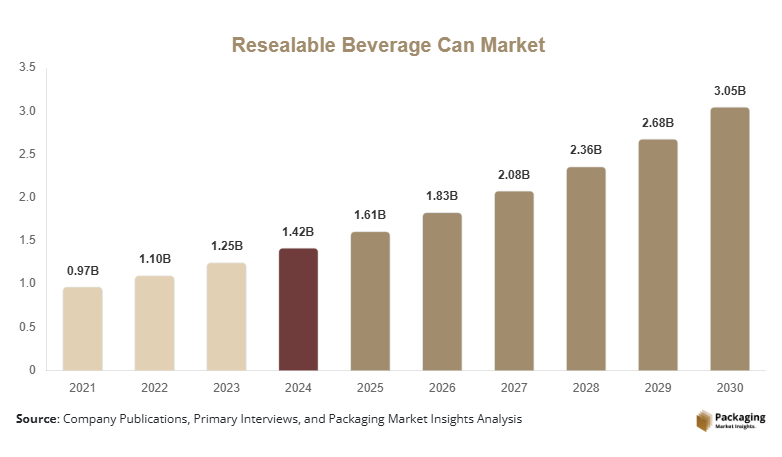
The global resealable beverage can market size was valued at approximately USD 1.42 billion in 2024 and is projected to grow from around USD 1.61 billion in 2025 to reach nearly USD 3.05 billion by 2030, expanding at a CAGR of about 13.60% during the forecast period (2025–2030). This growth trajectory reflects the rising preference for convenience-oriented beverage packaging solutions that enhance product usability while minimizing waste. Resealable beverage cans offer the combined advantages of traditional metal cans and reclosure functionality, making them increasingly attractive across carbonated drinks, energy beverages, functional drinks, and ready-to-drink alcoholic products.
A key global factor supporting market expansion has been the shift toward on-the-go consumption and portion control, particularly in urbanized economies. Changing lifestyles, longer working hours, and increased outdoor and travel-related consumption have accelerated demand for packaging formats that allow consumers to reseal beverages and consume them over multiple occasions without compromising freshness. In addition, advancements in can-end engineering and sealing mechanisms have improved reliability and reduced leakage risks, further strengthening adoption.
Manufacturers are increasingly collaborating with beverage brands to integrate resealable can technologies that align with sustainability goals, lightweighting initiatives, and brand differentiation strategies. The market outlook remains positive as beverage companies seek innovative packaging to stand out in competitive retail environments while meeting evolving consumer expectations.
Key Highlights
- North America accounted for a dominant 36.8% market share in 2025, while Asia Pacific is expected to be the fastest-growing region with a CAGR of 15.9%.
- By type, pull-tab resealable cans held the leading share, while slider-based resealable systems are projected to grow at a 16.8% CAGR.
- Aluminum-based resealable cans dominated the material segment, whereas hybrid aluminum-polymer systems are expected to register the fastest growth.
- The United States led the market with a value of USD 412 million in 2024, increasing to an estimated USD 465 million in 2025.
Explore more data points, trends and opportunities Download Free Sample Report
Latest Market Trends
Integration of Convenience-Driven Packaging Design
The Resealable Beverage Can Market has been shaped by a growing emphasis on consumer convenience and usability. Beverage brands are increasingly adopting resealable cans to cater to multi-serve consumption habits, particularly for energy drinks, functional beverages, and alcoholic mixes. This trend reflects a shift away from single-use consumption toward flexible drinking occasions. Improved ergonomics, smoother reclosure mechanisms, and enhanced spill resistance have positioned resealable cans as a premium yet practical packaging alternative.
Alignment with Sustainable Packaging Initiatives
Another notable trend has been the alignment of resealable beverage cans with broader sustainability strategies. Manufacturers are focusing on lightweight aluminum structures, recyclable sealing components, and reduced material usage per unit. Beverage companies are leveraging resealable cans to communicate sustainability credentials while maintaining product differentiation. This trend has also encouraged innovation in mono-material designs that simplify recycling processes and support circular economy objectives.
Market Drivers
Rising Demand for On-the-Go and Multi-Occasion Consumption
The increasing pace of urban lifestyles has driven demand for beverage packaging that supports portability and resealability. Consumers prefer containers that allow partial consumption without compromising carbonation or freshness. Resealable beverage cans directly address this need, making them suitable for commuters, travelers, and outdoor activities.
Brand Differentiation and Premiumization in Beverages
Beverage manufacturers are using innovative packaging formats as a strategic tool for brand differentiation. Resealable cans offer a perceived premium experience, enabling brands to justify higher price points while improving shelf visibility. This driver has been particularly influential in the energy drink and ready-to-drink alcoholic beverage segments.
Market Restraints
Higher Production and Component Costs
The primary restraint affecting the Resealable Beverage Can Market has been the higher cost associated with advanced can-end technologies and sealing mechanisms. Compared to conventional beverage cans, resealable variants require additional components, precision engineering, and specialized manufacturing processes. These factors increase unit costs and limit adoption among cost-sensitive beverage producers, particularly in price-competitive markets. Until economies of scale improve further, pricing pressures are expected to remain a limiting factor.
Market Opportunities
Expansion into Ready-to-Drink Alcoholic Beverages
The growing popularity of ready-to-drink cocktails and flavored alcoholic beverages presents a strong opportunity for resealable cans. These products are often consumed over extended periods, making resealability a valuable feature that enhances consumer experience and reduces waste.
Adoption in Functional and Health-Oriented Beverages
Functional drinks such as protein beverages, vitamin-infused waters, and nutraceutical drinks offer another emerging opportunity. These beverages are frequently consumed in portions, and resealable cans provide an ideal packaging solution that supports controlled intake and product integrity.
Report Scope
| Report Metric | Details |
|---|---|
| Market Size in 2024 | USD 1.42 Billion |
| Market Size in 2025 | USD 1.61 Billion |
| Market Size in 2030 | USD 3.05 Billion |
| CAGR | 13.60% (2025-2030) |
| Base Year for Estimation | 2024 |
| Historical Data | 2021-2023 |
| Forecast Period | 2025-2030 |
| Report Coverage | Revenue Forecast, Competitive Landscape, Supply Chain Disruption, Growth Factors, Environment & Regulatory Landscape and Trends |
| Geographies Covered | North America, Europe, APAC, Middle East and Africa, LATAM |
| Countries Covered | U.S., Canada, U.K., Germany, France, Spain, Italy, Russia, Nordic, Benelux, Rest of Europe, China, South Korea, Japan, India, Australia, Singapore, Taiwan, South East Asia, Rest of Asia-Pacific, UAE, Turky, Saudi Arabia, South Africa, Egypt, Nigeria, Rest of MEA, Brazil, Mexico, Argentina, Chile, Colombia, Rest of LATAM |
Explore more data points, trends and opportunities Download Free Sample Report
Segmental Analysis
By Type
The pull-tab resealable cans subsegment accounted for a dominant 54.2% share of the Resealable Beverage Can Market by type in 2024. This strong position was primarily attributed to their compatibility with existing can manufacturing infrastructure and familiarity among consumers. Pull-tab resealable systems offered an effective balance between functionality and cost, making them widely adopted by beverage manufacturers seeking incremental innovation without major production overhauls. Their ease of use, reliable sealing performance, and suitability for carbonated beverages further reinforced their widespread application across mainstream beverage categories.
The slider-based resealable cans subsegment is projected to be the fastest-growing, registering a CAGR of 16.8% from 2025 to 2030. This accelerated growth will be driven by increasing demand for advanced resealing performance, particularly in premium beverages such as energy drinks, functional beverages, and ready-to-drink alcoholic products. Slider mechanisms provide enhanced spill resistance and improved carbonation retention, positioning them as a preferred solution for multi-occasion consumption and higher-value beverage offerings.
By Material
The aluminum subsegment held a leading 61.5% share of the Resealable Beverage Can Market by material in 2024. This dominance was supported by aluminum’s lightweight properties, high recyclability, and strong barrier protection against light, oxygen, and moisture. Aluminum resealable cans aligned well with sustainability initiatives while offering durability and cost efficiency at scale. The established global aluminum recycling ecosystem further strengthened its adoption across beverage manufacturers aiming to reduce environmental impact.
The hybrid aluminum-polymer materials subsegment is anticipated to grow at the fastest CAGR of 15.2% from 2025 to 2030. Growth in this segment will be fueled by advancements in sealing technologies that require flexible and precision-engineered components. Hybrid materials enhance resealing efficiency and minimize leakage risks, making them suitable for complex can-end designs and premium beverage applications where performance reliability is critical.
By Application
The carbonated beverages subsegment represented a significant 38.9% share of the Resealable Beverage Can Market by application in 2024. This leading position was driven by the high global consumption of carbonated soft drinks and the growing need to maintain carbonation across multiple consumption occasions. Resealable cans enabled consumers to preserve freshness and fizz, addressing a longstanding limitation of traditional single-use cans and supporting repeat consumption behavior.
The functional beverages subsegment is projected to witness the fastest growth, expanding at a CAGR of 17.1% from 2025 to 2030. This growth will be supported by rising demand for health-focused drinks such as vitamin-enhanced waters, protein beverages, and nutraceutical drinks, which are often consumed in measured portions. Resealable cans provide a convenient packaging format that supports controlled intake while maintaining product integrity, driving adoption within this rapidly expanding beverage category.
By End Use
The energy drinks subsegment accounted for a dominant 34.7% share of the Resealable Beverage Can Market by end use in 2024. This large share was attributed to the high frequency of on-the-go consumption and the preference for flexible drinking occasions among energy drink consumers. Resealable cans addressed the need for partial consumption without compromising taste or carbonation, making them well suited for active lifestyles and extended usage patterns.
The ready-to-drink alcoholic beverages subsegment is expected to demonstrate the fastest growth, registering a CAGR of 16.4% from 2025 to 2030. This growth will be driven by increasing consumer acceptance of canned alcoholic products and social drinking trends that favor convenience and portability. Resealable cans enhance user experience by allowing extended consumption periods, positioning them as an attractive packaging solution within the evolving alcoholic beverage landscape.
Resealable Beverage Can Market Segmentations
By Type
- Pull-Tab Resealable Cans
- Slider-Based Resealable Cans
By Material
- Aluminum
- Hybrid Aluminum-Polymer
By Application
- Carbonated Beverages
- Functional Beverages
- Non-Carbonated Soft Drinks
By End Use
- Energy Drinks
- Ready-to-Drink Alcoholic Beverages
- Health and Wellness Drinks
Regional Analysis
North America
North America accounted for 36.8% of the Resealable Beverage Can Market share in 2025 and is expected to expand at a CAGR of 12.4% from 2025 to 2033. The region benefited from early adoption of innovative packaging technologies and strong collaboration between packaging suppliers and beverage brands. The market will continue to grow as premium beverage categories expand.
The United States dominated the regional landscape due to high consumption of energy drinks and ready-to-drink beverages. Strong retail penetration and consumer willingness to pay for convenience supported sustained demand for resealable cans.
Europe
Europe held approximately 28.5% market share in 2025 and will grow at a CAGR of 11.8% through 2033. The region emphasized sustainable packaging solutions, which supported the adoption of recyclable resealable cans.
Germany emerged as the dominant country, driven by strong beverage manufacturing capabilities and innovation-focused packaging regulations encouraging advanced can designs.
Asia Pacific
Asia Pacific represented 22.6% of the market in 2025 and is projected to grow at a CAGR of 15.9% between 2025 and 2033, making it the fastest-growing region. Rising urbanization and expanding middle-class populations will support market growth.
China led the region due to increasing consumption of functional beverages and growing investments in modern packaging infrastructure.
Middle East & Africa
The Middle East & Africa region captured a 6.1% share in 2025 and is expected to grow at a CAGR of 10.7%. Demand was supported by tourism-driven beverage consumption and premium product introductions.
The United Arab Emirates dominated due to its strong hospitality and retail sectors, adopting innovative beverage packaging.
Latin America
Latin America accounted for 6.0% of the market in 2025 and will expand at a CAGR of 11.2%. Increasing youth population and demand for energy drinks supported growth.
Brazil led the region with a strong domestic beverage industry and expanding modern retail channels.
Competitive Landscape
The Resealable Beverage Can Market is moderately consolidated, with global packaging companies focusing on product innovation and strategic partnerships. Ball Corporation emerged as a market leader, leveraging advanced can-end technologies and strong relationships with major beverage brands. The company recently introduced an enhanced resealable aluminum can system designed to improve recyclability and consumer convenience.
Other key players such as Crown Holdings, Ardagh Group, and CANPACK have expanded their portfolios through incremental innovations and capacity expansions. Competition remains focused on performance reliability, cost optimization, and sustainability alignment.
Key Players in the Resealable Beverage Can Market
- Ball Corporation
- Crown Holdings, Inc.
- Ardagh Group S.A.
- CANPACK Group
- Toyo Seikan Group Holdings
- Silgan Containers
- Amcor plc
- CPMC Holdings
- Showa Aluminum Can Corporation
- Daiwa Can Company
- Massilly Holding
- Interpack Group
- Orora Packaging
- Rexam Packaging
- UACJ Corporation