Aseptic Packaging For Non Carbonated Beverages Market Size and Growth
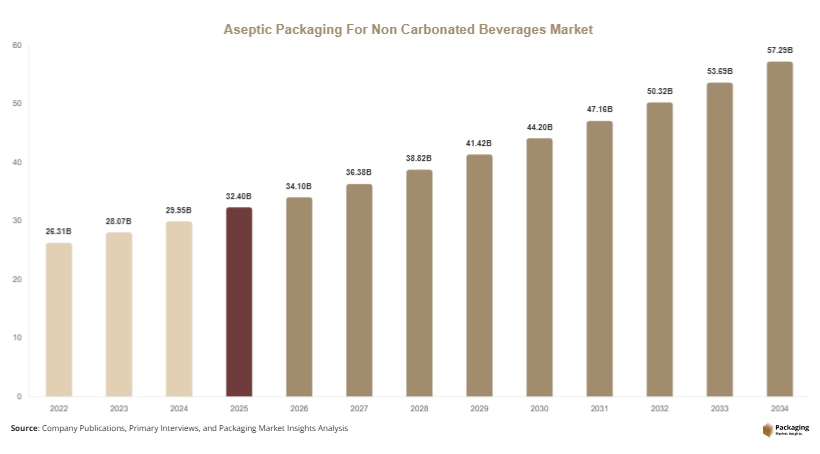
The global aseptic packaging for non carbonated beverages market size is estimated at approximately USD 32.4 billion in 2025, and it is projected to reach around USD 34.1 billion in 2026. By 2034, the market is expected to grow significantly to nearly USD 58.7 billion, expanding at a CAGR of 6.7% during 2025–2034. The market growth is strongly supported by rising consumption of ready-to-drink beverages, increasing urbanization, and the shift toward sustainable and lightweight packaging formats. The aseptic packaging for non carbonated beverages market is witnessing steady expansion due to increasing demand for safe, long-shelf-life, and preservative-free beverage packaging solutions across global food and beverage industries.
One of the major growth factors is the increasing demand for long shelf-life beverages without preservatives. Aseptic packaging technology allows sterilized beverages such as juices, dairy-based drinks, tea, coffee, and functional drinks to remain stable without refrigeration. Another key factor is the rising preference for convenience-based consumption patterns, especially in urban populations where on-the-go beverage consumption is increasing. Additionally, the expansion of global cold-chain alternatives and retail modernization is further accelerating aseptic packaging adoption.
Key Highlights
- Asia Pacific dominated the market with a 37.4% share in 2025.
- Latin America is projected to grow at the fastest CAGR of 6.2%.
- Antioxidants led the type segment with a 29.6% share.
- Plastic packaging dominated with a 52.3% share.
- Food & beverage applications led with a 43.1% share.
- The US remained the dominant country with a market size of USD 11.2 billion in 2025 and USD 11.9 billion in 2026.
Explore more data points, trends and opportunities Download Free Sample Report
Market Trends
Shift Toward Sustainable Aseptic Carton Packaging
One of the most important trends in the aseptic packaging for non carbonated beverages market is the rapid shift toward sustainable carton-based packaging solutions. Beverage manufacturers are increasingly adopting paper-based aseptic cartons to reduce plastic usage and meet environmental regulations. These cartons combine paperboard with thin layers of aluminum and polymers to maintain sterility while reducing environmental footprint. Companies such as juice and dairy producers are actively replacing PET bottles with aseptic cartons in markets like Europe and Asia. This trend is expected to accelerate as governments introduce stricter recycling mandates and consumers demand eco-friendly packaging alternatives. In the future, fully recyclable mono-material aseptic solutions are likely to emerge.
Growth of Functional and Fortified Beverage Packaging
Another key trend is the growing demand for aseptic packaging in functional and fortified beverages. Products such as vitamin-infused drinks, plant-based beverages, protein shakes, and herbal teas require sterile packaging to preserve nutrients and extend shelf life. Aseptic technology ensures product stability without refrigeration or preservatives, making it ideal for health-focused beverages. For example, plant-based milk brands are increasingly using aseptic cartons for global distribution. This trend is expected to expand further with rising health awareness, especially among younger consumers. Packaging innovation such as lightweight designs and portion-controlled formats is also supporting market growth.
Market Drivers
Rising Demand for Shelf-Stable Beverages
A major driver of the market is increasing demand for shelf-stable beverages across global retail channels. Consumers prefer beverages that do not require refrigeration and can be stored for long durations. Aseptic packaging technology enables manufacturers to sterilize both the product and packaging separately, ensuring long shelf life without preservatives. This is particularly important in emerging economies where cold-chain infrastructure is limited. For example, fruit juice brands in India and Southeast Asia rely heavily on aseptic cartons for rural and semi-urban distribution. This demand is expected to increase further as retail expansion continues in developing regions.
Expansion of Retail and E-commerce Beverage Distribution
The rapid expansion of retail chains and e-commerce platforms is another key growth driver. Online grocery and beverage delivery services require durable, leak-proof, and long-lasting packaging formats. Aseptic packaging ensures product integrity during long-distance transportation and storage. Global beverage brands are increasingly investing in aseptic filling lines to meet growing online demand. For instance, dairy and juice brands in China and Europe are expanding aseptic production capacity to support e-commerce sales channels. This shift is expected to significantly boost market demand in the coming years.
Market Restraint
One of the key restraints in the aseptic packaging for non carbonated beverages market is the high initial investment cost associated with aseptic filling technology and packaging systems. Setting up aseptic production lines requires advanced sterilization equipment, controlled environments, and specialized materials, making it capital-intensive for small and mid-sized manufacturers. Additionally, maintenance and operational costs are higher compared to conventional packaging systems.
This cost barrier limits adoption in price-sensitive markets, particularly in developing regions where beverage manufacturers operate on low margins. For example, small juice producers in Africa and parts of Southeast Asia often rely on traditional packaging methods due to affordability constraints. Although long-term efficiency benefits exist, the upfront investment remains a significant challenge.
Market Opportunities
Expansion of Plant-Based and Dairy Alternative Beverages
The rising global demand for plant-based milk alternatives such as almond milk, soy milk, oat milk, and coconut beverages presents a significant opportunity for aseptic packaging manufacturers. These beverages require sterile packaging to maintain freshness and prevent spoilage without refrigeration. Aseptic cartons are becoming the preferred solution for global distribution of plant-based drinks. Companies in North America and Europe are expanding production facilities to meet growing demand. This trend is expected to create strong long-term opportunities for aseptic packaging suppliers.
Innovation in Lightweight and Smart Aseptic Packaging
Another major opportunity lies in the development of lightweight and smart aseptic packaging solutions. Manufacturers are focusing on reducing material usage while maintaining barrier protection. Smart packaging technologies such as QR codes, freshness indicators, and traceability systems are also being integrated into aseptic cartons. These innovations improve consumer engagement and supply chain transparency. In the future, digitalized aseptic packaging is expected to play a key role in premium beverage segments, especially in health-focused and export-oriented markets.
Report Scope
| Report Metric | Details |
|---|---|
| Market Size in 2025 | USD 32.4 Billion |
| Market Size in 2026 | USD 34.1 Billion |
| Market Size in 2034 | USD 58.7 Billion |
| CAGR | 6.7% (2026-2034) |
| Base Year for Estimation | 2025 |
| Historical Data | 2022-2024 |
| Forecast Period | 2026-2034 |
| Report Coverage | Revenue Forecast, Competitive Landscape, Supply Chain Disruption, Growth Factors, Environment & Regulatory Landscape and Trends |
| Geographies Covered | North America, Europe, APAC, Middle East and Africa, LATAM |
| Countries Covered | U.S., Canada, U.K., Germany, France, Spain, Italy, Russia, Nordic, Benelux, Rest of Europe, China, South Korea, Japan, India, Australia, Singapore, Taiwan, South East Asia, Rest of Asia-Pacific, UAE, Turky, Saudi Arabia, South Africa, Egypt, Nigeria, Rest of MEA, Brazil, Mexico, Argentina, Chile, Colombia, Rest of LATAM |
Explore more data points, trends and opportunities Download Free Sample Report
Segmental Analysis
By Type
The type segment in the aseptic packaging for non carbonated beverages market is primarily divided into cartons, bottles, pouches, and bags. Among these, cartons dominated the market with a significant share of around 44.6% in 2024 due to their strong barrier properties, lightweight structure, and cost efficiency. Cartons are widely used for juices, plant-based drinks, flavored milk, and functional beverages because they provide extended shelf life without refrigeration. Major beverage manufacturers prefer carton-based aseptic packaging as it reduces logistics costs and improves product stability during long-distance transportation. For example, brands in Europe and North America increasingly rely on multilayer cartons made of paperboard, polyethylene, and aluminum foil to maintain product safety and flavor integrity.
The fastest-growing subsegment is pouches, which are projected to grow at a CAGR of around 6.1% during 2025–2034. The demand is increasing due to their flexibility, lower packaging weight, and rising adoption in single-serve beverage formats. Emerging markets such as India, Indonesia, and Brazil are seeing rapid growth in ready-to-drink beverages, where pouch packaging is gaining popularity due to affordability and convenience. Additionally, sustainability concerns are pushing manufacturers to develop recyclable and mono-material pouch solutions, further supporting long-term growth.
By Material
Plastic-based materials dominate the aseptic packaging market for non carbonated beverages, holding around 52.3% share in 2024. The dominance is driven by polyethylene (PE) and polypropylene (PP) usage in multilayer packaging structures, which offer excellent sealing ability, flexibility, and cost advantages. Plastic materials are widely used in beverage packaging because they provide strong barrier protection against oxygen, moisture, and contamination. Large-scale beverage producers in the U.S., China, and Germany depend heavily on plastic-based aseptic solutions due to high production efficiency and compatibility with automated filling systems.
On the other hand, paper-based and bio-based materials are emerging as the fastest-growing segment, expected to grow at a CAGR of 5.9% during 2025–2034. The growth is strongly linked to sustainability regulations in Europe and increasing consumer preference for eco-friendly packaging. Countries like Sweden, Germany, and the Netherlands are leading the adoption of fully recyclable cartons and bio-coated paper packaging. Companies such as Tetra Pak and SIG are investing heavily in plant-based barrier coatings and aluminum-free solutions, which are expected to reshape future packaging structures.
By End-Use Segment
The food and beverage industry remains the dominant end-use segment, accounting for approximately 43.1% share in 2024. Non carbonated beverages such as fruit juices, dairy-based drinks, energy drinks, and herbal beverages are the primary users of aseptic packaging. The demand is driven by the need for extended shelf life, reduced preservatives, and improved product safety. Global beverage companies are increasingly shifting toward aseptic processing lines to support international distribution and e-commerce expansion.
The healthcare and nutritional beverages segment is the fastest-growing end-use category, projected to expand at a CAGR of 6.3% during 2025–2034. This growth is fueled by rising demand for protein shakes, medical nutrition drinks, and probiotic beverages. Hospitals and healthcare institutions are adopting aseptic packaging to ensure sterility and prevent contamination. Countries like Japan and South Korea are seeing strong growth due to aging populations and rising health awareness, which is increasing demand for functional non carbonated beverages.
Aseptic Packaging For Non Carbonated Beverages Market Segmentations
By Type
- Liquid Beverages
- Powder Beverages
- Functional Drinks
- Dairy-Based Drinks
By Material
- Plastic-Based Aseptic Packaging
- Paper-Based Aseptic Cartons
- Composite Materials
By End-Use
- Food & Beverages
- Healthcare
- Retail & E-commerce
- Industrial Beverages
Regional Analysis
North America
North America accounted for approximately 28.4% market share in 2025 and is projected to grow at a CAGR of 5.4% during 2025–2034. The region shows strong demand for aseptic packaging due to high consumption of ready-to-drink beverages, including cold-pressed juices, dairy alternatives, and functional drinks. The presence of advanced packaging technology and strong retail distribution networks further supports market expansion. The U.S. dominates regional growth due to high investment in food safety regulations and sustainable packaging solutions.
The United States leads the North American market due to strong adoption of aseptic filling technology in beverage manufacturing. A key growth factor is the rising demand for preservative-free beverages, particularly in urban populations focused on health and wellness. Companies in the U.S. are increasingly shifting toward recyclable carton-based aseptic packaging to meet sustainability goals and reduce carbon footprint across supply chains.
Europe
Europe held a market share of around 31.7% in 2025, with steady growth projected at a CAGR of 5.8% during the forecast period. The region is highly driven by strict environmental regulations and strong demand for eco-friendly packaging. Countries such as Germany, France, and the Netherlands are focusing on reducing plastic waste, which is accelerating adoption of paper-based aseptic solutions. The beverage industry in Europe is also highly advanced, supporting innovation in packaging design.
Germany dominates the European market due to its strong manufacturing base and sustainability initiatives. A unique growth driver is the EU’s circular economy policies, which encourage recyclable and reusable packaging formats. Beverage companies in Germany are investing in mono-material cartons and bio-based coatings to comply with environmental standards and improve recyclability across the supply chain.
Asia Pacific
Asia Pacific dominated the global market with a 37.4% share in 2025 and is expected to grow at the fastest CAGR of 6.2% during 2025–2034. Rapid urbanization, rising disposable income, and increasing demand for packaged beverages are major growth drivers. Countries like China, India, and Indonesia are experiencing strong growth in retail and e-commerce beverage distribution, boosting demand for aseptic packaging systems.
China remains the largest market in the region due to massive beverage consumption and strong manufacturing capabilities. A key growth factor is the expansion of domestic dairy and fruit beverage industries, which heavily rely on aseptic packaging for long shelf life. Government support for food safety standards and modernization of packaging infrastructure further strengthens market growth.
Middle East & Africa
Middle East & Africa held a share of 4.8% in 2025 and is projected to grow at a CAGR of 6.0% during the forecast period. Growth is driven by rising demand for imported beverages and increasing retail modernization. The region is witnessing gradual adoption of aseptic packaging due to improved cold chain alternatives and expansion of supermarket distribution networks.
The UAE dominates the regional market due to strong import-driven beverage consumption and tourism-led demand. A key growth factor is the expansion of premium juice and functional beverage brands targeting health-conscious consumers. Investments in retail infrastructure and food safety standards are also contributing to increased adoption of aseptic packaging systems.
Latin America
Latin America accounted for 5.1% market share in 2025 and is projected to grow at a CAGR of 6.2% during 2025–2034. Rising demand for affordable packaged beverages and increasing urbanization are key drivers. Countries such as Brazil and Mexico are witnessing strong growth in fruit juice and dairy beverage consumption, supporting aseptic packaging adoption.
Brazil leads the regional market due to its strong agricultural base and beverage production industry. A major growth factor is the expansion of local juice processing companies adopting aseptic technology to extend shelf life and reduce export losses. Government initiatives supporting food processing industries are further strengthening market growth.
Competitive Landscape
The market is moderately consolidated with key players focusing on sustainability, automation, and aseptic filling innovation. Major companies include Tetra Pak International S.A., SIG Combibloc Group, Elopak ASA, Greatview Aseptic Packaging, and Reynolds Group Holdings.
Tetra Pak leads the market due to its global aseptic carton dominance and continuous innovation in sustainable packaging systems. The company recently expanded its fully recyclable carton production lines to support global beverage manufacturers.
Key Players List
- Tetra Pak International S.A.
- SIG Combibloc Group
- Elopak ASA
- Greatview Aseptic Packaging
- Reynolds Group Holdings
- Amcor plc
- Ball Corporation
- Crown Holdings Inc.
- Stora Enso
- Mondi Group
- DS Smith Plc
- Uflex Ltd.
- Evergreen Packaging
- Berry Global Inc.
- WestRock Company