Composite Cardboard Tubes Size
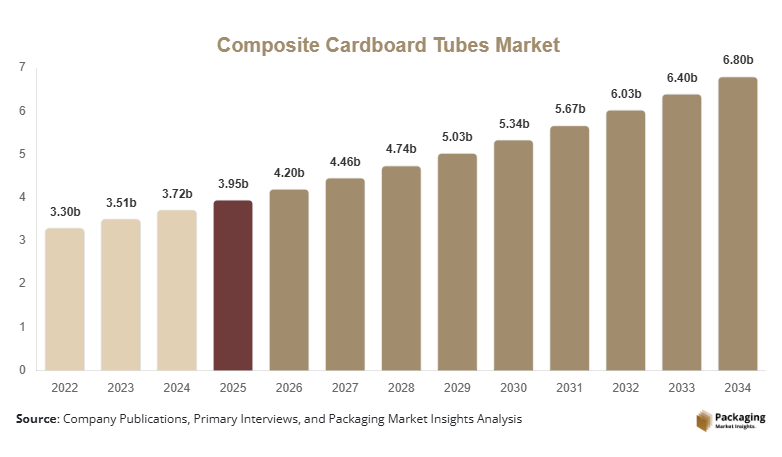
Composite Cardboard Tubes market size is projected at USD 4.2 billion in 2026 and is expected to hit USD 6.8 billion by 2034 with a CAGR of 6.2%.”
The Composite Cardboard Tubes Market includes cylindrical packaging solutions manufactured using multiple layers of paperboard, adhesives, and reinforcement materials to provide durability, lightweight structure, and cost efficiency. These tubes are widely used for packaging films, textiles, labels, construction materials, cosmetics, and consumer products. Global production of composite cardboard tubes exceeded 18 billion units in 2025, with packaging applications accounting for nearly 55% of total consumption. Industrial applications contribute approximately 30% share, while consumer goods represent around 15% demand. Increasing preference for recyclable materials, lightweight packaging formats, and sustainable alternatives to plastic packaging is supporting Composite Cardboard Tubes Market growth.
Explore more data points, trends and opportunities Download Free Sample Report
Composite Cardboard Tubes Market Trends
Rising Adoption of Sustainable Paper-Based Packaging Solutions
The Composite Cardboard Tubes Market is witnessing increasing adoption of eco-friendly packaging materials, with recyclable cardboard structures accounting for nearly 65% of newly developed tube packaging solutions in 2026. Global demand exceeded 18 billion units annually, supported by rising consumption of paper-based packaging across food, cosmetics, and industrial sectors. Manufacturers are investing in advanced adhesive technologies, moisture-resistant coatings, and high-strength paperboard layers, improving tube performance by approximately 20–30%. These innovations are strengthening Composite Cardboard Tubes Market trends.
Expansion of Customized and High-Performance Tube Packaging
The growing requirement for customized packaging formats is increasing demand for composite cardboard tubes, with premium printing and customized designs representing more than 35% of production volume. Over 7 billion units are manufactured annually for branded consumer products, specialty packaging, and industrial applications. Digital printing technology adoption has increased by nearly 40%, enabling improved graphics, shorter production cycles, and personalized packaging solutions. These developments are accelerating Composite Cardboard Tubes Market demand.
Composite Cardboard Tubes Drivers
Increasing Demand for Sustainable Alternatives to Plastic Packaging
The shift toward environmentally responsible packaging is a major driver for the Composite Cardboard Tubes Market. More than 70% of packaging companies are investing in paper-based solutions to reduce plastic dependency, while global paper packaging consumption exceeds 400 million tons annually. Composite cardboard tubes offer recyclability rates above 80% and reduce material usage by approximately 20% compared with traditional rigid packaging. Growing sustainability regulations and consumer awareness are driving Composite Cardboard Tubes Market growth.
Composite Cardboard Tubes Restraints
Raw Material Price Fluctuations and Moisture Sensitivity Issues
The Composite Cardboard Tubes Market faces limitations due to fluctuations in paperboard costs and performance challenges under high-moisture conditions. Raw material prices increased by nearly 10–15% between 2023 and 2025, affecting manufacturing margins. Approximately 25% of producers invest in additional coatings to improve moisture resistance, increasing production costs. These factors create challenges for manufacturers operating in the Composite Cardboard Tubes Market.
Composite Cardboard Tubes Opportunities
Growing Demand from Premium Packaging and Industrial Applications
The Composite Cardboard Tubes Market offers significant opportunities through increasing adoption in premium consumer packaging and industrial applications. More than 45% of brands are exploring sustainable cylindrical packaging formats, while demand for customized tubes is growing above 7% annually. Expansion in cosmetics, textiles, and construction material packaging is expected to create additional opportunities through 2034. These developments support Composite Cardboard Tubes Market expansion.
Challenges in Composite Cardboard Tubes Market
Balancing Strength Requirements with Lightweight Packaging Designs
A major challenge in the Composite Cardboard Tubes Market is achieving high structural strength while reducing material consumption. Manufacturers must maintain compression strength between 150–500 PSI while reducing packaging weight by 15–20%. Approximately 30% of companies face difficulties integrating advanced coatings and recyclable materials without increasing costs. These technical challenges influence innovation strategies in the Composite Cardboard Tubes Market.
Report Scope
| Report Metric | Details |
|---|---|
| Market Size in 2025 | USD 3.95 billion |
| Market Size in 2026 | USD 4.2 billion |
| Market Size in 2034 | USD 6.8 billion |
| CAGR | 6.2% (2026-2034) |
| Base Year for Estimation | 2025 |
| Historical Data | 2022-2024 |
| Forecast Period | 2026-2034 |
| Report Coverage | Revenue Forecast, Competitive Landscape, Supply Chain Disruption, Growth Factors, Environment & Regulatory Landscape and Trends |
| Geographies Covered | North America, Europe, APAC, Middle East and Africa, LATAM |
| Countries Covered | U.S., Canada, U.K., Germany, France, Spain, Italy, Russia, Nordic, Benelux, Rest of Europe, China, South Korea, Japan, India, Australia, Singapore, Taiwan, South East Asia, Rest of Asia-Pacific, UAE, Turky, Saudi Arabia, South Africa, Egypt, Nigeria, Rest of MEA, Brazil, Mexico, Argentina, Chile, Colombia, Rest of LATAM |
Explore more data points, trends and opportunities Download Free Sample Report
Composite Cardboard Tubes Market Segmentation
The Composite Cardboard Tubes Market segmentation is categorized by type and application. Spiral wound tubes dominate with approximately 50% share due to their high durability and cost efficiency. Packaging applications account for nearly 55% of market demand, supported by increasing adoption across flexible packaging, labels, and consumer products.
By Type
Spiral Wound Tubes
Spiral wound tubes represent approximately 50% of the Composite Cardboard Tubes Market share due to their excellent strength and versatility. More than 9 billion units are produced annually using multiple paper layers wound at specific angles for improved durability. These tubes typically feature wall thickness ranging from 1.5 mm to 10 mm and are widely used for films, paper rolls, and packaging applications.
Parallel Wound Tubes
Parallel wound tubes account for nearly 30% market share and are produced by layering paper sheets parallel to the tube axis. Annual production exceeds 5 billion units, with applications requiring enhanced rigidity and dimensional accuracy. These tubes are commonly used in industrial applications, construction materials, and specialty packaging formats.
Convolute Tubes
Convolute tubes contribute approximately 20% market share and provide high compression resistance for heavy-duty applications. More than 3.5 billion units are manufactured annually with reinforced paperboard structures. These tubes are preferred for shipping, storage, and industrial packaging due to their superior load-bearing capability.
By Application
Packaging
Packaging applications dominate the Composite Cardboard Tubes Market with nearly 55% share. More than 10 billion units are consumed annually for flexible packaging films, labels, textiles, and food-related products. These tubes provide lightweight protection, efficient storage, and recyclable packaging solutions across multiple industries.
Industrial
Industrial applications contribute around 30% market share, supported by demand from construction, textile, and manufacturing sectors. Approximately 5.5 billion units are produced annually for winding materials, protective storage, and transportation purposes. High-strength composite tubes improve operational efficiency and reduce packaging damage rates by nearly 25%.
Consumer Goods
Consumer goods represent approximately 15% market share, with more than 2.5 billion units produced annually for cosmetics, personal care products, and premium packaging. Increasing demand for attractive cylindrical packaging designs has improved adoption among luxury and specialty brands.
Composite Cardboard Tubes Market Segmentations
Type
- Spiral Wound Tubes
- Parallel Wound Tubes
- Convolute Tubes
Application
- Packaging
- Industrial
- Consumer Goods
Composite Cardboard Tubes Regional Outlook
North America
North America holds approximately 35% share of the Composite Cardboard Tubes Market due to advanced packaging infrastructure and strong demand for sustainable solutions. The United States contributes nearly 75% of regional consumption, supported by food, consumer goods, and industrial packaging industries. Regional production exceeds 6 billion units annually.
Europe
Europe accounts for around 30% market share, driven by strict sustainability regulations and recycling initiatives. Germany, France, and the United Kingdom contribute more than 65% of regional demand. Over 5 billion composite cardboard tubes are produced annually across European manufacturing facilities.
Asia-Pacific
Asia-Pacific represents nearly 25% share and is projected to witness strong growth through 2034. China, India, and Japan contribute more than 70% of regional consumption due to expanding manufacturing and packaging industries. Annual production exceeds 4.5 billion units.
Latin America and Middle East & Africa
These regions collectively account for approximately 10% market share. Brazil, Mexico, UAE, and South Africa are increasing adoption through industrial expansion and sustainable packaging initiatives. Demand growth is estimated at 5–7% annually.
Top players in Composite Cardboard Tubes Market
- Sonoco Products Company
- Smurfit Westrock
- Yazoo Mills Inc.
- Ace Paper Tube Corporation
- Valk Industries Inc.
- Paper Tube & Core Manufacturing Inc.
- Chicago Mailing Tube Co.
- Spiral Tube & Core Inc.
- Marshall Paper Tube Co.
- Corex Group
Sonoco Products Company
-
Holds a leading position with an estimated 10–12% share in global composite packaging solutions.
-
Provides advanced paper tubes and cores for industrial and consumer applications.
-
Operates manufacturing facilities across multiple regions with high-volume production capabilities.
-
Focuses on sustainable materials, recyclable designs, and lightweight packaging technologies.
Smurfit Westrock
-
Maintains approximately 8–10% share through strong paper-based packaging capabilities.
-
Offers customized composite cardboard tube solutions for industrial and commercial sectors.
-
Invests in sustainable packaging technologies and circular economy initiatives.
-
Supports global customers through extensive manufacturing and distribution networks.