Barrier Coated Flexible Paper Packaging Market Size and Growth
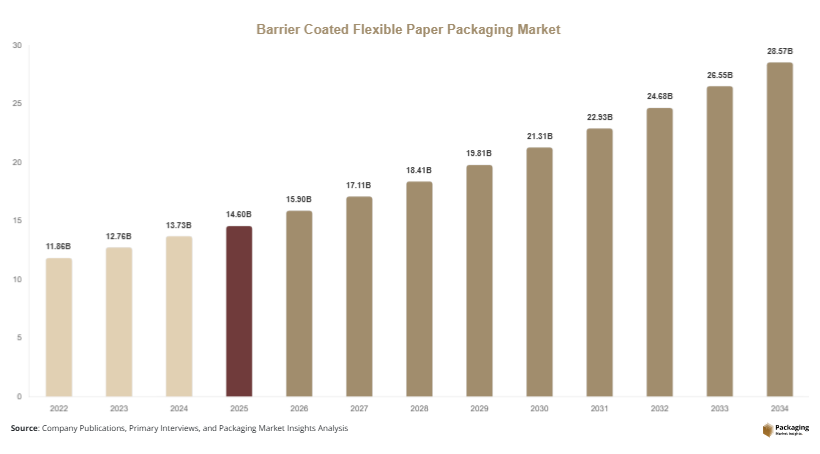
The Barrier Coated Flexible Paper Packaging Market size reached approximately USD 14.6 billion in 2025 and is projected to grow to USD 15.9 billion in 2026. By 2034, the market is forecast to reach USD 30.8 billion, expanding at a CAGR of 7.6% during the forecast period from 2025 to 2034. This growth trajectory reflects the increasing demand for eco-friendly alternatives to plastic packaging, coupled with technological advancements in barrier coatings that enhance product protection and shelf life.
One of the primary growth factors is the rising global emphasis on sustainability and circular economy practices. Governments and regulatory bodies are enforcing strict guidelines on single-use plastics, encouraging industries to adopt recyclable and biodegradable paper-based packaging solutions. Barrier coated flexible paper packaging provides moisture, grease, and oxygen resistance while maintaining recyclability, making it an attractive alternative.
Key Highlights:
- The market size reached USD 14.6 billion in 2025 and is projected to reach USD 30.8 billion by 2034, reflecting steady expansion across multiple industries. This growth highlights increasing adoption of paper-based alternatives to traditional plastic packaging.
- The market is expected to grow at a CAGR of 7.6% from 2025 to 2034, driven by rising environmental concerns and regulatory support. Continuous innovation in coating technologies is also supporting long-term growth.
- There is strong demand for sustainable and recyclable packaging solutions as companies aim to reduce plastic waste. Barrier coated paper offers an effective balance between performance and environmental responsibility.
- Increasing adoption in food, beverage, and consumer goods sectors is fueling market growth. These industries require packaging that ensures product safety while meeting sustainability goals.
- Advancements in eco-friendly barrier coating technologies are enhancing packaging performance. Innovations such as water-based and bio-based coatings are improving barrier properties while maintaining recyclability.
Explore more data points, trends and opportunities Download Free Sample Report
Market Trends
Shift Toward Plastic-Free and Recyclable Packaging Solutions
A major trend shaping the barrier coated flexible paper packaging market is the transition toward plastic-free packaging solutions. Consumers are becoming more environmentally conscious, leading to increased demand for packaging materials that reduce plastic waste. Companies across food, retail, and e-commerce sectors are adopting paper-based packaging with advanced barrier coatings to replace conventional plastic laminates. This shift is supported by regulatory frameworks that restrict single-use plastics and promote sustainable alternatives. As a result, manufacturers are investing in research and development to create high-performance coatings that maintain product integrity while ensuring recyclability. The trend is expected to continue as brands prioritize environmental responsibility and seek to enhance their sustainability credentials.
Adoption of Advanced Barrier Coating Technologies
Another notable trend is the rapid adoption of advanced barrier coating technologies that improve packaging performance. Innovations such as water-based coatings, bio-based polymers, and nano-material coatings are enabling paper packaging to achieve superior resistance to moisture, grease, and oxygen. These advancements allow barrier coated paper to compete with traditional plastic packaging in terms of functionality while offering environmental benefits. Additionally, manufacturers are focusing on lightweight and cost-effective solutions to improve operational efficiency. The integration of smart coatings that provide additional functionalities, such as antimicrobial properties and temperature resistance, is further driving innovation in the market. This trend is expected to accelerate as industries seek high-performance and sustainable packaging solutions.
Market Drivers
Increasing Demand for Sustainable Packaging Solutions
The growing demand for sustainable packaging is a key driver of the barrier coated flexible paper packaging market. Environmental concerns and regulatory pressures are pushing industries to reduce their reliance on plastic materials. Barrier coated paper packaging offers a viable alternative by combining the benefits of paper with enhanced protective properties. Companies are adopting these solutions to meet sustainability goals and improve brand image. The demand is particularly strong in regions with strict environmental regulations, where businesses are required to adopt recyclable and biodegradable packaging materials. As sustainability continues to gain importance, the adoption of barrier coated flexible paper packaging is expected to increase significantly.
Growth of the Food and Beverage Industry
The expansion of the food and beverage industry is another major driver of market growth. Increasing consumption of packaged and convenience foods has created a need for packaging solutions that offer extended shelf life and product safety. Barrier coated flexible paper packaging provides effective protection against moisture, oxygen, and contaminants, making it suitable for a wide range of food products. Additionally, the rise of e-commerce and online food delivery services has increased the demand for durable and lightweight packaging solutions. These factors are contributing to the widespread adoption of barrier coated paper packaging across the food and beverage sector.
Market Restraint
High Production Costs and Technical Limitations
One of the primary restraints affecting the barrier coated flexible paper packaging market is the relatively high production cost associated with advanced barrier coatings. Compared to conventional plastic packaging, barrier coated paper solutions often require specialized materials and manufacturing processes, which can increase overall costs. This cost factor can limit adoption, particularly among small and medium-sized enterprises that operate on tight budgets.
In addition to cost challenges, technical limitations also pose a restraint. While barrier coatings have improved significantly, achieving the same level of performance as multi-layer plastic packaging remains a challenge in certain applications. For example, packaging for highly perishable or sensitive products may require extremely high barrier properties that are difficult to achieve with paper-based materials alone. These limitations can restrict the use of barrier coated flexible paper packaging in specific industries.
Despite these challenges, ongoing research and technological advancements are expected to address cost and performance issues over time. However, in the short term, these factors may continue to hinder market growth to some extent.
Market Opportunities
Development of Bio-Based and Compostable Coatings
The development of bio-based and compostable coatings presents a significant opportunity for market growth. As sustainability becomes a priority, manufacturers are focusing on creating coatings derived from renewable resources that offer high barrier performance. These solutions not only reduce environmental impact but also align with regulatory requirements for eco-friendly packaging. Companies that invest in bio-based coating technologies can gain a competitive advantage by offering innovative and sustainable packaging solutions. This opportunity is expected to drive significant growth in the market over the forecast period.
Expansion in Emerging Markets
Emerging markets offer substantial growth opportunities for the barrier coated flexible paper packaging market. Rapid urbanization, increasing disposable incomes, and changing consumer lifestyles are driving demand for packaged goods in regions such as Asia Pacific and Latin America. As these markets continue to develop, the demand for sustainable and high-performance packaging solutions is expected to increase. Additionally, government initiatives promoting environmental sustainability are encouraging the adoption of paper-based packaging. Companies that expand their presence in these regions can capitalize on the growing demand and strengthen their market position.
Report Scope
| Report Metric | Details |
|---|---|
| Market Size in 2025 | USD 14.6 Billion |
| Market Size in 2026 | USD 15.9 Billion |
| Market Size in 2034 | USD 30.8 Billion |
| CAGR | 7.6% (2026-2034) |
| Base Year for Estimation | 2025 |
| Historical Data | 2022-2024 |
| Forecast Period | 2026-2034 |
| Report Coverage | Revenue Forecast, Competitive Landscape, Supply Chain Disruption, Growth Factors, Environment & Regulatory Landscape and Trends |
| Geographies Covered | North America, Europe, APAC, Middle East and Africa, LATAM |
| Countries Covered | U.S., Canada, U.K., Germany, France, Spain, Italy, Russia, Nordic, Benelux, Rest of Europe, China, South Korea, Japan, India, Australia, Singapore, Taiwan, South East Asia, Rest of Asia-Pacific, UAE, Turky, Saudi Arabia, South Africa, Egypt, Nigeria, Rest of MEA, Brazil, Mexico, Argentina, Chile, Colombia, Rest of LATAM |
Explore more data points, trends and opportunities Download Free Sample Report
Segmental Analysis
By Type
The polyethylene-coated paper segment dominated the market in 2024, accounting for approximately 38% of the total market share. This dominance is attributed to its excellent moisture resistance and cost-effectiveness. Polyethylene coatings are widely used in food packaging applications, as they provide reliable barrier properties while maintaining flexibility and durability. Additionally, the availability of recyclable polyethylene-coated paper solutions has further supported the growth of this segment. Manufacturers continue to invest in improving the recyclability and performance of polyethylene coatings to meet evolving market demands.
The bio-based coating segment is expected to be the fastest-growing, with a CAGR of 9.2% during the forecast period. This growth is driven by increasing demand for sustainable and eco-friendly packaging solutions. Bio-based coatings, derived from renewable resources, offer comparable barrier properties while reducing environmental impact. The rising focus on sustainability and regulatory support for biodegradable materials are key factors contributing to the growth of this segment.
By Application
The food packaging segment held the largest market share in 2024, accounting for approximately 45% of the total market. This dominance is driven by the increasing demand for packaged food products and the need for extended shelf life. Barrier coated flexible paper packaging is widely used in applications such as snacks, bakery products, and frozen foods, as it provides effective protection against moisture and contaminants. The growing trend of convenience foods and ready-to-eat meals further supports the growth of this segment.
The pharmaceutical packaging segment is expected to grow at the fastest CAGR of 8.8% during the forecast period. This growth is driven by the increasing demand for safe and secure packaging solutions in the healthcare industry. Barrier coated paper packaging offers protection against environmental factors, ensuring the integrity of pharmaceutical products. The rising focus on sustainability in the healthcare sector is also contributing to the adoption of paper-based packaging solutions.
By End-Use Industry
The food and beverage industry dominated the market in 2024, accounting for approximately 50% of the total market share. This dominance is attributed to the high demand for sustainable and functional packaging solutions in the sector. Barrier coated flexible paper packaging is widely used for packaging a variety of food products, as it offers excellent barrier properties and supports environmental sustainability. The increasing consumption of packaged foods and beverages further drives the growth of this segment.
The e-commerce industry is expected to be the fastest-growing segment, with a CAGR of 9.5% during the forecast period. This growth is driven by the rapid expansion of online retail and the increasing demand for sustainable packaging solutions. Barrier coated paper packaging provides lightweight and durable packaging options, making it suitable for e-commerce applications. The growing focus on reducing packaging waste in the e-commerce sector is also contributing to the growth of this segment.
Barrier Coated Flexible Paper Packaging Market Segmentations
By Type
- Polyethylene Coated Paper
- Wax Coated Paper
- Bio-Based Coated Paper
- Water-Based Coated Paper
By Application
- Food Packaging
- Pharmaceutical Packaging
- Personal Care Packaging
- Industrial Packaging
By End-Use Industry
- Food & Beverage
- Healthcare
- Consumer Goods
- E-commerce
Regional Analysis
North America
North America accounted for approximately 28% of the global market share in 2025 and is expected to grow at a CAGR of 6.9% during the forecast period. The region’s growth is driven by strong demand for sustainable packaging solutions and stringent environmental regulations. The presence of established packaging manufacturers and advanced technological capabilities further supports market expansion.
The United States dominates the North American market, driven by high consumption of packaged food and increasing adoption of eco-friendly packaging solutions. A key growth factor is the rising demand for recyclable packaging materials in the food and retail sectors, supported by government initiatives promoting sustainability.
Europe
Europe held a market share of around 25% in 2025 and is projected to grow at a CAGR of 7.2%. The region is characterized by strict regulations on plastic usage and a strong focus on sustainability. These factors are driving the adoption of barrier coated flexible paper packaging across various industries.
Germany is the leading country in the European market, supported by its well-established packaging industry and strong emphasis on environmental sustainability. A unique growth factor is the increasing investment in bio-based coating technologies, which is driving innovation and adoption in the region.
Asia Pacific
Asia Pacific accounted for the largest market share of approximately 32% in 2025 and is expected to grow at a CAGR of 8.5%. The region’s growth is driven by rapid industrialization, urbanization, and increasing demand for packaged goods. The expanding food and beverage industry further contributes to market growth.
China is the dominant country in the Asia Pacific market, driven by its large population and growing consumer base. A key growth factor is the rising adoption of sustainable packaging solutions in response to government regulations and increasing environmental awareness.
Middle East & Africa
The Middle East & Africa region held a market share of about 8% in 2025 and is projected to grow at a CAGR of 6.8%. The market is driven by increasing demand for packaged food products and growing awareness of sustainable packaging solutions.
Saudi Arabia is the leading country in this region, supported by its expanding retail and food industries. A unique growth factor is the increasing investment in infrastructure and packaging technologies, which is driving market growth.
Latin America
Latin America accounted for approximately 7% of the market share in 2025 and is expected to grow at a CAGR of 7.1%. The region’s growth is driven by rising demand for packaged goods and increasing adoption of sustainable packaging solutions.
Brazil dominates the Latin American market, driven by its large consumer base and growing food industry. A key growth factor is the increasing focus on reducing plastic waste, which is encouraging the adoption of barrier coated flexible paper packaging.
Competitive Landscape
The barrier coated flexible paper packaging market is moderately fragmented, with several key players focusing on innovation, sustainability, and strategic partnerships to strengthen their market position. Leading companies are investing in research and development to develop advanced barrier coating technologies that enhance product performance while maintaining environmental sustainability.
Mondi Group is a leading player in the market, known for its strong focus on sustainable packaging solutions. The company has recently introduced new recyclable barrier coated paper products, reflecting its commitment to innovation and sustainability. Other major players are also expanding their product portfolios and geographic presence to capture a larger market share.
Strategic collaborations, mergers, and acquisitions are common in the market, as companies seek to enhance their capabilities and expand their customer base. The competitive landscape is expected to remain dynamic, with continuous innovation and increasing focus on sustainability driving market growth.
Key Players List
- Mondi Group
- Amcor plc
- Stora Enso Oyj
- Smurfit Kappa Group
- WestRock Company
- Huhtamaki Oyj
- UPM-Kymmene Corporation
- DS Smith plc
- Sappi Limited
- Billerud AB
- Sealed Air Corporation
- Coveris Holdings S.A.
- Constantia Flexibles
- Nippon Paper Industries Co., Ltd.
- Twin Rivers Paper Company