Barrier Coated Papers Market Size
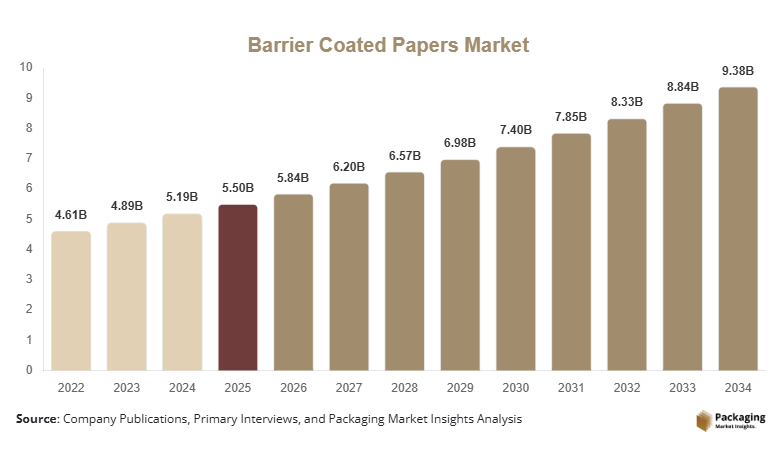
Barrier-coated papers' market size is projected at USD 5.84 billion in 2026 and is expected to hit USD 9.36 billion by 2034 with a CAGR of 6.1%. The report provides detailed analysis of production capacity, raw material trends, pricing dynamics, competitive landscape, technological advancements, and regional consumption. It also evaluates market performance through segmentation by type, application, and geography while assessing investment opportunities across the value chain.
Barrier-coated papers are specialty paper products engineered with protective coatings that provide resistance against moisture, grease, oxygen, water vapor, and contaminants for sustainable packaging applications. Global production exceeded 12.8 million metric tons in 2025, while recyclable barrier-coated paper products accounted for nearly 64% of total output. Food packaging represented approximately 56% of market consumption, beverage packaging contributed 24%, and industrial packaging accounted for 20%, reinforcing the expansion of the barrier coated papers market.
Explore more data points, trends and opportunities Download Free Sample Report
Barrier-Coated Papers: Trends
Rapid Transition Toward Sustainable Water-Based Coating Technologies
Manufacturers are replacing conventional plastic laminates with water-based and bio-based barrier coatings to meet sustainability regulations. More than 7.9 million metric tons of recyclable barrier-coated papers were produced in 2025, representing approximately 62% of total industry output. Water-based coating technology adoption exceeded 47%, while fiber recovery rates improved by nearly 21%. These developments continue strengthening the barrier-coated papers market.
Digital coating systems, precision application equipment, and high-speed paper converting technologies are improving manufacturing efficiency across the industry. Automated coating lines increased production efficiency by approximately 18%, while lightweight barrier paper demand expanded by 14%. Food service packaging applications recorded penetration exceeding 69%, supporting continued innovation within the barrier-coated papers market.
Barrier Coated Papers Market Drivers
Growing Demand for Sustainable Flexible Packaging
Global food packaging production exceeded 480 million metric tons in 2025, while paper-based packaging demand increased by nearly 11% year-over-year. Consumer preference for recyclable packaging surpassed 72%, and brand owners increased procurement of fiber-based barrier materials by approximately 19%. These factors continue accelerating the barrier-coated papers market.
Barrier Coated Papers Market Restraints
High Production and Specialty Coating Costs
Barrier coating chemicals, specialty polymers, and advanced converting technologies significantly increase manufacturing expenses. Raw material prices fluctuated by nearly 15%, coating material costs rose by 9%, and energy expenditures increased by approximately 10% during 2025. These factors constrain profitability and restrain the barrier-coated papers market growth.
Barrier Coated Papers Market Opportunities
Expansion of Recyclable Food and Beverage Packaging
Global investments in sustainable paper packaging exceeded USD 5.8 billion during 2025, while foodservice operators increased procurement of recyclable packaging by 24%. Paper-based beverage packaging adoption rose by 17%, and emerging economies represented approximately 43% of new manufacturing investments, creating long-term opportunities across the barrier-coated papers market.
Challenges in the Barrier-Coated Papers Market
Balancing Barrier Performance with Recyclability
Packaging manufacturers must achieve high moisture, grease, and oxygen barrier performance while maintaining recyclability. More than 68 countries introduced stricter packaging regulations, while recycled-content requirements exceeded 30% in several developed markets. Companies allocated approximately 6–8% of annual revenue toward product development and compliance, creating operational challenges within the barrier-coated papers market.
Report Scope
| Report Metric | Details |
|---|---|
| Market Size in 2025 | USD 5.50 Billion |
| Market Size in 2026 | USD 5.84 Billion |
| Market Size in 2034 | USD 9.36 Billion |
| CAGR | 6.1% (2026-2034) |
| Base Year for Estimation | 2025 |
| Historical Data | 2022-2024 |
| Forecast Period | 2026-2034 |
| Report Coverage | Revenue Forecast, Competitive Landscape, Supply Chain Disruption, Growth Factors, Environment & Regulatory Landscape and Trends |
| Geographies Covered | North America, Europe, APAC, Middle East and Africa, LATAM |
| Countries Covered | U.S., Canada, U.K., Germany, France, Spain, Italy, Russia, Nordic, Benelux, Rest of Europe, China, South Korea, Japan, India, Australia, Singapore, Taiwan, South East Asia, Rest of Asia-Pacific, UAE, Turkey, Saudi Arabia, South Africa, Egypt, Nigeria, Rest of MEA, Brazil, Mexico, Argentina, Chile, Colombia, Rest of LATAM |
Explore more data points, trends and opportunities Download Free Sample Report
Barrier Coated Papers Market Segmentation
The market is segmented by type and application, with water-based barrier coated papers accounting for nearly 48% of industry revenue, while food packaging contributes approximately 56% of total demand due to increasing adoption of sustainable fiber-based packaging solutions.
By Type
Water-Based Barrier Coated Papers: This segment accounted for approximately 48% of the market, with packaging production exceeding 6.1 million metric tons annually. These papers provide high moisture resistance, recyclability, food-contact compliance, excellent printability, and reduced environmental impact, making them the preferred solution for sustainable packaging.
Polymer-Coated Barrier Papers: Representing nearly 34% of global production, output exceeded 4.3 million metric tons during 2025. These papers deliver superior oxygen barrier properties, enhanced durability, excellent heat-sealing capability, and compatibility with high-speed packaging equipment across industrial and consumer applications.
Wax-Coated Barrier Papers: Holding around 18% market share, production surpassed 2.4 million metric tons annually. Wax-coated papers offer excellent grease resistance, moisture protection, product freshness preservation, and cost-effective packaging performance for foodservice and industrial sectors.
By Application
Food Packaging: This segment accounted for approximately 56% of industry demand, consuming more than 7.2 million metric tons annually. Applications include bakery products, frozen foods, confectionery, snacks, ready-to-eat meals, and takeaway packaging requiring moisture resistance, grease protection, and food safety compliance.
Beverage Packaging: Representing nearly 24% of market demand, beverage packaging utilized approximately 3.1 million metric tons during 2025. Barrier-coated papers are widely used for cup stock, beverage cartons, carrier packaging, and liquid food containers while providing liquid resistance and product protection.
Industrial Packaging: Accounting for around 20% of total consumption, industrial packaging exceeded 2.5 million metric tons annually. Applications include chemical packaging, automotive components, construction materials, and protective wrapping requiring durability, barrier protection, and improved transportation performance.
Barrier Coated Papers Market Segmentations
Type
- Water-Based Barrier Coated Papers
- Polymer-Coated Barrier Papers
- Wax-Coated Barrier Papers
Application
- Food Packaging
- Beverage Packaging
- Industrial Packaging
Barrier Coated Papers Regional Outlook
North America
North America accounted for approximately 27% of global demand, producing more than 3.5 million metric tons annually. The United States represented nearly 82% of regional consumption, supported by food processing, beverage packaging, and sustainable packaging initiatives.
Europe
Europe contributed approximately 31% of the market with production exceeding 4.0 million metric tons. Germany, France, Italy, Sweden, and Finland collectively generated more than 73% of regional output, supported by circular economy regulations and advanced paper manufacturing infrastructure.
Asia-Pacific
Asia-Pacific dominated with nearly 35% market share and production exceeding 4.5 million metric tons annually. China contributed approximately 45% of regional manufacturing, followed by India, Japan, and South Korea. Expanding food processing industries and rising packaged food consumption continue driving regional demand.
Latin America
Latin America represented around 4% of global consumption. Brazil and Mexico together accounted for approximately 67% of regional production, supported by growing food exports and increasing investments in sustainable packaging materials.
Middle East & Africa
The Middle East & Africa accounted for approximately 3% of the market. Saudi Arabia, the UAE, and South Africa contributed more than 57% of regional demand, driven by expanding food manufacturing, retail packaging, and industrial packaging investments.
Top Players In The Barrier-Coated Papers Market
- Stora Enso Oyj
- UPM-Kymmene Corporation
- Mondi plc
- Billerud AB
- Sappi Limited
- Nippon Paper Industries Co., Ltd.
- Metsä Board Corporation
- Smurfit Westrock plc
- Lecta Group
- Koehler Paper SE
- Ahlstrom Corporation
- Graphic Packaging International LLC
- Twin Rivers Paper Company
- Seaman Paper Company
- Pixelle Specialty Solutions
Stora Enso Oyj Estimated market share: 16–18% Stora Enso is a leading supplier of renewable packaging materials with extensive expertise in fiber-based barrier-coated paper technologies. The company operates advanced paper mills across Europe and serves food packaging, foodservice, and industrial customers globally. Continuous investments in water-based coatings, recyclable packaging solutions, sustainable forestry, and research capabilities strengthen its competitive position while supporting circular economy objectives. Mondi plc Estimated market share: 11–13% Mondi maintains a strong presence in sustainable packaging through integrated paper manufacturing, coating technologies, and global converting operations. The company emphasizes recyclable barrier papers, lightweight packaging materials, innovation-driven product development, and customer-specific packaging solutions. Its diversified production footprint, strong supply chain, and continuous investment in environmentally friendly packaging technologies reinforce its leadership within the global barrier coated papers industry.