Box Filling Machine Market Size
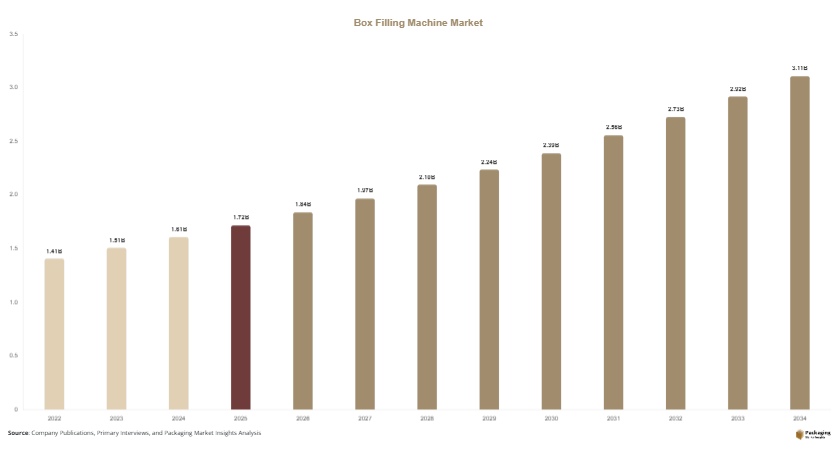
The box filling machine market size is projected at USD 1.84 billion in 2026 and is expected to hit USD 3.12 billion by 2034 with a CAGR of 6.8%.
The market continues to expand with rising automation across packaging operations, increasing demand for high-speed production lines, and growing investments in warehouse automation. This report delivers detailed market data covering segmentation, production capacity, technological developments, competitive landscape, and regional analysis for stakeholders across the packaging equipment industry.
The box filling machine market comprises automated and semi-automated systems designed to fill cartons, corrugated boxes, and shipping containers with products across manufacturing and logistics industries. Global production exceeded 182,000 units in 2025, while automation penetration surpassed 61% among large packaging facilities. Automatic machines contributed approximately 56% of total installations, semi-automatic systems accounted for 31%, and manual equipment represented 13%. Increasing demand from food processing, pharmaceutical manufacturing, and e-commerce fulfillment continues to strengthen the box filling machine market.
Explore more data points, trends and opportunities Download Free Sample Report
Box Filling Machine Market Trends
Increasing Integration of Smart Automation and Robotics
Manufacturers are deploying intelligent box filling machines equipped with robotic handling systems, vision inspection, PLC controls, and IoT-enabled monitoring. More than 72,000 smart filling machines were installed globally during 2025, while Industry 4.0-enabled production facilities increased by 28%. Automated packaging line efficiency improved by nearly 24%, supporting higher production throughput across industrial applications. Continuous automation investments reinforce the box-filling machine market.
Growing labor shortages and higher operational efficiency requirements are accelerating the adoption of fully automatic packaging equipment. Annual production exceeded 190,000 machines, while robotic palletizing integration surpassed 46% across newly commissioned packaging facilities. Energy-efficient servo-driven machines reduced electricity consumption by nearly 18%, and demand from e-commerce warehouses increased by approximately 21% year over year, supporting the box-filling machine market.
Box Filling Machine Market Drivers
Expansion of Automated Packaging Operations Across Manufacturing Industries
Rapid industrial automation and increasing production capacity across food, pharmaceutical, and logistics sectors continue driving market expansion. Global packaging machinery investments exceeded USD 54 billion, while automated production lines increased by 19% during recent years. More than 67% of manufacturers prioritize automated filling systems to improve operational efficiency and reduce labor costs by nearly 25%. These factors continue supporting the box-filling machine market.
Box Filling Machine Market Restraints
High Capital Investment and Maintenance Costs
Advanced automatic box filling systems require significant upfront investment and periodic maintenance. Initial equipment costs may exceed USD 250,000 for high-capacity production lines, while maintenance expenses represent nearly 8–12% of annual operating costs. Small and medium-sized manufacturers account for only 38% of automation investments due to budget constraints, limiting broader adoption within the box-filling machine market.
Box Filling Machine Market Opportunities
Growing E-commerce Fulfillment Infrastructure
The rapid expansion of e-commerce distribution centers creates substantial opportunities for automated box-filling technologies. Global warehouse automation investments increased by 23%, while fulfillment center construction expanded by approximately 17% annually. Demand for high-speed packaging systems capable of processing over 35 boxes per minute continues rising, creating long-term opportunities for the box-filling machine market.
Challenges in the Box-Filling Machine Market
Complex Integration with Existing Packaging Lines
Integrating modern filling systems into legacy manufacturing facilities presents technical and operational challenges. Nearly 34% of industrial facilities operate mixed automation environments requiring customized machine interfaces. Installation timelines often exceed 8–14 weeks, while integration costs account for approximately 10% of total project expenditure. These factors remain ongoing challenges for the box-filling machine market.
Report Scope
| Report Metric | Details |
|---|---|
| Market Size in 2025 | USD 1.72 Billion |
| Market Size in 2026 | USD 1.84 Billion |
| Market Size in 2034 | USD 3.12 Billion |
| CAGR | 6.8% (2026-2034) |
| Base Year for Estimation | 2025 |
| Historical Data | 2022-2024 |
| Forecast Period | 2026-2034 |
| Report Coverage | Revenue Forecast, Competitive Landscape, Supply Chain Disruption, Growth Factors, Environment & Regulatory Landscape and Trends |
| Geographies Covered | North America, Europe, APAC, Middle East and Africa, LATAM |
| Countries Covered | U.S., Canada, U.K., Germany, France, Spain, Italy, Russia, Nordic, Benelux, Rest of Europe, China, South Korea, Japan, India, Australia, Singapore, Taiwan, South East Asia, Rest of Asia-Pacific, UAE, Turkey, Saudi Arabia, South Africa, Egypt, Nigeria, Rest of MEA, Brazil, Mexico, Argentina, Chile, Colombia, Rest of LATAM |
Explore more data points, trends and opportunities Download Free Sample Report
Box Filling Machine Market Segmentation
The market is segmented by machine type and end-use industry based on production capacity, automation level, operational flexibility, and industrial application. Automatic equipment represents approximately 56% of global installations, while food and beverage applications contribute nearly 41% of overall equipment demand.
By Machine Type
Automatic machines dominate with approximately 56% market share. High-speed servo-driven systems, robotic filling machines, integrated conveyor systems, and PLC-controlled equipment deliver production rates exceeding 40 boxes per minute. Annual production surpassed 102,000 units, supporting continuous manufacturing operations with minimal manual intervention.
Semi-automatic machines account for nearly 31% of the market. Pneumatic filling systems, operator-assisted loading, modular conveyors, and programmable control units provide production capacities ranging from 10–25 boxes per minute. Annual output exceeded 56,000 units, making them suitable for medium-scale manufacturing facilities.
Manual equipment contributes around 13% of market demand. Portable filling stations, adjustable worktables, compact filling mechanisms, and mechanical positioning systems are widely adopted by small manufacturers. Production exceeded 24,000 units, offering economical solutions for low-volume packaging operations.
By End-use Industry
Food and beverage applications account for approximately 41% of total demand. Snack foods, beverages, frozen foods, dairy products, and bakery items require reliable high-speed filling systems. Equipment utilization exceeds 80% in large processing plants, with annual installations surpassing 76,000 units.
Pharmaceutical manufacturing represents nearly 29% of the market. Medicines, medical devices, diagnostic kits, nutraceuticals, and healthcare products require precision filling with GMP-compliant automation. Machine installations exceeded 42,000 units, while automated packaging penetration surpassed 69% across large pharmaceutical facilities.
E-commerce and logistics contribute approximately 30% of total demand. Automated fulfillment systems, parcel packaging, warehouse distribution, order consolidation, and shipping operations processed over 14 billion parcels annually using advanced box filling solutions with utilization rates exceeding 72%.
Box Filling Machine Market Segmentations
Machine Type
- Automatic
- Semi-Automatic
- Manual
End-use Industry
- Food & Beverage
- Pharmaceuticals
- E-commerce & Logistics
Box Filling Machine Regional Outlook
North America
North America accounts for approximately 30% of the global market. The United States contributes nearly 81% of regional machine production, while Canada and Mexico continue investing in packaging automation. Annual production exceeds 55,000 units, supported by food processing and logistics industries.
Europe
Europe represents around 27% of market demand. Germany, Italy, France, and the United Kingdom lead regional equipment manufacturing. Automation penetration exceeds 68%, while packaging machinery production surpasses 48,000 units annually.
Asia-Pacific
Asia-Pacific holds approximately 34% of the global market and remains the fastest-growing region. China contributes nearly 45% of regional output, followed by Japan, India, and South Korea. Annual production exceeds 63,000 machines, driven by expanding manufacturing and e-commerce infrastructure.
Latin America
Latin America contributes around 5% of global demand. Brazil, Mexico, and Argentina account for the majority of regional installations. Food processing investments and industrial modernization continue supporting market expansion.
Middle East & Africa
The Middle East & Africa represent approximately 4% of global demand. Saudi Arabia, the UAE, and South Africa continue expanding industrial packaging infrastructure, increasing demand for automated filling equipment across manufacturing facilities.
Top Players in the Box-Filling Machine Market
- Syntegon Technology GmbH
- KHS Group
- Tetra Pak International S.A.
- IMA Group
- Coesia S.p.A.
- Bosch Packaging Technology
- ProMach Inc.
- OPTIMA packaging group GmbH
- Marchesini Group S.p.A.
- Ishida Co., Ltd.
- Fuji Machinery Co., Ltd.
- Barry-Wehmiller Companies Inc.
- A-B-C Packaging Machine Corporation
- Douglas Machine Inc.
- Econocorp Inc.
Syntegon Technology GmbH
- Estimated global market share: 11–13%
- Strong presence across automated filling, packaging, and processing equipment.
- Extensive portfolio covering food, pharmaceutical, and consumer goods industries.
- Operates manufacturing facilities and service centers across Europe, North America, and Asia.
- Continuous investments in smart automation, robotics, digital monitoring, and sustainable packaging technologies strengthen its competitive position within the global market.
ProMach Inc.
- Estimated global market share: 9–11%
- Offers integrated packaging solutions including filling, conveying, sealing, and end-of-line automation.
- Strong presence in North America with expanding international operations.
- Focuses on flexible automation systems supporting food, beverage, pharmaceutical, and industrial packaging applications.
- Continuous acquisitions and product innovation enhance its market positioning and customer support capabilities.