Case Packing Machines Market Size
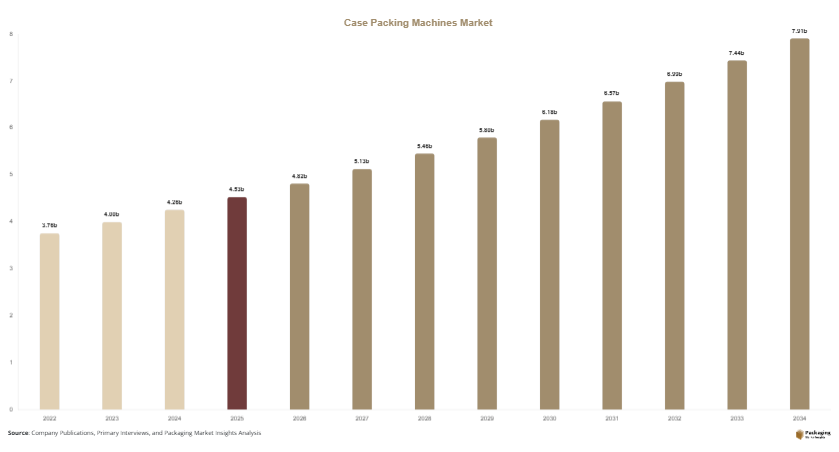
Case Packing Machines market size is projected at USD 4.82 billion in 2026 and is expected to hit USD 7.91 billion by 2034 with a CAGR of 6.39%.
The market is expanding due to increasing investments in automated packaging systems, growing production capacities, and rising demand for high-speed end-of-line packaging solutions across manufacturing industries. The report provides detailed quantitative analysis covering market segmentation, production capacity, competitive landscape, pricing trends, technological developments, and regional performance across the forecast period.
The Case Packing Machines market comprises automated equipment designed to load products into corrugated cases, cartons, or trays for storage and transportation. These systems are widely deployed across food processing, pharmaceutical manufacturing, personal care, and consumer goods industries to improve packaging efficiency while reducing labor dependency. Global production of case packing machines exceeded 92,000 units in 2025, with automated models accounting for approximately 63% of total installations. Food and beverage applications contributed nearly 46% of total deployments, while pharmaceutical applications represented around 24%. Industrial automation adoption across manufacturing facilities surpassed 58%, supporting continuous expansion of the Case Packing Machines market.
Explore more data points, trends and opportunities Download Free Sample Report
Case Packing Machines Market Trends
Rising Adoption of Robotic Automation
Manufacturers are increasingly integrating robotic pick-and-place technologies with intelligent vision systems to improve packaging speed and reduce operational errors. More than 31,000 robotic case packing units were shipped globally during 2025, while robotic installations increased by approximately 14% year-over-year. Modern equipment is capable of processing 20–80 cases per minute, depending on product configuration, while AI-assisted inspection systems have improved packaging accuracy beyond 99%. These advancements continue to strengthen the Case Packing Machines market.
Growing demand for flexible packaging lines has encouraged manufacturers to introduce modular machines supporting multiple carton sizes and product formats. Nearly 48% of newly commissioned packaging facilities now utilize modular automation platforms, while energy-efficient servo-driven systems reduce electricity consumption by 15–22% compared with conventional equipment. Production of intelligent packaging machinery exceeded 18,500 units globally during 2025, reinforcing long-term Case Packing Machines market expansion.
Case Packing Machines Drivers
Increasing Automation Across Manufacturing Facilities
Manufacturers continue replacing manual packaging operations with automated systems to improve productivity and minimize labor shortages. More than 67% of newly established production facilities include automated end-of-line packaging systems, while packaging throughput has improved by 25–40% after automation deployment. Automated machines reduce packaging downtime by nearly 18% and improve operational efficiency by over 30%, supporting sustained Case Packing Machines market demand.
Case Packing Machines Restraints
High Capital Investment and Maintenance Costs
Advanced robotic case packing systems require significant initial investments ranging from USD 180,000 to over USD 1.2 million depending on production capacity and automation level. Annual maintenance costs typically account for 5–8% of equipment value, while skilled technical personnel remain limited in several developing economies. Nearly 37% of small manufacturers continue relying on semi-automatic solutions due to budget limitations, slowing broader Case Packing Machines market adoption.
Case Packing Machines Opportunities
Expansion of Smart Manufacturing Facilities
Growing implementation of Industry 4.0 technologies creates substantial opportunities for machine manufacturers offering IoT-enabled packaging systems. More than 52% of large manufacturing plants are investing in connected production equipment, while predictive maintenance solutions reduce unexpected downtime by approximately 28%. Cloud-based monitoring systems now manage over 12 million operational data points annually across automated packaging lines, generating new opportunities for the Case Packing Machines market.
Chalanges in Case Packing Machines
Supply Chain Disruptions and Component Availability
Packaging equipment manufacturers continue experiencing procurement challenges for servo motors, industrial sensors, controllers, and electronic components. Average delivery times increased by approximately 16% during recent procurement cycles, while raw material prices for structural steel and aluminum fluctuated by 9–14%. These factors affect production planning and delivery schedules, creating ongoing operational challenges for the Case Packing Machines market.
Report Scope
| Report Metric | Details |
|---|---|
| Market Size in 2025 | USD 4.53 billion |
| Market Size in 2026 | USD 4.82 billion |
| Market Size in 2034 | USD 7.91 billion |
| CAGR | 6.39% (2026-2034) |
| Base Year for Estimation | 2025 |
| Historical Data | 2022-2024 |
| Forecast Period | 2026-2034 |
| Report Coverage | Revenue Forecast, Competitive Landscape, Supply Chain Disruption, Growth Factors, Environment & Regulatory Landscape and Trends |
| Geographies Covered | North America, Europe, APAC, Middle East and Africa, LATAM |
| Countries Covered | U.S., Canada, U.K., Germany, France, Spain, Italy, Russia, Nordic, Benelux, Rest of Europe, China, South Korea, Japan, India, Australia, Singapore, Taiwan, South East Asia, Rest of Asia-Pacific, UAE, Turky, Saudi Arabia, South Africa, Egypt, Nigeria, Rest of MEA, Brazil, Mexico, Argentina, Chile, Colombia, Rest of LATAM |
Explore more data points, trends and opportunities Download Free Sample Report
Case Packing Machines Market Segmentation
The market is segmented according to machine type and application. Automatic systems account for nearly 49% of total revenue, while food and beverage applications contribute approximately 46% of market demand due to expanding packaged food production worldwide.
By Type
Automatic Case Packing Machines
Automatic systems represent the largest segment with approximately 49% market share. More than 45,000 units were produced during 2025, operating at speeds between 25 and 80 cases per minute using servo-controlled motion, integrated PLC systems, and automated product handling.
Semi-Automatic Case Packing Machines
Semi-automatic equipment contributes nearly 29% of market revenue with production exceeding 27,000 units annually. These systems typically process 10–30 cases per minute, making them suitable for medium-volume manufacturing environments requiring lower investment costs.
Robotic Case Packing Machines
Robotic machines account for approximately 22% of global installations. Equipped with articulated robots, machine vision, and intelligent gripping technologies, these systems deliver positioning accuracy within ±0.1 mm while supporting multiple packaging formats and high-speed changeovers.
By Application
Food & Beverage
Food and beverage remains the largest application with nearly 46% market share. Packaging facilities process over 3.2 billion packaged units annually using automated case packing systems. Machine utilization rates frequently exceed 85%, supporting continuous production operations.
Pharmaceuticals
Pharmaceutical applications contribute approximately 24% of global demand. More than 14,000 packaging lines utilize automated case packing machines to ensure product traceability, regulatory compliance, and contamination-free packaging with inspection accuracy above 99%.
Consumer Goods
Consumer goods account for nearly 18% of market demand. High-volume production facilities package household products, cosmetics, and personal care items using flexible systems capable of processing numerous product configurations while improving packaging efficiency by over 25%.
Case Packing Machines Market Segmentations
Type
- Automatic Case Packing Machines
- Semi-Automatic Case Packing Machines
- Robotic Case Packing Machines
Application
- Food & Beverage
- Pharmaceuticals
- Consumer Goods
Case Packing Machines Regional Outlook
North America
North America accounts for approximately 31% of global revenue. The United States contributes nearly 79% of regional demand, supported by advanced food processing, pharmaceutical manufacturing, and logistics automation. Regional production exceeds 21,000 units annually, while automated equipment adoption surpasses 70%.
Europe
Europe represents nearly 28% of the market, led by Germany, Italy, France, and the United Kingdom. The region manufactures over 24,000 machines annually and maintains strong export capabilities. Food processing contributes around 43% of regional equipment demand.
Asia-Pacific
Asia-Pacific holds approximately 30% market share and records the fastest industrial expansion. China, Japan, India, and South Korea account for over 74% of regional production capacity. More than 34,000 units are manufactured annually, driven by rapid industrialization and packaging automation investments.
Latin America
Latin America contributes around 6% of global revenue. Brazil and Mexico represent more than 68% of regional demand, supported by expanding food processing industries and increasing automation investments across consumer goods manufacturing.
Middle East & Africa
The Middle East & Africa account for approximately 5% of the global market. Saudi Arabia, the UAE, and South Africa continue investing in food manufacturing and pharmaceutical packaging, with industrial automation adoption increasing by nearly 11% annually.
Top players in Case Packing Machines
- Syntegon Technology
- Krones AG
- IMA Group
- Marchesini Group
- Douglas Machine Inc.
- Massman Automation Designs
- Mpac Group plc
- Brenton LLC
- Schneider Packaging Equipment Co., Inc.
- Delkor Systems
- Jacob White Packaging
- A-B-C Packaging Machine Corporation
- EndFlex
- Cama Group
- ProMach
Syntegon Technology
-
Estimated market share of approximately 9–11% globally.
-
Strong presence in food, pharmaceutical, and consumer goods packaging automation.
-
Extensive portfolio of intelligent case packing systems with Industry 4.0 connectivity.
-
Global manufacturing footprint and strong aftermarket service capabilities support leadership across high-speed automated packaging applications.
Krones AG
-
Estimated global market share of approximately 8–10%.
-
Leading supplier of beverage packaging and integrated production systems.
-
High-capacity equipment capable of processing more than 80 cases per minute.
-
Continuous investments in digital manufacturing, energy-efficient machinery, and automated packaging technologies strengthen competitive positioning worldwide.