Syringe Filling Machine Market Size
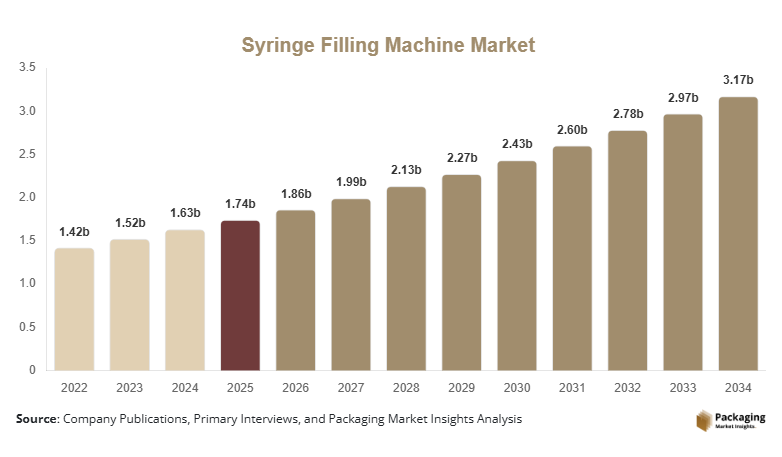
Syringe Filling Machine market size is projected at USD 1.86 billion in 2026 and is expected to hit USD 3.17 billion by 2034 with a CAGR of 6.9%. The report evaluates equipment production, technological innovations, application-specific demand, regulatory compliance, and competitive developments across global pharmaceutical manufacturing markets. Rising investments in injectable drug production and aseptic processing continue to strengthen equipment demand.
Syringe filling machines are specialized pharmaceutical processing systems designed for sterile filling, stoppering, sealing, and inspection of prefilled syringes used for vaccines, biologics, insulin, and injectable therapeutics. More than 3,900 syringe filling machines were operational worldwide during 2025, supporting production exceeding 22 billion prefilled syringes annually. Automatic systems accounted for nearly 68% of installed capacity, while pharmaceutical manufacturers contributed approximately 61% of equipment demand, reinforcing the Syringe Filling Machine market.
Explore more data points, trends and opportunities Download Free Sample Report
Syringe Filling Machine Trends
Rising Adoption of Fully Automated Aseptic Filling Systems
Demand for fully automated syringe filling equipment continues to increase as pharmaceutical manufacturers expand biologics and vaccine production. More than 1,150 automated systems were installed globally during 2025, representing annual growth of 14%. Advanced robotic filling technologies improved production efficiency by 17% while reducing contamination risks by 22%, supporting Syringe Filling Machine market trends.
Manufacturers are integrating machine vision inspection, isolator technology, and digital monitoring solutions to enhance product quality. Smart manufacturing platforms reduced production downtime by 16%, while AI-enabled inspection systems improved defect detection accuracy beyond 99%. Growing adoption of Industry 4.0 technologies continues strengthening the Syringe Filling Machine market.
Syringe Filling Machine Market Drivers
Growing Production of Injectable Biopharmaceuticals
Increasing demand for biologics, vaccines, biosimilars, and injectable therapies continues driving equipment investments. Global injectable drug production exceeded 190 billion doses during 2025, while investments in aseptic manufacturing facilities surpassed USD 7.2 billion. Pharmaceutical capacity expansion and regulatory compliance continue supporting Syringe Filling Machine market growth.
Syringe Filling Machine Market Restraints
High Capital Investment and Regulatory Complexity
Advanced syringe filling equipment requires significant capital expenditure and strict GMP compliance. Equipment installation costs increased by approximately 11%, while validation expenses rose by 9% during 2025. Regulatory approval timelines and qualification requirements continue affecting market expansion, influencing the Syringe Filling Machine market.
Syringe Filling Machine Market Opportunities
Expansion of Biologics and Personalized Medicine
Rapid growth in biologics, cell therapies, and personalized injectable medicines presents substantial opportunities for equipment manufacturers. More than 38% of newly commissioned pharmaceutical filling lines supported biologic production during 2025, while investments exceeding USD 3.4 billion accelerated adoption of advanced syringe filling technologies, strengthening the Syringe Filling Machine market.
Challenges in Syringe Filling Machine Market
Maintaining Sterility in High-Speed Production
Manufacturers must achieve high-speed filling while maintaining aseptic integrity and minimizing contamination risks. Modern production lines exceed 600 syringes per minute, while environmental monitoring requirements increased by 18%. Balancing productivity with stringent regulatory standards remains a major challenge for the Syringe Filling Machine market.
Report Scope
| Report Metric | Details |
|---|---|
| Market Size in 2025 | USD 1.74 billion |
| Market Size in 2026 | USD 1.86 billion |
| Market Size in 2034 | USD 3.17 billion |
| CAGR | 6.9% (2026-2034) |
| Base Year for Estimation | 2025 |
| Historical Data | 2022-2024 |
| Forecast Period | 2026-2034 |
| Report Coverage | Revenue Forecast, Competitive Landscape, Supply Chain Disruption, Growth Factors, Environment & Regulatory Landscape and Trends |
| Geographies Covered | North America, Europe, APAC, Middle East and Africa, LATAM |
| Countries Covered | U.S., Canada, U.K., Germany, France, Spain, Italy, Russia, Nordic, Benelux, Rest of Europe, China, South Korea, Japan, India, Australia, Singapore, Taiwan, South East Asia, Rest of Asia-Pacific, UAE, Turky, Saudi Arabia, South Africa, Egypt, Nigeria, Rest of MEA, Brazil, Mexico, Argentina, Chile, Colombia, Rest of LATAM |
Explore more data points, trends and opportunities Download Free Sample Report
Syringe Filling Machine Market Segmentation
Automatic syringe filling machines account for approximately 68% of global demand, followed by semi-automatic machines with 23%, while manual systems represent nearly 9%. Pharmaceutical manufacturing dominates applications with approximately 61% of equipment utilization.
By Type
This segment accounts for approximately 68% of market demand with annual production exceeding 1,850 units. These systems integrate robotic filling, stoppering, capping, and automated inspection to maximize productivity while ensuring aseptic manufacturing.
Representing nearly 23% of demand, over 630 machines are produced annually. These systems provide flexibility for medium-scale pharmaceutical production while maintaining regulatory compliance and high filling precision.
Manual equipment contributes approximately 9% of global demand with annual production exceeding 250 units. These machines are primarily utilized for laboratory applications, pilot production, and small-volume specialty pharmaceutical manufacturing.
By Application
Pharmaceutical manufacturers account for approximately 61% of total equipment demand, operating more than 2,350 syringe filling systems globally. Rising production of vaccines, insulin, and biologics continues supporting segment growth.
Biotechnology firms represent approximately 24% of market demand with over 930 installed systems. Expansion of biologic drug development and personalized medicine continues driving investments in advanced aseptic filling technologies.
CMOs contribute approximately 15% of total demand, utilizing more than 620 syringe filling machines annually. Increasing outsourcing of sterile manufacturing continues supporting equipment adoption.
Syringe Filling Machine Market Segmentations
Product Type
- Automatic Syringe Filling Machines
- Semi-Automatic Syringe Filling Machines
- Manual Syringe Filling Machines
Application
- Pharmaceutical Manufacturing
- Biotechnology Companies
- Contract Manufacturing Organizations (CMOs)
Automation Level
- Fully Automatic Systems
- Semi-Automatic Systems
- Standalone Filling Systems
- Integrated Filling & Packaging Lines
Syringe Filling Machine Regional Outlook
North America
North America accounts for approximately 36% of global revenue with more than 1,400 installed syringe filling systems. The United States contributes nearly 84% of regional demand due to extensive pharmaceutical manufacturing capacity and biologics production.
Europe
Europe represents approximately 31% of global demand with over 1,200 installed systems. Germany, Switzerland, Italy, France, and the United Kingdom remain major pharmaceutical manufacturing hubs supporting advanced aseptic processing technologies.
Asia-Pacific
Asia-Pacific holds approximately 27% of global market revenue with over 1,050 installed systems. China, Japan, India, and South Korea continue expanding injectable pharmaceutical production through substantial investments in manufacturing infrastructure.
Latin America
Latin America contributes approximately 4% of global demand. Brazil and Mexico account for nearly 69% of regional pharmaceutical equipment installations, supported by expanding vaccine manufacturing.
Middle East & Africa
The Middle East & Africa account for approximately 2% of global demand. Saudi Arabia, the UAE, Egypt, and South Africa continue increasing investments in domestic pharmaceutical production and sterile manufacturing capabilities.
Top players in Syringe Filling Machine Market
- Bausch+Ströbel SE + Co. KG
- Syntegon Technology GmbH
- IMA S.p.A.
- Optima Packaging Group GmbH
- Vanrx Pharmasystems (Cytiva)
- Groninger & Co. GmbH
- Romaco Group
- Marchesini Group S.p.A.
- Tofflon Science and Technology Co., Ltd.
- N.K. Industries
Bausch+Ströbel SE + Co. KG
-
Estimated market share of approximately 17%.
-
Leading supplier of aseptic syringe filling and pharmaceutical packaging equipment.
-
Strong expertise in high-speed sterile filling technologies.
-
The company focuses on robotic automation, isolator integration, advanced inspection systems, and GMP-compliant production equipment while continuously expanding its global pharmaceutical customer base through technology innovation.
Syntegon Technology GmbH
-
Estimated market share of approximately 14%.
-
Global leader in pharmaceutical processing and packaging equipment.
-
Extensive portfolio of automated aseptic filling solutions.
-
Syntegon continues investing in digital manufacturing, AI-enabled inspection, sustainable equipment design, and integrated pharmaceutical production technologies that improve productivity, quality assurance, and regulatory compliance.