Drug Delivery Solutions Market Size
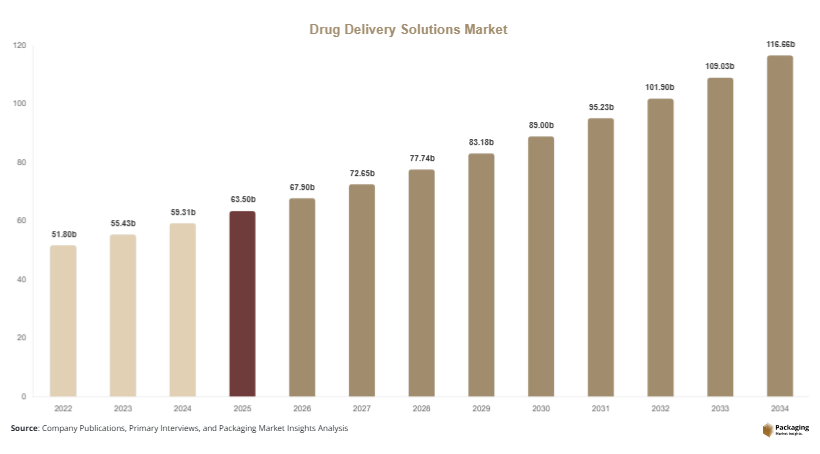
Drug Delivery Solutions market size is projected at USD 67.9 billion in 2026 and is expected to hit USD 116.8 billion by 2034 with a CAGR of 7.0%. The report provides comprehensive quantitative and qualitative assessment across product categories, applications, and regional markets, supported by extensive demand analysis and competitive benchmarking. It evaluates production capacity exceeding 18.5 billion delivery units annually, market penetration across healthcare systems, pricing trends, and strategic developments shaping the global industry.
Drug delivery solutions comprise technologies and devices designed to administer pharmaceutical compounds with improved efficacy, safety, and patient compliance. The industry includes conventional and advanced delivery systems such as injectable, oral, transdermal, implantable, and targeted drug delivery platforms. More than 62% of pharmaceutical therapies continue to rely on advanced delivery technologies, while injectable systems contribute approximately 46% of total industry revenue. Annual production has surpassed 18.5 billion units, with adoption exceeding 78% across hospital-based therapies and 54% within home healthcare environments, reinforcing the expansion of the Drug Delivery Solutions Market.
Explore more data points, trends and opportunities Download Free Sample Report
Drug Delivery Solutions Market Trends
Rising Adoption of Smart and Targeted Drug Delivery Technologies
Manufacturers are increasingly integrating digital monitoring, sustained-release formulations, and targeted delivery technologies into therapeutic products. Global production of advanced delivery devices exceeded 5.4 billion units in 2025, while smart injector adoption increased by 18% year over year. More than 41% of newly approved biologic therapies utilize specialized delivery mechanisms that improve treatment efficiency and patient adherence, strengthening the Drug Delivery Solutions Market.
Growing investment in biologics, biosimilars, and personalized medicine continues to accelerate technological innovation. Targeted delivery platforms account for nearly 29% of ongoing pharmaceutical research projects, while wearable injectors and connected delivery devices recorded adoption growth above 21%. Pharmaceutical companies are expanding manufacturing capacity by over 12% annually to meet rising therapeutic demand, supporting the Drug Delivery Solutions Market.
Drug Delivery Solutions Drivers
Increasing prevalence of chronic diseases and biologic therapies
The rising burden of diabetes, cancer, autoimmune disorders, and cardiovascular diseases continues to stimulate demand for advanced drug delivery technologies. More than 2.6 billion prescription therapies are administered annually through specialized delivery systems, while biologic medicines represent nearly 39% of pharmaceutical pipeline candidates. Healthcare expenditure on advanced therapies continues to increase by over 8% annually, supporting sustained Drug Delivery Solutions Market demand.
Drug Delivery Solutions Restraints
High development costs and stringent regulatory requirements
Advanced delivery systems require extensive clinical validation, regulatory approval, and manufacturing investments. Development timelines frequently exceed 6–10 years, while R&D spending often surpasses USD 300 million for complex delivery platforms. Compliance costs have increased by approximately 14%, limiting commercialization for smaller manufacturers and affecting Drug Delivery Solutions Market expansion.
Drug Delivery Solutions Opportunities
Expansion of home healthcare and self-administration therapies
Home healthcare services continue to expand globally, creating significant opportunities for wearable injectors, oral controlled-release formulations, and transdermal systems. Self-administered therapies account for nearly 35% of chronic disease treatments, while home-based care adoption has increased by 24% over the past five years. Annual production of portable delivery devices exceeds 2.1 billion units, generating substantial opportunities for the Drug Delivery Solutions Market.
Challenges in Drug Delivery Solutions Market
Manufacturing complexity and supply chain optimization
Maintaining sterility, precision dosing, and consistent product quality remains challenging for manufacturers. Raw material costs have increased by nearly 11%, while specialized component shortages affect approximately 16% of global production facilities. Manufacturers continue investing in automation and digital quality control to improve production efficiency and support the Drug Delivery Solutions Market.
Report Scope
| Report Metric | Details |
|---|---|
| Market Size in 2025 | USD 63.5 billion |
| Market Size in 2026 | USD 67.9 billion |
| Market Size in 2034 | USD 116.8 billion |
| CAGR | 7.0% (2026-2034) |
| Base Year for Estimation | 2025 |
| Historical Data | 2022-2024 |
| Forecast Period | 2026-2034 |
| Report Coverage | Revenue Forecast, Competitive Landscape, Supply Chain Disruption, Growth Factors, Environment & Regulatory Landscape and Trends |
| Geographies Covered | North America, Europe, APAC, Middle East and Africa, LATAM |
| Countries Covered | U.S., Canada, U.K., Germany, France, Spain, Italy, Russia, Nordic, Benelux, Rest of Europe, China, South Korea, Japan, India, Australia, Singapore, Taiwan, South East Asia, Rest of Asia-Pacific, UAE, Turky, Saudi Arabia, South Africa, Egypt, Nigeria, Rest of MEA, Brazil, Mexico, Argentina, Chile, Colombia, Rest of LATAM |
Explore more data points, trends and opportunities Download Free Sample Report
Drug Delivery Solutions Market Segmentation
Injectable drug delivery remains the dominant segment with nearly 46% revenue contribution, followed by oral systems at approximately 34%, while hospitals account for nearly 52% of overall application demand due to extensive administration of specialty therapies.
By Type
Injectable Drug Delivery
Injectable systems lead the market because of increasing biologic therapies, vaccines, and emergency medications. The segment contributes around 46% of revenue with production exceeding 8.2 billion units annually. Auto-injectors, prefilled syringes, and infusion systems continue improving dosage precision, patient safety, and treatment effectiveness.
Oral Drug Delivery
Oral formulations account for nearly 34% of the market, supported by strong patient preference and cost-effective manufacturing. Annual production exceeds 7.4 billion units, with controlled-release tablets and capsules improving therapeutic outcomes and medication adherence across chronic disease management.
Transdermal Drug Delivery
Transdermal systems represent approximately 20% of revenue, supported by pain management, hormone therapy, and neurological treatments. Production has surpassed 2.9 billion patches annually, while advanced polymer technologies improve controlled drug release and reduce dosing frequency.
By Application
Hospitals
Hospitals account for approximately 52% of total demand owing to high utilization of injectable biologics, chemotherapy, and intensive care therapies. Annual consumption exceeds 9 billion delivery units, with advanced infusion technologies supporting complex clinical procedures and high treatment penetration.
Home Care Settings
Home healthcare contributes nearly 30% of market demand. More than 4.6 billion units are administered annually through wearable injectors, oral therapies, and transdermal systems, while patient self-administration penetration continues to exceed 58% in chronic disease management.
Specialty Clinics
Specialty clinics represent approximately 18% of demand, focusing on oncology, fertility, rheumatology, and dermatology treatments. Facilities administer over 2.8 billion therapeutic doses annually while increasingly adopting precision drug delivery platforms for targeted patient care.
Drug Delivery Solutions Market Segmentations
Type
- Injectable Drug Delivery
- Oral Drug Delivery
- Transdermal Drug Delivery
Application
- Hospitals
- Home Care Settings
- Specialty Clinics
Drug Delivery Solutions Regional Outlook
North America
North America holds nearly 39% of global revenue, supported by advanced pharmaceutical manufacturing and strong biologics adoption. The United States contributes over 84% of regional demand, while annual production exceeds 6.8 billion delivery units.
Europe
Europe accounts for approximately 27% of the market, led by Germany, France, the United Kingdom, Italy, and Switzerland. Regional manufacturing exceeds 4.3 billion units, supported by expanding biosimilar production and advanced healthcare infrastructure.
Asia-Pacific
Asia-Pacific represents nearly 25% of global revenue and records the fastest expansion. China, Japan, India, and South Korea collectively contribute more than 78% of regional production, with manufacturing surpassing 5.5 billion units annually.
Latin America, Middle East & Africa
These regions collectively contribute approximately 9% of market revenue. Brazil, Mexico, Saudi Arabia, South Africa, and the UAE continue increasing healthcare investments, while annual production exceeds 1.6 billion units.
Top players in Drug Delivery Solutions Market
- Becton, Dickinson and Company
- West Pharmaceutical Services
- Gerresheimer AG
- Baxter International Inc.
- Pfizer Inc.
- Johnson & Johnson
- Novo Nordisk A/S
- Ypsomed AG
- SCHOTT Pharma
- Medtronic plc
- AbbVie Inc.
- B. Braun SE
- Nemera
- AptarGroup, Inc.
- Insulet Corporation
Becton, Dickinson and Company
-
Holds an estimated 10–12% global market share.
-
Maintains leadership through diversified injectable delivery technologies, prefilled syringes, infusion systems, and pharmaceutical partnerships. The company operates multiple global manufacturing facilities producing billions of medical devices annually. Continuous investment in connected drug delivery technologies, automation, and regulatory compliance strengthens its competitive position across hospitals, pharmaceutical manufacturers, and home healthcare providers while expanding innovation in biologics delivery.
West Pharmaceutical Services
-
Accounts for approximately 8–10% market share.
-
The company specializes in pharmaceutical packaging components, containment systems, injectable delivery solutions, and self-administration devices. Strong collaborations with leading pharmaceutical companies, extensive R&D investment, and expansion of high-value manufacturing facilities enable continued growth. Its focus on elastomer components, wearable injectors, and integrated delivery platforms positions the company among the leading suppliers supporting global biologic drug commercialization.