Spreads And Toppings Packaging Market Size
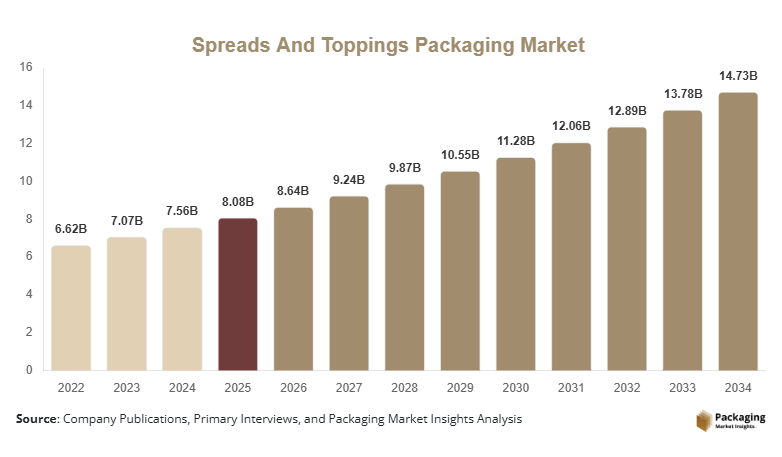
The spreads and toppings packaging market size is projected at USD 8.64 billion in 2026 and is expected to hit USD 14.73 billion by 2034 with a CAGR of 6.9%.
The report provides an in-depth assessment of production capacity, market segmentation, regional performance, technological advancements, and the competitive landscape. It evaluates historical data from 2022–2024, analyzes the base year 2025, and forecasts market developments through 2034 to support strategic decision-making across the global packaging industry.
"Spreads and toppings packaging" refers to packaging solutions specifically designed for products such as jams, jellies, peanut butter, chocolate spreads, honey, syrups, dairy spreads, and dessert toppings. These packaging formats emphasize product protection, shelf-life extension, convenience, and branding while complying with food safety regulations. Global production of spreads and toppings packaging exceeds 28 billion units annually, with plastic containers contributing nearly 48% of total production, glass jars accounting for approximately 32%, and flexible packaging representing around 20%. Food retail applications contribute more than 65% of overall consumption, reinforcing spreads and toppings' packaging market demand.
Explore more data points, trends and opportunities Download Free Sample Report
Spreads And Toppings Packaging Trends
Sustainable Packaging Innovation
Packaging manufacturers are increasingly investing in recyclable plastics, lightweight glass, mono-material pouches, and bio-based packaging solutions. More than 38% of new spread products' packaging now utilize recyclable or renewable materials. Annual production of sustainable food packaging exceeds several billion units globally, while lightweight container technologies reduce packaging weight by nearly 18%–25%. These developments continue strengthening the spreads and toppings packaging market trends.
Smart Packaging and Premium Product Positioning
Food brands are integrating tamper-evident closures, resealable lids, QR-enabled labeling, and improved barrier technologies into spreads' packaging. Premium packaging adoption has increased by over 30% among branded food manufacturers, while digital printing enables customized packaging for retail shelves. Flexible pouch demand has grown by approximately 22% due to convenience and lower transportation costs. These innovations continue supporting spreads and toppings' packaging market growth.
Spreads And Toppings Packaging Market Drivers
Growing Consumption of Ready-to-Eat Food Products
The increasing popularity of breakfast spreads, dessert toppings, and convenience foods is driving packaging demand worldwide. Food manufacturers produce more than 28 billion packaged spread units annually, with retail sales increasing by nearly 7% each year in emerging economies. Plastic packaging accounts for approximately 48% of production due to lightweight characteristics and cost efficiency, while premium glass packaging continues expanding in high-value product categories. These factors continue accelerating the spreads and toppings packaging market's growth.
Spreads And Toppings Packaging Market Restraints
Volatile Raw Material Prices and Sustainability Regulations
Fluctuating resin, paperboard, and glass manufacturing costs continue affecting packaging manufacturers. Raw material prices fluctuate between 12% and 25% annually, while stricter sustainability regulations require significant investments in recyclable packaging technologies. Glass transportation costs remain approximately 20% higher than lightweight plastic alternatives. These challenges influence profitability across the spreads and toppings packaging markets.
Spreads And Toppings Packaging Market Opportunities
Expansion of Sustainable and Flexible Food Packaging
Increasing consumer preference for recyclable and convenient food packaging presents substantial opportunities. Flexible packaging adoption has increased by more than 22%, while recyclable plastic container demand continues growing across developed markets. Manufacturers are expanding production of mono-material pouches and lightweight jars capable of reducing packaging waste by nearly 30%. These developments create attractive opportunities for the spreads and toppings packaging market.
Challenges in Spreads And Toppings Packaging Market
Maintaining Product Freshness Throughout Distribution
Maintaining product integrity during transportation and long shelf-life requirements remains a major challenge. Manufacturers must balance oxygen barrier performance, moisture resistance, sealing efficiency, and recyclability. Packaging failure rates below 2% are required for premium food products, while distribution losses can increase by over 10% without advanced packaging technologies. These operational challenges influence the spreads and toppings packaging market.
Report Scope
| Report Metric | Details |
|---|---|
| Market Size in 2025 | USD 8.08 Billion |
| Market Size in 2026 | USD 8.64 Billion |
| Market Size in 2034 | USD 14.73 Billion |
| CAGR | 6.9% (2026-2034) |
| Base Year for Estimation | 2025 |
| Historical Data | 2022-2024 |
| Forecast Period | 2026-2034 |
| Report Coverage | Revenue Forecast, Competitive Landscape, Supply Chain Disruption, Growth Factors, Environment & Regulatory Landscape and Trends |
| Geographies Covered | North America, Europe, APAC, Middle East and Africa, LATAM |
| Countries Covered | U.S., Canada, U.K., Germany, France, Spain, Italy, Russia, Nordic, Benelux, Rest of Europe, China, South Korea, Japan, India, Australia, Singapore, Taiwan, South East Asia, Rest of Asia-Pacific, UAE, Turkey, Saudi Arabia, South Africa, Egypt, Nigeria, Rest of MEA, Brazil, Mexico, Argentina, Chile, Colombia, Rest of LATAM |
Explore more data points, trends and opportunities Download Free Sample Report
Spreads And Toppings Packaging Market Segmentation
The Spreads And Toppings The packaging market is segmented by packaging type and application. Plastic containers dominate with approximately 48% market share because of affordability and durability, while jam and jelly packaging represents the leading application with more than 40% contribution. Flexible packaging continues recording the fastest adoption due to convenience and sustainability benefits.
By Packaging Type
Plastic containers account for approximately 48% of the market. More than 13 billion units are manufactured annually for peanut butter, chocolate spreads, dairy spreads, and honey packaging. High-impact polypropylene and PET materials provide lightweight construction, resealable closures, moisture protection, and efficient logistics. Recycling initiatives continue improving sustainability performance across this segment.
Glass jars contribute nearly 32% of total market share. Annual production exceeds 9 billion units, primarily serving premium jams, honey, preserves, and specialty spreads. Glass provides superior barrier protection, chemical stability, premium shelf appearance, and excellent recyclability. Demand remains strong across premium food categories.
Flexible pouches represent around 20% market share and are expanding rapidly due to lower material consumption and transportation efficiency. More than 6 billion units are produced annually, offering easy dispensing, lightweight design, and reduced storage requirements. Mono-material pouch development continues improving recyclability.
By Application
Jam and jelly packaging holds approximately 40% market share, with annual packaging production exceeding 11 billion units. Glass jars remain the preferred format, while lightweight plastic containers continue gaining popularity. High oxygen barrier properties and leak-resistant closures support product preservation.
Chocolate and nut spread packaging contributes nearly 35% market share. More than 9 billion units are manufactured annually using plastic jars, pouches, and premium packaging formats. Resealable closures, wide-mouth designs, and improved barrier materials enhance consumer convenience and shelf life.
Dairy and honey packaging accounts for approximately 25% of market demand. Annual production exceeds 7 billion units across squeezable bottles, glass jars, and plastic containers. Packaging solutions emphasize freshness, contamination prevention, and controlled dispensing for consumer convenience.
Spreads And Toppings Packaging Market Segmentations
Packaging Type
- Plastic Containers
- Glass Jars
- Flexible Pouches
Application
- Jam & Jelly Packaging
- Chocolate & Nut Spread Packaging
- Dairy & Honey Packaging
Distribution Channel
- Supermarkets & Hypermarkets
- Online Retail
- Foodservice Distributors
- Specialty Food Stores
Spreads And Toppings Packaging Market Regional Outlook
North America
North America accounts for approximately 29% of the global market. The United States contributes nearly 72% of regional production, supported by large food processing industries and high packaged food consumption. Plastic containers dominate regional packaging demand, while premium glass packaging maintains steady expansion.
Europe
Europe represents approximately 27% market share, supported by Germany, France, Italy, and the United Kingdom. Sustainable packaging adoption exceeds 42%, with glass packaging maintaining strong demand for premium preserves and honey products. Food safety regulations continue driving innovation across the region.
Asia Pacific
Asia Pacific holds the largest market share at approximately 34%. China, India, Japan, and South Korea collectively account for more than 75% of regional production. Rapid urbanization, expanding retail chains, and growing packaged food consumption support production exceeding 10 billion packaging units annually.
Latin America
Latin America contributes around 6% of global demand, led by Brazil and Mexico. Growing consumption of processed food and expanding retail infrastructure support increasing adoption of lightweight packaging solutions.
Middle East & Africa
The Middle East & Africa account for nearly 4% of the market. Rising packaged food consumption, urban retail expansion, and increasing food imports continue generating demand for advanced spreads and toppings packaging solutions.
Top Players In The Spreads And Toppings Packaging Market
- Amcor plc
- Berry Global Inc.
- Silgan Holdings Inc.
- Gerresheimer AG
- Berlin Packaging
- Huhtamaki Oyj
- Sonoco Products Company
- Mondi Group
- WestRock Company
- Graphic Packaging Holding Company
Amcor plc maintains a leading position in the global food packaging industry through its diversified packaging portfolio and sustainable innovation initiatives. The company supplies billions of food packaging units annually across flexible and rigid packaging categories while maintaining strong relationships with global food manufacturers. Advanced barrier technologies, recyclable packaging materials, and lightweight packaging solutions support premium food packaging applications. Continued investments in mono-material packaging and circular economy initiatives strengthen its competitive position within the spreads and toppings packaging market. Berry Global Inc. Berry Global Inc. is a major manufacturer of rigid plastic containers and flexible food packaging solutions. The company offers advanced injection-molded containers, closures, and sustainable packaging products serving leading food brands worldwide. Manufacturing facilities across multiple regions support large-scale production and consistent supply capabilities. Ongoing investment in recycled content packaging and lightweight product development reinforces its market position in food packaging applications.