Smart Food Packaging Market Size and Growth
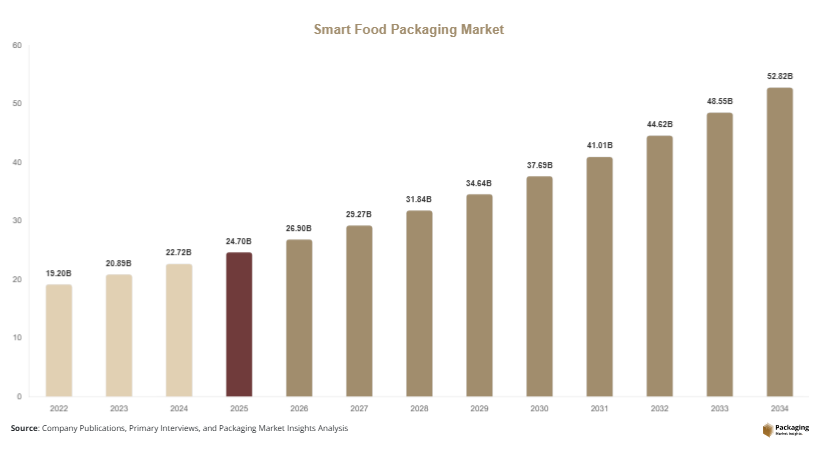
The global smart food packaging market size was valued at approximately USD 24.7 billion in 2025 and is expected to reach USD 26.9 billion in 2026. By 2034, the market is projected to grow to nearly USD 52.8 billion, registering a CAGR of 8.8% during 2025–2034. The smart food packaging market is witnessing significant expansion due to increasing demand for advanced food safety solutions, extended shelf-life technologies, and connected packaging systems across the food and beverage industry. Smart food packaging integrates technologies such as sensors, indicators, RFID tags, QR codes, freshness monitoring systems, and active packaging materials to improve product protection, traceability, and consumer engagement.
One of the primary growth factors supporting the smart food packaging market is the rising consumer demand for food transparency and safety. Consumers increasingly prefer packaging that provides real-time information regarding freshness, storage conditions, expiration dates, and product authenticity. Smart packaging technologies help manufacturers improve consumer confidence while reducing food contamination risks. Another important growth factor is the rapid expansion of e-commerce grocery platforms and cold chain logistics networks. Online food delivery services require intelligent packaging systems capable of monitoring temperature, humidity, and product quality during transportation and storage.
Key Highlights
- North America dominated the market with a 34.2% share in 2025.
- Asia Pacific is projected to grow at the fastest CAGR of 9.6%.
- Intelligent packaging led the technology segment with a 41.8% share.
- Food safety and quality monitoring applications dominated with a 38.7% share.
- Plastic-based smart packaging materials dominated with a 53.1% share.
- The US remained the dominant country with a market size of USD 6.8 billion in 2025 and USD 7.4 billion in 2026.
Explore more data points, trends and opportunities Download Free Sample Report
Market Trends
Increasing Integration of IoT and Connected Packaging Technologies
The smart food packaging market is witnessing strong growth in IoT-enabled and connected packaging technologies designed to improve supply chain visibility and consumer interaction. Food manufacturers are increasingly integrating QR codes, NFC tags, RFID sensors, and cloud-based tracking systems into packaging formats. These technologies help monitor product conditions during transportation while enabling real-time traceability and authentication. Consumers can also access nutritional details, sourcing information, and freshness status using smartphones. Retailers are adopting connected packaging systems to improve inventory management and reduce product losses. As digital transformation expands across the food industry, connected packaging technologies are expected to become a standard feature in premium and export-oriented food products.
Rising Adoption of Sustainable and Active Packaging Solutions
Sustainability and food preservation are becoming central trends within the smart food packaging market. Packaging companies are increasingly developing active packaging systems capable of absorbing oxygen, controlling moisture, and extending shelf life while reducing food waste. At the same time, manufacturers are introducing recyclable and biodegradable smart packaging materials to address environmental concerns and regulatory requirements. Food producers are adopting intelligent freshness indicators combined with eco-friendly packaging substrates to improve sustainability performance and product safety. Advances in bio-based materials and printed sensor technologies are also enabling the development of lightweight and resource-efficient smart packaging solutions suitable for large-scale commercial applications.
Market Drivers
Rising Demand for Food Safety and Product Traceability
Growing concerns regarding food contamination, product recalls, and counterfeit food products are major drivers of the smart food packaging market. Consumers and regulatory authorities are increasingly demanding transparent food supply chains and reliable product monitoring systems. Smart packaging technologies such as freshness indicators, RFID tracking systems, and time-temperature sensors help manufacturers monitor product conditions throughout distribution networks. These solutions improve traceability, support regulatory compliance, and enhance consumer confidence. Food companies are also investing in intelligent labeling systems that provide real-time information regarding product freshness and storage conditions, reducing food safety risks and improving quality management practices.
Expansion of E-commerce Grocery and Cold Chain Logistics
The rapid expansion of online grocery delivery services and cold chain logistics infrastructure is another important driver supporting market growth. Smart food packaging solutions help monitor temperature fluctuations, humidity levels, and transportation conditions during food distribution. This is particularly important for fresh produce, seafood, dairy products, and frozen foods that require strict temperature control. E-commerce retailers and logistics providers are increasingly adopting connected packaging technologies to improve supply chain efficiency and reduce spoilage-related losses. The growing demand for home delivery meal kits and packaged fresh foods is further increasing adoption of intelligent packaging systems globally.
Market Restraint
High Technology Integration Costs and Limited Infrastructure
One of the major restraints affecting the smart food packaging market is the high cost associated with integrating advanced technologies into packaging systems. Smart packaging solutions often require sensors, RFID chips, printed electronics, data tracking systems, and specialized materials, increasing production costs compared to conventional food packaging formats. Small and medium-sized food manufacturers may face difficulties adopting these technologies because of budget limitations and operational complexity. In addition, many emerging markets still lack the digital infrastructure and supply chain capabilities required for large-scale deployment of connected packaging systems. For example, implementing RFID-enabled food packaging across a nationwide retail network requires compatible scanning equipment, cloud-based software integration, and trained logistics personnel. These requirements can increase operational expenses and slow technology adoption. Furthermore, concerns related to electronic waste management and recycling challenges for sensor-integrated packaging materials may create additional barriers for market expansion. The combination of high investment costs and limited infrastructure can reduce adoption rates, particularly among cost-sensitive food producers operating in developing economies.
Market Opportunities
Expansion of Smart Packaging in Emerging Economies
Emerging economies are creating significant opportunities for the smart food packaging market due to rising urbanization, increasing packaged food consumption, and expanding retail infrastructure. Countries across Asia Pacific, Latin America, and the Middle East are witnessing rapid growth in organized food retail and e-commerce grocery platforms. Food manufacturers in these regions are increasingly adopting smart packaging technologies to improve product safety, shelf life, and supply chain visibility. Government investments in cold chain logistics and food safety regulations are also encouraging adoption of intelligent packaging systems. As production costs decline, emerging markets are expected to become major growth centers for affordable smart packaging solutions.
Development of Sustainable Intelligent Packaging Materials
The development of recyclable and biodegradable intelligent packaging materials presents another strong opportunity for market participants. Packaging companies are investing in printed electronics, bio-based sensors, and compostable active packaging solutions to align with environmental regulations and sustainability targets. Food brands are seeking packaging systems that combine smart functionality with reduced environmental impact. Advances in flexible electronics and water-based conductive inks are enabling the production of environmentally friendly intelligent packaging at lower costs. This trend is expected to create opportunities for manufacturers capable of delivering scalable and sustainable smart food packaging technologies.
Report Scope
| Report Metric | Details |
|---|---|
| Market Size in 2025 | USD 24.7 Billion |
| Market Size in 2026 | USD 26.9 Billion |
| Market Size in 2034 | USD 52.8 Billion |
| CAGR | 8.8% (2026-2034) |
| Base Year for Estimation | 2025 |
| Historical Data | 2022-2024 |
| Forecast Period | 2026-2034 |
| Report Coverage | Revenue Forecast, Competitive Landscape, Supply Chain Disruption, Growth Factors, Environment & Regulatory Landscape and Trends |
| Geographies Covered | North America, Europe, APAC, Middle East and Africa, LATAM |
| Countries Covered | U.S., Canada, U.K., Germany, France, Spain, Italy, Russia, Nordic, Benelux, Rest of Europe, China, South Korea, Japan, India, Australia, Singapore, Taiwan, South East Asia, Rest of Asia-Pacific, UAE, Turky, Saudi Arabia, South Africa, Egypt, Nigeria, Rest of MEA, Brazil, Mexico, Argentina, Chile, Colombia, Rest of LATAM |
Explore more data points, trends and opportunities Download Free Sample Report
Segmental Analysis
By Technology Type
Intelligent packaging dominated the smart food packaging market in 2024, accounting for approximately 41.8% of the total market share. Intelligent packaging systems include freshness indicators, temperature sensors, gas sensors, and RFID labels designed to monitor food quality and storage conditions. These solutions are widely used across dairy, seafood, meat, and fresh produce applications because they help improve food safety and reduce spoilage. Manufacturers are increasingly integrating printed electronics and digital tracking technologies into packaging formats to enhance supply chain visibility. In addition, regulatory pressure regarding food traceability is encouraging adoption of intelligent packaging systems across global food industries.
Connected packaging solutions are expected to register the fastest CAGR of 10.1% during the forecast period. The growth of this segment is driven by increasing consumer engagement and digital transformation across the food industry. Connected packaging technologies use QR codes, NFC chips, and cloud-based data systems to provide real-time product information and interactive experiences. Food brands are increasingly adopting connected packaging to improve brand communication, product authentication, and customer loyalty programs. The expansion of smartphone penetration and IoT infrastructure is expected to accelerate demand for connected packaging solutions globally.
By Application
Food safety and quality monitoring applications dominated the market in 2024 with a share of approximately 38.7%. Smart packaging technologies are widely used to monitor temperature, humidity, gas levels, and microbial activity throughout food transportation and storage processes. Food producers and retailers are increasingly implementing freshness indicators and time-temperature sensors to reduce spoilage and maintain product quality. These systems are particularly important for perishable products such as seafood, dairy products, meat, and ready-to-eat meals. Regulatory requirements regarding food safety and traceability are also supporting widespread adoption of monitoring-focused packaging technologies.
Supply chain tracking applications are projected to grow at the fastest CAGR of 9.9% during the forecast period. The increasing complexity of global food distribution networks is encouraging companies to implement advanced tracking and authentication systems. RFID-enabled labels, NFC tags, and digital inventory management platforms help improve logistics visibility and reduce losses caused by theft or spoilage. Food exporters and e-commerce grocery providers are investing in connected tracking technologies to strengthen operational efficiency and consumer trust. The expansion of automated warehousing and cold chain logistics systems is expected to further support segment growth.
By Material Type
Plastic-based smart packaging materials dominated the market in 2024, accounting for approximately 53.1% of the total share. Plastic materials are widely used because they offer flexibility, durability, transparency, and compatibility with printed electronics and sensor technologies. Manufacturers commonly use polyethylene, polypropylene, and PET materials in intelligent food packaging applications requiring moisture resistance and sealing performance. Plastic-based packaging also supports integration with RFID tags, QR codes, and freshness indicators, making it suitable for large-scale food packaging operations. Technological advancements in flexible electronic printing are further enhancing the performance of plastic-based smart packaging materials.
Sustainable smart packaging materials are expected to register the fastest CAGR of 10.4% during the forecast period. Increasing environmental concerns and regulatory pressure regarding plastic waste are encouraging development of recyclable and biodegradable intelligent packaging solutions. Packaging companies are investing in bio-based films, compostable sensor materials, and water-based conductive inks to reduce environmental impact while maintaining smart functionality. Food brands are increasingly adopting eco-friendly intelligent packaging to align with sustainability goals and consumer preferences. Continuous innovation in printed electronics and biodegradable substrates is expected to drive long-term growth within this segment.
Smart Food Packaging Market Segmentations
By Technology Type
- Intelligent Packaging
- Active Packaging
- Connected Packaging
By Application
- Food Safety & Quality Monitoring
- Shelf-Life Extension
- Supply Chain Tracking
- Consumer Engagement
By Material Type
- Plastic-Based Smart Packaging
- Paper-Based Smart Packaging
- Sustainable Smart Packaging Materials
Regional Analysis
North America
North America accounted for approximately 34.2% of the global smart food packaging market share in 2025 and is projected to expand at a CAGR of 8.3% during the forecast period. The region benefits from advanced food processing infrastructure, strong technology adoption, and high consumer awareness regarding food safety and transparency. Food manufacturers and retailers are increasingly implementing RFID-enabled packaging, freshness sensors, and connected labeling systems to improve traceability and reduce spoilage losses. The expansion of e-commerce grocery delivery services is also contributing significantly to regional market demand.
The United States dominates the North American market due to its advanced retail sector and strong investment in packaging innovation. A unique growth factor is the increasing adoption of IoT-based packaging solutions within cold chain logistics operations. Food companies are integrating real-time temperature monitoring systems and smart tracking technologies to improve product quality management and regulatory compliance across distribution networks.
Europe
Europe represented approximately 27.1% of the global market share in 2025 and is expected to grow at a CAGR of 8.1% through 2034. Strict food safety regulations and sustainability requirements are major factors supporting market growth across the region. European food manufacturers are actively investing in active packaging technologies, intelligent freshness indicators, and recyclable smart packaging materials. Increasing focus on reducing food waste and improving supply chain transparency is further strengthening adoption of intelligent packaging systems across retail and foodservice industries.
Germany remains the dominant country in the European smart food packaging market due to its advanced manufacturing capabilities and strong packaging technology sector. A unique growth factor is the growing implementation of smart traceability systems within export-oriented food supply chains. German food producers are increasingly adopting RFID-enabled labels and digital packaging platforms to improve logistics efficiency and consumer trust.
Asia Pacific
Asia Pacific accounted for approximately 24.8% of the global market share in 2025 and is anticipated to register the fastest CAGR of 9.6% during the forecast period. Rising urbanization, growing packaged food demand, and rapid expansion of e-commerce grocery platforms are supporting regional market growth. Countries such as China, India, Japan, and South Korea are increasingly investing in smart packaging technologies to improve food quality monitoring and supply chain management. Expanding cold chain logistics infrastructure is also driving adoption of intelligent food packaging systems.
China dominates the Asia Pacific market due to its large food manufacturing sector and rapidly growing retail industry. A unique growth factor is the increasing use of QR-code-enabled packaging for food traceability and consumer engagement. Domestic food brands are adopting connected packaging technologies to improve product authentication and strengthen consumer confidence in packaged food products.
Middle East & Africa
The Middle East & Africa region accounted for approximately 6.2% of the global market share in 2025 and is projected to grow at a CAGR of 8.5% during the forecast period. Increasing urbanization, growth in food imports, and expansion of organized retail infrastructure are supporting demand for smart food packaging solutions. Governments and food distributors are focusing on improving food safety standards and reducing spoilage during transportation. Investments in refrigerated logistics systems are also contributing to market growth across the region.
Saudi Arabia dominates the regional market due to increasing investment in food security initiatives and cold chain infrastructure. A unique growth factor is the expansion of smart labeling technologies for imported packaged foods. Retailers and distributors are increasingly implementing intelligent packaging systems to improve inventory management and ensure compliance with food safety regulations.
Latin America
Latin America held approximately 7.7% of the global smart food packaging market share in 2025 and is expected to grow at a CAGR of 8.9% over the forecast period. Rising demand for packaged foods and increasing penetration of supermarket retail chains are supporting regional market expansion. Improvements in logistics infrastructure and food distribution networks are also contributing to demand for intelligent packaging solutions capable of reducing spoilage losses and improving traceability. Manufacturers are increasingly investing in affordable smart packaging technologies suitable for regional food supply chains.
Brazil dominates the Latin American market due to its large food processing industry and expanding retail sector. A unique growth factor is the increasing adoption of active packaging technologies for fresh produce exports. Food exporters are implementing oxygen scavengers and freshness monitoring systems to improve product shelf life and maintain quality during long-distance transportation.
Competitive Landscape
The global smart food packaging market is moderately competitive, with leading companies focusing on sensor integration, connected packaging technologies, and sustainable intelligent packaging solutions to strengthen market position. Manufacturers are investing in research and development activities to improve packaging functionality, reduce production costs, and expand smart labeling capabilities. Strategic collaborations between packaging companies, technology providers, and food manufacturers are becoming increasingly common across the industry.
Amcor plc remains one of the leading companies in the market due to its broad smart packaging portfolio and global packaging infrastructure. The company recently introduced intelligent packaging solutions integrating freshness monitoring technologies for perishable food products. Other key participants include Avery Dennison Corporation, Sealed Air Corporation, BASF SE, and Crown Holdings Inc. These companies are focusing on RFID-enabled labels, active packaging systems, and recyclable smart packaging materials to improve competitiveness. Increasing investment in IoT-enabled packaging and printed electronics is expected to shape future market dynamics.
Key Players List
- Amcor plc
- Avery Dennison Corporation
- Sealed Air Corporation
- BASF SE
- Crown Holdings Inc.
- Ball Corporation
- Smurfit Kappa Group
- Tetra Pak International S.A.
- Stora Enso Oyj
- Huhtamaki Oyj
- WestRock Company
- Thin Film Electronics ASA
- Multisorb Technologies Inc.
- Timestrip UK Ltd.
- Insignia Technologies Ltd.