Nanotechnology For Food Packaging Market Size and Growth
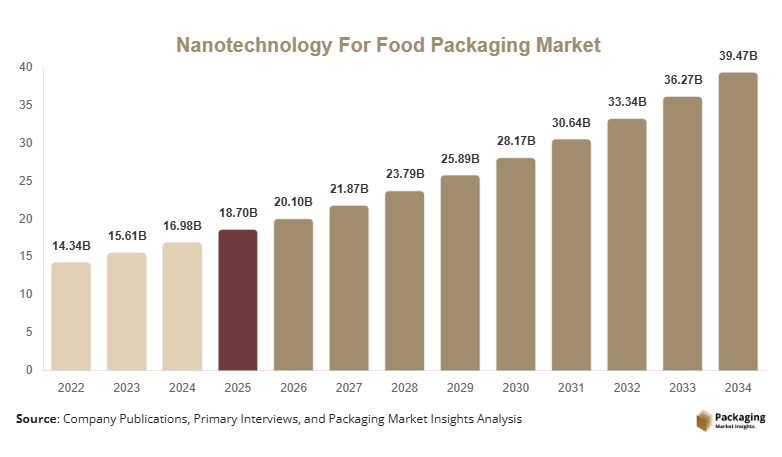
The global nanotechnology for food packaging market was valued at approximately USD 18.7 billion in 2025 and is expected to reach nearly USD 20.1 billion in 2026. By 2034, the market is projected to attain around USD 39.6 billion, growing at a CAGR of 8.8% during 2025–2034. The nanotechnology for food packaging market is witnessing substantial expansion due to rising demand for advanced packaging solutions that improve food safety, shelf life, and product quality. Nanotechnology-based food packaging incorporates nanoscale materials and additives to enhance barrier properties, antimicrobial performance, mechanical strength, and freshness monitoring capabilities.
The increasing global concern regarding food waste and spoilage is one of the key growth factors driving market demand. Food manufacturers and retailers are adopting nanotechnology-enabled packaging materials that improve oxygen resistance, moisture protection, and microbial control. These features help extend the shelf life of packaged foods and reduce product losses throughout the supply chain. Another major growth factor is the growing consumption of packaged and processed food products. Urbanization, changing dietary patterns, and the expansion of organized retail channels are encouraging the use of innovative packaging technologies that maintain freshness and product quality during transportation and storage.
Key Highlights
- Asia Pacific dominated the market with a 39.7% share in 2025.
- Latin America is projected to grow at the fastest CAGR of 9.4%.
- Active packaging technologies led the technology segment with a 36.2% share.
- Nanocomposite materials dominated with a 42.8% share.
- Food and beverage applications accounted for 61.5% of the total market share in 2025.
- The US remained the dominant country with a market size of USD 3.8 billion in 2025 and USD 4.1 billion in 2026.
Explore more data points, trends and opportunities Download Free Sample Report
Market Trends
Growing Adoption of Active and Intelligent Packaging Systems
The adoption of active and intelligent packaging systems is becoming a major trend within the nanotechnology for food packaging market. Food manufacturers are increasingly integrating nanosensors and antimicrobial materials into packaging structures to monitor freshness and improve food preservation. Intelligent packaging solutions can detect temperature fluctuations, gas accumulation, and microbial activity, helping suppliers maintain food quality across transportation and storage stages. Retailers and food exporters are adopting these technologies to reduce spoilage losses and strengthen supply chain visibility. The growing demand for smart packaging solutions in dairy, seafood, meat, and ready-to-eat food applications is expected to accelerate the adoption of nanotechnology-enabled packaging systems globally.
Rising Use of Nanocomposite Barrier Materials
Nanocomposite barrier materials are gaining strong traction across the food packaging industry due to their enhanced oxygen and moisture resistance capabilities. Packaging manufacturers are increasingly incorporating nanoclays and nano-fillers into plastic films and flexible packaging structures to improve durability and extend shelf life. These advanced materials reduce gas permeability and maintain food freshness for longer periods compared to conventional packaging solutions. Beverage, snack, and frozen food manufacturers are actively investing in nanocomposite packaging formats to improve transportation performance and reduce product degradation. Growing focus on lightweight and high-performance packaging materials is expected to continue driving this trend during the forecast period.
Market Drivers
Increasing Need to Reduce Food Waste and Spoilage
The growing global concern regarding food waste reduction is a major driver supporting the nanotechnology for food packaging market. Perishable food products such as meat, dairy, fruits, and seafood are highly vulnerable to microbial contamination and environmental exposure during transportation and storage. Nanotechnology-based packaging solutions improve moisture resistance, antimicrobial protection, and oxygen barrier performance, helping extend product shelf life. Food manufacturers and retailers are increasingly adopting advanced packaging systems to reduce inventory losses and improve supply chain efficiency. Governments and regulatory authorities are also encouraging food preservation technologies that support sustainability goals and minimize food wastage across distribution networks.
Rising Demand for High-Performance Packaging Materials
The demand for high-performance food packaging materials is increasing due to the rapid growth of packaged food consumption worldwide. Consumers are expecting packaging solutions that preserve freshness, prevent contamination, and maintain product quality over extended periods. Nanotechnology enhances packaging performance by improving mechanical strength, thermal stability, and barrier protection without significantly increasing material thickness. Packaging manufacturers are investing in nanocomposite films and antimicrobial coatings to meet evolving food safety requirements. The expansion of e-commerce grocery delivery and international food trade is further driving the need for durable and efficient packaging solutions.
Market Restraint
Regulatory and Consumer Concerns Regarding Nanomaterial Safety
One of the primary restraints affecting the nanotechnology for food packaging market is the growing concern regarding the safety and regulatory approval of nanomaterials used in food-contact packaging applications. Regulatory authorities in several countries are imposing strict evaluation procedures for nanoparticles because of uncertainties related to human health and environmental impact. Packaging manufacturers often face lengthy approval timelines and additional testing costs before introducing new nanotechnology-based packaging products into commercial markets.
Consumer perception also remains a significant challenge for the industry. Many consumers are unfamiliar with the use of nanoparticles in food packaging and may express concerns regarding chemical migration or long-term exposure risks. For example, silver nanoparticles used in antimicrobial packaging have generated discussions regarding possible environmental accumulation and food safety implications. These concerns may affect purchasing decisions and slow adoption rates in some regions. In addition, the high cost of advanced nanomaterials and specialized manufacturing technologies can limit market penetration among small and medium-sized packaging companies. To overcome these challenges, industry participants must focus on transparent communication, safety validation, and regulatory compliance strategies.
Market Opportunities
Expansion of Smart Food Monitoring Technologies
The growing demand for real-time food monitoring technologies presents major opportunities for the nanotechnology for food packaging market. Packaging companies are developing nanosensor-enabled solutions capable of detecting spoilage indicators, gas emissions, and temperature changes during transportation and storage. These technologies improve food traceability and help retailers reduce losses caused by contamination or improper storage conditions. Food exporters and cold chain operators are increasingly investing in intelligent packaging systems to maintain product quality across long-distance supply chains. Rising demand for connected and data-driven packaging solutions is expected to create significant growth opportunities for advanced nanosensor technologies.
Rising Demand for Sustainable Nanocomposite Packaging
Sustainable packaging innovation is creating new growth opportunities for nanotechnology-based food packaging manufacturers. Companies are increasingly developing biodegradable nanocomposite materials that improve packaging performance while reducing environmental impact. Bio-based polymers integrated with nanoclays and natural antimicrobial agents are gaining attention among food producers seeking eco-friendly packaging alternatives. The growing consumer preference for sustainable products and increasing government restrictions on conventional plastics are supporting investment in green nanotechnology packaging solutions. As sustainability targets become more important across the food industry, demand for recyclable and biodegradable nanotechnology packaging products is expected to rise steadily.
Report Scope
| Report Metric | Details |
|---|---|
| Market Size in 2025 | USD 18.7 Billion |
| Market Size in 2026 | USD 20.1 Billion |
| Market Size in 2034 | USD 39.6 Billion |
| CAGR | 8.8% (2026-2034) |
| Base Year for Estimation | 2025 |
| Historical Data | 2022-2024 |
| Forecast Period | 2026-2034 |
| Report Coverage | Revenue Forecast, Competitive Landscape, Supply Chain Disruption, Growth Factors, Environment & Regulatory Landscape and Trends |
| Geographies Covered | North America, Europe, APAC, Middle East and Africa, LATAM |
| Countries Covered | U.S., Canada, U.K., Germany, France, Spain, Italy, Russia, Nordic, Benelux, Rest of Europe, China, South Korea, Japan, India, Australia, Singapore, Taiwan, South East Asia, Rest of Asia-Pacific, UAE, Turky, Saudi Arabia, South Africa, Egypt, Nigeria, Rest of MEA, Brazil, Mexico, Argentina, Chile, Colombia, Rest of LATAM |
Explore more data points, trends and opportunities Download Free Sample Report
Segmental Analysis
By Technology
Active packaging technologies dominated the nanotechnology for food packaging market in 2024 and accounted for approximately 36.2% of the total market share. Active packaging systems incorporate antimicrobial agents, oxygen scavengers, and moisture regulators that help preserve food quality and extend shelf life. Food manufacturers increasingly prefer active packaging solutions because they reduce microbial contamination and improve freshness retention for perishable products. Meat, dairy, bakery, and seafood applications are major contributors to demand within this segment. Rising concerns regarding food spoilage and increasing pressure to reduce food waste continue to strengthen adoption of active packaging technologies worldwide.
Intelligent packaging technologies are expected to be the fastest-growing segment, registering a CAGR of 9.7% during the forecast period. Intelligent packaging integrates nanosensors and monitoring systems capable of detecting temperature changes, gas levels, and spoilage indicators. Retailers and logistics companies are increasingly adopting intelligent packaging to improve supply chain transparency and ensure food safety compliance. The rapid growth of online grocery delivery services and cold chain transportation is creating strong demand for smart monitoring solutions. Advances in nanosensor miniaturization and digital packaging integration are expected to accelerate segment expansion globally.
By Material Type
Nanocomposite materials dominated the material segment in 2024 with a market share of approximately 42.8%. Nanocomposites improve barrier performance, mechanical strength, and thermal resistance in food packaging applications. Packaging manufacturers widely use nanoclays and nano-fillers in flexible films and rigid containers to reduce oxygen and moisture permeability. Food companies prefer nanocomposite packaging because it enhances product shelf life while maintaining lightweight packaging structures. Increasing demand for durable and high-performance packaging materials across frozen foods, beverages, and snack products continues to support segment growth.
Antimicrobial nanoparticles are projected to witness the fastest CAGR of 9.3% during the forecast period. Silver nanoparticles, zinc oxide nanoparticles, and other antimicrobial additives help reduce bacterial growth and improve food safety performance. Food manufacturers are increasingly adopting antimicrobial packaging solutions for meat, dairy, and ready-to-eat food applications where contamination prevention is critical. Growing consumer awareness regarding food hygiene and increasing regulatory emphasis on food safety are driving investment in antimicrobial nanotechnology packaging solutions globally.
By Application
Food and beverage applications dominated the market in 2024 and held approximately 61.5% of the total market share. Nanotechnology-enabled packaging is widely used across snacks, beverages, dairy products, processed foods, frozen foods, and meat products because it improves freshness preservation and shelf life. Packaging manufacturers are introducing high-barrier films and intelligent packaging systems to support transportation efficiency and product safety. The expansion of organized retail and increasing consumer demand for packaged convenience foods continue to support segment growth globally.
Pharmaceutical and nutraceutical packaging applications are projected to register the fastest CAGR of 9.0% during the forecast period. Nutritional supplements, functional foods, and pharmaceutical-grade food products require advanced packaging solutions that protect against moisture, oxygen exposure, and microbial contamination. Nanotechnology packaging improves product stability and supports temperature-sensitive transportation requirements. Rising health awareness and increasing consumption of nutraceutical products are expected to accelerate growth within this segment during the forecast period.
Nanotechnology For Food Packaging Market Segmentations
By Technology
- Active Packaging
- Intelligent Packaging
- Controlled Release Packaging
- Antimicrobial Packaging
By Material Type
- Nanocomposites
- Nanoclays
- Antimicrobial Nanoparticles
- Nano-Coatings
By Application
- Food and Beverage
- Pharmaceutical and Nutraceutical
- Dairy Products
- Meat and Seafood
Regional Analysis
North America
North America accounted for approximately 26.4% of the global nanotechnology for food packaging market share in 2025 and is expected to grow at a CAGR of 8.1% during the forecast period. The region benefits from advanced food processing industries, high packaged food consumption, and increasing adoption of smart packaging technologies. Food manufacturers are investing in antimicrobial packaging films and nanosensor-based freshness monitoring systems to improve supply chain efficiency and reduce spoilage losses. The strong presence of packaging technology companies and research institutions also supports market development across the region.
The United States dominates the North American market because of its advanced food safety regulations and strong investment in packaging innovation. One unique growth factor is the increasing adoption of intelligent packaging technologies in e-commerce grocery delivery services. Online grocery retailers are using nanosensor-enabled packaging systems to maintain product quality during transportation and cold chain distribution.
Europe
Europe represented approximately 28.1% of the global market share in 2025 and is projected to expand at a CAGR of 8.3% during the forecast period. Strict food safety standards and sustainability regulations are encouraging the adoption of advanced packaging technologies across the region. Packaging manufacturers are focusing on recyclable nanocomposite materials and antimicrobial packaging solutions to comply with environmental policies. Dairy products, processed meat, and frozen foods are among the major applications driving regional market demand.
Germany remains the dominant country within the European market due to its strong packaging manufacturing sector and technological innovation capabilities. One unique growth factor is the increasing investment in sustainable nanocomposite food packaging research. Food producers and packaging companies are collaborating to develop lightweight and recyclable packaging materials that offer enhanced barrier performance and extended shelf life.
Asia Pacific
Asia Pacific dominated the nanotechnology for food packaging market with a 39.7% share in 2025 and is projected to register a CAGR of 9.1% during the forecast period. Rapid urbanization, growing packaged food consumption, and expansion of organized retail channels are supporting strong regional market growth. Food manufacturers are increasingly adopting nanotechnology-based packaging to improve food preservation and reduce spoilage during transportation. The rising demand for packaged snacks, dairy products, seafood, and convenience foods is also accelerating market expansion.
China dominates the Asia Pacific market due to its large food processing industry and growing packaging production capacity. One unique growth factor is the rapid expansion of food exports requiring advanced preservation technologies. Chinese food exporters are increasingly investing in nanocomposite and antimicrobial packaging solutions to maintain product quality during international shipping and long-distance transportation.
Middle East & Africa
The Middle East & Africa region accounted for approximately 3.5% of the global market share in 2025 and is expected to grow at a CAGR of 8.5% during the forecast period. Rising demand for packaged food products and increasing investment in food preservation technologies are supporting regional market growth. Food import dependency in several countries is encouraging the adoption of advanced packaging solutions capable of extending shelf life and reducing spoilage during transportation.
Saudi Arabia remains the dominant country in the regional market because of rising consumption of imported packaged food products. One unique growth factor is the increasing investment in cold chain logistics and food storage infrastructure. Food distributors are adopting nanotechnology-enabled packaging systems to improve product quality and reduce losses caused by temperature fluctuations during distribution.
Latin America
Latin America represented approximately 2.3% of the global market share in 2025 and is expected to witness the fastest CAGR of 9.4% during the forecast period. The growth of processed food exports and increasing urbanization are contributing to rising demand for advanced packaging technologies across the region. Packaging manufacturers are introducing antimicrobial films and nanocomposite packaging materials to improve food preservation and support export activities.
Brazil dominates the Latin American market due to its large agricultural and food processing industries. One unique growth factor is the increasing export of meat and seafood products requiring long shelf life packaging solutions. Food exporters are adopting nanotechnology-based packaging systems to maintain freshness and comply with international food safety standards.
Competitive Landscape
The nanotechnology for food packaging market is characterized by growing investments in smart packaging technologies, nanocomposite materials, and antimicrobial packaging innovations. Leading companies are focusing on research partnerships, sustainable packaging development, and advanced nanosensor integration to strengthen market presence. Competitive strategies include product innovation, regional expansion, and collaboration with food manufacturers to improve packaging performance and food safety capabilities.
Amcor plc remains one of the leading companies in the market due to its strong portfolio of advanced food packaging solutions and global manufacturing capabilities. In 2024, the company introduced a nanocomposite-based high-barrier food packaging film designed for dairy and snack applications. Other important market participants include BASF SE, Sonoco Products Company, Sealed Air Corporation, and Avery Dennison Corporation. These companies are investing in intelligent packaging technologies, antimicrobial coatings, and recyclable nanomaterials to address evolving food safety and sustainability requirements.
Key Players List
- Amcor plc
- BASF SE
- Sonoco Products Company
- Sealed Air Corporation
- Avery Dennison Corporation
- DuPont de Nemours Inc.
- Honeywell International Inc.
- Mondi plc
- Tetra Pak International S.A.
- Klöckner Pentaplast Group
- Bemis Company Inc.
- NanoPack Ltd.
- Chevron Phillips Chemical Company
- Danaflex Group
- Cosmo Films Ltd.
- Mitsubishi Chemical Group
- Huhtamaki Oyj