Reusable E Commerce Packaging Market Size and Growth
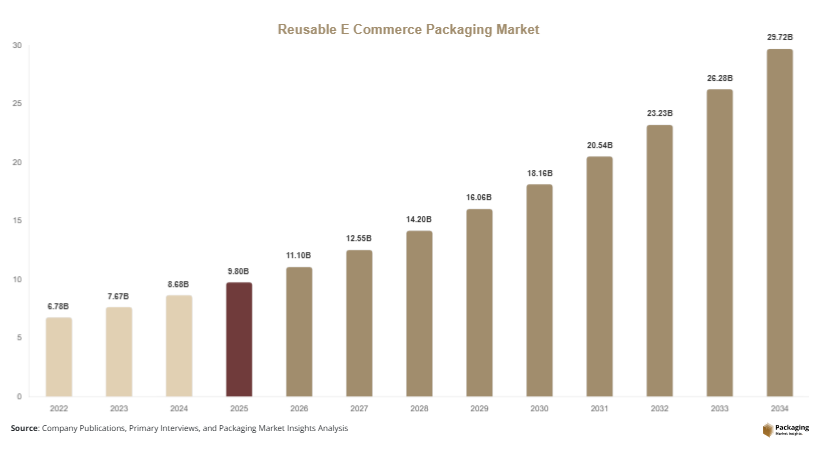
The global reusable e-commerce packaging market size was valued at approximately USD 9.8 billion in 2025 and is expected to reach USD 11.1 billion in 2026. By 2034, the market is projected to reach nearly USD 29.6 billion, expanding at a CAGR of 13.1% during 2025–2034. The reusable e-commerce packaging market is experiencing rapid expansion due to increasing online retail activity, growing environmental awareness, and rising pressure on companies to reduce packaging waste. Reusable e-commerce packaging refers to durable packaging solutions such as reusable boxes, returnable mailers, foldable containers, insulated bags, and reusable shipping totes designed for multiple delivery cycles. These packaging systems are gaining attention as retailers and logistics providers seek cost-effective and environmentally responsible alternatives to single-use corrugated boxes and plastic mailers.
One of the key growth factors driving the market is the increasing emphasis on sustainability within the global retail and logistics industries. E-commerce companies are adopting reusable packaging systems to reduce carbon emissions, lower material consumption, and meet environmental targets. Another important growth factor is the rapid growth of online shopping and home delivery services. The increasing volume of parcel shipments is encouraging retailers to invest in packaging solutions that improve operational efficiency while reducing packaging waste generation. In addition, government regulations limiting single-use plastics and promoting circular economy initiatives are accelerating adoption of reusable packaging systems across multiple regions.
Key Highlights
- Europe dominated the market with a 36.4% share in 2025.
- Asia Pacific is projected to grow at the fastest CAGR of 14.2%.
- Reusable mailers led the product segment with a 33.7% share.
- Plastic-based reusable packaging dominated the material segment with a 48.9% share.
- Apparel and fashion applications led the segment with 29.4% share.
- Germany remained the dominant country with a market size of USD 1.3 billion in 2025 and USD 1.5 billion in 2026.
Explore more data points, trends and opportunities Download Free Sample Report
Market Trends
Increasing Adoption of Circular Packaging Systems
Circular economy principles are becoming a major trend in the reusable e-commerce packaging market as retailers and logistics providers focus on reducing packaging waste. Companies are implementing reusable packaging systems supported by return logistics networks, digital tracking technologies, and consumer incentive programs. Reusable mailers, foldable shipping boxes, and returnable containers are being adopted across apparel, electronics, and grocery delivery applications. Retailers are also partnering with packaging service providers to develop subscription-based reuse systems that improve operational efficiency and reduce single-use packaging expenses. As environmental regulations become stricter and sustainability reporting gains importance, circular packaging systems are expected to witness stronger adoption globally.
Integration of Smart Tracking and RFID Technologies
The integration of RFID tracking, QR codes, and digital logistics platforms is transforming reusable e-commerce packaging operations. Companies are increasingly using smart tracking systems to monitor packaging circulation, improve return rates, and optimize inventory management. RFID-enabled reusable packaging helps retailers reduce package losses and improve reverse logistics efficiency. Digital tracking platforms also provide consumers with packaging return instructions and reward-based sustainability programs. E-commerce companies are investing in smart reusable packaging technologies to improve supply chain visibility and operational transparency. These innovations are expected to strengthen packaging recovery systems and improve the commercial viability of reusable packaging models over the forecast period.
Market Drivers
Rising Environmental Concerns and Sustainability Targets
Growing environmental awareness among consumers, governments, and businesses is one of the major drivers supporting the reusable e-commerce packaging market. Traditional single-use packaging generates substantial waste and contributes to rising landfill volumes and carbon emissions. Retailers and logistics companies are increasingly adopting reusable packaging solutions to meet sustainability commitments and reduce environmental impact. Many e-commerce companies are implementing packaging reduction strategies and carbon-neutral shipping initiatives to improve brand image and comply with environmental regulations. Consumers are also showing increasing preference for brands that use reusable and recyclable packaging systems, encouraging broader adoption across the online retail industry.
Rapid Growth of E-Commerce and Home Delivery Services
The rapid expansion of global e-commerce and home delivery services is significantly driving demand for reusable packaging systems. Online retail sectors including apparel, electronics, grocery delivery, and subscription services are generating massive packaging consumption volumes. Reusable packaging solutions help companies reduce long-term packaging procurement costs and improve delivery efficiency. Grocery delivery platforms, in particular, are adopting insulated reusable packaging to maintain product freshness during transportation. In addition, rising consumer expectations for sustainable shopping experiences are encouraging retailers to invest in innovative reusable delivery packaging formats that support customer convenience and environmental responsibility.
Market Restraint
High Initial Investment and Reverse Logistics Complexity
One of the major restraints affecting the reusable e-commerce packaging market is the high upfront investment required for reusable packaging systems and reverse logistics infrastructure. Reusable packaging solutions generally involve higher manufacturing costs compared to disposable alternatives because they require durable materials and advanced tracking technologies. Companies must also invest in packaging collection, cleaning, sorting, and redistribution systems to maintain operational efficiency. Reverse logistics operations can become particularly complex in cross-border e-commerce environments where return infrastructure may be limited. For example, apparel retailers using reusable mailers must ensure that customers return packaging through designated systems, which may involve additional transportation and administrative expenses. Inconsistent consumer participation in packaging return programs can further reduce system efficiency and increase replacement costs. These operational challenges may limit adoption among smaller retailers with constrained financial resources.
Market Opportunities
Expansion of Reusable Packaging in Grocery Delivery
The rapid growth of online grocery delivery services is creating significant opportunities for reusable e-commerce packaging providers. Grocery products require durable and temperature-controlled packaging solutions capable of maintaining freshness and reducing food waste during transportation. Reusable insulated totes, foldable containers, and temperature-resistant delivery boxes are increasingly being adopted by grocery retailers and meal kit providers. Companies are also introducing deposit-based reusable packaging systems to encourage packaging returns and strengthen customer participation. As urban grocery delivery networks continue expanding globally, demand for reusable packaging solutions within the food retail sector is expected to increase substantially.
Growth of Subscription-Based Packaging Models
Subscription-based reusable packaging programs present strong growth opportunities within the reusable e-commerce packaging market. Packaging-as-a-service models allow retailers to lease reusable packaging systems instead of purchasing disposable packaging materials repeatedly. These systems often include digital tracking platforms, return logistics support, and packaging lifecycle management services. Subscription models are gaining popularity among fashion retailers, electronics brands, and direct-to-consumer companies seeking scalable sustainability solutions. Growing investment in circular economy business models and collaborative logistics networks is expected to support expansion of reusable packaging subscription services during the forecast period.
Report Scope
| Report Metric | Details |
|---|---|
| Market Size in 2025 | USD 9.8 Billion |
| Market Size in 2026 | USD 11.1 Billion |
| Market Size in 2034 | USD 29.6 Billion |
| CAGR | 13.1% (2026-2034) |
| Base Year for Estimation | 2025 |
| Historical Data | 2022-2024 |
| Forecast Period | 2026-2034 |
| Report Coverage | Revenue Forecast, Competitive Landscape, Supply Chain Disruption, Growth Factors, Environment & Regulatory Landscape and Trends |
| Geographies Covered | North America, Europe, APAC, Middle East and Africa, LATAM |
| Countries Covered | U.S., Canada, U.K., Germany, France, Spain, Italy, Russia, Nordic, Benelux, Rest of Europe, China, South Korea, Japan, India, Australia, Singapore, Taiwan, South East Asia, Rest of Asia-Pacific, UAE, Turky, Saudi Arabia, South Africa, Egypt, Nigeria, Rest of MEA, Brazil, Mexico, Argentina, Chile, Colombia, Rest of LATAM |
Explore more data points, trends and opportunities Download Free Sample Report
Segmental Analysis
By Product Type
Reusable mailers dominated the reusable e-commerce packaging market in 2024, accounting for approximately 33.7% of total market revenue. These packaging solutions are widely used in apparel, electronics, and consumer goods shipping because they are lightweight, foldable, and capable of supporting multiple delivery cycles. Reusable mailers are commonly manufactured using durable polypropylene or recycled textile materials that improve resistance to tearing and moisture exposure. Retailers prefer reusable mailers because they reduce long-term packaging procurement costs and support sustainability goals. Consumer-friendly return systems and digital tracking integration are further strengthening demand for reusable shipping mailers across global e-commerce operations.
Reusable insulated packaging is expected to witness the fastest growth, registering a CAGR of 14.5% during the forecast period. Online grocery delivery services, meal kit providers, and pharmaceutical retailers increasingly require temperature-controlled packaging capable of maintaining product quality during transportation. Reusable insulated packaging reduces waste generated by disposable thermal packaging systems while improving operational efficiency. Companies are investing in advanced insulation materials and foldable designs that support repeated usage and easier storage. Growth in online fresh food retail and demand for environmentally responsible cold chain packaging solutions are expected to support strong segment expansion.
By Material
Plastic-based reusable packaging dominated the reusable e-commerce packaging market in 2024 with a revenue share of approximately 48.9%. Durable plastics such as polypropylene and polyethylene are widely used because they provide strength, lightweight performance, and moisture resistance. Plastic reusable packaging solutions support multiple shipment cycles and are commonly used in delivery totes, returnable boxes, and protective mailers. Manufacturers are increasingly incorporating recycled plastics into reusable packaging production to improve sustainability performance. The ability to integrate RFID tracking systems and smart labeling technologies into plastic packaging formats also supports strong market demand across retail and logistics applications.
Recycled textile packaging is projected to grow at the fastest CAGR of 15.1% during the forecast period. Retailers are increasingly adopting reusable fabric mailers and tote bags manufactured from recycled polyester, cotton blends, and other sustainable materials. Textile packaging solutions are lightweight, flexible, and visually appealing, making them suitable for fashion retail and subscription service applications. Companies are also promoting textile-based reusable packaging as part of broader sustainability branding strategies. Rising consumer preference for low-waste shopping experiences and expansion of eco-friendly apparel retail are expected to accelerate growth within this segment.
By Application
Apparel and fashion applications dominated the reusable e-commerce packaging market in 2024, accounting for approximately 29.4% of total market revenue. Online apparel retailers are among the earliest adopters of reusable mailers and returnable packaging systems because clothing products are generally lightweight and suitable for circular packaging models. Reusable packaging improves brand sustainability positioning while reducing long-term packaging waste and shipping material consumption. Fashion brands are also using reusable packaging designs to improve customer engagement and support premium unboxing experiences. The continued growth of direct-to-consumer apparel retail is expected to maintain strong demand within this application segment.
Grocery delivery applications are expected to grow at the fastest CAGR of 14.8% during the forecast period. The expansion of online grocery shopping and meal delivery services is increasing demand for reusable insulated containers, foldable totes, and temperature-controlled packaging systems. Grocery retailers are implementing reusable packaging programs to reduce disposable packaging waste and improve operational efficiency in urban delivery networks. Consumers are increasingly supporting sustainable grocery delivery solutions that minimize environmental impact. Rising investment in cold chain logistics and reusable packaging recovery systems is expected to drive strong segment growth globally.
Reusable E Commerce Packaging Market Segmentations
By Packaging Type
- Reusable Boxes
- Reusable Mailers
- Reusable Pallets & Crates
- Insulated Reusable Packaging
- Returnable Protective Packaging
By Material Type
- Plastic
- Corrugated Paperboard
- Fabric-Based Materials
- Metal
- Composite Materials
By End-Use Industry
- Retail & Consumer Goods
- Food & Beverage
- Electronics
- Healthcare
- Fashion & Apparel
- Automotive Parts
Regional Analysis
North America
North America accounted for approximately 26.3% of the global reusable e-commerce packaging market share in 2025 and is projected to grow at a CAGR of 12.4% during the forecast period. Increasing consumer awareness regarding packaging waste and strong growth in online retail are supporting regional market expansion. E-commerce companies are investing in reusable shipping mailers and smart packaging tracking systems to improve sustainability performance. Retailers are also introducing consumer return incentive programs to strengthen reusable packaging adoption.
The United States dominates the North American market because of its large e-commerce sector and advanced logistics infrastructure. One unique growth factor is the increasing adoption of reusable packaging among apparel subscription services and direct-to-consumer brands. Retailers are using digital return systems and reusable delivery mailers to improve customer engagement and reduce packaging waste.
Europe
Europe held around 36.4% of the reusable e-commerce packaging market share in 2025 and is expected to grow at a CAGR of 13.0% through 2034. Strong environmental regulations and circular economy initiatives are encouraging widespread adoption of reusable delivery packaging across the region. Governments and retailers are increasingly promoting packaging reuse programs to reduce single-use packaging waste and improve recycling efficiency. The region also benefits from strong consumer support for sustainable retail practices.
Germany remains the dominant country in the European market due to its advanced recycling systems and strong sustainability regulations. One unique growth factor is the growing adoption of reusable parcel delivery systems supported by major logistics providers and online retailers. Companies are integrating RFID-enabled packaging to improve return logistics management and operational transparency.
Asia Pacific
Asia Pacific represented approximately 24.8% of the global reusable e-commerce packaging market share in 2025 and is projected to grow at the fastest CAGR of 14.2% during the forecast period. Rapid growth in e-commerce activity, urbanization, and digital retail adoption is driving demand for reusable packaging solutions across the region. Governments are also introducing regulations limiting plastic waste and encouraging sustainable packaging alternatives. The expansion of grocery delivery and online fashion retail sectors is further supporting market growth.
China dominates the Asia Pacific market because of its extensive e-commerce industry and large-scale parcel delivery networks. One unique growth factor is the increasing use of reusable delivery boxes by online grocery and food delivery platforms. Domestic retailers are investing in reusable packaging systems to reduce packaging disposal costs and improve sustainability performance.
Middle East & Africa
The Middle East & Africa region accounted for nearly 5.1% of the global reusable e-commerce packaging market share in 2025 and is expected to grow at a CAGR of 11.6% during the forecast period. Rising investment in e-commerce infrastructure and growing awareness regarding sustainable packaging are supporting regional market growth. Retailers are increasingly exploring reusable delivery packaging for grocery, electronics, and luxury retail applications. The region is also witnessing growing adoption of environmentally responsible logistics practices.
The United Arab Emirates leads the regional market because of rapid digital commerce growth and strong investment in smart logistics infrastructure. One unique growth factor is the increasing adoption of reusable insulated packaging for online food delivery services operating in high-temperature environments. Companies are focusing on temperature-controlled reusable delivery systems to improve product quality and reduce waste.
Latin America
Latin America accounted for approximately 7.4% of the reusable e-commerce packaging market share in 2025 and is projected to grow at a CAGR of 13.4% through 2034. Rising e-commerce penetration, expansion of mobile shopping platforms, and increasing environmental awareness are contributing to regional market growth. Retailers are introducing reusable delivery packaging programs to strengthen sustainability positioning and reduce long-term packaging costs.
Brazil dominates the Latin American market because of its expanding online retail sector and increasing adoption of sustainable consumer products. One unique growth factor is the growing popularity of reusable packaging within online fashion retail and beauty subscription services. Domestic retailers are partnering with packaging technology companies to improve packaging return rates and operational efficiency.
Competitive Landscape
The reusable e-commerce packaging market is highly competitive, with companies focusing on circular packaging innovation, smart logistics integration, and sustainable material development. Major market participants are investing in RFID-enabled tracking technologies, durable reusable packaging materials, and reverse logistics infrastructure to strengthen operational efficiency and customer participation. Strategic partnerships between packaging providers, retailers, and logistics companies are also accelerating market expansion.
DS Smith Plc remains one of the leading companies in the market because of its strong sustainable packaging portfolio and circular packaging expertise. In 2024, the company launched reusable e-commerce shipping containers designed for apparel and consumer electronics applications. Other major players operating in the market include RePack, Returnity Innovations, TerraCycle Loop, LimeLoop, and ORBIS Corporation. These companies continue focusing on reusable mailer systems, packaging-as-a-service platforms, and digital return management technologies to strengthen competitive positioning and support circular retail operations.
Key Players List
- DS Smith Plc
- RePack
- Returnity Innovations
- TerraCycle Loop
- LimeLoop
- ORBIS Corporation
- Amcor plc
- Packaging Corporation of America
- Berry Global Inc.
- Rent The Runway Packaging Solutions
- EcoEnclose
- Liviri, Inc.
- WWF Eco Packaging Solutions
- Noissue Co.
- Georgian Package Solutions