Sustainable E Commerce Packaging Market Size and Growth
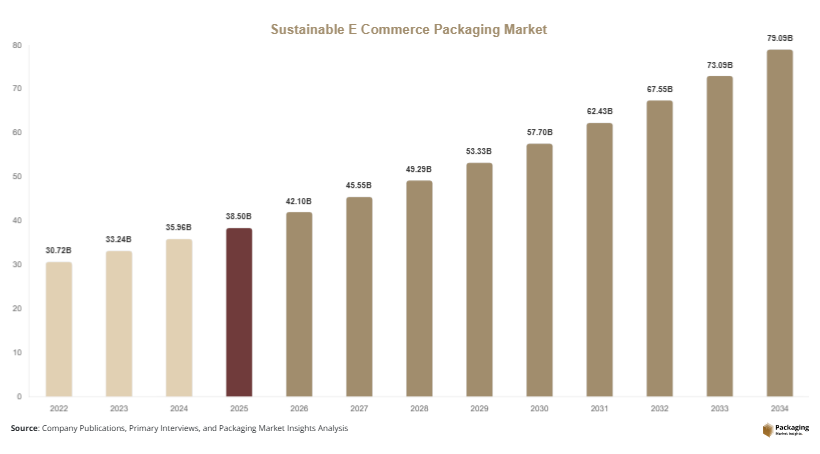
The global Sustainable E Commerce Packaging Market size was valued at approximately USD 38.5 billion in 2025 and is projected to reach USD 42.1 billion in 2026. Over the forecast period, the market is expected to grow significantly and reach USD 85.6 billion by 2034, registering a CAGR of 8.2% from 2025 to 2034. This growth reflects the rapid evolution of e-commerce platforms combined with increasing awareness of environmental sustainability.
One of the key growth factors is the surge in global e-commerce activities. Online retail has grown rapidly, leading to higher demand for packaging materials that are both protective and environmentally friendly. As order volumes increase, companies are under pressure to adopt packaging solutions that minimize waste while ensuring product safety during transit.
Key Highlights:
- Market size reached USD 38.5 billion in 2025 and is projected to reach USD 85.6 billion by 2034
- CAGR of 8.2% from 2025 to 2034
- Rising demand driven by rapid expansion of e-commerce platforms
- Increasing regulatory pressure on plastic waste reduction
- Advancements in sustainable and recyclable packaging materials
Explore more data points, trends and opportunities Download Free Sample Report
Market Trends
Shift Toward Paper-Based and Biodegradable Packaging Materials
A significant trend in the sustainable e commerce packaging market is the increasing shift toward paper-based and biodegradable packaging materials. Companies are replacing traditional plastic packaging with alternatives such as corrugated boxes, kraft paper mailers, and molded pulp inserts. These materials are not only recyclable but also biodegradable, making them more environmentally friendly. This trend is driven by regulatory requirements and consumer demand for sustainable solutions. Additionally, advancements in coating technologies are improving the durability and water resistance of paper-based materials, making them suitable for a wide range of applications. As a result, paper-based packaging is becoming a preferred choice for e-commerce companies.
Adoption of Minimalist and Right-Sized Packaging Solutions
Another key trend is the adoption of minimalist and right-sized packaging solutions. Companies are focusing on reducing excess packaging materials by designing packages that fit products more efficiently. This approach minimizes waste and reduces shipping costs by optimizing space utilization. Advanced packaging design tools and automation technologies are enabling companies to create customized packaging solutions for different products. Additionally, the use of lightweight materials is helping to lower transportation emissions. This trend aligns with sustainability goals and operational efficiency, making it a critical focus area for e-commerce businesses.
Market Drivers
Rapid Growth of E-Commerce and Online Retail Platforms
The rapid growth of e-commerce and online retail platforms is a major driver of the sustainable e commerce packaging market. Increasing internet penetration, smartphone usage, and digital payment adoption have led to a surge in online shopping activities. This growth has resulted in a significant increase in packaging demand, as products need to be safely delivered to consumers. E-commerce companies are adopting sustainable packaging solutions to manage this demand while minimizing environmental impact. Additionally, the rise of direct-to-consumer brands is further driving the need for innovative and eco-friendly packaging solutions.
Rising Environmental Awareness Among Consumers and Businesses
Environmental awareness among consumers and businesses is another key driver of the market. Consumers are increasingly choosing products from brands that demonstrate a commitment to sustainability. This has prompted companies to adopt eco-friendly packaging solutions as part of their corporate responsibility initiatives. Businesses are also recognizing the long-term benefits of sustainable packaging, such as reduced waste management costs and improved brand reputation. This shift in mindset is driving the adoption of sustainable packaging solutions across the e-commerce industry.
Market Restraint
Higher Costs Associated with Sustainable Packaging Materials
One of the major challenges facing the sustainable e commerce packaging market is the higher cost associated with sustainable packaging materials. Compared to traditional plastic packaging, eco-friendly materials such as biodegradable polymers and recycled paper can be more expensive to produce. This cost difference can impact profit margins, particularly for small and medium-sized enterprises. Additionally, the availability of sustainable materials may be limited in certain regions, further increasing costs. For example, sourcing high-quality recycled materials can be challenging, leading to supply chain constraints. These factors can hinder the widespread adoption of sustainable packaging solutions, especially in price-sensitive markets.
Market Opportunities
Innovation in Bio-Based and Compostable Packaging Materials
The development of bio-based and compostable packaging materials presents significant growth opportunities for the market. Advances in material science are enabling the production of packaging solutions made from renewable resources such as plant fibers and agricultural waste. These materials offer environmental benefits by reducing reliance on fossil fuels and minimizing waste. Companies are investing in research and development to create innovative solutions that meet performance requirements while maintaining sustainability. This trend is expected to drive the adoption of eco-friendly packaging solutions across the e-commerce industry.
Expansion of Sustainable Packaging Solutions in Emerging Markets
Emerging markets offer substantial growth opportunities for the sustainable e commerce packaging market. Rapid urbanization, increasing disposable incomes, and growing e-commerce penetration are driving demand for packaging solutions in these regions. Governments are also implementing policies to promote sustainability, creating a favorable environment for market growth. Local manufacturers are developing cost-effective sustainable packaging solutions tailored to regional needs. This expansion is expected to contribute significantly to the overall growth of the market.
Report Scope
| Report Metric | Details |
|---|---|
| Market Size in 2025 | USD 38.5 Billion |
| Market Size in 2026 | USD 42.1 Billion |
| Market Size in 2034 | USD 85.6 Billion |
| CAGR | 8.2% (2026-2034) |
| Base Year for Estimation | 2025 |
| Historical Data | 2022-2024 |
| Forecast Period | 2026-2034 |
| Report Coverage | Revenue Forecast, Competitive Landscape, Supply Chain Disruption, Growth Factors, Environment & Regulatory Landscape and Trends |
| Geographies Covered | North America, Europe, APAC, Middle East and Africa, LATAM |
| Countries Covered | U.S., Canada, U.K., Germany, France, Spain, Italy, Russia, Nordic, Benelux, Rest of Europe, China, South Korea, Japan, India, Australia, Singapore, Taiwan, South East Asia, Rest of Asia-Pacific, UAE, Turky, Saudi Arabia, South Africa, Egypt, Nigeria, Rest of MEA, Brazil, Mexico, Argentina, Chile, Colombia, Rest of LATAM |
Explore more data points, trends and opportunities Download Free Sample Report
Segmental Analysis
By Material Type
Paper & paperboard dominated the market in 2024, accounting for approximately 46% of the total share. These materials are widely used due to their recyclability, biodegradability, and cost-effectiveness. They are commonly used in corrugated boxes, mailers, and protective packaging solutions. The increasing demand for eco-friendly packaging is driving the adoption of paper-based materials. Additionally, advancements in coating technologies are enhancing the performance of these materials, making them suitable for various applications.
Bio-based plastics are the fastest-growing segment, with a CAGR of 9.3%. These materials are derived from renewable resources and offer environmental benefits compared to traditional plastics. The growing demand for sustainable packaging solutions is driving the adoption of bio-based plastics. These materials are increasingly used in flexible packaging applications, providing durability and flexibility while reducing environmental impact.
By Packaging Type
Corrugated boxes held the largest market share in 2024, accounting for approximately 52%. These boxes are widely used in e-commerce due to their strength, durability, and recyclability. They provide excellent protection for products during transportation and are easy to customize. The growth of e-commerce is driving demand for corrugated packaging solutions.
Flexible packaging is the fastest-growing segment, with a CAGR of 8.9%. This type of packaging includes mailers, pouches, and wraps made from sustainable materials. Flexible packaging offers advantages such as lightweight design and reduced material usage, making it an attractive option for e-commerce companies. The increasing demand for cost-effective and sustainable packaging solutions is driving the growth of this segment.
By End-Use
Retail e-commerce dominated the market in 2024, accounting for approximately 55% of the total share. The rapid growth of online retail platforms is driving demand for sustainable packaging solutions. Companies are adopting eco-friendly packaging to meet consumer expectations and regulatory requirements.
Food & beverage e-commerce is the fastest-growing segment, with a CAGR of 9.0%. The increasing demand for online food delivery services is driving the need for sustainable packaging solutions. These solutions help maintain product quality while reducing environmental impact. The growth of this segment is supported by changing consumer preferences and increasing adoption of online food ordering platforms.
Sustainable E Commerce Packaging Market Segmentations
By Material Type
- Paper & Paperboard
- Bio-Based Plastics
- Others
By Packaging Type
- Corrugated Boxes
- Flexible Packaging
- Protective Packaging
By End-Use
- Retail E-Commerce
- Food & Beverage E-Commerce
- Electronics & Others
Regional Analysis
North America
North America accounted for approximately 33% of the global sustainable e commerce packaging market share in 2025 and is expected to grow at a CAGR of 7.5% during the forecast period. The region’s growth is driven by strong e-commerce infrastructure and increasing focus on sustainability. Companies are investing in eco-friendly packaging solutions to comply with regulations and meet consumer expectations.
The United States dominates the regional market due to its large e-commerce sector and high consumer awareness. A unique growth factor is the widespread adoption of corporate sustainability initiatives, which are encouraging companies to transition to environmentally friendly packaging solutions.
Europe
Europe held around 28% of the market share in 2025 and is projected to grow at a CAGR of 7.3%. The region is characterized by strict environmental regulations and a strong emphasis on reducing plastic waste. These factors are driving the adoption of sustainable packaging solutions.
Germany leads the European market due to its advanced manufacturing capabilities and focus on sustainability. A unique growth factor is the implementation of circular economy policies, which are promoting the use of recyclable and reusable packaging materials.
Asia Pacific
Asia Pacific accounted for approximately 24% of the market share in 2025 and is expected to grow at a CAGR of 9.1%, making it the fastest-growing region. Rapid urbanization and increasing e-commerce activities are key drivers of market growth.
China dominates the regional market due to its large population and expanding online retail sector. A unique growth factor is the increasing government support for sustainable packaging initiatives, which is encouraging the adoption of eco-friendly solutions.
Middle East & Africa
The Middle East & Africa region held around 8% of the market share in 2025 and is projected to grow at a CAGR of 7.8%. The growing e-commerce sector and increasing awareness of environmental issues are driving market growth.
Saudi Arabia is the dominant country in this region, supported by its expanding retail industry. A unique growth factor is the increasing investment in sustainable infrastructure, which is supporting the adoption of eco-friendly packaging solutions.
Latin America
Latin America accounted for approximately 7% of the market share in 2025 and is expected to grow at a CAGR of 8.0%. The region is experiencing steady growth due to increasing e-commerce penetration and changing consumer preferences.
Brazil leads the regional market due to its large population and growing online retail sector. A unique growth factor is the rising demand for sustainable packaging solutions among local businesses, which is driving market growth.
Competitive Landscape
The sustainable e commerce packaging market is characterized by the presence of several global and regional players competing on the basis of innovation, sustainability, and cost efficiency. Companies are focusing on developing eco-friendly packaging solutions and expanding their product portfolios to meet evolving customer needs. Strategic partnerships and acquisitions are also common in the market.
Amcor Plc is a leading player in the market, known for its sustainable packaging solutions. The company recently introduced recyclable and bio-based packaging materials for e-commerce applications. Other key players are also investing in research and development to enhance their product offerings and strengthen their market position.
Key Players List
- Amcor Plc
- DS Smith Plc
- Smurfit Kappa Group
- Mondi Group
- Sealed Air Corporation
- WestRock Company
- Berry Global Inc.
- International Paper Company
- Uflex Ltd.
- Stora Enso Oyj
- Packaging Corporation of America
- Ranpak Holdings Corp.
- Pregis LLC
- EcoEnclose
- Noissue