Retail Paper Bags Market Size
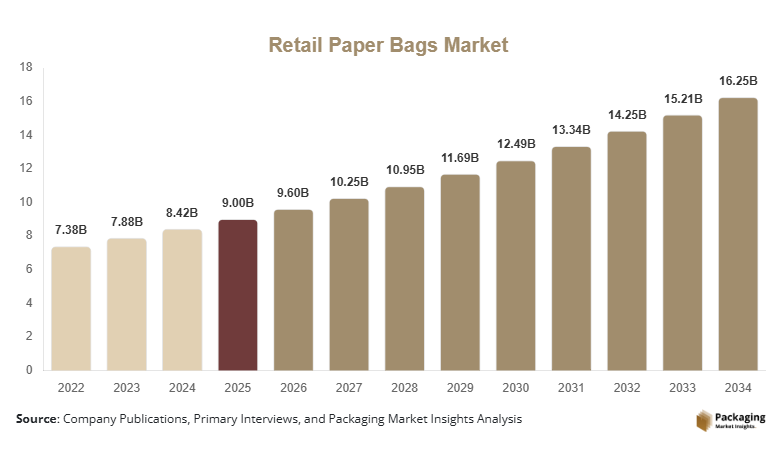
The retail paper bags market size is projected at USD 9.6 billion in 2026 and is expected to hit USD 16.3 billion by 2034 with a CAGR of 6.8%. Increasing regulatory support for sustainable packaging, rising retail sales, and consumer preference for recyclable shopping bags are supporting industry expansion. Detailed segmentation, production analysis, and competitive benchmarking provide a comprehensive assessment of current and future market performance.
The Retail Paper Bags Market comprises paper-based carry bags used across supermarkets, apparel stores, food outlets, pharmacies, and specialty retailers. Global production exceeded 36.8 billion units in 2025, while utilization reached nearly 34.9 billion units, representing 95% production efficiency. Retail stores contributed approximately 46% of overall consumption, food & beverage accounted for 36%, and fashion & apparel represented 18%. Flat paper bags held nearly 41% of production, satchel paper bags represented 34%, and SOS paper bags accounted for 25%. The growing replacement of plastic bags continues to strengthen the retail paper bags market.
Explore more data points, trends and opportunities Download Free Sample Report
Retail Paper Bags Market Trends
Rising Adoption of Sustainable Retail Packaging
Global production exceeded 38.5 billion units during 2026 as retailers accelerated adoption of recyclable paper packaging. More than 69% of organized retailers introduced paper bag programs, while recycled fiber utilization increased beyond 58%. Digital printing technologies improved customization capabilities by 18%, supporting premium retail branding and reinforcing the retail paper bag market.
Demand from supermarkets, convenience stores, and restaurants expanded consistently as biodegradable packaging adoption exceeded 61% globally. Lightweight kraft paper technologies reduced raw material usage by 11%, while automated paper bag manufacturing increased production efficiency by 15%. Food delivery applications recorded demand growth of 9%, strengthening the retail paper bag market.
Retail Paper Bags Market Drivers
Government Regulations Supporting Plastic Bag Alternatives
More than 80 countries implemented regulations restricting single-use plastic bags, encouraging paper bag adoption. Retail paper bag production increased by 8%, recycled paper consumption exceeded 18 million metric tons, and sustainable packaging investments surpassed USD 1.1 billion during 2026. Growing environmental awareness and retailer commitments continue supporting retail paper bag market growth.
Retail Paper Bags Market Restraints
Higher Manufacturing Costs Compared with Plastic Bags
Paper bag manufacturing requires greater fiber input and energy consumption. Wood pulp prices increased by 13%, transportation costs rose by 9%, and energy expenses accounted for nearly 20% of production costs. Small manufacturers continue facing pricing pressure due to fluctuating raw material availability.
Retail Paper Bags Market Opportunities
Expansion of Organized Retail and E-commerce Packaging
Global retail store expansion exceeded 5% annually, while online retail parcel shipments surpassed 220 billion units. Premium branded paper bag demand increased by 14%, and investments in automated converting facilities exceeded USD 900 million. Sustainable retail packaging initiatives continue creating opportunities for the retail paper bags market.
Challenges in Retail Paper Bags Market
Balancing Durability with Lightweight Material Design
Manufacturers aim to reduce paper basis weight by 10% while maintaining carrying capacity above 12 kg. Moisture resistance improvements increased production costs by 7%, while maintaining burst strength above 3.5 kPa remains critical. These technical requirements continue challenging manufacturers operating in the retail paper bags market.
Report Scope
| Report Metric | Details |
|---|---|
| Market Size in 2025 | USD 9.0 Billion |
| Market Size in 2026 | USD 9.6 Billion |
| Market Size in 2034 | USD 16.3 Billion |
| CAGR | 6.8% (2026-2034) |
| Base Year for Estimation | 2025 |
| Historical Data | 2022-2024 |
| Forecast Period | 2026-2034 |
| Report Coverage | Revenue Forecast, Competitive Landscape, Supply Chain Disruption, Growth Factors, Environment & Regulatory Landscape and Trends |
| Geographies Covered | North America, Europe, APAC, Middle East and Africa, LATAM |
| Countries Covered | U.S., Canada, U.K., Germany, France, Spain, Italy, Russia, Nordic, Benelux, Rest of Europe, China, South Korea, Japan, India, Australia, Singapore, Taiwan, South East Asia, Rest of Asia-Pacific, UAE, Turkey, Saudi Arabia, South Africa, Egypt, Nigeria, Rest of MEA, Brazil, Mexico, Argentina, Chile, Colombia, Rest of LATAM |
Explore more data points, trends and opportunities Download Free Sample Report
Retail Paper Bags Market Segmentation
The market is segmented by product type and end user. Flat paper bags dominated with nearly 41% share, followed by satchel paper bags at 34% and SOS paper bags at 25%. Retail stores remained the leading application with approximately 46% demand, followed by food & beverage at 36% and fashion & apparel at 18%.
By Product Type
Flat paper bags accounted for approximately 41% of market volume, exceeding 15 billion units annually. They provide high printability and lightweight construction and are widely used for pharmacies, bookstores, and specialty retail applications with paper grammage ranging between 70 and 120 GSM.
Satchel paper bags represented nearly 34% of production, totaling over 12.5 billion units. Their reinforced base, superior storage capacity, and customizable handles make them suitable for grocery stores and takeaway packaging with load capacities reaching 10 kg.
SOS Paper Bags contributed approximately 25% of global demand with production exceeding 9.3 billion units. Square-bottom construction, high stability, and efficient stacking characteristics support widespread usage across supermarkets and food service establishments.
By End User
Retail stores represented around 46% of total consumption, utilizing over 16 billion units annually. More than 72% of organized retailers adopted recyclable paper bags to comply with environmental regulations and improve brand sustainability.
Food & Beverage accounted for nearly 36% of market demand, consuming over 13 billion units each year. Restaurants, bakeries, cafés, and grocery outlets increasingly adopted grease-resistant and food-grade paper bags with market penetration exceeding 66%.
Fashion & Apparel represented approximately 18% of consumption with more than 6 billion units annually. Premium printed bags, reinforced handles, and luxury finishes support brand visibility while increasing sustainable packaging adoption across apparel retailers.
Retail Paper Bags Market Segmentations
Product Type
- Flat Paper Bags
- Satchel Paper Bags
- SOS Paper Bags
End User
- Retail Stores
- Food & Beverage
- Fashion & Apparel
Retail Paper Bags Regional Outlook
North America
North America accounted for approximately 28% of global demand. The United States represented nearly 84% of regional consumption, while Canada contributed 13%. Annual production exceeded 10.3 billion units, supported by retail chains and sustainability regulations.
Europe
Europe held around 32% market share. Germany, France, Italy, and the United Kingdom generated over 71% of regional production. Manufacturing surpassed 11.8 billion units, driven by plastic bag restrictions and circular economy initiatives.
Asia-Pacific
Asia-Pacific represented nearly 35% of global production. China contributed approximately 49% of regional output; India accounted for 19%, Japan 11%, and South Korea 8%. Regional production exceeded 13 billion units due to rapid retail expansion.
Latin America
Latin America accounted for approximately 3% of market demand. Brazil represented nearly 45% of regional consumption, followed by Mexico at 27%. Retail modernization continues supporting paper bag adoption.
Middle East & Africa
The Middle East & Africa contributed approximately 2% of global demand. The UAE, Saudi Arabia, and South Africa collectively accounted for over 60% of regional consumption, supported by supermarket expansion and sustainability initiatives.
Top Players In The Retail Paper Bags Market
- Mondi plc
- Smurfit Westrock
- International Paper Company
- Novolex Holdings, LLC, and
- DS Smith, plc
- WestRock Company
- Billerud AB,
- Oji Holdings Corporation
- Stora Enso Oyj
- Nippon Paper Industries Co., Ltd.
- Georgia-Pacific LLC
- Hood Packaging Corporation
Mondi plc has an estimated market share of approximately 10%. Operates integrated paper manufacturing and converting facilities across Europe, Asia, and Africa. Offers recyclable kraft shopping bags, premium retail packaging, and customized paper bag solutions. Continues investing in recycled fiber technologies, lightweight paper innovations, and capacity expansion to strengthen its global position in sustainable retail packaging. Smurfit Westrock's estimated market share is approximately 9%. Maintains a strong manufacturing presence across North America, Europe, and Latin America. Provides paper bags for supermarkets, fashion retailers, food service, and specialty retail applications. Focuses on circular packaging systems, advanced printing technologies, recycled fiber integration, and sustainable product development to enhance market competitiveness.