Kraft Paper Bag Market Size and Growth
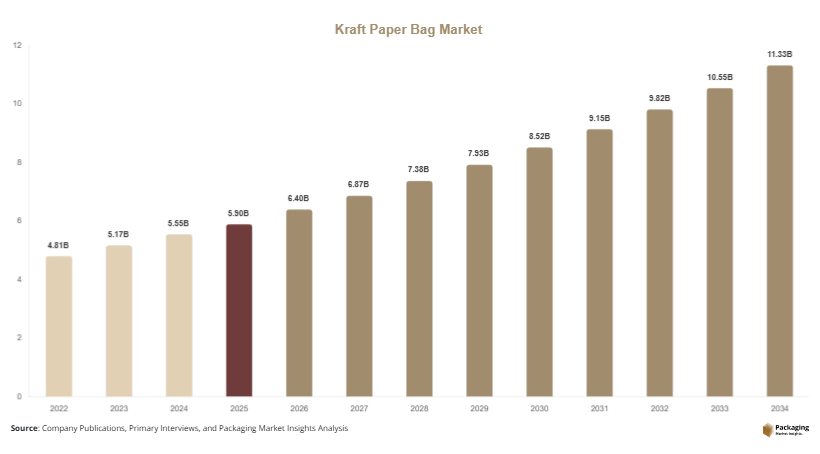
In 2025, the global kraft paper bag market size is estimated at USD 5.9 billion, with growth to approximately USD 6.4 billion in 2026. The market is projected to reach USD 11.8 billion by 2034, registering a CAGR of 7.4% during the forecast period (2025–2034). This growth reflects the transition from plastic packaging to eco-friendly alternatives driven by regulatory policies and consumer awareness.
One of the key growth factors is the global push to reduce plastic waste. Governments across regions are implementing bans and restrictions on single-use plastics, encouraging the use of recyclable and biodegradable materials such as kraft paper bags. Secondly, the rapid expansion of the retail and e-commerce sectors is increasing the demand for durable and cost-effective packaging solutions. Kraft paper bags are widely used for shopping, food delivery, and takeaway services due to their strength and recyclability. Thirdly, rising consumer preference for environmentally responsible products is prompting businesses to adopt sustainable packaging to enhance brand image and meet customer expectations.
Key Highlights:
- Market size estimated at USD 5.9 billion in 2025, supported by rising demand for sustainable packaging across retail and industrial applications. Increasing environmental awareness and regulatory pressure are contributing to steady market expansion.
- Expected to reach USD 11.8 billion by 2034, driven by continued growth in end-use industries and the shift toward eco-friendly alternatives. Businesses are increasingly replacing plastic bags with kraft paper solutions to meet sustainability goals.
- CAGR of 7.4% from 2025 to 2034 reflects consistent market growth over the forecast period. This growth is supported by advancements in paper processing technologies and expanding applications across industries.
- Strong demand from retail, food service, and e-commerce industries is accelerating market adoption. These sectors require cost-effective, durable, and sustainable packaging solutions for daily operations.
- Increasing adoption of biodegradable and recyclable packaging solutions is shaping industry trends. Companies are focusing on reducing environmental impact and complying with regulations, which is boosting the demand for kraft paper bags.
Explore more data points, trends and opportunities Download Free Sample Report
Market Trends
Rising Demand for Customized and Branded Packaging
The kraft paper bag market is witnessing increasing demand for customized and branded packaging solutions. Businesses across retail, food service, and consumer goods industries are focusing on enhancing customer experience through visually appealing packaging. Kraft paper bags offer excellent printability, allowing companies to display logos, product information, and promotional messages effectively. This trend is particularly strong among premium brands that aim to create a distinctive identity through sustainable packaging. Additionally, customization enables businesses to align packaging with their brand values, especially sustainability. As a result, manufacturers are investing in advanced printing technologies and design capabilities to meet evolving customer requirements.
Shift Toward High-Strength and Multi-Layered Bags
Another key trend in the kraft paper bag market is the growing adoption of high-strength and multi-layered bags. These bags are designed to handle heavier loads and provide enhanced durability, making them suitable for industrial and bulk packaging applications. Multi-layer kraft paper bags are widely used in sectors such as construction, chemicals, and agriculture. The trend is driven by the need for reliable packaging solutions that can withstand transportation and storage conditions. Additionally, innovations in material composition and manufacturing processes are improving the strength and performance of kraft paper bags, expanding their application scope.
Market Drivers
Increasing Environmental Regulations and Sustainability Initiatives
Stringent environmental regulations aimed at reducing plastic waste are a major driver for the kraft paper bag market. Governments worldwide are implementing policies to restrict the use of plastic bags and promote eco-friendly alternatives. Kraft paper bags, being biodegradable and recyclable, align with these regulations. Companies are adopting sustainable packaging solutions to comply with legal requirements and improve their environmental footprint. Additionally, corporate sustainability initiatives are encouraging businesses to transition toward greener packaging options. This shift is creating significant demand for kraft paper bags across various industries, including retail, food service, and e-commerce.
Growth of Retail and E-commerce Sectors
The expansion of retail and e-commerce sectors is significantly contributing to the growth of the kraft paper bag market. With increasing consumer spending and online shopping activities, the demand for packaging solutions has surged. Kraft paper bags are widely used for packaging products in retail stores and for delivery purposes in e-commerce. Their strength, cost-effectiveness, and recyclability make them an ideal choice for businesses. Additionally, the rise of food delivery services is driving demand for kraft paper bags for takeaway packaging. This trend is expected to continue as digital commerce and urbanization increase globally.
Market Restraint
Limited Durability Compared to Plastic Alternatives
A key restraint in the kraft paper bag market is the relatively lower durability and moisture resistance compared to plastic packaging. Kraft paper bags are susceptible to tearing and damage when exposed to moisture or heavy loads. This limitation restricts their use in certain applications, particularly in industries requiring high-strength and water-resistant packaging.
For example, in the construction and chemical industries, where products may be heavy or exposed to harsh conditions, plastic or woven bags are often preferred due to their superior durability. Although manufacturers are developing coated and laminated kraft paper bags to address these challenges, these enhancements can increase production costs and reduce recyclability. As a result, the trade-off between performance and sustainability remains a challenge for market growth.
Market Opportunities
Expansion in Food Service and Takeaway Packaging
The growing food service industry presents a significant opportunity for the kraft paper bag market. With the rise of quick-service restaurants and food delivery platforms, there is increasing demand for sustainable takeaway packaging solutions. Kraft paper bags are widely used for packaging food items due to their biodegradability and cost-effectiveness. Additionally, regulatory restrictions on plastic packaging in the food industry are encouraging the adoption of paper-based alternatives. This trend is expected to drive demand for kraft paper bags in the coming years.
Growth in Emerging Markets
Emerging markets offer substantial growth opportunities for the kraft paper bag industry. Rapid urbanization, increasing disposable income, and expanding retail sectors are driving demand for packaging solutions in regions such as Asia Pacific, Latin America, and Africa. Governments in these regions are also promoting sustainable practices, encouraging the adoption of eco-friendly packaging. Additionally, the availability of raw materials and low manufacturing costs support local production. As consumer awareness of environmental issues increases, the demand for kraft paper bags is expected to grow significantly in these regions.
Report Scope
| Report Metric | Details |
|---|---|
| Market Size in 2025 | USD 5.9 Billion |
| Market Size in 2026 | USD 6.4 Billion |
| Market Size in 2034 | USD 11.8 Billion |
| CAGR | 7.4% (2026-2034) |
| Base Year for Estimation | 2025 |
| Historical Data | 2022-2024 |
| Forecast Period | 2026-2034 |
| Report Coverage | Revenue Forecast, Competitive Landscape, Supply Chain Disruption, Growth Factors, Environment & Regulatory Landscape and Trends |
| Geographies Covered | North America, Europe, APAC, Middle East and Africa, LATAM |
| Countries Covered | U.S., Canada, U.K., Germany, France, Spain, Italy, Russia, Nordic, Benelux, Rest of Europe, China, South Korea, Japan, India, Australia, Singapore, Taiwan, South East Asia, Rest of Asia-Pacific, UAE, Turky, Saudi Arabia, South Africa, Egypt, Nigeria, Rest of MEA, Brazil, Mexico, Argentina, Chile, Colombia, Rest of LATAM |
Explore more data points, trends and opportunities Download Free Sample Report
Segmental Analysis
By Type
Flat bottom bags dominated the kraft paper bag market in 2024, accounting for approximately 42% of the total share. These bags are widely used in retail and food packaging due to their stability and ability to stand upright. The design allows for efficient storage and display, making them a preferred choice for supermarkets and grocery stores. Additionally, flat bottom bags provide better weight distribution, reducing the risk of tearing. Their versatility and ease of handling contribute to their dominance in the market.
Multi-wall bags are the fastest-growing segment, expected to expand at a CAGR of 8.1%. These bags are used for industrial packaging due to their strength and durability. The increasing demand for bulk packaging solutions in industries such as construction and chemicals is driving the growth of this segment.
By Application
Retail packaging was the dominant application segment in 2024, holding a market share of approximately 48%. Kraft paper bags are widely used in retail stores for packaging goods due to their cost-effectiveness and sustainability. The growing trend of eco-friendly shopping is further driving demand.
Food service packaging is the fastest-growing application segment, projected to grow at a CAGR of 8.5%. The rise of food delivery services and takeaway culture is increasing demand for kraft paper bags in this segment. Their biodegradability makes them a preferred choice.
By End-Use Industry
The retail industry dominated the market in 2024, accounting for around 46% of the total share. The increasing number of retail outlets and consumer preference for sustainable packaging are driving this segment.
The food & beverage industry is the fastest-growing segment, expected to grow at a CAGR of 8.7%. The increasing demand for takeaway and delivery services is driving the adoption of kraft paper bags in this sector.
Kraft Paper Bag Market Segmentations
By Type
- Flat Bottom Bags
- Satchel Bags
- Multi-Wall Bags
By Application
- Retail Packaging
- Food Service Packaging
- Industrial Packaging
By End-Use Industry
- Retail
- Food & Beverage
- Industrial
- Agriculture
Regional Analysis
North America
North America accounted for approximately 27% of the kraft paper bag market share in 2025 and is expected to grow at a CAGR of 6.9% during the forecast period. The region’s growth is driven by strong environmental regulations and increasing consumer preference for sustainable packaging. The presence of established retail and e-commerce industries further supports market expansion.
The United States dominates the North American market due to its large retail sector and high adoption of eco-friendly packaging. A unique growth factor is the increasing implementation of plastic bag bans at state and local levels, which is driving the adoption of kraft paper bags across retail and food service industries.
Europe
Europe held a market share of around 26% in 2025 and is projected to grow at a CAGR of 6.7% through 2034. The region is characterized by strict environmental policies and strong support for sustainable packaging solutions. Increasing awareness among consumers is also contributing to market growth.
Germany leads the European market due to its advanced manufacturing sector and focus on sustainability. A unique growth factor is the widespread adoption of circular economy practices, which promote the use of recyclable materials such as kraft paper.
Asia Pacific
Asia Pacific is the fastest-growing region, accounting for approximately 31% of the market share in 2025 and expected to expand at a CAGR of 8.2%. Rapid industrialization, urbanization, and growth in retail and e-commerce sectors are driving demand for kraft paper bags.
China dominates the Asia Pacific market due to its large manufacturing base and availability of raw materials. A key growth factor is government initiatives to reduce plastic waste, which are encouraging the adoption of paper-based packaging solutions.
Middle East & Africa
The Middle East & Africa region accounted for around 8% of the market share in 2025 and is expected to grow at a CAGR of 6.1%. The market is expanding due to increasing awareness of environmental issues and demand for sustainable packaging.
South Africa is a leading market in the region, supported by growing retail and food service sectors. A unique growth factor is the increasing adoption of eco-friendly packaging solutions by businesses to align with global sustainability trends.
Latin America
Latin America held approximately 8% of the market share in 2025 and is projected to grow at a CAGR of 6.5%. The region’s growth is driven by increasing demand for sustainable packaging in retail and agriculture sectors.
Brazil dominates the Latin American market due to its large consumer base and expanding retail industry. A key growth factor is the increasing use of kraft paper bags for packaging agricultural products and retail goods.
Competitive Landscape
The kraft paper bag market is moderately fragmented, with several global and regional players competing based on product quality, pricing, and sustainability initiatives. Leading companies are focusing on expanding production capacity and investing in advanced manufacturing technologies. Strategic partnerships and acquisitions are also common strategies to strengthen market position.
International Paper Company is a leading player in the market due to its extensive product portfolio and global presence. A recent development includes the expansion of its sustainable packaging solutions to meet increasing demand. Other companies are also investing in innovation to develop stronger and more durable kraft paper bags.
Key Players List
- International Paper Company
- Mondi Group
- Smurfit Kappa Group
- WestRock Company
- Novolex Holdings, Inc.
- Ronpak, Inc.
- Langston Companies, Inc.
- Global-Pak, Inc.
- El Dorado Packaging, Inc.
- B&H Bag Company
- United Bags, Inc.
- Novey Bag Company
- OJI Holdings Corporation
- Stora Enso Oyj
- DS Smith Plc